Blue Diamond Emerges at Cullinan Mine: A 41.82-Carat Discovery
DSF Antique Jewelry News — January 18, 2026
A rare blue diamond weighing 41.82 carats has been recovered at South Africa’s celebrated Cullinan Mine, according to Petra Diamonds. In the world of natural colored diamonds, discoveries of this scale are unusual—and when the color is blue, the excitement is amplified across the entire high jewelry ecosystem, from cutters and designers to collectors and auction specialists.
The company has described the stone as a Type IIb blue diamond and noted that it is currently under analysis, with the preferred method of sale yet to be announced. At this stage, the diamond remains in its rough state, meaning the most important details—final color grade, clarity, and polished outcome—are still unknown. But even before a single facet is cut, the recovery is already being discussed as one of the more notable blue-diamond finds reported in recent years.
What has been confirmed so far
Here is what is known from the initial reporting and company statements:
-
Weight (rough): 41.82 carats
-
Classification: Type IIb blue diamond
-
Origin: Cullinan Mine, South Africa
-
Next steps: Ongoing analysis; sales format not yet disclosed
Because the diamond is still being examined, there is no public information yet on how it will be cut, how much weight it may yield as a polished gem, or the quality factors that ultimately determine historic significance.
Why “Type IIb” matters
Natural blue diamonds occupy a category of rarity that is difficult to exaggerate. Most diamonds contain nitrogen, which influences how they absorb light and can affect color. Type II diamonds are defined by the absence of measurable nitrogen—and Type IIb diamonds are even more exceptional, typically associated with the presence of trace boron, which can contribute to blue coloration.
In practical terms, “Type IIb” is the kind of descriptor that immediately signals scarcity to professionals. It does not automatically guarantee a top color grade or a flawless stone—those outcomes depend on many variables—but it places the rough in a class that is closely watched by the market.

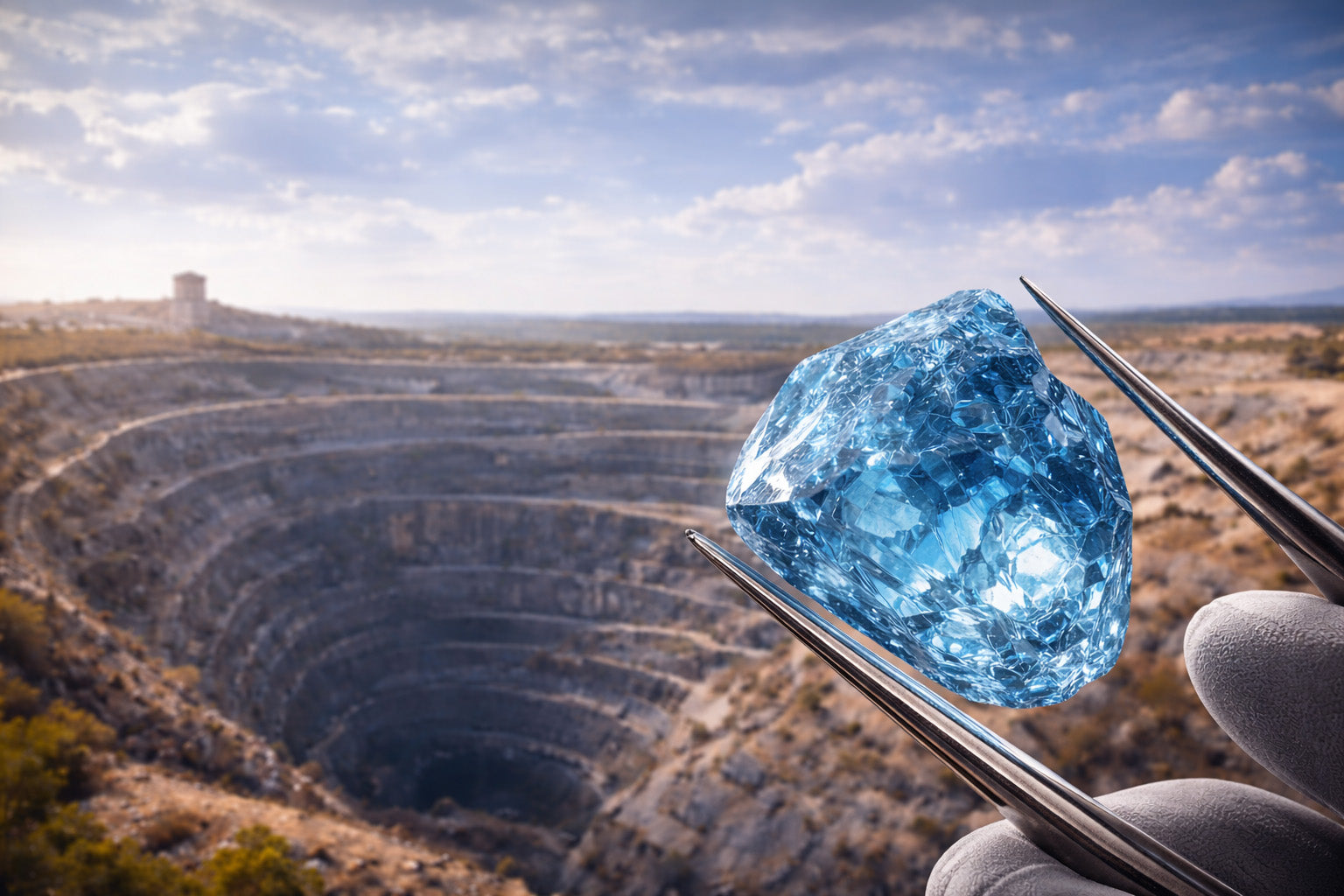
Visuals are AI-generated illustrations used for editorial purposes.
Cullinan Mine and the legacy of exceptional stones
Cullinan Mine is one of the most storied names in the diamond world. It is historically linked to the Cullinan Diamond, discovered in 1905, a 3,106-carat gem-quality rough that remains the largest of its kind ever found. Over time, the mine has also become widely associated with the recovery of high-value diamonds, including notable blue stones.
That history is part of why this new recovery has drawn immediate attention. When a significant blue diamond is reported from Cullinan, the trade tends to take it seriously—not only because of the mine’s legacy, but because discoveries there have repeatedly proven capable of producing exceptional results after cutting and certification.
The question everyone asks: what could it be worth?
It is natural to wonder about value, but the honest answer is that it is too early for meaningful pricing. Blue diamonds do not follow simple, linear valuation rules. A stone’s eventual market impact depends less on the rough carat weight and more on what emerges after careful planning, cutting, and laboratory grading.
Among the factors that will shape the final outcome:
-
Color grade (tone, saturation, and overall visual presence)
-
Clarity (and where inclusions fall within the finished stone)
-
Polished yield (how much weight remains after cutting)
-
Finished shape and proportions (which can influence both brilliance and face-up color)
-
Certification and market timing (including how and when it is offered for sale)
As a point of reference, industry reporting has noted that a previous blue diamond recovered by Petra from Cullinan—a 39.34-carat blue diamond discovered in 2021—later sold for $40.2 million. That figure does not “price” the new stone, but it illustrates how strongly the market can respond when a blue diamond achieves an outstanding final result.
What happens next: analysis, strategy, and sale format
For important rough diamonds, the period immediately after recovery can be as critical as the discovery itself. Decisions made during analysis can influence not only value, but the ultimate identity of the gem.
At this stage, Petra has said it is evaluating the diamond and determining the preferred approach to sale. For exceptional stones, sale formats can vary. Some are offered through special tenders or private processes designed to attract the most serious buyers; others may be channeled through more structured sales depending on the company’s strategy.
For the jewelry world, the next milestone will be the moment when more concrete details emerge—especially any information about:
-
The intended cutting plan
-
The expected polished yield
-
The official color description once examined further
-
The future lab certification pathway
Why this discovery matters beyond headlines
Even if a collector never plans to purchase a stone in this category, high-profile discoveries influence the market in subtle ways:
-
They renew attention on natural colored diamonds.
Major finds tend to bring new energy to the category and prompt renewed interest in rarity and provenance. -
They elevate the importance of documentation.
As prices rise at the top end, buyers increasingly look for strong laboratory reports, transparency, and credible sales channels. -
They shape design conversations.
When a significant blue diamond appears, it often inspires high jewelry houses and designers, influencing editorial coverage and creative direction.
DSF watchlist: the details that will define the final story
As more information becomes available, the most meaningful indicators of the diamond’s importance will be the results that cannot be known from a rough weight alone:
-
The final color grade and overall visual saturation
-
The polished carat weight and face-up presence
-
The clarity and how it presents after cutting
-
The certification and accompanying documentation
-
The sale method and market response once offered
For now, the recovery of a 41.82-carat Type IIb blue diamond at Cullinan stands as a remarkable headline in the world of natural colored diamonds—and a reminder that true rarity still appears, unexpectedly, from the earth.
DSF Antique Jewelry will continue to follow updates as the analysis progresses and more details are released.