A Journey Through the Fascinating Universe of Necklaces and Pendants
There is no place in the architecture of the human body more suitable for receiving a jewel than the base of the neck, says Eugène Fontenay in his famous book "Ancient and Modern Jewelry".
"The contour of the necklace is admirably traced there. Its curve is charming, behind, on the nape, below the wisps of hair; the shoulders, slightly raised on each side, provide a graceful support, and the chest reserves, in front, a privileged nest where its elegance and richness can be displayed at will. Thus, one can affirm, without fear of being mistaken, that the first woman to appear on earth soon wore the first necklace."
Jewelry is more than ornamentation—it is a silent language, a thread connecting us to ancient civilizations, personal stories, and artistic revolutions. And yes, among all adornments, necklaces and pendants hold a unique and enduring allure.
To truly appreciate their history, artistry, and symbolism, we invite you on a journey inspired by Eugène Fontenay’s seminal work, “Bijoux Anciens et Modernes.” Fontenay, a celebrated 19th-century French jeweler and historian, devoted his life to chronicling the evolution of jewelry, and his insights remain as compelling today as they were over a century ago.
Let us explore, through Fontenay’s eyes and beyond, the captivating world of necklaces and pendants—from their primal origins to their Renaissance splendor, and onward to their modern expressions.

The Human Body as a Canvas: The Perfect Place for a Necklace
As Fontenay says, from the earliest days, nature provided the materials for necklaces: flowers, berries, shells, and feathers. As humanity advanced, so did its adornments—amber, coral, glass, and eventually the precious metals and gemstones that continue to fascinate us.
Importantly, men also wore necklaces, but often for reasons beyond mere beauty. Early necklaces, made from stone rings, animal teeth, and bones, were imbued with spiritual significance.
These artifacts, unearthed from ancient tombs, bear witness to the belief in the protective powers of amulets. For ancient peoples, necklaces were not just decorations; they were powerful symbols of status, protection, and identity.
Ancient Civilizations: Ritual, Power, and Innovation
Egypt: The Birthplace of Ornamental Splendor
The necklace is a recurring motif in ancient Egyptian art and ritual. Fontenay describes how necklaces are depicted on monuments and even referenced in the Bible, such as in the story of Joseph.
Egyptian necklaces, often wide circular bands of strung beads called “menat,” were not only decorative but also deeply symbolic. Amulets and scarabs were attached for protection, and the arrangement of beads—coral, lapis, and other materials—created infinite variations of color and form.
These necklaces were heavy, requiring a counterweight (the menat) to keep them in place. The Louvre Museum displays funerary figurines from the Fifth Dynasty adorned with such necklaces, which covered the shoulders and upper chest.
The menat, sometimes made of tin or thin metal, is a testament to the technical ingenuity of ancient jewelers. These objects were not only signs of virility and power but also of coquetry and personal expression.

Amulets and the Evil Eye
The belief in the evil eye and the use of amulets as protection is rooted in Egyptian superstition. Special necklaces, such as the Ousekh, were reserved for mummies, crafted with repoussé gold and adorned with motifs like lions, jackals, and sparrowhawks. These pieces were sewn to the wrappings of the deceased, ensuring protection in the afterlife.
The Ousekh necklace, specially reserved for mummies, on which it was placed according to a ritual prescription, was fastened at the shoulders and covered only the chest, which it completely concealed.
The album published by Mariette Bey reproduces one of a composition as rich as it is unusual. Twisted cords, four-petaled flowers in a cross, lions, running antelopes, seated jackals, sparrowhawks, vultures, and winged vipers make up the design. The two clasps, as usual, are in the shape of a sparrowhawk's head. All these ornaments are in repoussé gold. They were sewn to the mummy’s wrappings by means of small rings soldered at the back.
Technical Mastery
Fontenay’s keen observation of ancient Egyptian jewelry reveals a sophisticated understanding of metalworking.
Many necklace fittings, made of jasper and gold, were hollow and constructed by folding metal sheets—a technique that hints at the use of lathes for metal reduction.
Some amulets, made of enameled earth, were as large as playing balls, demonstrating both technical skill and artistic ambition.
Beyond Egypt: Assyria, Phoenicia, and the Ancient World
The contrast between Egyptian and Assyrian jewelry traditions, particularly regarding necklaces, highlights the diverse cultural practices of the ancient Near East.
While Egyptian women were renowned for their elaborate necklaces—crafted from gold, faience, carnelian, lapis lazuli, and adorned with amulets for both beauty and spiritual protection—Assyrian art depicts a different emphasis.
In Assyria, men and deities are frequently shown wearing earrings, bracelets, and sometimes rosette bracelets, but necklaces are far less prominent in their iconography. When necklaces do appear in Assyrian reliefs, they are often simple and secondary compared to the more elaborate display of other jewelry items.
Archaeological evidence, however, reveals that necklaces were not entirely absent in Assyrian material culture. Graves from Ashur, the religious capital, have yielded necklaces made of gold beads and pomegranate-shaped pendants, as well as necklaces combining gold tubes and almond-shaped pendants of semi-precious stones.
These finds indicate that, despite their limited depiction in art, necklaces were indeed crafted and worn, likely by both men and women, though perhaps with less symbolic or social emphasis than in Egypt.
Assyrian jewelry also included intricate earrings—such as crescent-shaped bases with dangling floral motifs—and bracelets featuring motifs like lion heads, reflecting the high level of craftsmanship and the symbolic importance of certain animals and plants. Anklets, bangles, and crowns further demonstrate the variety and sophistication of Assyrian adornment.
Bead Necklaces in Cyprus, Phoenicia, and Chaldea
Beyond Assyria, bead necklaces were a prominent feature in the jewelry traditions of Cyprus, Phoenicia, and Chaldea (Babylonia). Archaeological finds from these regions reveal a rich tradition of necklaces composed of carnelian, agate, rock crystal, and sometimes gold fragments. These beads varied in shape—spherical, cylindrical, barrel-shaped, or even pod-shaped—and were often combined in colorful, intricate patterns.
Phoenician Beadwork: The Phoenicians, famed for their maritime trade, produced distinctive sand-core glass beads and pendant head/amulet beads, often in the form of stylized human faces with elaborate hair and beards. These beads were strung into necklaces and widely traded across the Mediterranean, making them a hallmark of Phoenician identity and craftsmanship.
Chaldean and Babylonian Jewelry: In Chaldea and Babylonia, necklaces often included gold pendants representing deities or their symbols—such as the sun disk for Shamash or the rosette for Ishtar. These pieces served both as adornment and as talismans, reflecting the intertwining of artistry and religious belief.
Cypriot and Levantine Traditions: In Cyprus and the Levant, Late Bronze Age sites like Deir el-Balah have yielded necklaces featuring carnelian beads in both round and pendant forms. These styles were shared across the region, with similar beads found in Egypt, Mari (Syria), and Assur, illustrating the extensive trade and cultural exchange among ancient societies
The Renaissance: Artistry and Transformation
The Rise of the Art Jewel
The Renaissance marked a golden age for necklaces and pendants. Jewelers became artists, and the necklace became a canvas for their creativity. Fontenay describes the evolution of settings and motifs—raw gold, intricate enamels, and the incorporation of rare cameos.
The Cabinet of Antiques houses a remarkable collection of Renaissance jewelry, including neck pendants, hat badges, and plaques, each a testament to the era’s technical and artistic achievements.
Italian and German Influences
Italian jewelry of the period is characterized by vibrant enamels and bold compositions, such as the gold and ruby chain at the Cluny Museum.
German artisans, meanwhile, developed a distinctive style by transforming leather ornaments into delicate arabesques, creating a genre that was both bold and original.
The Dresden Museum’s collection of enameled pendants, including scenes like the Judgment of Paris, illustrates the diversity and innovation of Renaissance jewelry.
The Evolution of Gem Cutting
Before the 14th century, gemstones were typically cut in simple cabochons. The introduction of table cutting—flat surfaces with beveled edges—revolutionized jewelry design.
By the late 17th century, this technique allowed jewelers to create chains and monograms composed entirely of juxtaposed stones. Daniel Mignot, a pioneering jeweler, sought to give gemstones a more prominent role, grouping them in harmonious arrangements that foreshadowed modern jewelry design.

Pearls, Diamonds, and the Age of Opulence
The Reign of Pearls
By the 16th and 17th centuries, pearls had become the ultimate symbol of luxury and status.
Fontenay recounts how, in 1530, Eleonore of Austria wore one of the first necklaces of large pearls, and Henry VIII of England is depicted with a massive pearl necklace in a portrait at Hampton Court. Pearl necklaces, sometimes intertwined with gold and gemstones, adorned both men and women of the era.
As pearls became more common, their use proliferated across Europe. Sovereigns and princesses wore them in long cords, short necklaces, and garlands, often combining white, gray, and black pearls of all sizes.
The fashion endured throughout the 17th century, as seen in portraits of Marie de Medici, Catherine de Medici, and other royal figures, who are depicted surrounded by rows of pearls in their hair and around their faces.
The Diamond Revolution
The discovery of diamond mines in India—and later Brazil—ushered in a new era of necklace design. Diamonds, with their unmatched brilliance, became the centerpiece of the most luxurious necklaces.
Fontenay marvels at the skill required to arrange and set these stones, creating harmonious compositions that highlight the natural beauty of each gem. The setting itself became a work of art, sometimes so subtle that it escaped even the most trained eye.

Pendants: Focal Points of Meaning and Artistry
Amulets, Lockets, and Keepsakes
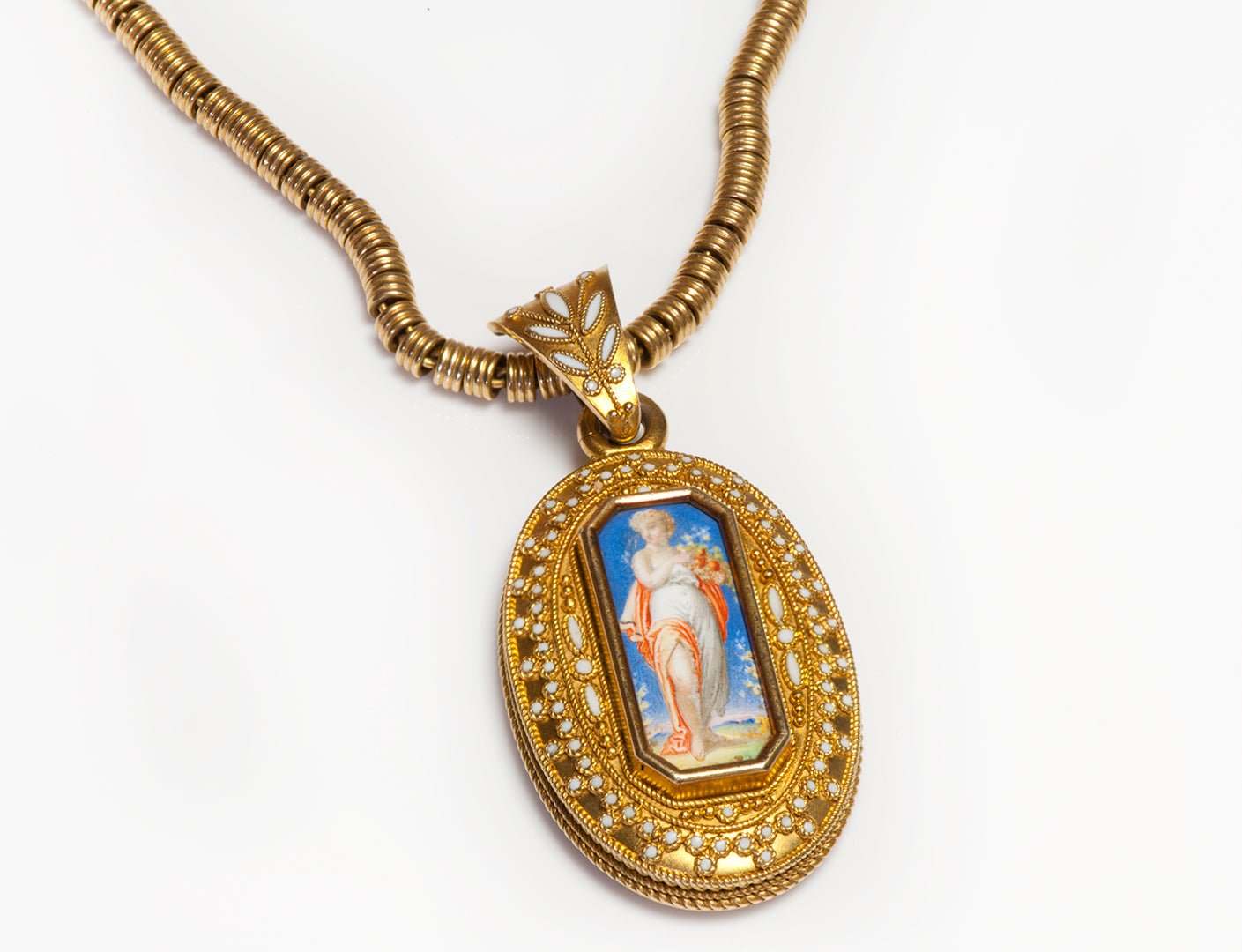
Pendants have always served as focal points, drawing attention to a single symbol, gem, or message. From ancient amulets to Renaissance cameos and modern lockets, pendants encapsulate personal meaning and artistic expression.
The Renaissance saw the creation of pendants that were both technically innovative and deeply symbolic, often incorporating religious or mythological themes.
The Belle Époque and Art Nouveau
The late 19th and early 20th centuries witnessed a flowering of creativity in pendant design. Jewelers embraced organic forms and flowing lines, often inspired by nature.
Enamel, opal, and colored stones were combined in dazzling compositions, reflecting the era’s fascination with beauty and innovation.
Technical Mastery and Artistic Vision, Materials and Techniques
The making of necklaces and pendants requires a delicate balance of artistry and technical skill. From goldsmithing and gem-setting to enameling and engraving, each technique contributes to the final masterpiece.
The choice of materials—gold, silver, platinum, pearls, diamonds, colored stones—affects not only the appearance but also the feel and durability of the piece.
The Role of the Jeweler
Fontenay saw the jeweler as both craftsman and artist, capable of transforming raw materials into objects of wonder. The jeweler must understand the properties of each material, the interplay of colors and textures, and the balance of weight and proportion.
A great necklace or pendant is more than the sum of its parts; it is a harmonious composition that reflects both the era and the individual who wears it.

Necklaces and Pendants in Culture and Myth - Symbols of Power, Faith, and Protection
Throughout history, necklaces and pendants have served as symbols of power, faith, and protection. From the amulets of ancient Egypt to the crosses and lockets of the Renaissance, these pieces carry meanings that transcend time and place. They are tokens of love, gifts of allegiance, and instruments of magic.
The Necklace in Art and Literature
Throughout history, necklaces have occupied a special place not only in personal adornment but also in the realms of art and literature. These objects, often crafted with exquisite skill and precious materials, transcend their decorative function to become powerful symbols of love, status, fate, and transformation.
In the world of art, necklaces are frequently depicted as emblems of beauty and power. Ancient portraits, such as those of Egyptian queens or Roman empresses, often show their subjects adorned with elaborate necklaces, signifying both wealth and divine favor.
The famous image of Cleopatra dissolving a priceless pearl in vinegar and drinking it—a gesture meant to demonstrate her immense wealth and audacity—has inspired countless artists and writers. This act transformed the necklace from a mere accessory into a symbol of extravagance, seduction, and the fleeting nature of material riches.
Literature, too, has long been fascinated by the necklace’s allure and its deeper meanings. One of the most famous literary examples is Guy de Maupassant’s short story "The Necklace" ("La Parure"), in which a borrowed diamond necklace becomes the catalyst for a woman’s downfall. In this tale, the necklace represents both aspiration and illusion.
Madame Loisel’s desire to appear wealthy leads her to borrow the necklace, but when it is lost, she and her husband endure years of hardship to replace it—only to discover in the end that the original was a fake. Maupassant’s story uses the necklace as a metaphor for the dangers of vanity and the harsh realities that often lie beneath glittering surfaces.
Necklaces also play significant roles in marking life’s milestones. Across cultures, the giving of a necklace is a gesture rich with meaning. In many societies, a necklace is presented to mark a child’s birth, a young person’s coming of age, or a couple’s union in marriage. These gifts are imbued with wishes for protection, prosperity, and happiness, making the necklace a tangible link between generations and a vessel for personal and familial history.
Artists and writers alike have explored the emotional weight carried by these objects. In poetry, a necklace might symbolize the unbroken circle of love or the inescapable bonds of fate. In visual art, the depiction of a necklace can hint at a subject’s inner life, social standing, or the cultural values of their time. Even in contemporary fiction and film, the discovery or loss of a necklace often serves as a turning point in the narrative, revealing hidden truths or forging new connections.
Ultimately, the enduring presence of necklaces in art and literature speaks to their unique ability to capture the complexities of human experience. Whether as tokens of affection, symbols of ambition, or harbingers of destiny, necklaces continue to inspire, reminding us that even the smallest adornments can carry the weight of our stories.
Enduring Allure
What is it about necklaces and pendants that continues to captivate us? Fontenay offers some clues: the harmonious arrangement of stones, the mastery of technique, the mystery of creation. But perhaps the true allure lies in the way these pieces become part of our personal stories—objects of beauty, memory, and meaning.