Aztec Jewelry: History, Craftsmanship & Cultural Meaning
Famous for its elaborate patterns and vivid hues, Aztec jewelry provides an intriguing window into the beliefs, society, and artistic abilities of one of the most powerful pre-Columbian civilizations in the Americas.
From the 14th to the 16th centuries, the Aztecs of central Mexico adorned themselves with objects that were not only ornamental but also deeply symbolic. This blog explores the materials, craftsmanship, cultural significance, and enduring legacy of Aztec jewelry.
Jewelry was a typical marker of status among the Aztec upper classes. Emperors, for instance, frequently wore earrings and necklaces.

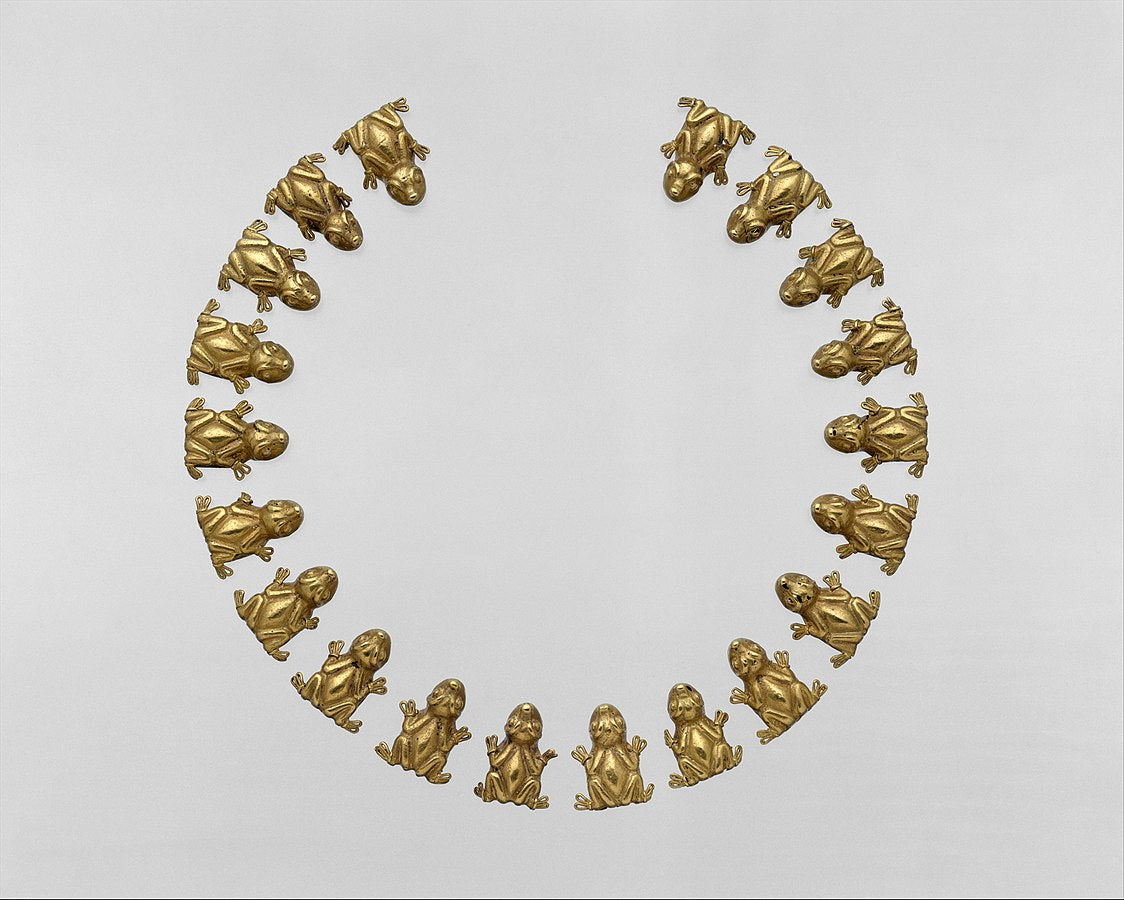
Aztec gold frog-shaped necklace ornaments - Photo Credit: Metropolitan Museum of Art via Wikimedia Commons
The Aztec Jewelers
The gods the Aztecs worshipped—as well as elements from the natural world—were frequently represented in their artwork. Archaeologists continue to uncover statues, masks, and other depictions of these deities at ancient Aztec sites.
Many of these statues are highly detailed and often lifelike. Their size varies from very small to monumental, and they were typically carved from stone or wood.
Aztec craftsmen were highly skilled professionals who dedicated their lives to their craft. In a society where religion and symbolism permeated daily life, demand for their work was high. In bustling marketplaces filled with colorful goods, jewelers would sell a few carefully crafted pieces.
Artisans held an elevated place in Aztec society. Tenochtitlan, the imperial capital, had distinct quarters where different groups of workers lived. Each guild guarded its trade secrets and had its own patron deity. Skills were passed down within families, ensuring continuity from one generation to the next, notes John Malam in The Aztecs. Uncovering the Past.
According to Malam, nobles created a strong demand for fine jewelers. The most talented artisans traveled from remote regions of the Aztec Empire to establish workshops in Tenochtitlan, where they worked with copper, silver, and gold.
Unfortunately, most Aztec gold jewelry was melted down by the Spanish, leaving only a limited number of surviving pieces.
Aztec jewelers used advanced techniques including engraving, hammering, and casting. Lost-wax casting—a method enabling the creation of intricate and sophisticated designs—was extremely popular. Other standard techniques included carving complex motifs and shaping thin metal sheets with hammers. The craftsmanship demonstrates a deep understanding of metallurgy.
Types of Jewelry
Necklaces and pectorals dominated Aztec jewelry. Often made of gold and embellished with precious stones and elaborate designs, these pieces were powerful symbols of wealth and authority.
Necklaces worn by Aztec nobles frequently featured small gold beads shaped like shells, turtles, and frogs.
The Aztecs were also fond of nose rings, ear spools, and large ornamental plugs worn in stretched earlobes. These items were often inlaid with detailed motifs and crafted from materials such as turquoise, jade, obsidian, and gold.
Anklets and bracelets—typically made of silver or gold—were also common. Many were decorated with tiny bells that jingled as the wearer moved, or with carved religious symbols meant to enhance their visual and spiritual impact.
Materials
Aztec jewelry incorporated a wide range of materials, often combining several in a single piece. Sometimes, precious stones were set into a clay or wooden base to create detailed mosaics.
Common materials included copper, gold, silver, shells, clay, wood, obsidian, and feathers. Numerous precious stones—such as jade, opal, moonstone, turquoise, quartz, and amethyst—were finely polished before being used.
Bronze-making techniques from South America had not yet reached the Aztecs, so copper was typically cold-hammered. However, goldsmiths mastered gilding copper and creating copper–gold alloys.
Both copper and gold ornaments were created using cire perdue (lost-wax casting).

The Mask of Xiuhtecuhtli (1400–1521) - Photo Credit: Hans Hillewaert via Wikimedia Commons
The technique involved modeling a shape in clay, sprinkling it with fine charcoal, then applying a layer of wax. Another charcoal layer followed, and the entire form was encased in clay with openings at the top and bottom.
After the wax was melted and drained, molten metal was poured into the mold. Once cooled, the clay was broken away, revealing the finished object.
While gold was highly valued, silver was also widely used due to its abundance in Mexico. Various materials were imported long distances, such as conch shells from the east, turquoise from the north, and gold from the south.
Stones were carved and polished using coarse and fine abrasives, similar to sandpaper. Simple drills were used to pierce shells or stone pendants. Metal sheets were hammered into intricate shapes with remarkable precision.
Cultural Importance
In Aztec society, jewelry symbolized political power and social rank. Warriors and nobles displayed their achievements through ornate ornaments. The more elaborate the piece, the higher the wearer’s prestige. Commoners, meanwhile, wore simpler jewelry made of clay or bone.
Religious symbolism was central in Aztec jewelry. Many pieces featured motifs inspired by nature, animals, and gods. One prominent symbol was the eagle—representing the warrior class and the sun. Jewelry was used in ceremonies, rituals, and religious offerings, and often formed part of a priest’s ceremonial attire.
The Legacy
Aztec jewelry continues to inspire modern designers. Its vivid colors, striking patterns, and symbolic themes remain a source of artistic creativity, underscoring the timeless appeal of Aztec art.
Many authentic pieces survive in private collections and museums around the world. These artifacts offer invaluable insight into the craftsmanship, beliefs, and daily life of the Aztec civilization.
For the people of Mexico and their descendants, Aztec jewelry represents a profound cultural legacy—one that reflects ingenuity, artistry, and a rich, complex heritage.
Every surviving piece tells a story, offering a glimpse into the values, beliefs, and lives of those who created and wore them. Whether viewed as historical treasures or sources of modern inspiration, Aztec jewelry continues to captivate and connect past and present through its beauty and symbolic depth.