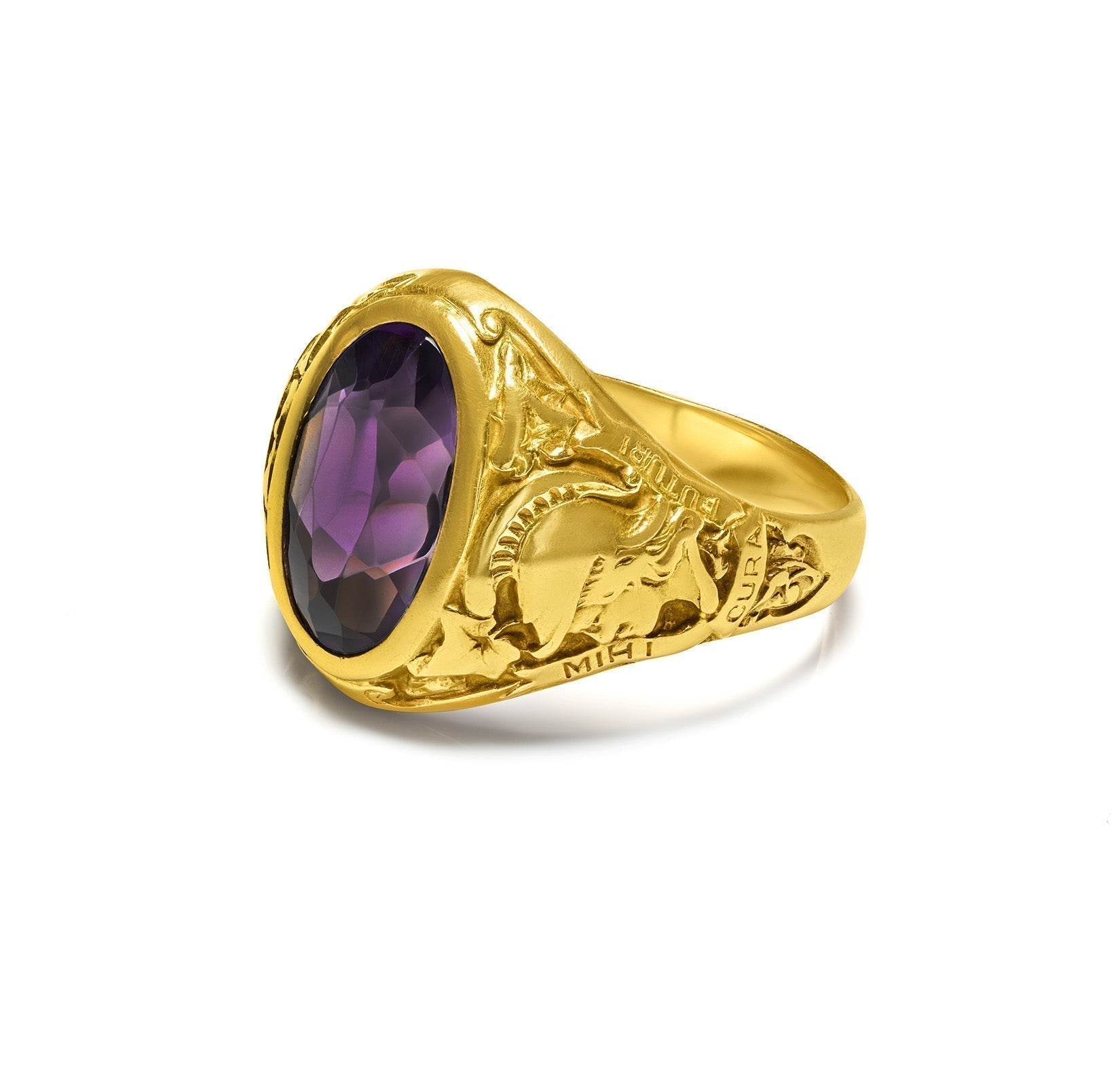
The Master Jewelers of Tiffany & Co.: An Artistic Lineage
Tiffany & Co. is often spoken of as a brand — a name, a blue box, a symbol of luxury. Yet behind this global recognition stands something far more specific and far more enduring: a lineage of master jewelers whose individual vision shaped the house across nearly two centuries.
From its beginnings in 19th-century New York, Tiffany distinguished itself not merely through commerce, but through an unusually consistent commitment to artistry. At decisive moments in its history, the firm entrusted its identity to designers, craftsmen, and creative minds whose work went beyond fashion or trend. These figures studied historical ornament, absorbed global influences, experimented with materials, and expanded the technical and aesthetic possibilities of jewelry.
What makes Tiffany exceptional is not that it employed talented designers — many houses did — but that it allowed certain individuals to leave a lasting, identifiable imprint on the firm’s artistic language. Their contributions did not remain isolated to a single collection or decade. Instead, they shaped Tiffany’s reputation, its standards of craftsmanship, and its understanding of what American jewelry could be on an international stage.
Some of these master jewelers became widely celebrated, their names now inseparable from the Tiffany legacy. Others worked more quietly, yet their influence can still be traced through objects preserved in museum collections and archival records. Together, they form a continuous artistic framework that explains how Tiffany evolved from a retailer into one of the most influential jewelry houses in the world.
To understand Tiffany & Co. is to understand these individuals — not as a marketing narrative, but as a sequence of creative voices that defined the house from within.


Meet The Master Jewelers of Tiffany & Co.
In tracing Tiffany & Co.’s artistic development from the 19th century to the present, this article examines the work and legacy of the following master jewelers and designers:
-
Charles Lewis Tiffany
-
Edward C. Moore
-
Paulding Farnham
-
Julia Munson Sherman
-
John Chandler Moore
-
Louis Comfort Tiffany
-
Meta Overbeck
-
Jean Schlumberger
-
Donald Claflin
-
Elsa Peretti
-
Paloma Picasso
-
Francesca Amfitheatrof
Together, these figures illustrate how Tiffany & Co. developed not simply as a luxury brand, but as a house shaped by individual artistic authority.


Charles Lewis (1812–1902)
The Founder Who Built a House Around Talent
Charles Lewis Tiffany is rarely described as a “jeweler” in the strict sense of the word. He was not a designer, nor a craftsman at the bench. Yet without him, Tiffany & Co. would never have become a house capable of producing master jewelers at all. His true legacy lies in something more fundamental: he created an environment in which artistic excellence could exist, develop, and endure.
When Tiffany & Young was founded in New York in 1837, the American jewelry trade was still largely provincial. Most firms relied on imported goods or direct imitation of European models, and quality varied widely. Jewelry was treated primarily as merchandise, not as an art form. Charles Lewis Tiffany recognized early on that if his firm were to distinguish itself, it would have to do so through standards, not novelty.
One of his most radical decisions was the introduction of fixed pricing. At a time when haggling was the norm, Tiffany insisted that every object be priced transparently and sold at its stated value. This was not merely a commercial tactic; it was a philosophical one.
Fixed pricing implied confidence in quality and an ethical relationship with the client. It also allowed the firm to focus on refinement rather than negotiation — a subtle but crucial shift that would later attract serious artists and craftsmen.
Equally important was Tiffany’s insistence on authenticity of materials. Long before hallmarking and standardization became widespread in the United States, he pushed for clarity in metal content and gemstone quality. This commitment culminated decades later, in 1906, when Tiffany adopted the now-standard .925 sterling silver purity in the U.S. — a move that codified standards across the industry. Although this occurred late in his life, it reflected principles he had upheld since the firm’s earliest years.
What truly sets Charles Lewis Tiffany apart, however, is his role as a curator of talent. Unlike many contemporaries who viewed designers as interchangeable employees, Tiffany understood that artistic identity was cumulative and fragile. He actively sought out individuals with intellectual depth and allowed them unusual autonomy within the firm.
This mindset paved the way for figures such as Edward C. Moore, whose scholarly approach to design would redefine Tiffany silver, and later Paulding Farnham, whose work would bring international acclaim.
Tiffany was also keenly aware of the symbolic power of institutional visibility. He understood that exhibitions, world’s fairs, and official commissions were not peripheral, but essential to establishing legitimacy. Under his leadership, Tiffany became deeply involved in national and international expositions, positioning the firm as a cultural representative of American craftsmanship rather than merely a retailer. This strategy created a platform on which future master jewelers could operate — and be seen.
Another often overlooked aspect of Tiffany’s influence is his role in shaping taste rather than following it. He believed that clients could be educated, that refinement was not innate but cultivated. This belief justified the firm’s investment in objects that were intellectually ambitious, historically informed, or technically demanding, even when they challenged prevailing fashions.
It is no coincidence that Tiffany would later become associated with revival styles, global influences, and experimental techniques — all rooted in a founder who valued depth over immediacy.
By the time of his death in 1902, Charles Lewis Tiffany had transformed a small stationery and fancy-goods shop into an institution with international stature. More importantly, he had established a structural philosophy that would define Tiffany & Co. long after him: the belief that a great jewelry house is not built by branding alone, but by empowering exceptional individuals and holding them to uncompromising standards.
In this sense, Charles Lewis Tiffany was the first and perhaps most important “master” of the house — not because he designed its jewels, but because he made it possible for true masters to exist within its walls.
Edward C. Moore (1827–1891)
The Scholar-Designer Who Gave Tiffany Its Artistic Language
If Charles Lewis Tiffany created the structure, Edward C. Moore gave Tiffany & Co. its soul. More than any other figure of the 19th century, Moore transformed the firm from a house of fine goods into a house of ideas. He did not merely design objects; he introduced a way of thinking about ornament, history, and craftsmanship that would define Tiffany’s artistic identity for decades.
Moore joined Tiffany in the early 1850s and rose to become head of the silver department in 1868. At the time, American decorative arts were still searching for legitimacy. European academies dominated taste, and most American firms relied heavily on imitation. Moore took a radically different approach: instead of copying contemporary European styles, he turned to historical scholarship and global decorative traditions.
What distinguished Moore was not only his curiosity, but his rigor. He assembled one of the most important private collections of Islamic, Persian, Japanese, and classical European metalwork in the United States. These objects were not treated as curiosities; they were studied, measured, and analyzed. Moore believed that good design could not exist without understanding structure, proportion, and historical context.
This scholarly approach led to one of Tiffany’s defining innovations: the revival and reinterpretation of non-Western ornament. Under Moore’s direction, Tiffany silver drew heavily from Saracenic, Persian, and Japanese sources, not as exotic decoration, but as fully integrated design systems. Motifs such as arabesques, geometric interlace, and stylized vegetal forms were adapted with extraordinary technical precision, resulting in objects that felt both ancient and startlingly modern.
Moore’s work reached its fullest expression at the 1878 Paris Exposition Universelle, where Tiffany silver caused a sensation. At a time when European critics viewed American decorative arts with skepticism, Tiffany was awarded the Grand Prix, an unprecedented honor. The success was widely attributed to Moore’s designs, which demonstrated that American craftsmanship could engage with historical ornament on equal intellectual footing with Europe.
Yet Moore’s influence extended far beyond exhibition pieces. Perhaps his most enduring contribution was the atelier culture he established at Tiffany. Unlike traditional workshops divided strictly by trade, Moore fostered collaboration between designers, silversmiths, chasers, enamellers, and engravers. Design was treated as a collective intellectual process, not a decorative afterthought.
It was within this environment that a young Paulding Farnham would later train. Farnham’s obsession with precision, botanical accuracy, and material experimentation can be traced directly to Moore’s insistence on disciplined study and technical excellence. In this sense, Moore was not only a designer, but a teacher — one whose influence multiplied through the artists he shaped.
Another often overlooked aspect of Moore’s legacy is his role in redefining American taste. He rejected the notion that luxury had to be flashy or ostentatious. Instead, he promoted depth, restraint, and complexity. His designs reward close examination: subtle variations in surface, carefully balanced proportions, and ornament that reveals itself gradually. This philosophy would later resonate strongly with collectors and institutions, securing Tiffany’s place in major museum collections.
By the time of Moore’s death in 1891, Tiffany & Co. had acquired something no American jewelry house had possessed before: an identifiable artistic language rooted in scholarship and craftsmanship. Moore did not simply decorate Tiffany objects; he gave them intellectual credibility. He proved that American design could be learned, serious, and globally informed.
Without Edward C. Moore, Tiffany might have remained a respected retailer. With him, it became an artistic institution capable of producing master jewelers who would carry its name onto the world stage.
Paulding Farnham (1859–1927)
The Visionary Who Took Tiffany to the World Stage
If Edward C. Moore gave Tiffany & Co. its intellectual foundation, Paulding Farnham gave it international legitimacy. More than any other jeweler of his generation, Farnham proved — publicly and unmistakably — that American jewelry could stand alongside the finest work of Europe. His career at Tiffany coincided with a crucial moment, when world’s fairs and international exhibitions served as arbiters of artistic authority.
Farnham entered Tiffany’s orbit as a young apprentice in the late 1870s, training directly under Moore. This formative experience shaped his entire approach to design. From Moore he absorbed an almost scientific respect for form, structure, and historical reference. Yet Farnham’s temperament was different. Where Moore was scholarly and restrained, Farnham was dramatic, experimental, and intensely visual.
His first major triumph came at the Exposition Universelle in Paris in 1889, an event dominated by European houses and watched closely by critics who were deeply skeptical of American decorative arts. Farnham’s response was audacious. Rather than competing in traditional gem-set jewelry, he presented a series of life-size orchid brooches, crafted in enamel, silver, and green gold, set with pearls and gemstones.
These were not stylized flowers. Farnham modeled them directly from living specimens, capturing botanical structures with extraordinary accuracy. Petals were formed in unannealed silver, then coated with layers of translucent enamel, carefully blended to reproduce the subtle tonal variations of real orchids. The result was unlike anything previously seen in jewelry — neither naturalistic sculpture nor conventional ornament, but something entirely new.
The reaction was immediate and decisive. Farnham’s orchids were awarded a gold medal, and contemporary reports described them as among the most striking objects of the entire exposition. European critics praised their originality, while American observers recognized them as a turning point: for the first time, jewelry made in the United States was not merely accepted, but celebrated abroad.
What makes this achievement even more remarkable is Farnham’s choice of materials. He treated enamel not as a decorative surface, but as a painterly medium, capable of depth, luminosity, and nuance. He also drew selectively on Orientalist and Japanese sources, adapting motifs without resorting to imitation. This synthesis of scholarship, observation, and technical daring became his signature.
Farnham’s success in 1889 fundamentally altered Tiffany’s position on the world stage. The firm was no longer viewed as an American outpost of European taste, but as an originator in its own right. This shift had long-term consequences, enabling Tiffany to compete for prestigious commissions and to attract collectors who previously looked exclusively to Paris or Vienna.
His second great moment came at the 1900 Paris Exposition Universelle, where Farnham once again pushed boundaries. Among the most celebrated pieces was a life-size iris brooch, set with over one hundred Yogo sapphires — a gemstone newly discovered in Montana and championed by Tiffany. By showcasing American stones in a context of high artistry, Farnham linked national resources with international design excellence.
This strategy was deliberate. Farnham understood that artistic prestige was inseparable from narrative. His jewelry told stories — of nature, of discovery, of technical mastery. In doing so, it aligned perfectly with Tiffany’s broader ambition to define an American luxury identity grounded in authenticity rather than imitation.
Beyond exhibition pieces, Farnham played a crucial internal role at Tiffany. Following Moore’s death in 1891, he assumed leadership of the jewelry department, shaping its creative direction during a period of transition. He oversaw commissions that combined ceremonial grandeur with technical innovation, reinforcing Tiffany’s reputation for both artistry and reliability.
Yet Farnham’s legacy is not confined to individual objects. His greatest contribution was demonstrating that jewelry could function as cultural diplomacy. Through his work, Tiffany became a representative of American artistic ambition on the international stage. This precedent would later make it possible for figures like Jean Schlumberger to operate at Tiffany with global authority.
By the time Farnham left Tiffany in 1908, he had accomplished something extraordinary: he had changed how American jewelry was perceived, both at home and abroad. His work marked the moment when Tiffany ceased to be judged as an American firm competing with Europe, and instead became a house judged on its own terms.
In the history of Tiffany & Co., Paulding Farnham stands as the figure who transformed internal excellence into external recognition — turning artistry into reputation, and innovation into legacy.
Julia Munson Sherman (1864–1957)
Sculpture, Symbolism, and the Female Voice at Tiffany
Julia Munson Sherman occupies a singular position in the history of Tiffany & Co. — not only as one of its most original designers, but as one of the very few women to exercise genuine artistic authority within a major jewelry house at the turn of the 20th century. Her work introduced a sculptural and symbolic dimension that expanded Tiffany’s creative vocabulary beyond ornament and into the realm of narrative form.
Trained as a sculptor rather than a traditional jeweler, Sherman approached jewelry as three-dimensional art. Her background profoundly shaped her designs, which often depict allegorical figures, mythological subjects, and expressive human forms rendered with remarkable sensitivity. Unlike many jewelers who treated figuration as decorative relief, Sherman conceived her pieces as miniature sculptures — objects meant to be read, not merely worn.
Sherman joined Tiffany in the 1890s, during a period of intense artistic experimentation. While the firm was gaining international recognition through Farnham’s exhibition pieces, Sherman was quietly developing a body of work that appealed to a different sensibility: collectors drawn to symbolism, storytelling, and emotional resonance. Her jewelry frequently features female figures, cherubs, and mythic beings, modeled with an attention to anatomy and gesture that reflects her sculptural training.
One of the defining characteristics of Sherman’s work is its integration of symbolism with material. Gold, enamel, and gemstones are not used simply for visual effect, but to reinforce narrative meaning. Surfaces are carefully modulated, proportions deliberately restrained, and ornament subordinated to form. This approach aligns her more closely with the ideals of late 19th-century Symbolism than with the decorative exuberance often associated with Art Nouveau.
Sherman’s designs were executed by Tiffany’s ateliers with extraordinary technical precision, translating her sculptural models into wearable form without sacrificing nuance. The challenge of producing such pieces — balancing weight, durability, and comfort while preserving artistic integrity — underscores the level of trust placed in her work by the firm. That trust was unusual, particularly for a woman working in a field dominated by male designers and craftsmen.
Her contributions were recognized during her lifetime, though often without the visibility afforded to her male contemporaries. Several of Sherman’s works were exhibited internationally and are now held in major museum collections, including the Metropolitan Museum of Art. These surviving pieces reveal a designer deeply concerned with expression, movement, and the psychological presence of her figures.
What makes Sherman especially important in the context of Tiffany is her role in broadening the definition of what jewelry could be. At a time when high jewelry was increasingly associated with gemstones and display, she demonstrated that intellectual and emotional content could be equally compelling. Her work invites contemplation, asking the viewer to engage with form and meaning rather than surface brilliance alone.
For decades, Julia Munson Sherman remained underrepresented in mainstream narratives of Tiffany’s history. Recent scholarship and renewed interest in women artists of the period have begun to correct this imbalance, revealing her as a pivotal figure in the house’s artistic development. Her work stands as evidence that Tiffany’s greatness was not the product of a single aesthetic, but of diverse creative voices operating within a shared standard of excellence.
Within the lineage of Tiffany master jewelers, Sherman represents a quiet but profound contribution — one that fused sculpture and jewelry, symbolism and craftsmanship, and opened space for artistic perspectives that had long been marginalized.
John Chandler Moore (c. 1803–1874)
The Silversmith Who Made “Tiffany Silver” Possible
Long before Tiffany & Co. became synonymous with high jewelry, it built its authority through silver — and behind that authority stood a name that deserves far more recognition than it usually receives: John Chandler Moore. If Edward C. Moore gave Tiffany an artistic language, John Chandler Moore helped give Tiffany something even more foundational: a manufacturing backbone capable of meeting luxury standards at scale.
Moore was a New York silversmith active from the early 19th century, and his career tracks the transition of American silver from small-shop production into a more modern system of organized, high-end manufacturing. He worked under several business forms (including partnerships), but his most consequential move—both for his own legacy and for Tiffany’s—came in 1851, when Tiffany contracted with J. C. Moore & Son to produce silver holloware exclusively for Tiffany.
That single business relationship is quietly one of the great strategic pivots in Tiffany’s early history. In the mid-19th century, American silver often used coin silver (lower purity, tied to circulating coinage practices). The relationship with Moore is documented as being linked to production in sterling standard (925/1000) rather than the then-typical American coin silver—an approach that aligned Tiffany with European expectations and helped shape the perception of Tiffany as a house of strict material standards.
This is one of those “infrastructure achievements” that rarely makes headlines, yet it changes everything. A luxury house can commission brilliant designs, but without consistent metal quality, predictable workshop capacity, and technical control, the work remains episodic. Moore’s operation made silver excellence repeatable—and that repeatability is what turns isolated masterpieces into a house reputation.
The relationship did not remain a simple supplier agreement. By 1868, Moore’s silverware business was acquired/absorbed into Tiffany’s organization—another critical shift, because it moved Tiffany from being partially dependent on outside makers toward deeper in-house control. This is exactly the kind of structural evolution you see in great European houses: first, top-level suppliers; later, integration.
From a collector’s standpoint, this era is also important because early Tiffany-marked pieces often carried both Tiffany marks and the maker’s own marks, reflecting a period when Tiffany sourced from multiple silversmiths before consolidating production. That broader practice is well documented: Tiffany purchased silverware from several major makers and the “Tiffany” mark could appear alongside the maker mark. In other words, the “Tiffany” name was already acting as a standard-setting retailer, but the Moore relationship shows Tiffany moving beyond retail identity into production identity.
This also helps explain why the Moore connection matters beyond one person’s biography. The Tiffany story is often told as a series of famous designers; yet the house’s credibility also rests on the technical systems that made those designers’ ambitions possible. John Chandler Moore represents a master-craftsman lineage where skill and manufacturing discipline are not separate from art, but prerequisites for it.
There is another subtle point here that strengthens your “master jewelers” narrative. In modern brand storytelling, the word “master” often gets reserved for flamboyant designers. But in the 19th century, mastery frequently meant something else: command over process, metal, tooling, repetition, and quality control—the ability to make excellence reliable. Moore’s significance is that he embodies the kind of mastery Tiffany needed before it could credibly present itself as an international leader.
Finally, Moore’s story sits at the origin of something Tiffany later liked to emphasize publicly: the idea that it helped shape American standards. Tiffany itself notes that it set the U.S. standard for sterling silver (.925) later on—an institutional claim that makes more sense once you understand the earlier groundwork laid by relationships like the Moore contract.
John Chandler Moore may not be the most famous “name” in Tiffany mythology, but he is one of the most structurally important figures in the house’s rise. He represents the point where Tiffany stopped merely selling luxury and began building the industrial and technical foundation necessary to sustain it.

Louis Comfort Tiffany (1848–1933)
Art Nouveau, Enamel, and the Poetic Expansion of Jewelry
Louis Comfort Tiffany occupies a paradoxical place in the history of Tiffany & Co. He is one of the most famous names associated with the house, yet his true impact on jewelry is often obscured by his reputation as a glass artist. In reality, Tiffany’s contribution to jewelry was neither incidental nor decorative — it represented a fundamental rethinking of what jewelry could express, both materially and emotionally.
Unlike most figures associated with Tiffany & Co., Louis Comfort Tiffany did not emerge from the world of traditional goldsmithing. He was trained as a painter, educated in an artistic environment shaped by travel, color theory, and the study of nature. This background decisively shaped his approach to jewelry. For Tiffany, ornament was not primarily about display or wealth; it was about atmosphere, symbolism, and organic rhythm.
When he began producing jewelry in the 1890s, Tiffany was working against the prevailing hierarchy of materials. Diamonds and precious stones dominated high jewelry, valued for brilliance and rarity. Tiffany challenged this convention by elevating enamel, glass, and semi-precious stones to primary artistic roles. In doing so, he aligned jewelry with the ideals of Art Nouveau, where form, line, and color mattered as much as intrinsic material value.
Tiffany’s enamel work deserves particular attention. He treated enamel not as a surface embellishment, but as a painterly medium capable of depth, translucency, and tonal variation. Using techniques such as plique-à-jour and richly layered enamels, he created effects that suggested wings, petals, water, and light. These pieces often feel less like jewels in the traditional sense and more like miniature visions of the natural world.
Motifs drawn from nature — dragonflies, peacocks, irises, wisteria, and moths — recur throughout Tiffany’s jewelry. Yet these were not literal illustrations. Tiffany studied the structure and movement of plants and insects, translating their essence rather than their exact appearance. Lines curve and taper as if growing, surfaces shimmer as if alive. Jewelry becomes an extension of the same artistic impulse that animated his stained glass and decorative objects.
Importantly, Tiffany’s jewelry was produced within a collaborative workshop environment, bringing together designers, enamellers, metalworkers, and gem setters. While many pieces bear his artistic imprint, they are the result of collective mastery — a model that echoed the atelier systems of Europe while retaining a distinctly American openness to experimentation. This approach further reinforced Tiffany & Co.’s identity as a house where artistry could flourish beyond rigid craft boundaries.
International recognition came swiftly. Tiffany’s jewelry was exhibited at major world’s fairs, including the 1900 Paris Exposition Universelle, where his work was awarded the Grand Prix. European critics, already familiar with Art Nouveau through figures such as Lalique, were forced to acknowledge that Tiffany’s interpretation was neither derivative nor provincial. It was deeply personal, rooted in color and light rather than line alone.
Yet Tiffany’s influence within the firm was not without tension. His artistic philosophy often conflicted with commercial expectations. Jewelry that emphasized enamel and artistic composition over gemstone value challenged traditional notions of luxury. As tastes shifted in the early 20th century toward more restrained and gem-centric designs, Tiffany’s approach gradually receded from prominence within the firm.
This retreat does not diminish his importance. On the contrary, it highlights the breadth of Tiffany & Co.’s artistic ambition at the turn of the century. Under Louis Comfort Tiffany’s influence, the house proved that jewelry could function as an expressive art form — poetic, symbolic, and deeply connected to the natural world — rather than merely a repository of value.
Today, Tiffany’s jewelry is held in major museum collections and studied as a central chapter in the history of Art Nouveau. His work expanded the emotional and aesthetic range of jewelry, leaving a legacy that continues to influence designers far beyond the confines of Tiffany & Co.
Within the lineage of Tiffany master jewelers, Louis Comfort Tiffany represents the moment when jewelry fully embraced artistic vision over hierarchy of materials. He stands as a reminder that true innovation often lies not in adding more value, but in redefining what value means.

Meta Overbeck (active early 20th century)
Experiment, Material Intelligence, and the Quiet Modernist Shift at Tiffany
Meta Overbeck belongs to a category of Tiffany designers whose importance is best understood not through fame, but through function within the creative ecosystem of the house. Unlike figures such as Louis Comfort Tiffany or Jean Schlumberger, Overbeck did not shape Tiffany’s public image through spectacular exhibition pieces. Instead, her contribution lies in something subtler and equally critical: the transition from late 19th-century ornament to early modernist thinking.
Working at Tiffany in the early decades of the 20th century, Overbeck was part of a generation tasked with navigating a changing aesthetic landscape. The exuberance of Art Nouveau was beginning to give way to restraint, structure, and abstraction. Materials were being reconsidered, and the relationship between form and decoration was under quiet revision. Within this context, Overbeck’s work reflects a designer deeply engaged with material logic rather than surface effect.
Overbeck’s designs demonstrate a sensitivity to proportion, negative space, and construction that distinguishes them from the ornamental density of earlier periods. Rather than relying on overt symbolism or figuration, her jewelry emphasizes clarity of form and technical coherence. Metal is treated as a structural element, not merely a carrier for stones or decoration. This approach aligns her with broader modernist tendencies emerging in Europe, though her work remains grounded in Tiffany’s tradition of refinement.
What makes Overbeck particularly significant is her role within the atelier system. She worked in close collaboration with silversmiths and jewelers, developing designs that could be executed with precision and consistency. This emphasis on feasibility and structural soundness contributed to Tiffany’s ability to maintain high standards during a period of stylistic transition. In other words, Overbeck helped ensure that innovation did not come at the expense of craftsmanship.
Her work also reflects a growing awareness of wearability. Jewelry becomes lighter, more integrated with the body, and less dependent on overt display. This shift anticipates later developments at Tiffany, particularly the mid-century and post-war emphasis on form-driven design. While Overbeck did not fully abandon ornament, she subordinated it to structure, allowing materials and construction to guide aesthetic decisions.
Overbeck’s relative obscurity in popular accounts of Tiffany’s history is not accidental. Designers who work within transitional periods are often overshadowed by more flamboyant predecessors or successors. Yet from a historical perspective, these figures are essential. They act as bridges, carrying forward standards while quietly adapting them to new sensibilities.
In the context of this article, Meta Overbeck represents Tiffany’s capacity for internal evolution. Her work shows that the house did not simply leap from Art Nouveau to mid-century modernism through isolated geniuses. Instead, it evolved through sustained, thoughtful design work carried out by figures whose contributions were incremental but foundational.
Overbeck’s legacy at Tiffany is therefore best understood not through a single iconic object, but through her influence on process, proportion, and material discipline. She exemplifies a form of mastery rooted in intelligence rather than spectacle — a quality that allowed Tiffany to remain artistically coherent during a period of significant aesthetic change.
Within the lineage of Tiffany master jewelers, Meta Overbeck stands as a reminder that innovation often happens quietly, through refinement and adaptation rather than radical departure. Her work helped prepare the ground for the next great transformation in Tiffany’s jewelry — one that would arrive decisively with Jean Schlumberger.
Jean Schlumberger (1907–1987)
The Designer Who Redefined Tiffany High Jewelry in the 20th Century
Jean Schlumberger represents the moment when Tiffany & Co. ceased to be perceived primarily as an American luxury house and became, unequivocally, a global authority in high jewelry design. His arrival marked a radical shift — not only in style, but in how Tiffany understood authorship, creativity, and artistic freedom.
Unlike earlier figures shaped within Tiffany’s internal culture, Schlumberger came from outside the American jewelry tradition altogether. Born in Alsace into a family involved in the textile industry, he was immersed from an early age in color, pattern, and material sensitivity. Before ever designing jewelry, he worked in Paris as a textile designer, absorbing the visual language of couture rather than that of traditional goldsmithing. This background would prove decisive.
Schlumberger entered the world of jewelry through Elsa Schiaparelli, designing fantastical costume jewelry in the late 1930s. These early works already displayed the qualities that would later define his Tiffany creations: exuberant color combinations, playful asymmetry, and a refusal to treat jewelry as static or symmetrical. Even at this stage, Schlumberger’s designs suggested movement — shells seemed to curl, creatures appeared mid-motion, and stones were arranged to evoke growth rather than order.
His relationship with Tiffany & Co. began in the 1950s, at a moment when the house was searching for renewal. Post-war tastes were shifting, and American luxury risked becoming conservative. Schlumberger offered Tiffany something it had never fully embraced before: a singular, unmistakable personal vision, allowed to flourish with minimal constraint.
At Tiffany, Schlumberger was granted an extraordinary degree of autonomy. He worked largely outside the conventional corporate design structure, often sketching ideas independently and relying on Tiffany’s workshops to realize them at the highest technical level. This arrangement was unusual, and it signals how highly Tiffany valued his creative authority. The house effectively reorganized itself around his talent.
Schlumberger’s jewelry is instantly recognizable. His work draws heavily on natural forms — leaves, sea creatures, flowers, stars — but these motifs are never literal. Instead, nature is abstracted, intensified, and stylized. Color plays a central role. Schlumberger was fearless in his use of unconventional gemstone combinations, pairing sapphires with emeralds, rubies with diamonds, and incorporating enamel to heighten contrast and rhythm.
One of his most enduring contributions was his reintroduction of enamel as a serious artistic medium in high jewelry, at a time when it had largely fallen out of favor. Schlumberger used enamel not as surface decoration, but as an integral part of composition, often to emphasize line, outline form, or create visual tension between metal and stone.
Technically, Schlumberger pushed Tiffany’s workshops to their limits. His designs demanded complex settings, hidden mechanisms, and intricate articulation. Pieces often required months of labor and collaboration between setters, goldsmiths, and enamellers. This level of complexity reinforced Tiffany’s reputation for technical mastery and elevated its high jewelry production to a level comparable with the great Parisian houses.
Perhaps most importantly, Schlumberger redefined the emotional tone of Tiffany jewelry. Where earlier American high jewelry often emphasized dignity and restraint, Schlumberger introduced joy, fantasy, and spontaneity. His pieces feel alive — they twist, leap, bloom, and sparkle with a sense of animation rarely seen before. This quality made his jewelry especially appealing to collectors seeking individuality rather than conformity.
Iconic clients, including Jacqueline Kennedy, gravitated toward Schlumberger’s designs precisely because they communicated confidence without rigidity. Jewelry became expressive rather than ceremonial, aligning perfectly with the cultural shifts of the mid-20th century.
Schlumberger’s influence at Tiffany extended far beyond his own lifetime. His work established a benchmark for what Tiffany high jewelry could be: author-driven, expressive, technically daring, and unmistakably artistic. Subsequent designers would inevitably be measured against him — often unfavorably — because his vision was so complete and so deeply integrated into the house’s identity.
Within the lineage of Tiffany master jewelers, Jean Schlumberger stands as a defining figure. He did not simply modernize Tiffany; he transformed it. His work marks the moment when Tiffany’s name became inseparable from a specific creative genius, setting a precedent that few designers since have been able to match.


Donald Claflin (active mid-20th century)
Continuity, Discipline, and Tiffany Between Eras
Donald Claflin represents a type of mastery that is rarely celebrated, yet absolutely indispensable to the survival of a great jewelry house. If Jean Schlumberger embodied the height of individual artistic expression at Tiffany & Co., Claflin’s importance lies in what followed: the preservation of standards, coherence, and credibility once that singular creative force was no longer central.
Unlike Schlumberger, Claflin was not a designer whose work sought public recognition or dramatic visual impact. His role at Tiffany was primarily internal, operating within the firm’s design and production structure during the mid-20th century — a period marked by transition, reassessment, and institutional consolidation. In this sense, Claflin functioned as a custodian of Tiffany’s artistic and technical values rather than a disruptor.
This period is often overlooked in jewelry history, yet it is one of the most delicate phases for any major house. After the departure or decline of a dominant creative figure, there is a real risk of dilution: styles become repetitive, standards slip, and identity fractures. Claflin’s significance lies in preventing precisely this outcome.
Working closely with Tiffany’s workshops, Claflin emphasized craftsmanship, balance, and wearability. Designs from this era tend to be more restrained than Schlumberger’s exuberant creations, yet they maintain a high level of technical refinement. Stones are carefully selected and set, proportions are controlled, and construction remains rigorous. There is a sense of discipline in the work — a deliberate refusal to chase novelty for its own sake.
Claflin’s approach reflects a broader mid-century shift in luxury. Following the excesses of pre-war and immediate post-war design, taste was moving toward clarity, functionality, and understatement. Tiffany’s jewelry under Claflin’s influence aligns with this sensibility, offering pieces that feel confident without theatricality. This restraint helped maintain Tiffany’s appeal among clients who valued longevity and elegance over spectacle.
Another key aspect of Claflin’s contribution is his role in internal knowledge transmission. He worked during a time when many traditional skills — hand fabrication, complex stone setting, and enamel work — were at risk of being overshadowed by industrial shortcuts. Claflin insisted on maintaining workshop discipline, ensuring that Tiffany’s artisans continued to operate at a level consistent with the house’s historical reputation.
While Claflin did not redefine Tiffany’s aesthetic, he ensured that the house did not lose its artistic center. His work provided a stable platform from which later revolutions could emerge. Without such periods of consolidation, radical innovation often collapses under its own weight. Claflin’s tenure illustrates that mastery can reside in stewardship as much as in invention.
From a historical perspective, Claflin’s importance becomes clearer when viewed alongside what came next. The radical simplicity and organic forms introduced by Elsa Peretti in the 1970s would not have been possible without a house that still possessed technical discipline and institutional memory. Claflin helped preserve that continuity.
In the lineage of Tiffany master jewelers, Donald Claflin stands for a quieter form of excellence. He represents the understanding that great houses are not sustained by genius alone, but by periods of careful maintenance, internal rigor, and respect for craft. His contribution reminds us that in the history of Tiffany & Co., not every master needed to be a visionary — some needed to be guardians.

Elsa Peretti (1940–2021)
Organic Form and the Reinvention of Tiffany Jewelry
Elsa Peretti represents the most dramatic transformation in Tiffany & Co.’s modern history. More than any designer before or after her, she redefined not only how Tiffany jewelry looked, but what it meant to wear it. Her arrival in the early 1970s marked a decisive break with tradition — one that reshaped the house’s identity and permanently altered the landscape of contemporary jewelry.
Peretti did not come from a conventional jewelry background. Born in Florence and trained in interior and industrial design, she moved fluidly between disciplines, absorbing influences from architecture, sculpture, and fashion. Before joining Tiffany, she worked closely with leading fashion designers, including Halston, for whom she created jewelry that functioned as an extension of the body rather than as an accessory layered upon it. This perspective would become central to her work at Tiffany.
When Peretti joined Tiffany & Co. in 1974, the house was still strongly associated with formality, preciousness, and traditional luxury codes. High jewelry existed largely in a ceremonial context, while everyday jewelry remained conservative. Peretti challenged this division outright. She proposed that jewelry could be sensual, intimate, and essential, designed to follow the natural lines of the human body rather than impose structure upon it.
Her forms were radically simple, yet deeply considered. Pieces such as the Bone Cuff, Open Heart, Bean, and Snake designs reveal a sculptor’s understanding of mass, void, and balance. These objects are not decorative in the conventional sense; they are pure forms, stripped of ornament and refined through iteration. Peretti’s genius lay in knowing when to stop — when a line had reached its most expressive state.
Material choice was equally revolutionary. Peretti elevated sterling silver to a central role at Tiffany, at a time when silver was still widely regarded as secondary to gold and gemstones. She treated silver as a noble material in its own right, capable of sensuality, weight, and emotional presence. This decision was not merely aesthetic; it fundamentally changed Tiffany’s commercial and cultural reach, making high design accessible without sacrificing integrity.
Peretti’s jewelry also introduced a new relationship between object and wearer. Her designs respond to movement, warmth, and touch. The Bone Cuff molds itself to the wrist; pendants rest against the skin rather than hovering above it. This emphasis on tactility and intimacy aligned perfectly with the broader cultural shifts of the 1970s, which valued authenticity, individuality, and physical presence over formal display.
From a technical standpoint, Peretti demanded extraordinary precision. What appears effortless is, in fact, extremely difficult to execute. Her designs require flawless surface finishing, exact symmetry (or deliberate asymmetry), and a deep understanding of how metal behaves at scale. Tiffany’s workshops were challenged to meet these demands, resulting in a renewed focus on finishing standards and production excellence.
Peretti’s impact on Tiffany cannot be overstated. Her designs became some of the house’s best-selling and most enduring creations, many of which remain in continuous production decades later. More importantly, she redefined Tiffany’s public image, aligning the brand with modernity, confidence, and understated sensuality. Jewelry was no longer something reserved for special occasions; it became part of everyday identity.
Culturally, Peretti expanded the definition of luxury. She demonstrated that value could reside in form, idea, and emotional resonance rather than in material excess. This shift had far-reaching consequences, influencing not only Tiffany’s future designers but the entire jewelry industry.
Within the lineage of Tiffany master jewelers, Elsa Peretti stands as a figure of profound disruption. She did not build upon existing traditions; she replaced them with a new language altogether. Her work marks the moment when Tiffany fully entered the modern world — not by abandoning craftsmanship, but by reimagining its purpose.


Paloma Picasso (b. 1949)
Color, Symbolism, and the Assertion of Personal Identity at Tiffany
Paloma Picasso entered Tiffany & Co. at a moment when the house was already transformed by Elsa Peretti’s radical modernism. Yet instead of following that language, she introduced something entirely different — a bold, graphic, emotionally charged vision rooted in color, symbol, and personal expression. Her work demonstrates that Tiffany’s strength did not lie in enforcing a single aesthetic, but in allowing multiple, powerful creative voices to coexist.
Unlike most designers associated with Tiffany, Paloma Picasso carried a name already charged with cultural meaning. As the daughter of Pablo Picasso, she grew up surrounded by art, color, and creative intensity. This background did not lead her toward abstraction or minimalism; instead, it sharpened her instinct for visual impact and symbolic clarity. Where Peretti stripped jewelry down to its essential form, Picasso rebuilt it around color and sign.
Paloma Picasso joined Tiffany in 1980, bringing with her a design language that was unapologetically expressive. Her jewelry does not whisper; it speaks directly and confidently. Strong outlines, saturated colors, and recurring motifs define her work. Lips, hearts, doves, olive branches, and X-shaped forms appear not as decoration, but as emblems, each carrying emotional or cultural weight.
Color plays a central role in Picasso’s designs. She embraced gemstones for their chromatic intensity rather than their rarity alone, pairing rubies, emeralds, sapphires, and enamel in combinations that feel instinctive rather than academic. This approach echoed her background in painting and drawing, where color functions as an emotional language. At Tiffany, she reintroduced chromatic boldness at a time when restraint and neutrality were often equated with sophistication.
Picasso’s jewelry also reflects a strong sense of personal symbolism. Many of her motifs draw from her own life and worldview — love, peace, strength, and independence recur as themes. Her work aligns with the cultural shifts of the late 20th century, particularly the growing emphasis on individuality and self-expression. Jewelry becomes a means of declaring identity, not simply status.
Technically, Picasso’s designs required a different kind of mastery from those of her predecessors. Her graphic forms demand precision in proportion and color balance. Enamel is often used as a flat, saturated field, requiring flawless execution to avoid visual disruption. Gemstone settings must reinforce outline and rhythm rather than overwhelm them. Tiffany’s workshops adapted once again, demonstrating the house’s capacity to translate diverse artistic visions into consistently high-quality objects.
What makes Picasso’s role at Tiffany especially important is how clearly it illustrates the house’s pluralism. Tiffany did not attempt to subsume her work into an existing aesthetic. Instead, it allowed her designs to stand alongside Peretti’s organic forms and Schlumberger’s exuberant high jewelry. This coexistence of radically different approaches strengthened Tiffany’s identity rather than fragmenting it.
Commercially, Picasso’s collections were highly successful, reaching a wide audience without diluting artistic intent. Her jewelry appealed to clients who wanted meaning, emotion, and visual confidence. It also broadened Tiffany’s cultural reach, connecting the house to contemporary art, fashion, and global symbolism.
Within the lineage of Tiffany master jewelers, Paloma Picasso represents the assertion of personal voice. Her work proves that Tiffany’s legacy is not built on a single style, but on its ability to accommodate strong, distinct identities. She transformed jewelry into a medium of self-expression, reinforcing Tiffany’s relevance in a changing cultural landscape.
Her contribution underscores a crucial truth about Tiffany & Co.: greatness, in this house, has always depended on allowing artists to speak in their own language — even when that language challenges expectations.


Francesca Amfitheatrof (b. 1968)
Authorship, Architecture, and the Question of a Modern Tiffany Master
Francesca Amfitheatrof occupies a fundamentally different position from every other figure discussed in this article. Unlike the master jewelers of Tiffany’s past, her role emerges in an era shaped by global branding, corporate ownership, and rapid cultural change. As Tiffany’s first Artistic Director in the modern sense, her work raises an essential question: is it still possible for Tiffany & Co. to produce a true master jeweler today?
Amfitheatrof joined Tiffany in 2013, at a moment when the house was searching for renewed relevance. Luxury was shifting away from tradition toward narrative, authorship, and design-led identity. Trained at Central Saint Martins and shaped by experience at houses such as Chanel and Fendi, Amfitheatrof brought a background rooted in architecture, spatial thinking, and material experimentation rather than classical jewelry lineage.
Her approach to design is conceptual and structural. Forms are often bold, geometric, and deliberately assertive. Collections such as Tiffany T and HardWear emphasize line, proportion, and repetition, translating architectural language into jewelry. These designs prioritize visual strength and recognizability, qualities essential in a contemporary luxury market dominated by imagery and instant recognition.
Unlike earlier Tiffany masters, Amfitheatrof does not operate as an isolated artistic voice. Her work exists within a complex corporate framework, where collections must satisfy multiple criteria simultaneously: brand coherence, global appeal, scalability, and commercial performance. This context inevitably shapes the scope of individual authorship.
Yet it would be a mistake to dismiss her contribution as merely strategic. Amfitheatrof reintroduced assertiveness and confidence into Tiffany’s visual language, moving the house away from nostalgia and toward contemporary expression. Her designs engage directly with modern themes — strength, identity, and urban presence — resonating with a new generation of clients.
From a technical standpoint, her collections demanded renewed attention to construction and finish, particularly in large-scale gold and silver forms. While these pieces differ radically from the high jewelry of Schlumberger or the organic intimacy of Peretti, they nonetheless require rigorous execution to maintain their sculptural integrity.
The critical distinction, however, lies in authorship. Earlier Tiffany master jewelers were allowed — even encouraged — to imprint the house with their personal vision over extended periods. Their influence accumulated slowly, organically, and often independently of market trends. Amfitheatrof’s work, by contrast, is inherently contextual. It responds to contemporary luxury dynamics rather than reshaping them.
This does not diminish her importance. Instead, it clarifies the evolution of Tiffany itself. The house today functions less as an atelier-centered institution and more as a global design platform. Within such a structure, mastery manifests differently: through coherence, adaptability, and relevance rather than singular artistic dominance.
Whether Amfitheatrof can be considered a “master jeweler” in the historical sense depends on how that term is defined. If mastery implies total artistic autonomy and long-term imprint, the conditions that produced figures like Schlumberger or Peretti may no longer exist. If, however, mastery is understood as the ability to navigate contemporary constraints while preserving design integrity, her role becomes more nuanced — and more significant.
In this sense, Amfitheatrof represents not a continuation of Tiffany’s past, but a reflection of its present reality. Her work invites us to reconsider what authorship means in modern luxury, and whether the concept of the master jeweler must evolve alongside the houses they serve.
Tiffany & Co. as a House of Artists
The history of Tiffany & Co. is not a linear progression of styles, nor a simple brand narrative. It is a constellation of individual creative voices, each responding to the conditions of their time while reshaping the house from within.
From Charles Lewis Tiffany’s foundational vision, through Edward C. Moore’s scholarly rigor, Paulding Farnham’s international ambition, Julia Munson Sherman’s sculptural symbolism, Louis Comfort Tiffany’s poetic materiality, Jean Schlumberger’s exuberant genius, Elsa Peretti’s radical modernism, and Paloma Picasso’s graphic identity, Tiffany’s legacy emerges as one of artistic plurality grounded in excellence.
The contemporary era challenges the very conditions that once allowed master jewelers to flourish. Yet the enduring power of Tiffany’s history lies in its proof that great houses are defined not by consistency of style, but by the courage to entrust their identity to remarkable individuals.
To understand Tiffany & Co. is therefore to understand its artists — not as a footnote to commerce, but as the true architects of its legacy.

FAQ – The Master Jewelers of Tiffany & Co.
1. Who were the master jewelers of Tiffany & Co.?
The master jewelers of Tiffany & Co. were the individual designers, craftsmen, and creative leaders whose work fundamentally shaped the house’s artistic identity, standards, and global reputation over nearly two centuries.
2. Was Tiffany & Co. always focused on artistry, or did this develop over time?
While Tiffany began as a luxury retailer, its focus on artistry developed early through deliberate decisions to prioritize quality, scholarship, and individual creative vision rather than mass commerce.
3. Why is Charles Lewis Tiffany considered important if he was not a jeweler?
Charles Lewis Tiffany is considered essential because he created the ethical, commercial, and structural framework that allowed master jewelers to thrive. He functioned as a curator of talent rather than a designer.
4. Who gave Tiffany its first true artistic language?
Edward C. Moore is widely regarded as the figure who gave Tiffany its first coherent artistic language through historical research, global influences, and disciplined design.
5. How did Tiffany gain international recognition in the 19th century?
Tiffany gained international recognition largely through Paulding Farnham’s groundbreaking exhibition jewelry at world’s fairs, especially the Paris Expositions of 1889 and 1900.
6. Why was Paulding Farnham’s work so influential?
Farnham demonstrated that American jewelry could rival European houses by combining technical innovation, naturalism, and narrative design on the international stage.
7. Did women play an important role among Tiffany’s master jewelers?
Yes. Julia Munson Sherman was a pivotal figure who introduced sculptural, symbolic jewelry at Tiffany and expanded the house’s artistic vocabulary at a time when female designers were rarely acknowledged.
8. How did Louis Comfort Tiffany change jewelry design?
Louis Comfort Tiffany redefined jewelry as an expressive art form by prioritizing enamel, color, and organic motifs over traditional hierarchies of precious materials.
9. Is Louis Comfort Tiffany more important for glass or jewelry?
While best known for glass, Tiffany’s jewelry is equally significant for its role in the Art Nouveau movement and its poetic approach to materials and form.
10. Who modernized Tiffany high jewelry in the 20th century?
Jean Schlumberger modernized Tiffany high jewelry by introducing bold color, movement, enamel, and highly personal artistic expression, making his work globally recognizable.
11. Why is Jean Schlumberger so closely associated with Tiffany today?
Schlumberger’s designs became synonymous with Tiffany because he was granted exceptional creative freedom and left a lasting, unmistakable imprint on the house’s high jewelry identity.
12. What role did lesser-known figures play at Tiffany?
Figures such as John Chandler Moore or Meta Overbeck played crucial roles behind the scenes, shaping production standards, material discipline, and stylistic transitions.
13. Why is Elsa Peretti considered revolutionary?
Elsa Peretti revolutionized Tiffany by introducing organic, body-centered forms and elevating sterling silver, redefining jewelry as intimate, modern, and wearable.
14. How did Elsa Peretti change Tiffany’s audience?
Peretti expanded Tiffany’s audience by making high design accessible without sacrificing artistic integrity, attracting younger and more design-conscious clients.
15. How does Paloma Picasso’s work differ from Elsa Peretti’s?
While Peretti focused on form and minimalism, Paloma Picasso emphasized color, symbolism, and graphic strength, bringing emotional and cultural narratives into Tiffany jewelry.
16. Why does Tiffany allow such different design voices?
Tiffany’s long-term strength lies in its willingness to accommodate multiple strong artistic voices rather than enforcing a single, fixed aesthetic.
17. Is Francesca Amfitheatrof a master jeweler in the traditional sense?
Francesca Amfitheatrof represents a modern interpretation of mastery, working within a global luxury framework where authorship is shaped by brand strategy as much as personal vision.
18. Does Tiffany still produce museum-quality jewelry today?
Yes, Tiffany continues to produce technically excellent jewelry, though the conditions that once allowed singular artistic dominance have evolved.
19. Why are some Tiffany master jewelers not widely known?
Many master jewelers worked within ateliers or internal structures where credit was secondary to the house’s identity, leading to historical under-recognition.
20. Why is Tiffany considered an artistic institution rather than just a brand?
Tiffany is considered an artistic institution because its most enduring achievements stem from empowering individual artists, maintaining rigorous standards, and valuing design scholarship over trends.