A Brief History of Jewelry in the Ancient World
Have you ever paused to consider where the jewelry you admire today truly comes from?
Long before goldsmiths signed their creations and gemstones were cut for brilliance, jewelry already existed as one of humanity’s earliest forms of expression. Its origins reach back to the very beginnings of civilization—far earlier than written history—when adornment served purposes that were at once spiritual, social, and symbolic.
It is often assumed that the earliest traditions of jewelry emerged in the East, in cultures that profoundly influenced the development of Western civilization. This assumption is not without merit. Ancient Eastern societies shaped not only public life and religious practice, but also the earliest understanding of precious materials and personal ornamentation.
What follows is not merely a chronology, but a cultural history of jewelry as an intimate art form—created for the body, the individual, and the beliefs that defined early societies.
From the earliest periods of human existence, people adorned themselves with ornaments. Prehistoric communities fashioned bracelets, pendants, and amulets long before the refinement of metals or gemstones. To trace the origins of jewelry, one must therefore journey deep into prehistory, to a time when adornment carried meanings far beyond decoration.
Some scholars once claimed that writing a history of jewelry was impossible due to the scarcity of surviving examples. Yet this view has long been disproven. Alongside pottery, jewelry stands as one of the few material witnesses to the lives of ancient peoples. While buildings collapsed, organic materials decayed, and weapons vanished with time, jewelry endured. Buried in tombs and preserved through funerary rites, it survived as a silent testament to belief systems, social structures, and artistic intent.
In this sense, jewelry is not merely an accessory of the past—it is evidence. It offers direct insight into civilizations whose daily lives would otherwise be lost to history. Compared to ancient cultures such as Egypt, Assyria, and Phoenicia, modern societies can indeed be seen as late arrivals in the long story of personal adornment.
These early civilizations established foundational traditions in nearly every branch of artistic craftsmanship. Their mastery of precious materials, symbolism, and form continues to underpin the history of jewelry. Anyone seeking to understand the evolution of goldsmithing must inevitably return to these cultures, where jewelry first assumed both artistic and cultural significance.
Early historical interpretations also suggest that, in many ancient societies, jewelry initially functioned as a marker of male authority and status. Power, rank, and religious roles were often expressed through ornament, while women’s participation in jewelry evolved more gradually. Over time, as social structures changed, adornment became increasingly associated with identity, ritual, and personal expression across genders.
Many generations passed before humanity mastered the techniques of metal melting and shaping. Through trial, experimentation, and accumulated knowledge, jewelry slowly evolved from simple organic ornaments into crafted objects of lasting value.
The Earliest Forms of Jewelry
The earliest jewelry naturally followed the contours of the human body. Ornaments were designed to encircle the head, neck, arms, and wrists—areas where form and movement invited adornment. As a result, curved lines dominated early jewelry design, appearing in diadems, necklaces, and protective amulets.
These early objects were rarely decorative alone. They were believed to ward off evil, protect the individual and the household, and invoke divine favor. Over time, jewelry gradually shed some of its spiritual weight, yet certain forms retained a powerful symbolic role. Among them, none proved more enduring than the ring.
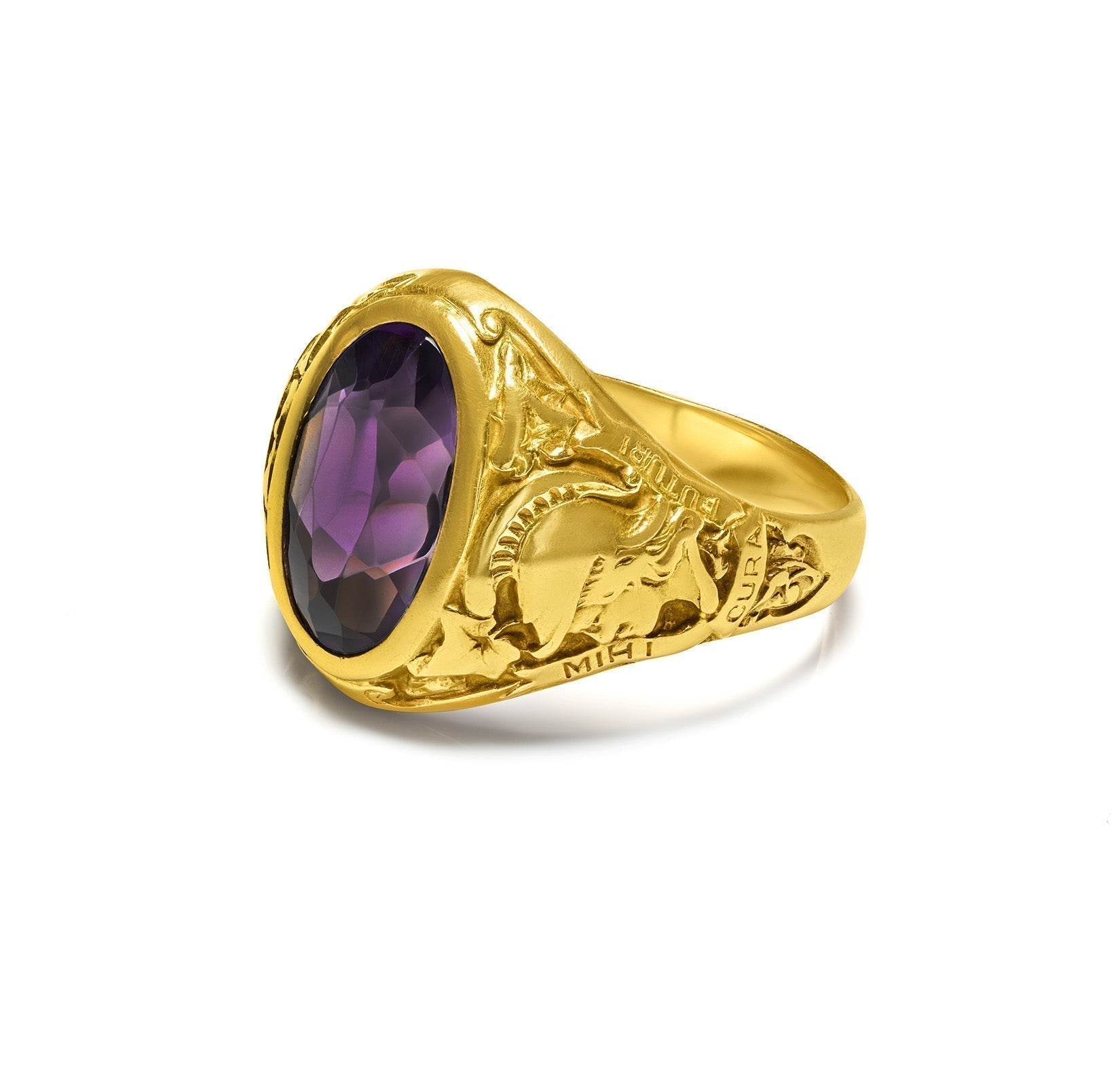
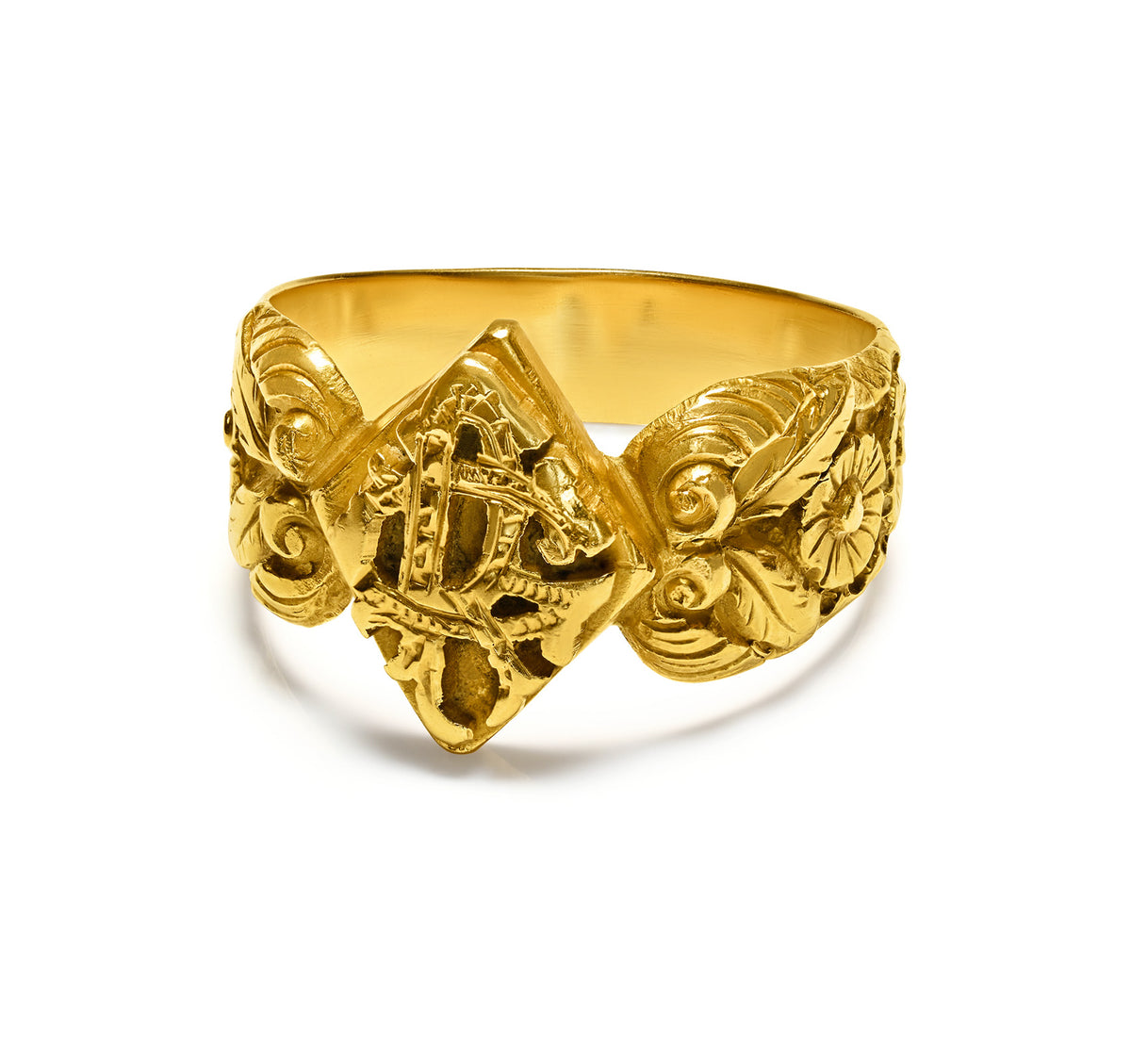
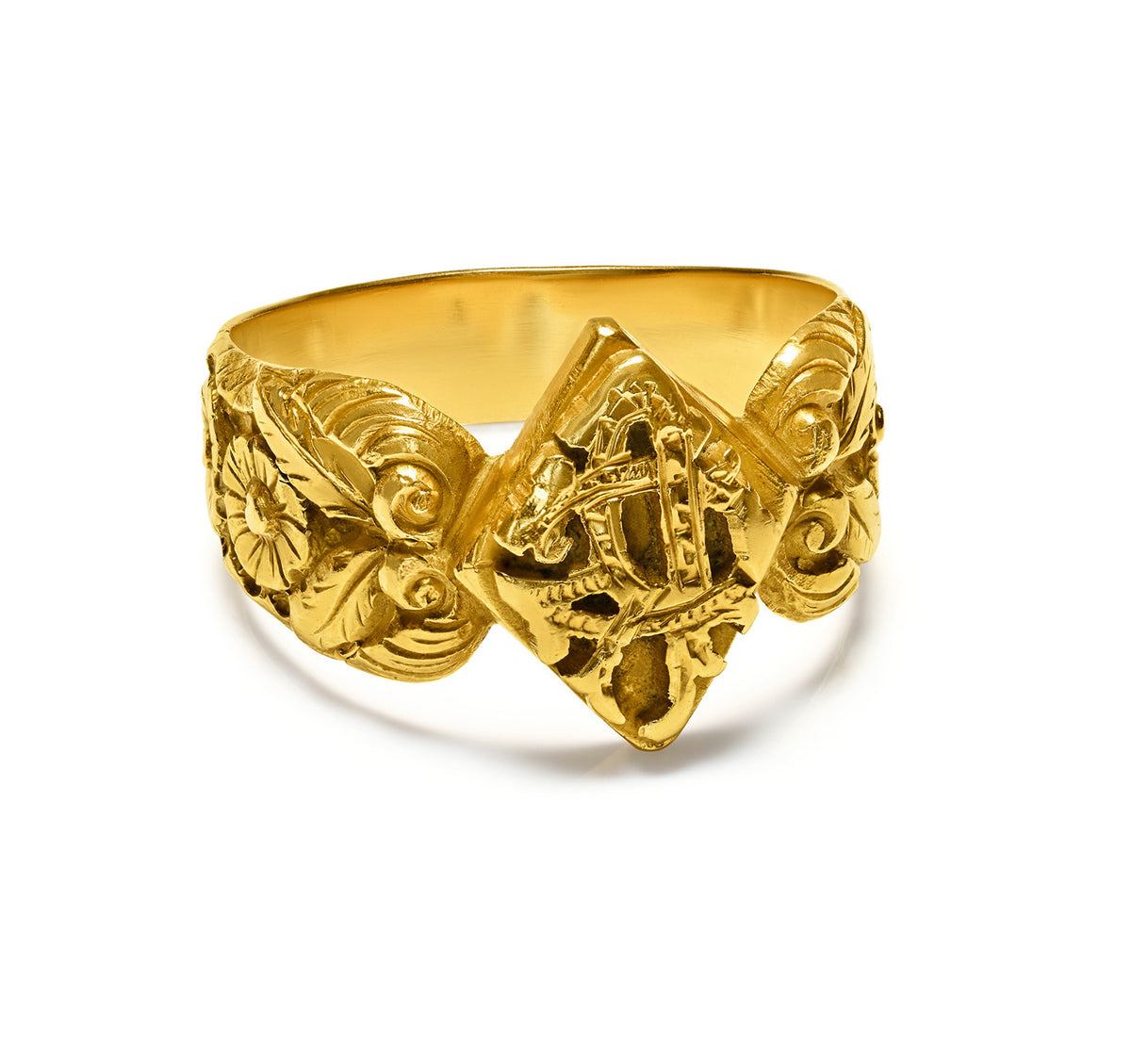
The ring occupies a singular position in the history of jewelry. It has always existed at the intersection of ornament and meaning. Even today, it represents concepts such as fidelity, love, authority, and dignity. For this reason, it has often been regarded as the most noble and compelling of all jewelry forms.
Across civilizations, rings appeared as symbols of power and legitimacy. They marked authority, sealed decisions, and embodied continuity. Ancient rulers wore rings not merely as decoration, but as emblems of command and succession. Religious traditions, political authority, and personal identity all found expression in this simple circular form.
From antiquity through the Middle Ages, the ring maintained its status as a sign of power and distinction, gradually shedding earlier superstitions while acquiring new layers of meaning. In later traditions, it came to embody commitment and moral values, particularly in the form of the engagement ring—a modest, unadorned symbol of unity and loyalty.
Even linguistic traditions preserve this symbolism. In parts of Italy, the engagement ring is known as fede, meaning “faith,” while in the Veneto region it is called vera, a word also associated with trust and belief. Such terms reflect how deeply the ring has remained embedded in cultural consciousness.
Jewelry in Ancient Egypt
Necklaces and the Language of Adornment
Ancient Egypt offers the earliest and most complete evidence of jewelry as a fully developed art form. Its legacy survives not only through monumental sculpture and wall paintings, but through an extraordinary body of actual jewelry that has endured for millennia. No other ancient civilization has left behind such a rich and coherent material record of personal adornment.
Written testimony also exists. At the Paris Exhibition of 1878, scholars presented an ancient Egyptian painting depicting craftsmen—dwarfs employed in royal workshops—melting metals and assembling necklaces. Above the scene, a hieroglyphic inscription reads: “You blow to melt gold in crucibles.” Dated to more than six thousand years ago, this image confirms that later goldsmithing traditions—from Assyria and Phoenicia to Greece and Etruria—were, in many respects, continuations of Egyptian techniques and design principles.
Although Egyptian clothing was generally simple and restrained, jewelry played a central role in visual culture. Adornment expressed rank, religious belief, and aesthetic refinement. Both men and women wore jewelry, though women appear more lavishly adorned in surviving reliefs.
Some representations show noble figures decorated with elaborate necklaces, bracelets, and belts, even when otherwise unclothed. These jewels were not exclusively fashioned from gold; colored glass, enamel, faience, and semi-precious materials were widely used, demonstrating a sophisticated understanding of color and texture.
Among the most characteristic Egyptian ornaments were the broad, multicolored necklaces that covered much of the chest. Frequently illustrated in archaeological publications—such as those by Rosellini, Wilkinson, and Perrot and Chipiez—these collars were composed of carefully arranged stones and vibrant enamels rather than fabric. Their scale and complexity suggest that they functioned as markers of status, with specific forms and patterns likely denoting rank or ceremonial role.
Egyptian necklaces were also deeply symbolic. Many incorporated representations of deities, sacred animals, or hieroglyphic signs, transforming jewelry into a communicative medium. Amulets, now often encountered as individual objects in museum collections, originally formed part of these necklaces. Small loops and perforations on surviving examples reveal how they were once strung together in elaborate compositions.

Bracelets and Pectorals in Ancient Egypt
Alongside necklaces, bracelets occupied a privileged place in Egyptian adornment. Worn in pairs on wrists, upper arms, and even ankles, bracelets were known in ancient Egyptian as Menofre. While women wore them more frequently, men also adopted them as symbols of rank and authority.
Egyptian bracelets were crafted from an impressive range of materials: gold and silver, but also bronze, iron, ivory, horn, leather, enamel, and woven plant fibers. The artistic value of these pieces did not depend solely on precious materials. Even humble substances were elevated through refined design and careful workmanship—a quality that anticipates the elegance later associated with Greek jewelry.
Among more ceremonial forms, Egyptian pectorals stand out. These chest ornaments, often worn in life and placed on the body in burial, held both decorative and religious significance. One notable example, discovered in the tomb of Khaemwaset, son of Ramses II, and now housed in the Louvre, features a miniature architectural shrine flanked by sacred symbols. A falcon spreads its wings above, holding the emblem of eternity, while royal cartouches affirm divine protection and lineage.
Rings, Earrings, and Materials
Rings and earrings were also valued in ancient Egypt and worn by both genders, though earrings appear to have gained popularity later in the dynastic period. Collections such as those of the Egyptian Museum in Florence preserve rings made from gold, hard stones, glazed ceramics, and turquoise-colored enamel. Many bear the names or symbols of gods, particularly Amun and Ptah, underscoring the intimate link between jewelry and belief.
The Italian jeweler and collector Alessandro Castellani noted remarkable examples of Egyptian jewelry in 19th-century collections, describing pieces made of pale gold alloyed with silver and adorned with frogs, scarabs, birds, and symbolic motifs. Suspended from finely braided chains, these ornaments bear striking formal similarities to later Etruscan jewelry, suggesting a long continuum of Mediterranean design traditions.
Egyptian mastery extended beyond metalwork. Their skill in glassmaking rivaled that of Renaissance Venice, and their use of glazed ceramics—known today as Egyptian faience—was widely admired by early scholars such as Georges Perrot.
Color was essential to Egyptian aesthetics. It appeared everywhere, from monumental architecture to everyday objects, and jewelry was no exception. Without understanding this sophisticated use of color, Egyptian jewelry cannot be fully appreciated.
Who taught the Egyptians the secrets of metalworking and gem-setting remains an open question. What is certain is that references to gold appear in the earliest Egyptian inscriptions. From these beginnings emerged a tradition so advanced that it shaped the jewelry of the ancient world for centuries to come.

Assyria and Jewelry: Power, Ornament, and Restraint
Compared to Egypt, Assyria has left behind fewer surviving examples of gold and silver jewelry. Yet there is little doubt that Assyrian craftsmen possessed a solid command of precious metals. The material record, though fragmentary, points to a culture that valued adornment—albeit in a manner distinct from the exuberance seen in neighboring civilizations.
Bronze ornaments constitute the majority of surviving Assyrian personal jewelry, and they reveal a people attentive to form and symbolism. Assyrian bas-reliefs frequently depict figures adorned with bracelets, necklaces, and earrings. These visual sources are particularly revealing, as they show that the wearing of earrings by men was not uncommon. A well-known relief housed in the Louvre, depicting King Sargon standing before the sacred tree, shows the ruler wearing earrings—an unmistakable sign that jewelry functioned as an expression of authority and status.
The earliest known Assyrian jewelry comes from the tombs of Warka. These objects are characterized by a pronounced solemnity and a deliberate simplicity of form. Unlike Egyptian ornaments, they tend to avoid elaborate complexity. Their restrained shapes suggest that Assyrian jewelry was conceived less as decoration for visual delight and more as an emblem of power, discipline, and hierarchy.
When compared to Phoenician craftsmanship, Assyrian jewelry appears markedly austere. Phoenician goldsmiths would later surpass both Assyria and, in certain respects, Egypt in technical refinement and inventive form. Egyptian jewelry, for all its grandeur and richness of material, often favors massive proportions—so much so that it can sometimes appear architectural in character. Assyrian jewelry pushes this solemnity even further, favoring dignity and symbolic gravity over elegance or delicacy.
Color was present in Assyrian adornment, but it was used sparingly. While the materials could be noble and visually striking, the overall aesthetic rarely aimed for refinement in the modern sense of luxury. This has led many scholars to conclude that jewelry played a less central role in Assyrian daily life than it did in Egypt.
Persia as a Cultural Bridge
In certain respects, Assyrian jewelry traditions anticipate those of ancient Persia. Persian adornment retained some Egyptian influences, such as the wearing of necklaces, but often simplified them into single strands.
Earrings, frequently pear-shaped or ring-like, appear in Persian reliefs and resemble those worn in Assyria. Jewelry was particularly common among kings, soldiers, and high-ranking individuals, who are often shown wearing bracelets and belts composed of rounded stones arranged like necklaces.
Persian rulers also extended ornament beyond the body, embellishing garments with precious stones in a manner that would later find echoes in Byzantine court dress. In this way, Persia acted as a cultural intermediary, transmitting and adapting earlier traditions while shaping new ones.
The Phoenicians and the Art of Jewelry
Among ancient civilizations, only the Phoenicians truly rivaled the Egyptians in the art of jewelry. Drawing inspiration primarily from Egypt rather than Assyria, Phoenician goldsmiths refined inherited forms to such a degree that their origins were often obscured.
Their mastery of metallurgy was exceptional, and it is reasonable to say that Phoenician craftsmen understood every essential secret of their trade.
Phoenician jewelry favored geometric and vegetal motifs almost exclusively. Human figures appear rarely and, when present, occupy a secondary role. This preference reflects a broader cultural disposition: the Phoenicians did not cultivate sculpture in the manner of the Greeks, and consequently, jewelry featuring heads or small figurative elements is uncommon.
What is particularly striking when examining Phoenician jewelry is its familiarity. Many of its forms—created centuries ago—remain in use today. This continuity underscores a fundamental truth of artistic history: innovation often builds upon ancient foundations. The Phoenicians perfected and popularized decorative forms that had already emerged in Egypt, ensuring their transmission across the Mediterranean world.
Evidence of this exchange is abundant. Jewelry of unmistakably Egyptian style has been found in Assyro-Phoenician and Egypto-Phoenician tombs in Cyprus, Rhodes, and Sardinia. Egyptian influence is equally visible in later Italian, Greek, and Etruscan jewelry, where it appears more strongly than is often acknowledged—particularly when viewed through the lens of Phoenician refinement.
It is common to praise Greek jewelry as the pinnacle of ancient craftsmanship, and the jewelry of Magna Graecia as its natural extension. Yet a closer examination of historical evidence suggests a more nuanced reality. Many of the forms and techniques attributed to Greek genius were shaped by earlier Eastern traditions.
In this light, the supposed supremacy of the Greek jeweler over the Phoenician one appears less absolute than tradition would have us believe.
The Greeks and Their Refinement
Jewelry occupied a natural and deeply integrated place in Greek life. Literary sources already attest to its importance. Homer evokes Hephaestus as a master craftsman of rings and brooches, and describes how suitors sought Penelope’s favor through gifts of gold ornaments, earrings, and necklaces. From myth to daily life, jewelry was understood as both adornment and expression of culture.
Greek women, in particular, embraced ornamentation with discernment rather than excess. They adorned their arms and wrists with rings and bracelets, and often decorated the leg above the ankle—a practice visible in surviving sculptures, including representations of Aphrodite. This preference reflects a distinctly Greek sensibility: an appreciation for beauty that avoids ostentation.
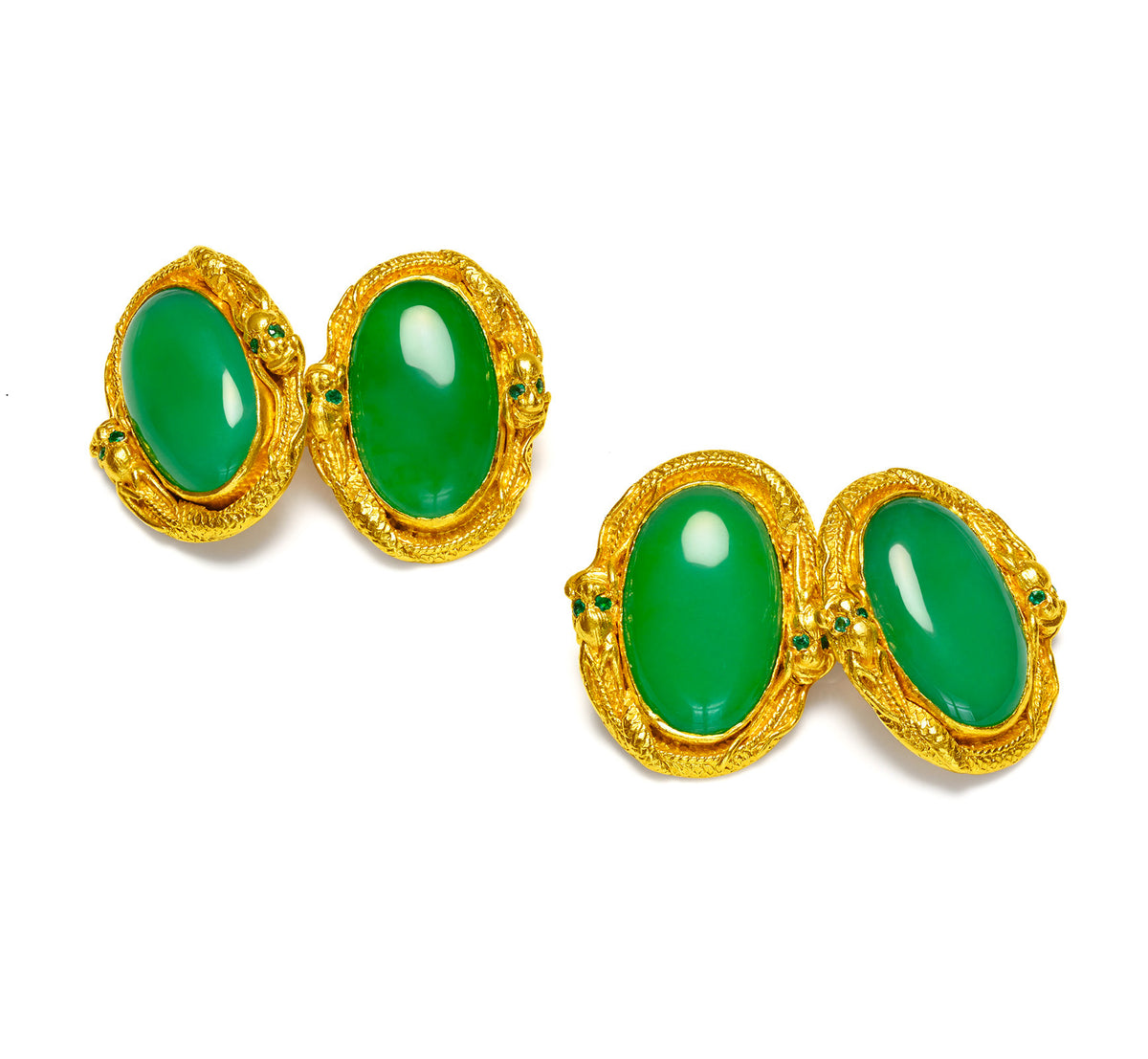
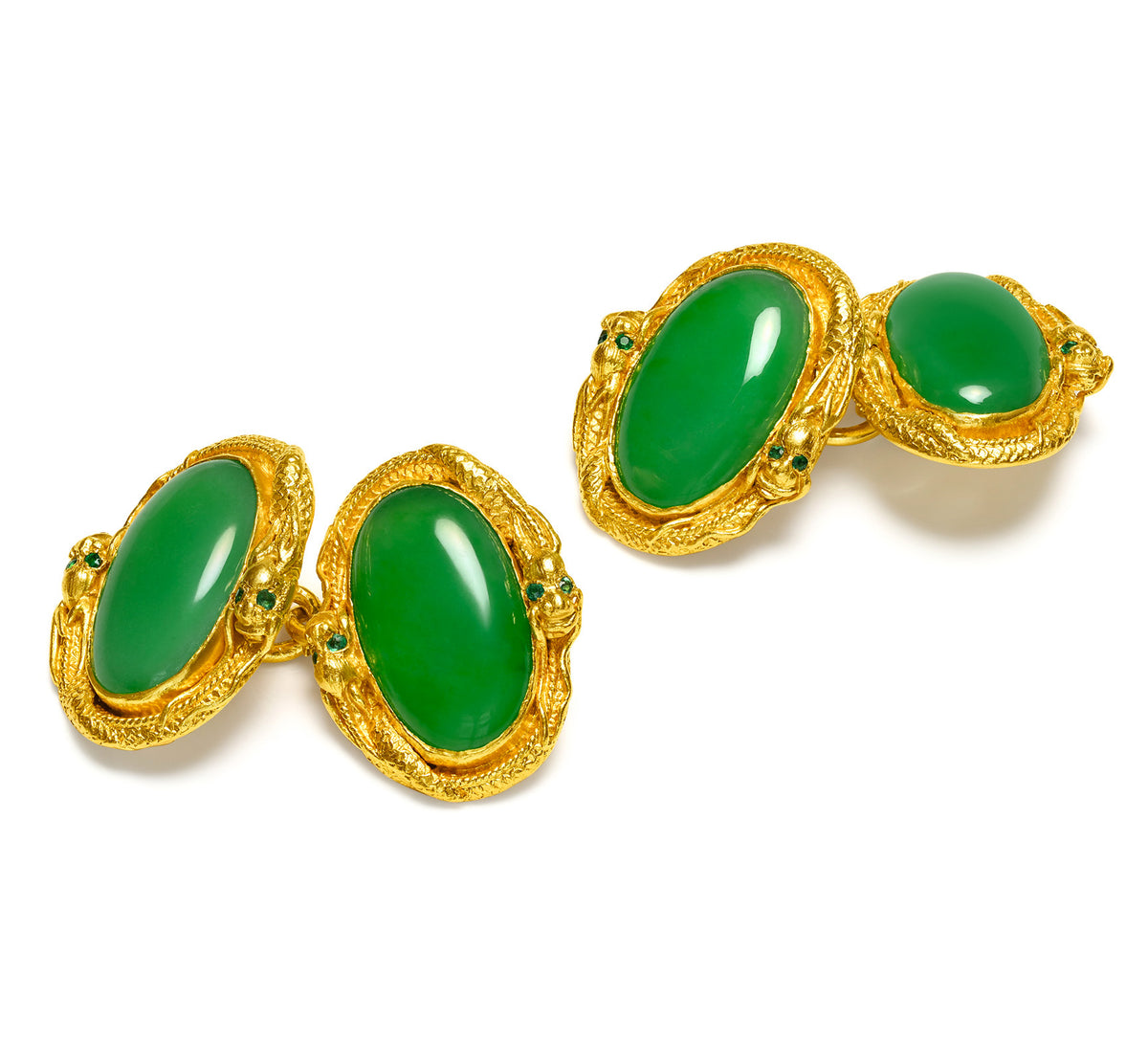
Bracelets and rings frequently adopted the form of serpents, a motif common in ancient jewelry and rich in symbolic meaning. The snake’s continuous, coiling form lent itself naturally to circular ornaments and conveyed associations with protection, renewal, and continuity.
In general, Greek jewelry favored noble simplicity. When not composed of finely worked gold patterns, it was enhanced with engraved gemstones executed with remarkable precision. These stones were not merely decorative accents; they represented one of the highest achievements of Greek craftsmanship.

Glyptics: Sculpture in Miniature
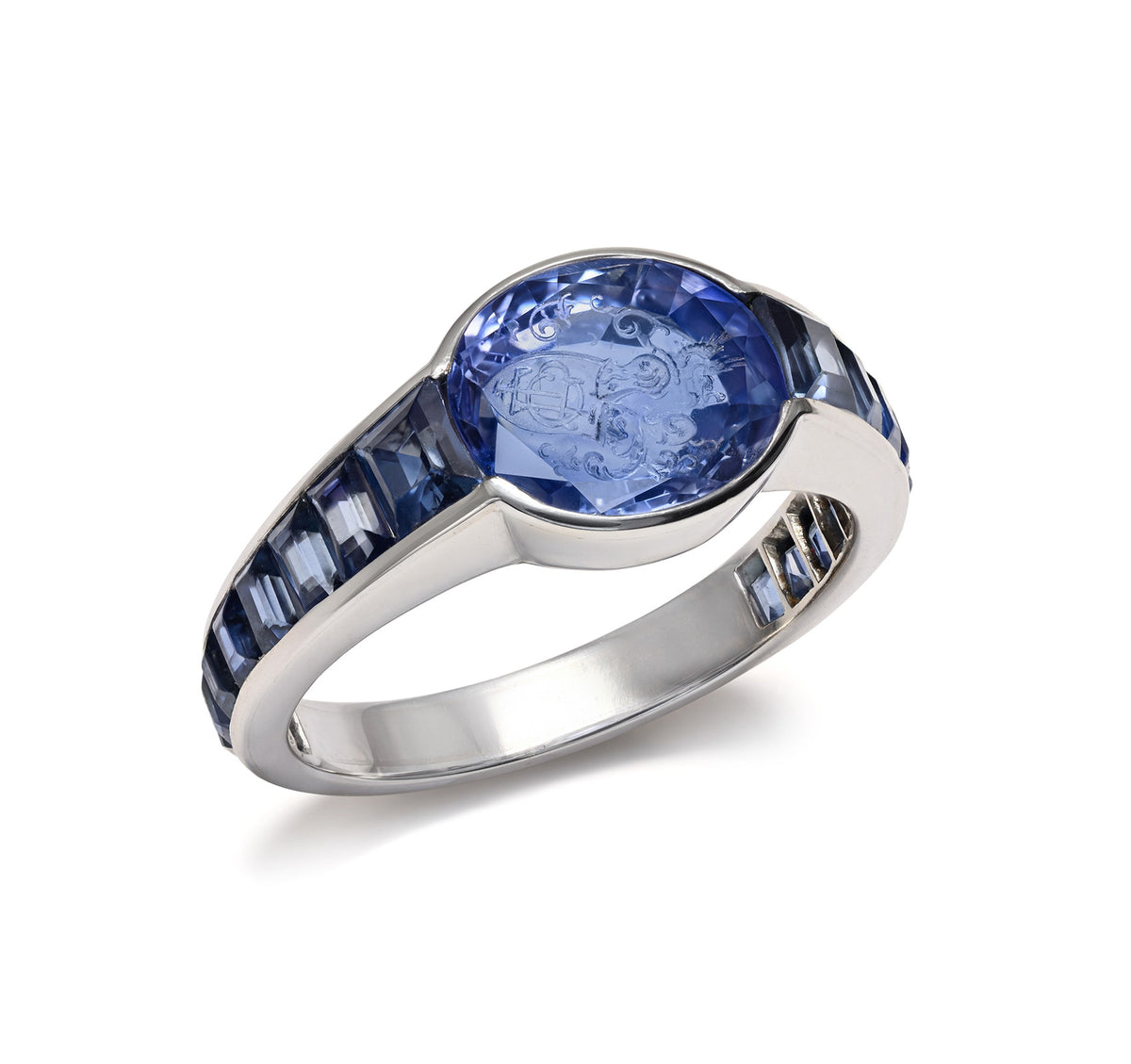
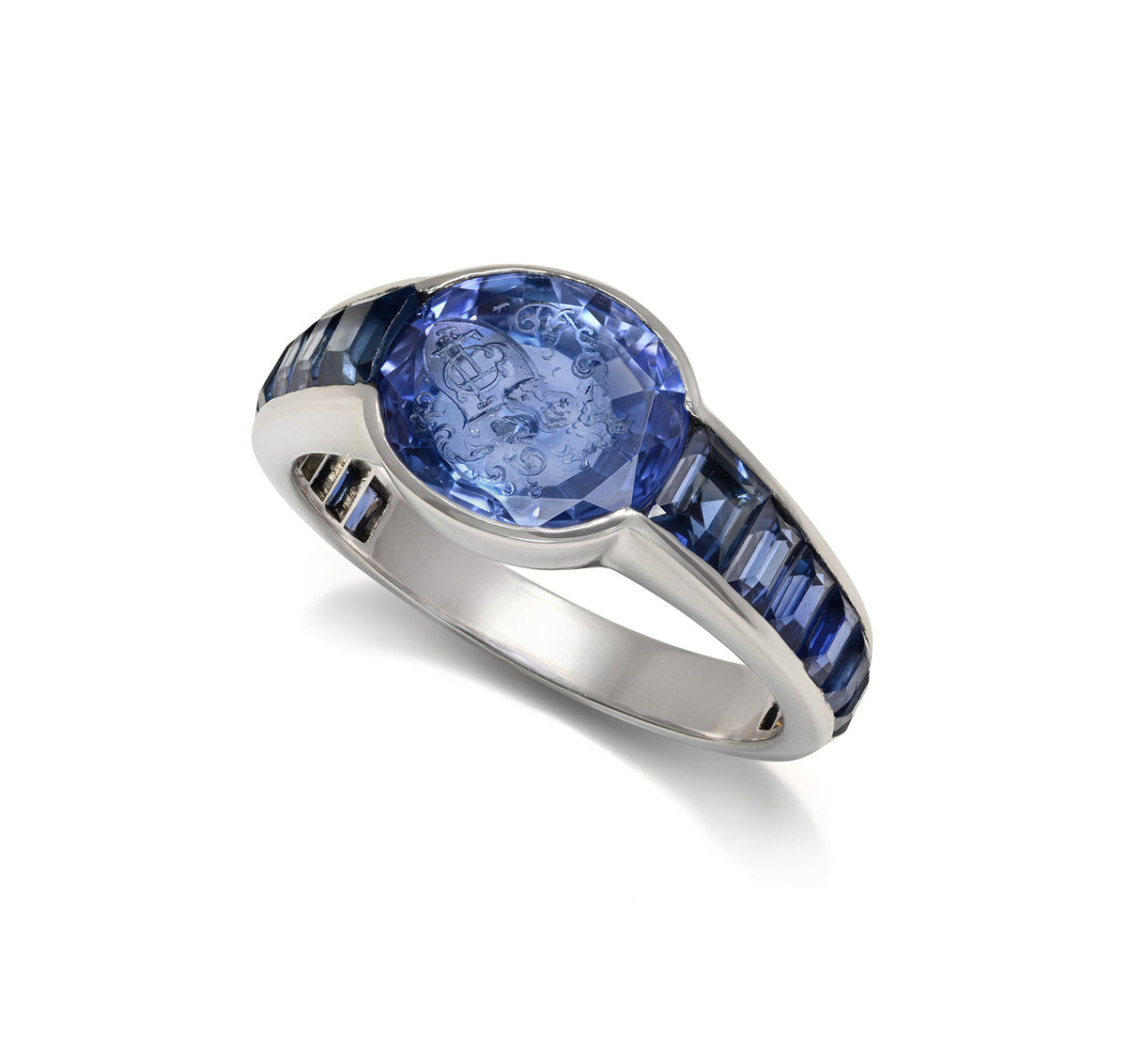
The art of engraving gemstones—known as glyptics—stands among the most refined expressions of Greek artistic genius. Often described as sculpture in miniature, glyptics involved carving figures into hard stones either in intaglio or in relief. While the origins of this art are ancient and likely trace back to Egypt, the Greeks elevated it to an unparalleled level of technical and artistic mastery.
Scholars such as Jules Labarte observed that engraved Greek gemstones appear to postdate the Homeric period, likely due to the need for advanced tools capable of cutting hard stones. Once established, however, glyptic art flourished. Greek engravers worked stones such as agate, chalcedony, carnelian, onyx, and jasper, transforming them into seals, cameos, and decorative elements.
When engraved in intaglio, these stones were known in Latin as gemmae sculptae or intagliate; when carved in relief, they became gemmae caelatae, or cameos. Such gems were mounted not only in rings but also in brooches, belts, necklaces, ceremonial weapons, luxury vessels, and even musical instruments.
Among the most celebrated Greek gem engravers was Pyrgoteles, who, alongside the painter Apelles and the sculptor Lysippos, enjoyed the exclusive privilege of portraying Alexander the Great. Pyrgoteles excelled at rendering complex compositions on the minute surface of a gemstone, combining precision of drawing with exceptional artistic sensitivity.
The popularity of engraved gems in Greece became so widespread that imitations soon appeared. Colored glass pastes were produced to replicate carved stones, and ancient writers such as Pliny noted that these imitations formed one of the most profitable deceptive trades of the period. Museums today preserve numerous examples of these glass replicas alongside genuine engraved gems.
A notable center of glyptic production also existed in Centuripe, a city in Sicily associated with a flourishing artistic tradition. Its workshops contributed significantly to the spread of Greek techniques throughout Magna Graecia.
Niello, Filigree, and Technical Transmission
In addition to glyptics, Greek jewelers were familiar with niello, a decorative technique involving engraved metal surfaces filled with dark alloys. Although niello did not achieve the same prominence in Greece as gemstone engraving, its presence demonstrates the technical breadth of Greek goldsmithing.
It is important to note that metal inlay techniques predate Greek civilization. They were already practiced in Egypt and Persia, where craftsmen reached remarkable levels of sophistication, particularly in the inlay of gold and silver into steel. The term niello itself derives from the Latin nigellum, and the technique remained known through Roman times and well into the Middle Ages.
Medieval treatises such as the Schedula diversarum artium—a manual of artistic techniques attributed to the 11th or 12th century—describe niello with clarity comparable to that found later in the writings of Benvenuto Cellini. This continuity underscores the enduring legacy of ancient craftsmanship.
The Greeks were also adept in filigree, a technique they inherited from Eastern traditions and transmitted to their colonies in southern Italy. In Magna Graecia, Greek jewelry reached an extraordinary level of refinement, both in execution and aesthetic balance.
Superb examples of Italo-Greek jewelry are preserved today in major collections, including the Kunsthistorisches Museum in Vienna, the Louvre in Paris, and the National Archaeological Museum in Naples. These works stand as enduring proof of the Greek contribution to the history of jewelry: a legacy defined not by excess, but by harmony, proportion, and intellectual refinement.
From Greece, these techniques and ideals would pass almost seamlessly into Roman hands. The Roman world would inherit not only Greek forms and technical knowledge, but also a deep respect for jewelry as a carrier of power, identity, and social order—transforming it into something both grander in scale and broader in influence.