Glyptics, the ancient art of engraving and sculpting gemstones, occupies a unique space between art and jewelry. These miniature masterpieces—intaglios and cameos—combine the creative vision and technical mastery of fine art with the allure and function of personal adornment.
While each engraved gem stands as a work of art in its own right, their transformation into rings, pendants, and other ornaments allows glyptics to be assimilated into the world of jewelry, uniting the expressive power of imagery with the prestige and beauty of precious stones.
In his comprehensive work, Pierres de lumière et objets précieux, Henri Jean Schubnel, renowned French mineralogist, composer, and writer, invites us into the fascinating world of glyptics. We invite you to join us on a journey through the history of Glyptics, as described by Schubnel.
Glyptics, derived from the ancient Greek word γλυπτός (glyptós), meaning "engraved object," represents one of humanity's oldest artistic traditions. This refined art form involves the carving and engraving of hard, precious, or fine stones, either in relief (cameo) or in hollow (intaglio). From its humble beginnings in ancient Mesopotamia to its revival during the Renaissance and beyond, glyptic art has served as both a practical tool and an exquisite form of artistic expression throughout human history. The materials used in glyptics extend beyond gemstones to include organic substances like shell, ivory, coral, mother-of-pearl, and amber, as well as precious woods. What distinguishes this technique is the shaping of material through abrasion—wear obtained by mechanical friction rather than percussion.
Portrait of Roman Emperor Caracalla, Source Wikimedia Commons, Wikimedia Commons, Author Marie-Lan Nguyen
Origins in Mesopotamia
The birth of glyptics can be traced back to the dawn of civilization in Mesopotamia, where humanity developed a balanced form of life reflected in early artistic expressions. The stone, which would become the raw material of choice for creative expression throughout the centuries, played a crucial role in the development of this art form. The earliest examples of glyptic art coincide with the birth of Sumerian civilization and the emergence of humanity’s most ancient writing systems.
Mesopotamian artists, endowed with remarkable sensitivity and instinct, created abstract compositions that often featured spirals and various forms, including prisms, cylinders, and tablets. These early works were oriented toward light, establishing glyptics as a unique frontier in visual expression using only the most basic materials available to ancient craftsmen.
Cylinder Seals: The First Glyptic Masterpieces
While engraved stones had been used as early as the seventh millennium BCE, it was the Sumerian invention of cylinder seals in the fourth millennium BCE that revolutionized the art form. These cylindrical objects, carved from precious gems, could be rolled over clay to create complex seal designs. They served multiple purposes: as marks of ownership, as a means to prevent unauthorized access to containers or rooms, as amulets with protective powers, and as signs of personal identity or professional affiliation.
Sumerian Cylinder Seal of King Ur-Nammu, Source https://www.flickr.com/photos/steveharris/84026155/ via Wikipedia Commons, Author, Steve Harris
The Uruk period (circa 3500–3000 BCE) witnessed the emergence of the first cylinder seals, which, despite being at the earliest stage of Mesopotamian glyptic art, displayed remarkable sophistication in both engraving skills and imagery. These early Sumerian seals often depicted religious scenes dedicated to deities within the Mesopotamian kingship and religious realms. The naturalistic style of Uruk cylinder seals frequently featured priests, greenery, and ruminants in heraldic groups, expressing strong religious ties associated with the fertility god Dumuzid.
Greek Mastery and Artistic Evolution
The art of glyptics reached new heights during the 5th century BCE in Greece, where artists combined intense spirituality with philosophical thought to create works of remarkable freedom and sobriety. One of the most celebrated Greek gem engravers was Dexamenes of Chios, active between 420 and 400 BCE. Only four stones signed with his name have survived, but they reveal his extraordinary talent. His works, including the famous flying heron engraved on bluish chalcedony, demonstrate a sovereign disposition of form in the transparent air of the Greek atmosphere.
Dexamenes is credited with creating the first Greek portrait of great refinement, representing a cultivated Athenian. Every work from his hand testifies to a profound understanding of both human existence and animal nature. Among his most notable works are the horse launched at full gallop on uneven terrain preserved at the Hermitage Museum and another at the Museum of Fine Arts in Boston.
The example of Dexamenes inspired numerous engravers who were trained throughout Asia Minor, Greece, and Magna Graecia (Southern Italy). Toward the end of the 5th century and the beginning of the 4th century BCE, glyptic imagery evolved toward more conventional representation with a more technical and ordinary conception, though still inspired by concern for the beauty of form.

Chalcedony scaraboid made by Dexamenos of Chios, Source https://sammlungonline.mkg-hamburg.de/en/object/Gemme-%C3%A4sender-Damhirsch/1964.296/dc0012611 via Wikimedia Commons
Alexander and the Hellenistic Period
Alexander the Great, the idealized hero and disciple of Aristotle, significantly influenced the development of glyptic art. He was so particular about his portrayal that he forbade anyone other than the sculptor Lysippus from executing his portrait. After his death in Babylon in 323 BCE, his vast empire was divided among his generals, including Ptolemy and Seleucus, who continued to patronize the glyptic arts.
The Hellenistic period marked a significant evolution in glyptic portraiture. The art of portraiture became one of the domains where this period excelled, revealing the characters of men, philosophers, thinkers, and sovereigns. A notable example is the abundant iconography of Mithridates, King of Pontus from 120 to 63 BCE, whose portraits through different phases of his reign show interpretations by various artists. He appears as a young king with the bearing and majesty of a great master, with distinctive features including a protruding eye, long pointed nose, and hair in long locks in motion,
The Roman Imperial Period: Cameos and Dynastic Imagery
During the Roman period, particularly under the Julio-Claudian emperors, glyptic art reached its pinnacle with the development of the cameo. Unlike intaglios, which were carved below the surface to create an inverse image, cameos featured relief images that protruded from the stone's surface. These were no longer merely functional seals but luxurious objects of art that far surpassed their utilitarian origins.
The craftsmanship of large imperial cameos proves the existence of well-equipped workshops established in Rome, where "dynasties" of engravers worked alongside princes and the Julio-Claudian family. Three sons of the master engraver Dioscorides left signed works, including Herophilos, who created a high-quality portrait of Emperor Tiberius.
A notable example from this period is a cameo that once belonged to Andrea Gritti, Doge of Venice, in the early 16th century. This piece depicts the bust of Athena with remarkable attention to detail, utilizing layers of agate with a honey-brown upper layer chosen for the helmet and hair, mixed with delicate beige tones for the cheek, fabric, and wings. The artist demonstrated mastery in minimal nuances, revealing the sophisticated use of stone layers to create visual depth and contrast.

Black jasper intaglio portrait of a Roman lady, source https://www.metmuseum.org/art/collection/search/248000 via Wikimedia Commons
Stylistic Evolution Under Later Emperors
The 2nd century CE saw another high point in glyptic art, especially during the reign of Antoninus Pius, a man of great probity and a true benefactor. Portraits increasingly translated a penetrating study of the soul, as seen in the portrait of Lucius Verus from the Cabinet of Medals, engraved in pale beryl. A large amethyst found in excavations in Georgia depicts Lucius Verus face-on, in the last years of his life, dressed in the paludamentum (war cloak). The master engraver captured the sadness and concern of power with remarkable sensitivity.
Glittica romana, Lucio Vero, Author Seiko, via Wikimedia Commons
This high level of artistry continued during the reign of Commodus, who succeeded his father Marcus Aurelius in 180 CE. The evolution of glyptic art through numerous masterpieces allows us to follow the personal degradation and progression of madness of this emperor, who was assassinated in 192 CE. His portrait on a blue-green beryl shows a cuirassed bust with an elongated head, characterized by an aquiline nose and raised eyebrow, contrasting with the insipid expression of the eye.
The Severan Dynasty and Decline
The precise definition of portraiture continued for two decades following Commodus's assassination. The pale beryl in the Metropolitan Museum representing Julia Domna, wife of Septimius Severus, shows the artist's discreet and sober modeling, drawing charm from the empress in a style almost identical to that of Commodus. This suggests a continuation of the imperial workshop tradition, revealed by the extreme precision in rendering details such as the hairstyle with its slightly undulated volume and vertical locks.
A cameo from the Cabinet of Medals shows an evolution toward sophisticated and subtle mannerism. In an oval of pale sardonyx against a dark blue background, it depicts the busts of the imperial family: Septimius Severus and Julia Domna on the left, and Caracalla and Geta on the right. The artist renounces expressing plastic volume but specifies particular features of the faces, such as Caracalla's self-satisfied mouth and Geta's tight expression.
Caracalla soon broke with this canon of courtly portraiture, as evidenced by a blue sapphire from the Walters Art Gallery in Baltimore that reveals a shift toward a raw style. After Caracalla's assassination in 217 CE, glyptic art degenerated further under his successor Elagabalus, though some carefully crafted engravings of his wife's effigies contrast with more schematized works. During the 3rd century CE, carefully elaborated works became rare, and a revival of classical glyptics inspired by Augustan art only occurred under Constantine the Great.
Medieval Obscurity and Renaissance Revival
With the fall of the Roman Empire, the taste for engraved stones gradually faded, marking the end of the golden age of glyptics. The art form fell into relative obscurity during the Middle Ages, with few notable works produced during this millennium of darkness. It wasn't until the 14th century that men of great culture and intelligence, such as Charles V of France and Charles IV of Bohemia, allowed the art of gem cutting to shake off this oblivion.
The Renaissance witnessed a renewed interest in glyptics, particularly through patrons like Lorenzo de’ Medici. The looting of Constantinople in 1204 by the Crusaders had already reintroduced ancient glyptic objects to Western Europe, where they were used to enrich church treasures and decorate royal jewelry. The founders of Renaissance glyptic art were Italians like Vittorio Pisano and Donatello, with the renowned sculptor and goldsmith Benvenuto Cellini also creating gems.

Female bust on lapis lazuli, 16th century, Italy, Author Saiko, via Wikimedia Commons
Neoclassical Revival and Modern Practice
The Neoclassical movement, following the ancient tradition of stone engraving, marked the last hours of glory for glyptics from the 18th to the early 20th centuries. This period saw artists drawing inspiration from classical models while developing their own distinctive styles.
Today, the art of glyptics continues, though on a smaller scale. Some contemporary jewelers are turning to gem carving to add appeal, tell stories, or make their creations stand out. While some jewelry companies have the skill to create carvings in-house, most seek out lapidary talent in gem hubs like India or Germany’s Idar-Oberstein, or search antique markets for original pieces to reset in fresh designs. Recognizing the importance of preserving this tradition, companies like Cartier have acquired workshops of master glypticians and now train new generations of gemstone carvers.
Techniques and Materials
The glyptician exercises the art of engraving, cutting, and sculpting gemstones through direct confrontation with matter, creating the work progressively. Traditional techniques involve wearing down the stone using iron, bronze, copper, or even wood supports with abrasives. Modern glypticians often use diamond powders calibrated according to the desired result, with grain size varying based on the smoothness or polish they want to achieve.
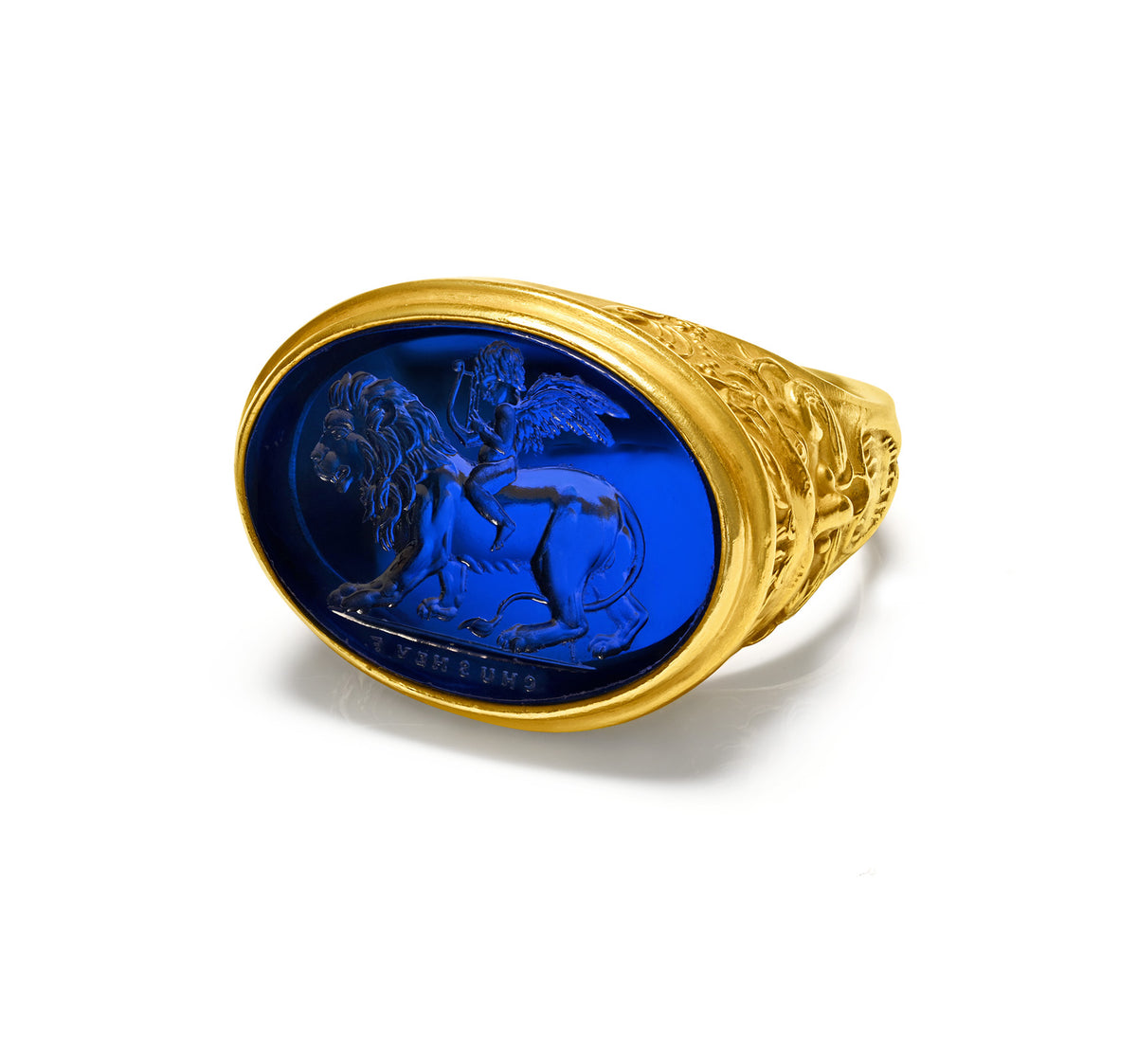
The two primary types of gem engraving are cameo and intaglio. Cameos feature subjects sculpted in relief, raised above the surface of the gem, while intaglios involve carving below the surface to create an inverse image. An intermediary technique called "chevet" (or "cheve," "curvette," "cuvette," or "dished") involves carving a figure in relief within a concave depression, typically into the table of a faceted gemstone.
Glyptic artists often work with a variety of materials organized into three main families:
Mineral materials: Including all gem-quality stones, precious, fine, and ornamental stones.
Organic materials: Ivory, coral, mother-of-pearl, and tortoiseshell.
Plant materials: Various precious woods and other plant-based substances.
Cultural Significance and Legacy
Throughout history, glyptic art has served multiple functions beyond mere decoration. In ancient times, engraved gems were used as personal signatures on documents or packages to guarantee authenticity or legitimize business deals. They also served as amulets, believed to ward off evil spirits and protect their owners from harm.
The social significance of glyptics extended across all strata of society. While the nobility commissioned elaborate works from master engravers, common people owned simpler pieces, including what Pliny called "the gems of the people"—glass reproductions that enriched the lives of ordinary citizens. During the Roman Republic, everyone possessed a small intaglio symbolizing their happiness, the promises of a prince, or depicting a favored god, hero, or animal.
Today, glyptic art is recognized as an important cultural heritage, with the know-how of glyptics included in France’s inventory of intangible cultural heritage. Museums around the world display these miniature masterpieces, testifying to the extraordinary skill of ancient and modern artists who could create detailed scenes and portraits on the smallest of canvases.
The art of glyptics represents one of humanity’s most enduring artistic traditions, spanning from the birth of civilization in Mesopotamia to the present day. Through its evolution across different cultures and time periods, it has served as both a practical tool for authentication and a sublime form of artistic expression. The exquisite craftsmanship and attention to detail demonstrated by master glypticians throughout history continue to captivate modern audiences, ensuring that this ancient art form remains relevant in contemporary society.
Despite the challenges of modern mass production and changing artistic tastes, glyptic art persists as a testament to human creativity and technical skill. As we appreciate these miniature masterpieces today, we connect with a tradition that has adorned and authenticated human interactions for millennia, bridging the gap between utility and sublime beauty.
Biography: Pierres de lumière et objets précieux, by Henri Jean Schubnel
Cover Photo: Lapis lazuli ring stone, Gift of John Taylor Johnston, 1881, Source https://www.metmuseum.org/art/collection/search/245082, via Wikimedia commons