From Ore to Ornament: The Timeless Art of Metal in Jewelry
The relationship between metal and jewelry is one of humanity’s oldest creative endeavors—a synergy where raw materials are transformed into objects that blend function, symbolism, identity, and beauty.
The history of jewelry, especially as related in classic texts like Histoire artistique du métal by René Ménard, is a tapestry rich with anecdotes, legendary treasures, and examples that reveal more than just metallic luster.
We invite you to a journey through the evolution of metal in jewelry as highlighted by Ménard, focusing particularly on the transformation of craft, materials, motifs, techniques, and aesthetics.
Ancient Legends and Buried Treasures
The Splendor of Mesopotamia: The Queen of Ur
Among the earliest stories is that of Queen Puabi of Ur, whose tomb yielded an astonishing trove: headdresses of hammered gold, elaborate necklaces of lapis and carnelian set in gold, and delicate filigree earrings. Each piece not only reflected her status but whispered stories of Sumerian society, where the shimmer of gold evoked both divinity and earthly power. Sumerian artisans were among the first to ply gold, using techniques that included hammering, soldering, and filigree, crafting wonders for both the living and the gods they worshipped.

Closeup of Queen Puabi's gold headdress recovered from the royal cemetery of Ur, Iraq 2550-2450 BCE, Source https://www.flickr.com/photos/mharrsch/33434979082/ via Wikimedia Commons, Author Mary Harrsch
The Snettisham Great Torc: Celtic Brilliance
The story of the Snettisham Great Torc, unearthed in Norfolk, England, captures the marvels of Celtic goldsmithing. Crafted from an alloy of gold, silver, and copper, this necklace—made from 64 twisted wires—was worn by a high-ranking figure, perhaps a chieftain. When found, its intricate beauty and weight (over 1 kg) prompted awe, evoking an age when the torc was both ornament and badge of rank.

Snettisham Torc, Source Wikimedia Commons, Author Johnbod
The Gold Lyre of Ur: Music, Myth, and Metal
In the Royal Cemetery of Ur, the Gold Lyre was discovered: a musical instrument adorned with a golden bull’s head and inlaid lapis lazuli. More than mere ornament, this lyre was used in ritual and myth, a testament to the blend of artistry, spirituality, and technical mastery achieved by ancient jewelers.

Metalwork and Myth in Classical Antiquity
Etruscan Gold: Secret Techniques
Travel to Italy, and you discover the dazzling granulated goldwork of the Etruscans. Their secret? Minute granules of gold fused onto surfaces to create patterns that seem drawn by a painter’s hand but are solid metal. The techniques they developed—still not fully understood—allowed rings, necklaces, and earrings of such finesse that Pliny the Elder, the Roman naturalist, marveled at them in his writings.
The Greek Olive Wreath: A Living Crown Cast in Gold
The Greeks bestowed olive wreaths on Olympic victors, but the most stunning of these are the golden olive wreaths. The “Gold Olive Wreath” from the 4th century BCE is nearly indistinguishable from an actual branch, each leaf and tendril a proof of the jeweler’s skill and a symbol of living immortality. Such wreaths were found in tombs, placed with the dead to crown them with everlasting glory.

Olive wreath crown, 3rd century BC, unknown provenance in the former Ottoman Empire, Source Wikimedia Commons, Author Francesco Bini
Stories of Mastery and Change in the Renaissance and Beyond
The Silver-Topped Gold Rivière
In the 18th century, innovation bloomed: jewelers began setting dazzling diamonds in silver “collets” (mounts) atop gold backing. This marriage not only created the iconic “rivière”—a shimmering circle of diamonds—but also prevented the silver from tarnishing clothing or skin, a problem that lasted until this clever solution was devised. Gems gleamed brighter, necklaces dazzled at candlelit balls, and the rivière became the must-have of the period.
The Appeal of Rose Gold Among Nobility
Rose gold, a delicately tinted gold-copper alloy, had a mystique: it was at first reserved mostly for European royals. Legend holds that Russian tsars adored rose gold for its warmth and subtle luxury—later, it would become widespread in Art Deco jewelry, embracing color as never before.
The Drama of Platinum: Modern Mystique
The Unworkable Metal That Conquered the World
Platinum’s use in jewelry is a tale of perseverance. In the 18th century, Spanish explorers found a mysterious, heavy white metal in riverbeds of South America—they named it “platina,” mocking it as “little silver.” For centuries, its impossible melting point baffled metallurgists; it was considered useless. Only in the late 19th century, with the invention of new torches and technologies, could platinum at last be tamed for jewelry. By the Edwardian era, platinum was the new “metal of kings”—loved for holding even the largest diamonds in secure, almost invisible settings. Rumor spread that Hollywood’s brightest, from Greta Garbo to aristocrats in London, vied for platinum’s cool prestige.
Tools, Techniques, and Everyday Marvels
The Secret of Champlevé and Cloisonné
Celtic and medieval goldsmiths introduced techniques like champlevé (where cells are carved into metal and filled with enamel) and cloisonné (using thin metal wires to create compartments for enamel). Imagine a craftsman at his bench, heating coals as he pours colored glass into a brooch, telling stories not just in gems, but in molten color—a vibrant art still sought in antique markets today.

Champlevé reliquary casket in the collection of Museum Kolumba in Cologne, Germany, Source Wikimedia Commons, Author Kleon 3Champlevé reliquary casket in the collection of Museum Kolumba in Cologne, Germany, Source Wikimedia Commons, Author Kleon 3
Repoussé and Granulation: Sculpting the Mythic
Repoussé, the process of hammering metal from behind to create relief images, enabled jewelers to mold scenes of gods, battles, or nature stories onto rings and bracelets. Granulation, perfected by the Etruscans, allowed for almost invisible patterns of tiny gold balls, each placed with tweezers heated over a simple lamp—an agonizing, meticulous process that demanded both patience and vision.

Small jug turned into a mustard pot, Source Wikimedia Commons, Author Ji-Elle
Metal in Modern Times
A Time of Artisans Without Boundaries
Until the seventeenth century, metalworkers moved fluidly among many disciplines. The same artisan might be responsible for grand statues that adorned palaces and churches, and equally for intimate, precious adornments worn on the person. Figures such as Benvenuto Cellini, François Clouet, and Wenzel Jamnitzer exemplify this polymathic ideal. They are remembered not solely for isolated specialties but for their total mastery of metalwork in many forms.
Cellini, for instance, is famed for both sculptural masterpieces and extraordinary jewelry pieces, merging facets of the Renaissance’s artistic and technical vigor. Jamnitzer’s elaborate vessels combined architectural precision with intricate allegory, while Clouet’s focused artistic studies extended to medallions and ornaments for French royalty. The absence of strict specialization meant artists drew their inspiration and skill from across domains, treating metal as a unified material to be manipulated into any form that commissions or imagination demanded.
Ménard notes that metalworking during this period was a fluid practice where the same hands shaped towering statues and delicate settings. This integration reflected the era’s overall artistic philosophy: an emphasis on the total harmony of art, not the mechanization of craft.
The Impetus for Specialization
Yet, as early modern society matured, the landscape of metalwork shifted. The seventeenth and eighteenth centuries saw the rise of new economic and social structures—markets grew, aristocratic demands escalated, and artistic tastes became more refined and exacting. It became increasingly difficult, if not impossible, for a single craftsman to produce every element of a complex piece with equal mastery.
This evolution generated a clear division between the goldsmith, still associated with broader metalwork, and the jeweler, who increasingly specialized in adornments and decorative objects. Jewelry began to take on a life of its own as a distinct art form, honed by specialists whose sole preoccupation was the pursuit of aesthetic and technical excellence in small-scale masterpieces.
Parallel to this artistic specialization was a practical industrial revolution. The advent of more systematic casting, molding, and reproduction technologies allowed manufacturers to produce multiples of intricate designs with greater uniformity and refinement. While this development widened access to finely crafted jewelry and propelled the art toward new heights of precision, Ménard laments the reduction in manual, unique craftsmanship it occasioned. The “handmade” character of jewelry, with all its thrilling imperfections and spontaneity, gave way to more uniform but technically impressive production.
Materials as Narrative and Medium
Throughout this period, Ménard emphasizes that the materials chosen for jewelry communicated more than mere monetary value. Gold and silver remained the pillars of noble ornamentation—symbols of wealth, power, and divine favor. But alongside these, artisans employed pearls, agate, coral, ivory, and exquisite enamels, imparting texture, color, and symbolic resonance.
While highly ornate, ceremonial pieces were crafted from these precious substances, functional or everyday jewelry was often fashioned from less noble metals, reflecting practical demands without sacrificing aesthetic pleasure. Fashion and utility both guided the changes in the shapes, stone cuts, and arrangements—pearls might be clustered or spaced according to trend; necklaces lengthened or shortened depending on dress styles.
Ménard notes that the purposes of jewelry extended beyond mere decoration. These objects were often imbued with a destiny—whether as badges of rank, insignias of authority, or talismans in religious or social contexts. The shape and setting of stones could indicate marriage, office, religious devotion, or simply the owner’s personal taste.
The Flourishing of Motifs: From the Sacred to the Mythical
The Renaissance catalyzed an explosion in the symbolic language of jewelry. Religious themes were no longer exclusive, though Christian symbolism—including crosses and sacred monograms—remained prominent in precious objects during the period’s dominant religious climate. However, the rediscovery of antiquity, and the imaginative liberties taken by jewelers, expanded the iconographic repertoire vastly
Jewelry became a canvas upon which came to life an array of figures: genii (guardian spirits), Pan, sphinxes, tritons, nereids, centaurs, and the elusive unicorn. These mythological beings graced brooches, signet rings, pendants, and necklaces, elevating jewelry from simple ornamentation to allegorical storytelling.

Antique Renaissance Revival Exceptional Gold Enamel Fob in DSF Antique Store
Heraldic devices also flourished as aristocracies vied for distinction by combining familial crests with imaginative new images. Crosses of Malta and Saint Andrew, intricate cameos, and sprays of garnets or pearls adorned coats of arms, signaling lineage and prominence. The skill of jewelers in combining the symbolic depth of ancient and medieval motifs with contemporary innovation created an aesthetic that was both timeless and deeply personal.
Throughout this period, master craftsmen such as Giorgio Ghisi, Lorenzo Ghiberti, and Andrea del Verrocchio set standards in technique and creativity that have echoed through centuries. Benvenuto Cellini’s transformative role cannot be understated—his delicate settings and ingenuity formed the basis from which much of modern European jewelry aesthetics developed.
Enduring Splendor: Collections and Changing Fashion
The artistry of the seventeenth and eighteenth centuries remains vividly alive in collections worldwide. The Louvre houses remarkable examples—ornaments once belonging to the Medici family, priceless crosses decorated with colored stones and enamel, and delicate filigree work that shines as brightly as when first crafted.
Fashion’s evolution is also captured in the placement and form of jewelry. Before the popularization of earrings, women adorned their hair and brows with grand jewels, competing in splendor and complexity. Eventually, as aesthetics shifted, those dazzling elements moved to the ear and neck, surrounding and complementing the figure. Elaborate necklaces, sometimes worn under the arm in a flowing cascade, framed the body’s form as tightly laced bodices emphasized elegance and stature. Such jewelry was both a visual delight and a social statement.
The International Influence and the Great Jewelry Houses
Paris and London, as centers of artistic innovation and economic power, shaped the jewelry industry profoundly during the modern era. Houses such as Alfred Boucheron’s workshop epitomized the blend of artistic taste, technical excellence, and manufacturing clarity.

Boucheron Paris Emerald, Ruby, Sapphire & Diamond 18K Gold Bracelet in stock at DSF Antique Jewelry
English artisans led notable technical advances—introducing new processes and materials, refining compositions, and instilling a spirit of invention that refreshed traditional forms. Italy’s Venetian and Neapolitan jewelers synthesized centuries of classical techniques, with Neapolitan style strongly reflecting ancient Greek motifs. Spain retained a distinctive approach, seen in Toledo’s jewelry treasures preserved in monasteries and linked to Pompeii’s archaeological heritage.
Boucheron, among others, successfully preserved a tradition of masterful finishing while boldly incorporating diverse historical influences, keeping French artistic jewelry vital and esteemed in a growing international market.
Romanticism’s Flourish: History and Individuality Intertwined
The Romantic movement’s embrace of emotion and history profoundly affected jewelry design and production. Where earlier designers looked simply to replicate antique patterns, visionary jewelers sought not mere copies but renewed sensibilities. This shift gave birth to highly original works that harmonized historical reverence with modern creativity.

Romantic Jewelry in stock at DSF Antique
Boucheron’s jewelry, showcased at the Universal Exhibition of 1867, was admired as among the most difficult to imitate—a testament to both their technical sophistication and unique artistic voice. The exhibition displayed masterpieces such as the bracelet by M. Falize, which married Greek classical influences with the charm of Italian goldsmithing traditions. Kovorkian’s arm bracelets mingled Indian, Greek, and Armenian motifs, embodying the nineteenth century’s cosmopolitan artistic ethos and curiosity.
Ménard highlights that beyond technique, the “hand of the master”—the distinctive style of the artist—remains the defining standard. These creators forged new paths while respecting the pulse of tradition, marrying legacy with innovation.
Revival and Reinvention: Cesellatura and Chasing
The intricate art of chasing—or “cesellatura,” as the Italians call it—experienced a notable revival. Once a declining practice, it was reinvigorated by bronze workers, chiselers, and jewelers with a renewed passion for handcraft, texture, and detail.
Barbedienne’s collaborations with leading sculptors like Falguière and Levèque exemplify how industrial and artistic realms could merge fruitfully. These partnerships produced ornamental works that balanced technical skill with symbolic and decorative depth.
Meanwhile, efforts to revive and perfect ancient techniques flourished, most notably with the Castellani family’s Etruscan-style jewelry. Using granulation and filigree techniques resurrected from Roman ruins, Castellani recreated lost methods with extraordinary fidelity, enriching the modern repertoire with treasures echoing antiquity.
Public Exhibitions and the Educative Role of Technical Schools
The proliferation of international exhibitions in the nineteenth century accelerated both the diffusion of jewelry artistry and the professionalization of its makers. The 1867 Paris Universal Exhibition, in particular, served as a showcase for diadems, tiaras, necklaces, brooches, and pins that displayed the height of creative and technical achievement.
Technical schools in Paris, Lyon, and Bordeaux began nurturing a cadre of skilled artists who brought fresh ideas and expert knowledge to the trade. This institutional input reinforced France’s position as a leading jewelry center and underscored the vital relationship between education, innovation, and tradition.
Diamonds: The Crown Jewel and Their Setting Challenges
Diamonds, as Ménard notes, took on a paramount role in jewelry—it would not be an exaggeration to call them the undisputed kings of the art. The brilliance, fire, and rarity of diamonds made them a magnet for both technical innovation and artistic invention.
Louis XIV’s diamond cutters revolutionized the craft by adorning stones with dozens of facets (“à la rose”), greatly enhancing shine. This technique became highly prized and led to the development of settings specifically designed to cradle and maximize the play of light in diamonds. The works of Louis de Brossard for Boucheron represent the pinnacle of such expertise—each piece a study in precision and radiance.

Louis XIV of France, Department of Paintings of the Louvre, Source Wikimedia Commons, Source wartburg.edu
Even as diamonds captured the spotlight, the French celebrated the interplay of gems, metals, and enamel to achieve chromatic harmony and textural fascination, revealing their jewelers’ persistent taste for subtlety amid glamour.
View our Collection of Antique & Vintage Jewelry
Biography: Histoire artistique du métal, René Ménard
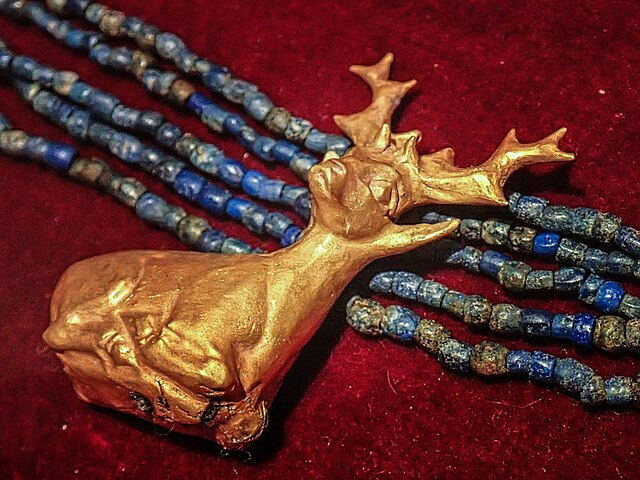
Cover Photo: Lapis lazuli necklace with gold deer pendant recovered from the royal cemetery of Ur, Source https://www.flickr.com/photos/mharrsch/32780602764/ via Wikimedia Commons, Author Mary Harrsch