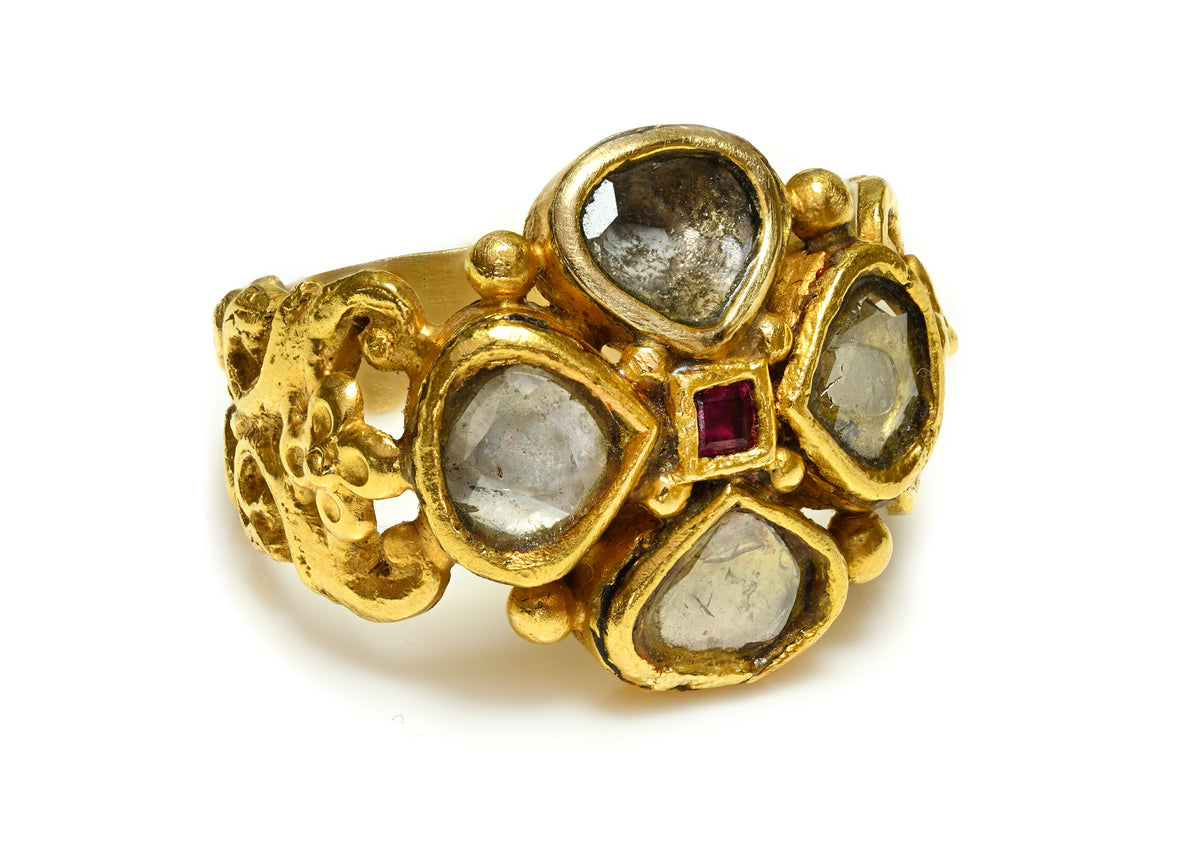
Article: How to Identify Hammerman Brothers Jewelry: Hallmarks, Signatures, Craftsmanship
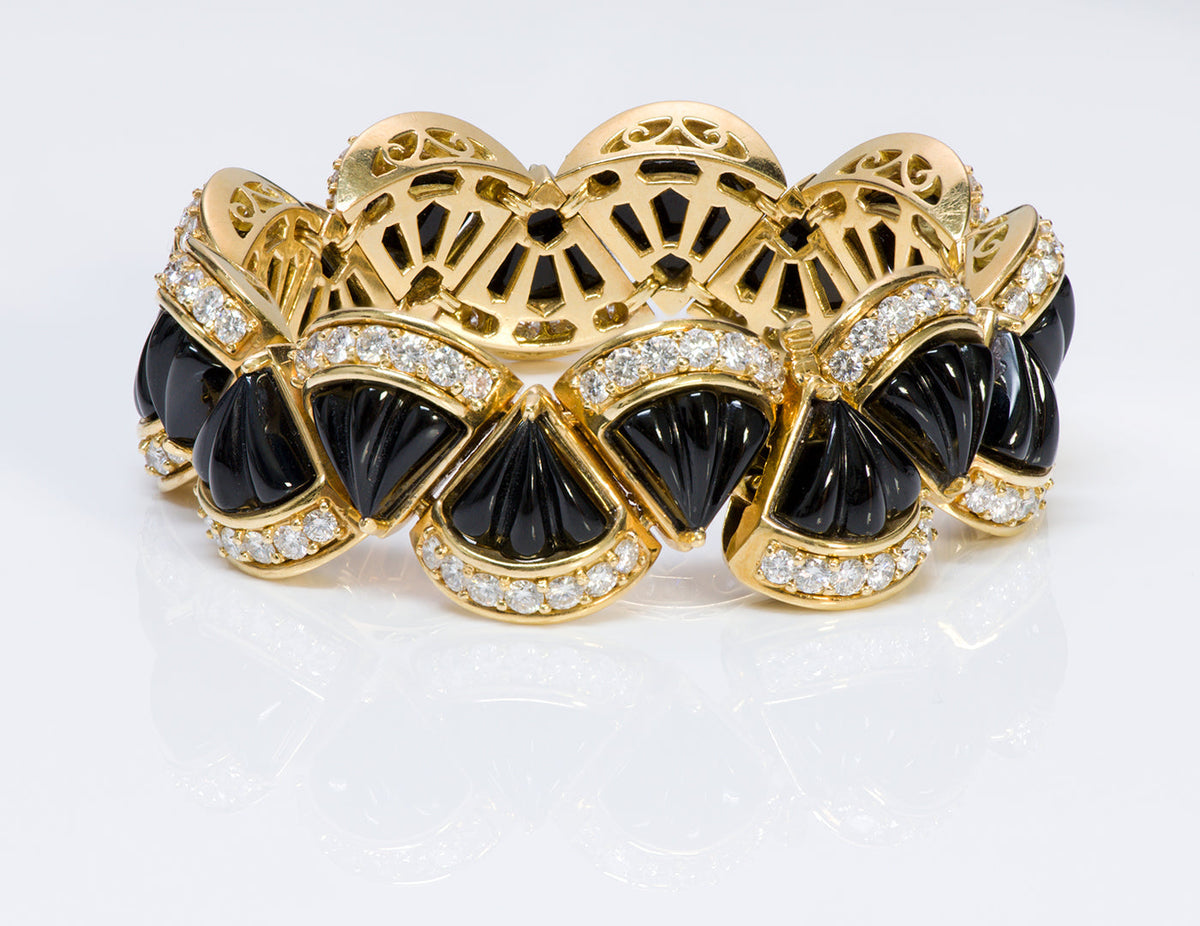
How to Identify Hammerman Brothers Jewelry: Hallmarks, Signatures, Craftsmanship
Hammerman Brothers occupies a distinctive place in the history of American fine jewelry. Founded in New York in 1946 by brothers Benjamin, Bernard and Hyman Hammerman, the firm developed from a family background in jewelry and watchmaking into a respected manufacturer known for sophisticated goldwork, diamond-intensive designs and carefully constructed jewelry in both gold and platinum.
Unlike jewelry houses whose identity is immediately associated with one famous motif or collection, Hammerman Brothers developed a broader design vocabulary. Surviving pieces range from elegant diamond rings and flexible necklaces to substantial gold bracelets, colorful gemstone jewels, floral forms and highly engineered pieces with complex articulation. As a result, identifying Hammerman Brothers jewelry usually requires more than recognizing a particular visual style.
The maker’s mark is an important starting point, but it should never be considered in isolation. Authentic identification involves looking at the relationship between the signature, metal purity marks, construction, finishing, gemstone setting, proportions and overall quality of manufacture. Comparison with documented examples can also be particularly valuable, especially when examining an older jewel whose markings are small, worn or incomplete.
One of the most frequently encountered marks on documented Hammerman Brothers jewelry is HB, although pieces signed HAMMERMAN are also known. These marks may appear alongside indications such as 18K, 750 or platinum marks, depending on the piece and period. Because the initials HB are not unique to a single jewelry maker, however, the presence of those letters alone should not be treated as definitive proof of authorship.
That distinction is central to this guide.
Rather than attempting to identify Hammerman Brothers jewelry from a single stamp, we will examine the jewel as a whole: how it was made, how the stones were set, how the metal was finished, what markings are present and whether those details correspond with documented examples of the firm’s work.
The goal is not to create a shortcut for authentication. It is to understand the evidence that can support—or challenge—an attribution.
For collectors, dealers and anyone examining a signed or possibly signed jewel, this approach is particularly useful with Hammerman Brothers because the craftsmanship itself often tells as much of the story as the name stamped inside.


Table of Contents
- Start With the Hammerman Brothers Signature
- Examine the HB Maker’s Mark
- Check the Metal Purity Marks and Other Stamps
- Study the Construction and Quality of the Goldwork
- Examine the Diamond and Gemstone Setting
- Recognize Hammerman Brothers Design Characteristics
- How Hammerman Brothers Jewelry Changed by Period
- Hammerman Brothers Watches and Bracelet Watches
- Compare the Jewel With Documented Auction Examples
- Condition, Repairs and Alterations
- Putting Everything Together: Evaluating a Hammerman Brothers Jewel
- Frequently Asked Questions
1. Start With the Hammerman Brothers Signature
When examining a piece that may be by Hammerman Brothers, the signature is the logical place to begin. It can provide an important first indication of authorship, but—as with most signed jewelry—it should be treated as one piece of evidence rather than a complete authentication on its own.
Documented Hammerman Brothers jewelry is most commonly encountered with the initials HB. The mark appears on a wide range of pieces, including rings, bracelets, necklaces, brooches and suites of jewelry, and is frequently identified in major auction catalogues as the maker’s mark for Hammerman Brothers.
Other documented pieces are signed HAMMERMAN, rather than simply HB. This means that collectors should not expect every authentic Hammerman Brothers jewel to carry exactly the same wording or format.
When inspecting a possible signature, begin by recording precisely what is present. Look not only for the letters themselves but also for accompanying metal marks, numbers, additional stamps and the location of the signature on the jewel. On a ring, for example, the mark may appear inside the shank. On a bracelet or necklace it may be found near the clasp, on a tongue mechanism, inside a fastening component or on another discreet part of the construction.
What Does the HB Mark Mean?
On documented Hammerman Brothers jewelry, HB is a well-established maker’s mark for the firm. However, the initials should not be interpreted in isolation. Other jewelry makers have also used similar initials, and maker’s-mark references document a similarly styled HB mark associated with Heintz Brothers. For that reason, an HB stamp becomes significantly more meaningful when the metal marks, construction, workmanship and overall character of the jewel are also consistent with documented Hammerman Brothers production.
That means examining the quality of the metalwork, the type of setting, the construction of the clasp or mechanism, the materials used and the overall standard of finishing.
A poorly made piece should not suddenly be accepted as Hammerman Brothers simply because HB appears somewhere on it.
The signature and the object should make sense together.
HAMMERMAN Versus HB
Collectors may encounter both HB and HAMMERMAN on documented jewelry.
This is useful because it prevents one of the most common mistakes in jewelry identification: assuming that there must be a single “correct” signature for every period and every type of object.
Jewelry houses can use different marks over time, and markings can also vary according to the type of jewel, its size, its construction and the available surface on which the maker could stamp a signature.
A broad bracelet, for instance, offers considerably more room for marking than a narrow ring or a small articulated component.
For this reason, the absence of the full word HAMMERMAN should not immediately raise concern when an HB maker’s mark is present and the jewel otherwise corresponds with documented examples.
Conversely, the presence of a full HAMMERMAN signature deserves the same careful examination as an HB stamp. The lettering, placement, accompanying purity marks and quality of the jewel should all be considered.
Examine the Signature Under Magnification
A jeweler’s loupe can reveal details that are difficult to see with the naked eye.
The first question is whether the signature appears to belong naturally to the jewel.
Look at the depth and consistency of the letters. Consider whether the stamp appears to have aged in the same way as the surrounding metal. A mark that looks unusually sharp and fresh on a heavily worn vintage jewel deserves closer examination, although this alone does not prove that anything is wrong.
The surface surrounding the mark can also be informative. Polishing, resizing or repair may partially soften or distort an original signature. Rings are particularly susceptible to this because marks positioned inside the shank can be affected when the piece is resized.
A weak signature therefore does not necessarily mean that a jewel is incorrect.
At the same time, an unusually crude, uneven or awkwardly positioned mark should encourage further investigation.
Look at All the Marks Together
The Hammerman signature should never be studied separately from the other stamps on the piece.
Documented Hammerman Brothers jewelry can carry marks indicating 18K gold, 750 fineness or platinum, sometimes together with additional numbers or manufacturing information.
These combinations can be more informative than the maker’s mark by itself.
For example, a jewel marked HB together with a plausible gold purity mark and exhibiting the level of construction expected from Hammerman Brothers provides a more coherent body of evidence than an isolated HB stamp on an otherwise inconsistent object.
It is therefore useful to photograph all markings before attempting to identify the piece. Small stamps that initially appear unimportant may become significant when compared with documented examples.
Do Not Authenticate a Jewel From the Signature Alone
Signatures are valuable, but they are also among the easiest features of a jewel to misunderstand.
A genuine signature can remain on a heavily altered piece. A jewel may have been resized, repaired, reset or converted while retaining its original maker’s mark. Conversely, a legitimate jewel may have lost part of its signature through decades of wear or alteration.
There is also the broader issue of spurious or later-added signatures.
For those reasons, identification should always move beyond the stamp.
A convincing Hammerman Brothers jewel should present a consistent picture: the signature, precious-metal marks, materials, workmanship, construction and design should support one another.
This becomes especially important with pieces carrying only the initials HB. The initials may point the investigation in the right direction, but the rest of the jewel must provide the supporting evidence.


2. Examine the HB Maker’s Mark
The HB maker’s mark is one of the most useful identifiers found on documented Hammerman Brothers jewelry. Archival and documented market records show the initials on a wide range of pieces, from diamond rings and brooches to substantial bracelets, necklaces and complete jewelry suites. Across these documented examples, HB is consistently identified as a maker’s mark for Hammerman Brothers.
The consistency with which the mark appears across different categories of jewelry makes it an important point of reference, but there is more information to be gained from an HB mark than the two initials alone. The accompanying stamps can help establish whether the markings as a group are consistent with documented Hammerman Brothers production.
HB With Gold and Platinum Marks
On many known pieces, the HB mark appears alongside a precious-metal fineness mark.
Documented combinations include HB with 750, indicating 18K gold, as well as HB with 18K. Hammerman Brothers also combined yellow gold with platinum in diamond-set jewelry, and surviving pieces may therefore carry markings for both metals. Documented examples include pieces marked HB together with 18K PLAT, as well as jewelry carrying HB with 750.
Other documented examples carry HB together with both 750 and PT950, reflecting construction that combines 18K gold and platinum. These variations demonstrate why the complete group of marks should be considered rather than expecting one universal marking format.
These combinations are particularly useful because they allow the maker’s mark to be considered within a larger manufacturing context. A jewel made primarily in yellow gold may use platinum selectively around diamond-set sections, for example, taking advantage of platinum’s strength and allowing the setting metal to visually recede around the stones.
The important point is not to expect one universal combination of stamps. Hammerman Brothers worked in different precious metals and combinations of metals, and the markings should correspond logically with the actual construction of the jewel.
The HB Mark Appears Across Very Different Designs
The presence of HB is not confined to one recognizable Hammerman Brothers style.
Documented examples include pavé-set wirework rings, textured gold brooches, floral jewelry, turquoise and diamond bracelets, articulated diamond necklaces and substantial gold-and-platinum bracelets. Signed HB examples range from bombé wirework constructions in 18K gold and platinum to sculptural gold jewels and more geometrically arranged diamond pieces.
This is important when identifying the maker because the mark is often more consistent than the design vocabulary. Hammerman Brothers produced jewelry over many decades and did not depend on one signature motif in the way certain houses are associated with an immediately recognizable collection or emblem.
An HB mark on a floral brooch, therefore, may be just as appropriate as the same mark on a modernist gold bracelet or a diamond-intensive cocktail ring.
Do Not Attempt to Date a Piece From the HB Stamp Alone
One of the easiest mistakes to make is to treat subtle differences in the appearance of an HB stamp as a reliable dating system.
That approach should be avoided unless a particular mark can be connected to securely dated documentation.
The auction records examined for this guide establish that HB was used on numerous authentic Hammerman Brothers jewels, but they do not provide a comprehensive period-by-period chronology showing that a particular shape, spacing or typography of the initials belongs exclusively to a specific decade.
In other words, a slightly different-looking HB stamp should not automatically be described as an “early mark” or “later mark” without additional evidence.
Dating should instead draw on the complete object: design, construction, metalwork, gemstone cuts, setting techniques, provenance and comparison with securely dated examples.
Study the Mark as Part of the Construction
The physical way in which a mark appears can also offer useful clues.
Under magnification, examine whether the HB stamp sits naturally within the surrounding surface and whether its degree of wear is broadly consistent with the rest of the jewel. Vintage jewelry may have been polished repeatedly, and an authentic mark can consequently become shallow or partially softened over time. Repairs and alterations can also affect markings.
For this reason, a faint HB mark is not automatically problematic, just as an unusually clear mark is not automatically proof of authenticity.
What matters is consistency.
A well-worn jewel with a perfectly crisp stamp deserves closer inspection, but there may be legitimate explanations—for example, the marked area may have received less contact or polishing than the exterior surfaces. Conversely, an old piece can retain extremely clear original marks if it was rarely worn.
Magnification should therefore be used to gather information rather than to reach a conclusion from the stamp alone.
Foreign Assay Marks Can Appear on Hammerman Brothers Jewelry
Collectors should also be aware that an American-made Hammerman Brothers jewel can carry additional marks applied outside the United States.
Documented Hammerman Brothers jewelry includes pieces bearing French assay and maker’s marks in addition to the HB signature, including examples constructed in 18K gold and platinum and set with sapphires, emeralds and diamonds.
The presence of a foreign assay mark therefore does not necessarily conflict with an American attribution. Such marks may reflect importation, sale or testing within another jurisdiction.
This can make a group of stamps initially appear more complicated than expected, particularly on jewelry that has moved between countries during its lifetime. Each mark should be identified separately before deciding whether the complete set of markings is coherent.
Pay Attention to the Entire Marking Sequence
On some pieces, the sequence in which the marks appear can be useful to record. Documented Hammerman Brothers jewelry includes examples stamped “750 / HB,” as well as pieces carrying HB in more than one location together with a 750 fineness mark.
For identification purposes, photographs of the complete marking area are considerably more useful than a transcription of “HB” alone. Record the maker’s initials, metal fineness, any numbers, assay marks and their relative placement before the jewel is polished, resized or repaired.
These details may later allow a comparison with other documented pieces of similar construction or period.
The HB maker’s mark is therefore best understood as a strong identification clue within a larger group of physical evidence. Its real value emerges when the initials, metal marks and workmanship tell the same story.

3. Check the Metal Purity Marks and Other Stamps
Once the maker’s mark has been recorded, the next step is to examine the metal marks surrounding it. On Hammerman Brothers jewelry, these stamps can provide useful information about the materials used in the piece and can sometimes help explain details of its construction.
Documented Hammerman Brothers jewelry was produced in 14K and 18K gold, platinum, and combinations of these metals. Depending on the piece and period, documented examples may therefore carry marks such as 14K, 18K, 750, PLAT or PT950.
These markings should correspond with what is physically visible in the piece. A purity stamp is most useful when it makes sense in relation to the construction rather than when it is considered as an isolated piece of text.
18K and 750 Gold Marks
Two of the most common ways of indicating 18K gold are 18K and 750.
The first expresses purity in karats. The second uses the millesimal system, in which 750 indicates that the alloy contains 750 parts gold per thousand, equivalent to 18 karats.
Both forms appear on documented Hammerman Brothers jewelry.
A 750 stamp should therefore not be interpreted as evidence that a piece is necessarily European in manufacture. American jewelry makers have also used millesimal fineness marks, particularly on fine jewelry intended for an international market or produced during periods when such notation had become increasingly common.
Likewise, the use of 18K rather than 750 should not by itself be used to assign a specific decade.
The metal mark helps identify the material. It is generally not a reliable dating system on its own.
Gold and Platinum in the Same Jewel
Hammerman Brothers frequently worked with more than one precious metal within a single object.
This is especially relevant when examining diamond jewelry.
A bracelet, brooch, necklace or ring may have a substantial 18K gold body while using platinum for selected stone-set areas. Documented pieces can therefore carry markings for both gold and platinum, including combinations such as 18K PLAT or separate 750 and PT950 stamps.
This type of construction has practical as well as aesthetic advantages. Platinum is strong and can be used effectively for fine prongs and settings around diamonds, while its pale color can visually disappear around white stones. Yellow gold, by contrast, can provide structure, warmth and sculptural presence elsewhere in the jewel.
When both metals are marked, inspect the piece to determine whether the construction supports the stamps. A platinum designation on a jewel that appears entirely yellow gold, for example, may simply indicate that small diamond-setting components are made in platinum rather than that the entire jewel is platinum.
The marks and the physical construction should agree.
Do Not Confuse Metal Marks With Maker’s Marks
Small stamps inside fine jewelry are easy to misread, particularly when they have been softened by wear or polishing.
A 750 stamp can become difficult to distinguish when one numeral is faint. The letters in PLAT can partially disappear. Even an HB maker’s mark may look different when viewed at an angle or through accumulated surface wear.
For this reason, identifying each stamp separately is preferable to trying to interpret an entire group of marks at once.
A useful examination sequence is:
- identify the maker’s mark;
- identify the metal fineness mark;
- note any additional letters or numbers;
- look for assay or import marks;
- compare those findings with the physical construction of the jewel.
This approach reduces the risk of assigning meaning to a stamp simply because it appears next to the Hammerman mark.
Serial Numbers and Additional Numbers
Numbers occasionally appear on signed jewelry, but collectors should be cautious about assuming that every number is a serial number.
Depending on the piece, a number may relate to internal production, inventory, design references, assembly, stone matching, repairs or later ownership records. Without documentation connecting a particular numbering system to Hammerman Brothers, an isolated number should not be presented as a reliable method for dating or authenticating the jewel.
This is an important distinction because collectors are often accustomed to houses where reference numbers or serial numbers have well-established chronological significance.
Hammerman Brothers does not currently have a widely published serial-number chronology that allows an unknown piece to be dated simply by consulting a number stamped inside it.
If an additional number is present, record it carefully, but avoid assigning it a function until supporting evidence is available.
Assay and Import Marks
Because fine jewelry can move internationally during its lifetime, a Hammerman Brothers piece may acquire additional marks outside the United States.
Foreign assay marks can indicate that a jewel was tested, imported or offered for sale in another jurisdiction. Such stamps do not necessarily identify where the jewel was originally manufactured.
This is particularly important when examining estate jewelry. A piece made in New York may have spent decades in Europe and subsequently carry marks that reflect its later history rather than its place of manufacture.
French assay marks, for example, can appear on documented Hammerman Brothers jewelry. Their presence should therefore be analyzed alongside the HB signature and original metal marks rather than treated as evidence against an American origin.
The same principle applies to later import stamps or control marks from other countries.
Look for Marks on More Than One Component
Complex jewelry can contain several separately manufactured elements.
A necklace may have marks on the clasp rather than on the principal decorative section. A bracelet may carry a stamp on the tongue of the clasp, inside a hinged section or on an inconspicuous link. A convertible jewel may contain marks on more than one detachable component.
When examining a piece, do not stop after finding the first signature.
Check all appropriate surfaces.
Multiple components carrying consistent marks can strengthen the understanding of how the jewel was originally manufactured. Conversely, differences between sections may indicate that a clasp was replaced, an element was added later or the piece underwent some other alteration.
This becomes particularly relevant with estate jewelry, where decades of repairs can create combinations of original and replacement parts.
Metal Marks Can Be Lost Through Alteration
The absence of a purity mark should be interpreted with the same caution as the absence of a maker’s signature.
Rings are routinely resized, and the section removed or replaced may have contained original stamps. Clasps can be replaced. Bracelet links may be shortened. Heavily worn jewelry may be polished repeatedly, gradually weakening shallow marks.
A missing stamp therefore does not automatically exclude Hammerman Brothers attribution.
However, an unsigned or incompletely marked piece requires stronger support from other evidence. Construction, documented provenance, design characteristics and comparison with known examples become increasingly important when the original markings are absent.
The Marks Should Form a Coherent Record
The most useful way to read a group of stamps is to treat them as a small manufacturing record.
An HB maker’s mark identifies the possible maker. An 18K or 750 stamp describes the gold content. A platinum mark can explain a second metal used around diamond-set areas. An assay or import mark may record testing, importation or sale in another jurisdiction.
When these elements correspond with the materials and construction in front of you, they strengthen one another.
When they conflict, the discrepancy deserves investigation.
For Hammerman Brothers jewelry, the question is therefore not simply whether the expected marks are present. It is whether the marks, materials and construction form a consistent and believable whole.

4. Study the Construction and Quality of the Goldwork
The period framework below is intended as stylistic context rather than a definitive factory chronology, as individual Hammerman Brothers designs and manufacturing approaches can overlap across decades.
With Hammerman Brothers jewelry, construction can be as informative as the signature. The firm developed its reputation as a manufacturer rather than simply a retailer, and many documented pieces reveal a strong emphasis on substantial precious-metal work, carefully engineered movement and finely finished components.
This does not mean that every Hammerman Brothers jewel is heavy or visually bold. The company produced a wide range of designs over many decades. What tends to remain consistent is the expectation that the structure of the piece should feel deliberate: links should articulate smoothly, clasps should function cleanly, settings should be integrated into the design and surfaces that are not intended to be visible should still show careful finishing.
When examining a possible Hammerman Brothers jewel, it is therefore worth looking beyond the front.
Examine the Back of the Jewel
The reverse of a piece can reveal considerably more about its manufacture than the decorative surface.
On a well-made brooch, bracelet or necklace, the back should not look like an unfinished version of the front. Openings beneath gemstones should generally appear purposeful, structural components should be neatly integrated and soldering should be controlled rather than excessive or irregular.
A substantial jewel may contain numerous separate elements, yet those components should form a coherent structure once assembled.
This is particularly useful when examining elaborate diamond or gemstone jewelry. From the front, a dense arrangement of stones can conceal much of the metalwork. Turning the jewel over exposes the architecture supporting those stones and can reveal how carefully the piece was engineered.
Uneven construction on the reverse does not automatically prove that a piece is incorrect—repairs can substantially alter an older jewel—but it should prompt a closer examination.
Substantial Gold Does Not Mean Excessive Bulk
Hammerman Brothers is particularly associated with confidently handled 18K gold.
In many documented pieces, the gold is not merely a framework for gemstones. It is an important visual element in its own right. Broad polished surfaces, textured sections, rounded links, wirework and sculptural forms can all become central to the design.
The challenge for a skilled manufacturer is to create this sense of substance without making the piece unnecessarily cumbersome.
A large bracelet, for example, may appear massive but still need to move comfortably around the wrist. A broad ring must feel secure without becoming awkward between the fingers. A flexible necklace requires enough strength to support gemstones while still following the contour of the neck.
This relationship between visual weight and functional wearability is worth studying closely.
An object that looks impressive from a distance but feels poorly balanced when worn may deserve further investigation.
Look Closely at Articulation
Flexible and articulated construction appears in a number of documented Hammerman Brothers designs.
On these pieces, movement should be considered part of the craftsmanship rather than an incidental feature.
Links should generally move consistently without obvious binding. Sections designed to lie flat should do so naturally. A flexible necklace should curve without producing abrupt or unnatural angles, while a bracelet should articulate sufficiently to follow the wrist.
Complex diamond-set pieces present an additional challenge because articulation must be engineered without exposing unsightly gaps when the jewel bends.
The best construction allows the wearer to experience the movement without constantly noticing the mechanism responsible for it.
When inspecting an articulated jewel, gently observe whether individual sections move in a similar manner. One unusually stiff link may simply indicate dirt, wear or an old repair, but significant inconsistencies can reveal replaced components or later intervention.
Clasps Should Be Considered Part of the Design
A clasp can provide valuable information about the quality and history of a jewel.
On substantial fine jewelry, the fastening mechanism must be strong enough to secure the weight of the piece while remaining reasonably discreet. Box clasps, tongue-and-groove systems, hinged mechanisms and additional safety devices may all be encountered depending on the form of the jewel.
Rather than judging the clasp solely by its type, examine how it has been incorporated into the piece.
Does the bracelet maintain its visual rhythm when closed? Does the clasp interrupt the design unnecessarily? Are safety mechanisms integrated cleanly? Does the closure feel appropriately engineered for the weight it is supporting?
A clasp that appears significantly lighter, newer or stylistically unrelated to the rest of the jewel may be a replacement.
That does not necessarily diminish the quality of the original manufacture, but it is important when evaluating condition and originality.
Examine Soldering and Joinery
Solder joints often reveal the difference between original construction and later repair.
On finely manufactured jewelry, original joins tend to be controlled and integrated into the overall structure. Heavy solder accumulation, irregular seams or visibly mismatched metal can indicate later intervention.
This is particularly important with estate jewelry that may have been repaired repeatedly during decades of wear.
A bracelet may have received reinforcement at a weak link. A brooch fitting may have been replaced. A necklace may have been shortened and reassembled. A ring may have been resized several times.
None of these circumstances automatically eliminates Hammerman Brothers authorship, but they can complicate the physical evidence.
When possible, distinguish between the quality of the original manufacture and the quality of subsequent work.
Surface Finishing Can Reveal Intent
Hammerman Brothers used polished, textured and contrasting metal surfaces across different designs, and the finish should be considered part of the original aesthetic.
On a polished gold jewel, the surface should flow naturally with the form. On textured pieces, the pattern should appear intentional rather than the accidental result of scratches or wear.
Mixed finishes can be especially revealing. A jewel may combine highly polished gold with textured sections or use platinum around diamonds to create visual separation from yellow gold.
Over-polishing can significantly change these effects.
Edges may become softer, texture may lose definition and engraved details or marks may become faint. For this reason, a vintage jewel that appears exceptionally bright and smooth should not automatically be considered to be in better condition than one retaining some appropriate surface wear.
Preservation of the original form can be more important than achieving a completely flawless surface.
Study the Interior as Carefully as the Exterior
Rings and bracelets often reveal particularly useful construction details on their interior surfaces.
Inside a ring, examine the transition between the shank and the stone-set upper section. On a well-integrated design, the architecture should appear intentional rather than as though a decorative top has simply been attached to a generic band.
On bracelets, inspect the inner links, hinges and connecting elements. These areas often retain more evidence of the original manufacture because they are less exposed to polishing than exterior surfaces.
They may also preserve maker’s marks more clearly.
Interior surfaces can reveal old solder, alterations, replacement components or wear patterns that are not visible when the jewel is being worn.
Symmetry Should Be Evaluated With Care
Symmetrical jewelry should normally display a high degree of consistency in construction, but not every Hammerman Brothers design is intended to be perfectly symmetrical.
Organic, floral and sculptural designs may deliberately vary in shape or stone placement.
The important distinction is between intentional asymmetry and inconsistent manufacture.
In a deliberately asymmetric brooch, for example, the composition may differ from side to side while the quality of the setting and finishing remains equally controlled throughout. In a geometric bracelet, however, irregular spacing or poorly aligned repeated components would be more difficult to explain as part of the design.
Understanding the intended visual language of the object is therefore essential before using symmetry as an identification criterion.
Manufacturing Quality Should Support the Attribution
A Hammerman Brothers signature should raise expectations about the rest of the jewel.
The piece should not need to be perfect after decades of wear, but its original construction should demonstrate the level of skill expected from a fine New York jewelry manufacturer.
Look for coherence rather than one supposedly definitive feature. The metalwork, articulation, clasp, gemstone settings and finishing should appear to belong to the same standard of manufacture.
When several of these elements are convincingly present alongside appropriate signatures and metal marks, the attribution becomes considerably stronger.
Conversely, when the workmanship appears fundamentally inconsistent with documented Hammerman Brothers jewelry, the presence of a maker’s mark deserves closer scrutiny rather than automatic acceptance.

5. Examine the Diamond and Gemstone Setting
Gemstone setting is another area where Hammerman Brothers jewelry can reveal the quality of its manufacture. The firm produced a considerable amount of diamond jewelry, often combining diamonds with 18K gold, platinum or colored gemstones, and the settings were designed to work as part of the overall structure rather than as separate decorative elements added to the surface.
There is no single setting technique that identifies Hammerman Brothers. Documented pieces include pavé-set surfaces, channel-set and individually prong-set stones, diamond accents incorporated into sculptural gold forms, and more elaborate compositions combining diamonds with sapphires, emeralds, turquoise and other colored stones.
The useful question is therefore not simply which setting technique was used, but how well it has been executed and how naturally it relates to the rest of the design.
Look at the Relationship Between Stones and Metal
In strong Hammerman Brothers designs, gemstones and metal tend to be conceived together.
A diamond-set section should not look like an unrelated component attached to a gold framework. The transition between polished or textured metal and the stone-set area should normally feel intentional, with the proportions of the setting responding to the shape of the jewel.
This is particularly noticeable in pieces that combine yellow gold and platinum. Platinum may form the immediate setting around diamonds while yellow gold provides the larger structural or decorative element. When carefully executed, the contrast allows the diamonds to appear bright and uninterrupted while the warmer gold remains visually distinct.
The setting should therefore be evaluated within the architecture of the jewel rather than in isolation.
Pavé Setting
Pavé diamonds appear frequently in fine Hammerman Brothers jewelry, including rings and sculptural forms in which diamond-covered sections contrast with polished or textured gold.
A successful pavé surface should appear even and controlled. The diamonds should follow the contour of the jewel rather than creating an irregular layer on top of it, and the surrounding metal should be sufficiently restrained that the stones dominate visually without compromising security.
Look closely at the spacing between stones.
Slight variations can be normal, particularly on curved surfaces or older hand-finished jewelry, but conspicuous gaps, inconsistent angles or noticeably uneven levels may indicate repairs or later replacement stones.
The pavé should also follow the shape of the piece naturally. On a domed ring, for example, the setting must accommodate changing angles while maintaining a coherent surface. This requires considerably more skill than setting stones into a flat plane.
Prong-Set Diamonds and Colored Stones
Larger diamonds and colored gemstones may be held individually by prongs rather than incorporated into pavé.
Examine whether the prongs are proportionate to the stones and reasonably consistent with one another. They should hold the stones securely without unnecessarily obscuring them.
On older jewelry, prongs can become worn or may have been retipped. A newly rebuilt prong can therefore look different from its neighbors without indicating that the entire piece is incorrect.
The important question is whether the underlying setting appears coherent.
When several gemstones are arranged in a repeated pattern, compare the height, spacing and orientation of the settings. Carefully manufactured jewelry generally maintains a strong visual rhythm, even when natural gemstones themselves vary slightly.
Examine Stone Matching, But Do Not Expect Mechanical Uniformity
Hammerman Brothers jewelry can contain closely matched groups of diamonds or colored gemstones, particularly in bracelets, necklaces and suites.
Matching may involve several characteristics: apparent color, size, shape, proportions and visual intensity.
Diamonds used together in a continuous design should generally create a balanced appearance. One stone that is substantially darker, shallower or visibly different from its neighbors may be a later replacement.
The same principle applies to colored stones, although greater variation can be intentional.
Natural sapphires, emeralds and turquoise may show differences in tone, saturation, inclusions or texture. Older fine jewelry should not necessarily be expected to display the absolute uniformity associated with modern calibrated production.
The objective is visual harmony, not artificial sameness.
A sophisticated arrangement may even use slight variations deliberately to create depth or movement within the composition.
Stone Cuts Can Help With Period Context
The cuts used in a jewel can provide clues about its likely period, although they should not be used as a precise dating method by themselves.
Hammerman Brothers was founded in 1946 and worked through successive changes in jewelry fashion and gemstone cutting. Consequently, documented pieces can incorporate different forms of round, baguette, marquise, pear-shaped and other fancy-cut diamonds, depending on the design and period.
A jewel combining several diamond shapes may use those cuts architecturally. Baguettes, for example, can create lines or transitions within a geometric design, while round diamonds can provide continuous brilliance across curved surfaces.
When examining an older piece, consider whether the gemstone cuts are plausible for the proposed period and whether they appear original to the design.
A single later replacement stone does not necessarily alter the attribution of an entire jewel, but substantial changes to the gemstones can affect both historical integrity and value.
Colored Gemstones Are an Important Part of the Hammerman Vocabulary
Although Hammerman Brothers is strongly associated with diamond jewelry, its work should not be reduced to diamonds alone.
Documented pieces incorporate sapphires, emeralds, rubies, turquoise and other colored materials, often using color against substantial gold or in combination with diamonds.
In some designs, the colored gemstone is the focal point and diamonds provide emphasis. In others, colored stones are repeated throughout a bracelet, necklace or brooch to become part of the overall pattern.
This breadth is important when attempting identification. A colorful jewel should not be dismissed simply because it does not resemble a more familiar diamond-intensive Hammerman piece.
The firm’s output was varied, and the setting should be evaluated according to the specific design rather than against one generalized idea of what Hammerman Brothers jewelry is supposed to look like.
Consider the Setting From the Reverse
The back of a stone-set jewel can be particularly revealing.
Open-backed settings may allow light into the gemstones and provide access for cleaning, but the exact construction will vary according to the piece. Examine whether openings are evenly shaped and whether the framework supporting the stones appears purposeful.
The reverse can also expose later work.
A replacement stone may have required alterations to its original seat. A damaged setting may have been reinforced with additional solder. A formerly open area may have been modified during repair.
These changes are sometimes almost invisible from the front.
For this reason, a complete examination should include both sides of the stone-set areas whenever the construction allows it.
Check for Replaced or Reset Stones
Vintage jewelry often has a long maintenance history.
Stones can be lost and replaced. Prongs wear down. A chipped gemstone may be exchanged for another. Occasionally, a particularly valuable center stone may be removed and replaced before a jewel enters the secondary market.
Replacement stones do not automatically make a Hammerman Brothers piece inauthentic, but they matter when assessing originality.
Possible clues include differences in cut, fluorescence, apparent color, girdle thickness or setting style compared with neighboring stones. Under magnification, alterations to the surrounding metal may also become visible.
If a piece contains an important central diamond or colored gemstone, a professional gemological examination may be appropriate to determine whether the stone itself corresponds with the description or provenance attached to the jewel.
Be Careful With Assumptions About Diamond Quality
The quality of the setting can often be assessed visually. Exact diamond grades cannot.
Statements about color, clarity, treatment or geographic origin should not be inferred simply because the jewel is signed Hammerman Brothers.
A fine maker may have selected high-quality stones, but that does not justify assigning an unsupported grade such as F color or VS clarity to an untested jewel.
The same caution is even more important with colored gemstones. Sapphire origin, emerald treatment or ruby heat treatment cannot be reliably determined from the maker’s signature or visual appearance alone.
When those details materially affect the value of a jewel, they should be supported by an appropriate gemological laboratory report.
The maker and the gemstones are related parts of the object, but they represent different questions of identification.
Setting Quality Should Be Consistent With the Rest of the Jewel
Ultimately, gemstone setting should reinforce the conclusions drawn from the metalwork and construction.
A substantial Hammerman Brothers jewel with sophisticated goldwork but noticeably crude original stone setting would present an inconsistency requiring further investigation. Conversely, finely controlled setting, carefully integrated into well-executed metalwork and accompanied by appropriate marks, creates a much more persuasive overall picture.
The strongest identifications rarely depend on one spectacular detail. They emerge from consistency.
In Hammerman Brothers jewelry, the diamonds and gemstones should appear not simply to have been placed into the jewel, but to have been considered as part of its structure from the beginning.

6. Recognize Hammerman Brothers Design Characteristics
Hammerman Brothers does not have one universally recognizable motif that can be used as a shortcut for identification. Unlike houses whose names are closely associated with a particular emblem or collection, Hammerman Brothers developed a broad design vocabulary over decades of production.
That variety is part of what makes the jewelry interesting—and also why identification requires care.
Documented pieces range from restrained diamond rings to substantial sculptural bracelets, flexible necklaces, floral jewels, richly colored gemstone designs and intricate gold constructions. Certain tendencies recur, however, and learning to recognize them can help place an unsigned or partially marked jewel within the broader context of Hammerman Brothers production.
These characteristics should be treated as design clues, not authentication criteria. None is exclusive to Hammerman Brothers, and an attribution should never be made from style alone.
Sculptural Use of Gold
One of the most consistent qualities seen across Hammerman Brothers jewelry is the treatment of gold as an important design material in its own right.
In many pieces, gold is not merely a support for gemstones. It provides volume, rhythm and texture. Surfaces may be highly polished, patterned, braided, twisted, woven or arranged into dimensional structures that remain visually important even when diamonds are present.
This approach can be especially evident in bracelets and rings where broad areas of 18K gold create the principal form of the jewel and diamonds are used selectively to introduce light and contrast.
The result often feels substantial without being unnecessarily decorative. The architecture of the gold itself carries much of the design.
This is one reason photographs of the reverse and side profile of a Hammerman Brothers jewel can be as informative as the frontal view. The depth of a domed ring, the construction of a bracelet link or the transition between gold and platinum may reveal more about the design than the gemstones alone.
Wirework and Open Gold Construction
A particularly recognizable aspect of some Hammerman Brothers jewelry is the use of wirework or openwork gold structures.
Rather than forming a completely solid surface, gold can be arranged into repeated curved or interwoven elements that create volume while allowing openings between individual sections. Diamonds may then be incorporated into selected parts of the construction.
This technique can give a large ring or bracelet an impressive three-dimensional presence without producing the visual heaviness of a completely solid mass of gold.
Bombé forms are especially suited to this approach. A ring may rise significantly above the finger while retaining a sense of movement because the surface has been constructed from repeated strands, loops or open elements rather than one uninterrupted dome.
Not every Hammerman Brothers bombé jewel uses this technique, and wirework itself is not exclusive to the firm. What matters is the combination of controlled repetition, precise construction and integration of gemstones into the overall structure.
Bold Scale With Refined Execution
Many documented Hammerman Brothers pieces have significant visual presence.
Bracelets can be broad, rings can be strongly dimensional, and necklaces may use substantial articulated sections. Yet the scale of the jewel is often balanced by careful construction.
This distinction matters.
Large jewelry can easily become cumbersome or visually crude if proportion is not carefully controlled. In well-executed Hammerman Brothers pieces, substantial scale is frequently combined with refined finishing and thoughtful articulation.
A broad bracelet may consist of many individually engineered elements rather than one inflexible form. A large cocktail ring may use a carefully constructed gallery beneath the stones to manage both height and weight. A necklace can appear substantial while remaining sufficiently flexible to follow the neckline.
The visual impact is therefore often produced through engineering as much as through sheer quantity of metal or gemstones.
Floral and Naturalistic Designs
Hammerman Brothers also produced numerous jewels inspired by flowers, leaves and other organic forms.
These pieces can be quite different from the firm’s more geometric or architectural jewelry. Petals may be rendered in polished or textured gold, while diamonds or colored gemstones form centers, edges or accents. Brooches and earrings are particularly suited to this naturalistic vocabulary.
The strongest examples avoid appearing completely flat.
Petals may overlap, curve or project at different angles so that light moves across the surface. Diamond-set sections can contrast with plain gold, giving the design additional depth.
When evaluating a floral Hammerman Brothers jewel, examine the construction beneath the visible decoration. A convincing flower should remain carefully engineered even where the complexity of the front might conceal the supporting metalwork.
Texture as a Design Element
Surface texture is another recurring feature.
Hammerman Brothers employed different forms of textured gold to contrast with highly polished sections or diamond-set areas. Texture can soften the reflectivity of yellow gold, emphasize the shape of a sculptural element and create visual depth without requiring additional gemstones.
On vintage pieces, preserving that original finish can be particularly important.
Repeated polishing may gradually erase subtle texture, producing a smoother and brighter surface than the designer intended. This can alter the character of a jewel even if its basic form remains unchanged.
When comparing a piece with documented examples, pay attention not only to shape but to surface treatment. Two jewels with similar outlines can appear very different if one retains its original texture and the other has been heavily refinished.
Diamonds Used Architecturally
Diamonds are central to a considerable portion of Hammerman Brothers production, but they are frequently used as structural elements within the design rather than simply as isolated focal stones.
Pavé-set sections can emphasize a curve or dome. Baguette diamonds may establish linear movement. Rows of round diamonds can define the edge of a bracelet or create rhythm across an articulated necklace.
In mixed-metal pieces, diamond-set platinum may be visually integrated with yellow gold so that the white metal nearly disappears around the stones.
This can produce a characteristic tension between richly visible gold and areas that seem almost entirely composed of diamonds.
It is therefore worth considering where the diamonds are placed, not simply how many are present.
Their arrangement often tells more about the design than total carat weight.
Colored Gemstones Used With Confidence
Hammerman Brothers also worked extensively with colored gemstones.
Sapphires, emeralds, rubies and turquoise appear in documented jewelry, often combined with diamonds and substantial 18K gold. Colored stones can be used as central focal points, arranged repetitively across a bracelet or incorporated into more elaborate compositions.
These pieces demonstrate why Hammerman Brothers should not be viewed solely as a maker of white diamond jewelry.
Color could become an important part of the design vocabulary, particularly when contrasted against yellow gold.
Some pieces use highly saturated gemstones against relatively simple metal forms, allowing color to dominate. Others combine multiple materials so that the gemstones participate in a more complex pattern.
The quality of the composition remains more useful for identification than any one preferred gemstone.
Flexible and Repetitive Structures
Repeated elements appear frequently in necklaces and bracelets.
A design may be built from a sequence of similar links, diamond-set sections or sculptural gold components, creating rhythm across the entire jewel. This type of repetition presents a manufacturing challenge: each unit must relate closely to the next while allowing sufficient movement for comfortable wear.
When successfully executed, the mechanism almost disappears.
The eye sees a continuous bracelet or necklace rather than a collection of individual components.
This is another area where examining the reverse can be valuable. The hidden hinges and connecting structures often reveal the precision required to make a substantial piece move naturally.
Geometric and Architectural Forms
Not all Hammerman Brothers jewelry is organic.
The firm also produced pieces based on clear geometry, repeated shapes and architectural arrangements of diamonds and gold. Straight lines may be combined with curves, while groups of baguette, round or fancy-shaped diamonds can create structured patterns.
These designs can look very different from floral brooches or textured gold bracelets, yet they often share the same emphasis on strong construction and carefully controlled proportions.
This breadth makes it difficult—and potentially misleading—to describe Hammerman Brothers with a single stylistic label such as “modernist” or “naturalistic.”
The company worked across several visual languages.
Classic Forms Were Often Given a Distinctive Treatment
Hammerman Brothers also produced recognizable jewelry categories such as diamond eternity-style bracelets, cluster rings, hoop earrings and gemstone necklaces.
The presence of a familiar form does not make the jewelry generic.
Differences often lie in proportion, metal construction, articulation or the way gemstones are arranged. A conventional bracelet format, for example, may become much more distinctive through unusual links or through alternating polished gold and diamond-set sections.
This is useful when examining pieces that do not immediately appear “signature.”
Not every important maker produces only instantly identifiable statement designs. Some of the most revealing evidence may be found in how a familiar type of jewel has been executed.
Avoid Creating a False “Hammerman Look”
Because recurring characteristics exist, it is tempting to build a checklist and conclude that any jewel combining textured 18K gold, diamonds and substantial construction must be Hammerman Brothers.
That would be a mistake.
Similar approaches were used by numerous American and European fine-jewelry manufacturers during the second half of the 20th century. Broad gold bracelets, pavé bombé rings, floral brooches and colored-stone designs all belong to a wider history of postwar jewelry.
The objective is therefore not to identify one visual formula.
A more reliable question is whether the design language, manufacturing quality, materials and markings are collectively consistent with documented Hammerman Brothers work.
This distinction becomes particularly important with unsigned jewelry described in the market as “in the style of Hammerman Brothers” or “attributed to Hammerman Brothers.” Those phrases are not equivalent to a signed or securely documented attribution.
Style can suggest where to investigate. It cannot replace evidence.

7. How Hammerman Brothers Jewelry Changed by Period
Hammerman Brothers was founded in New York in 1946, and its jewelry reflects several decades of changing taste in American fine jewelry. Because the firm remained active across different stylistic eras, its work cannot be reduced to one period look.
This is useful for identification, but it also requires caution. A Hammerman Brothers jewel should not be dated solely because it appears “1950s,” “1970s” or “1980s.” Designs can overlap stylistically, older ideas may be revisited, and individual jewels can be difficult to place precisely without documentation.
Period analysis is most effective when style is considered alongside the maker’s marks, metalwork, gemstone cuts, construction and provenance. The period framework below is intended as stylistic context rather than a definitive factory chronology, as individual Hammerman Brothers designs and manufacturing approaches can overlap across decades.
Late 1940s and 1950s: Postwar Fine Jewelry
Hammerman Brothers began production in the immediate postwar period, when American fine jewelry was still strongly influenced by platinum, diamonds and carefully structured formal design.
Jewelry from this broader period often favors refined proportions, precise stone setting and a more restrained relationship between metal and gemstones than would become common in later decades.
For Hammerman Brothers, this early phase established the manufacturing standards that would remain important throughout the company’s history. The emphasis was on workmanship: secure settings, well-engineered construction and precious-metal fabrication executed to a high level.
Diamonds were particularly important, but the firm was not limited to traditional solitaire-based jewelry. Even relatively classic forms could show thoughtful construction and sophisticated handling of the metal.
When examining a jewel believed to date from these earlier decades, pay attention to the overall proportion of the piece and the relationship between its diamonds and structural metalwork. A more restrained appearance should not be mistaken for simpler manufacture.
The 1960s: Gold Becomes Increasingly Important
By the 1960s, fine jewelry internationally was becoming more experimental in its use of gold.
Yellow gold gained increasing visual importance, and jewelry became larger, more textured and more sculptural. Hammerman Brothers participated in this broader shift while continuing to produce diamond-intensive pieces.
This period is particularly relevant when examining substantial rings, bracelets and brooches in which the gold itself becomes a prominent design element.
Instead of functioning only as a setting material, 18K gold might form broad polished surfaces, repeated links, wirework or dimensional structures. Diamonds could then be integrated into selected areas rather than covering the entire jewel.
The combination of rich yellow gold with white diamonds became an effective visual contrast and would remain an important component of Hammerman Brothers jewelry in later decades.
Colored gemstones also offered designers another way to introduce contrast against gold.
However, not every jewel with substantial yellow gold should automatically be assigned to the 1960s. This aesthetic continued well beyond the decade.
The 1970s: Scale, Texture and Sculptural Construction
The 1970s brought a particularly strong appetite for jewelry with physical presence.
Across the fine-jewelry world, designs became more dimensional, textured and wearable with the decade’s increasingly expressive fashion. Hammerman Brothers jewelry from this broader stylistic environment can include substantial gold forms, flexible bracelets and necklaces, pronounced textures, wirework and combinations of diamonds with richly visible yellow gold.
This is one of the periods most likely to produce the type of jewel collectors may immediately recognize as “bold” Hammerman Brothers.
Yet the strength of the better designs lies in the way that scale is controlled.
A broad bracelet still needs to articulate properly. A large ring must remain wearable. A three-dimensional brooch requires sufficient internal structure to support its form without appearing unnecessarily heavy.
The engineering behind such pieces is therefore just as significant as their visual scale.
When examining jewelry attributed to this decade, surface texture can also become particularly informative. Original finishing may include deliberate contrast between polished areas, textured gold and diamond-set sections. Excessive later polishing can significantly reduce that distinction and make an older jewel appear flatter or less defined than it originally was.
The 1980s: High Impact and Greater Visual Contrast
The appetite for substantial jewelry continued into the 1980s, often with even greater emphasis on strong silhouettes and visual impact.
Hammerman Brothers pieces associated with this general period can combine large areas of yellow gold with pavé diamonds, colored stones or platinum-set details. Earrings, bracelets and rings could become particularly assertive in scale, reflecting a wider taste for jewelry that was intended to be noticed.
Colored gemstones can play an especially strong role in pieces from this stylistic environment.
Sapphires, emeralds, rubies and turquoise may appear against yellow gold, sometimes accompanied by diamonds that heighten the contrast rather than dominate the entire composition.
This period also illustrates why total carat weight alone is an incomplete way of understanding Hammerman Brothers jewelry. In many designs, the metal architecture and arrangement of the stones are as important as the stones themselves.
A relatively modest quantity of diamonds can have considerable visual impact when used strategically across a large sculptural surface.
The 1990s and Later: Refinement Rather Than a Complete Break With the Past
By the 1990s, fine jewelry tastes were broad enough to accommodate both bold statement pieces and more streamlined designs.
Hammerman Brothers continued to work within a vocabulary that had developed over previous decades: high-quality goldwork, diamonds, colored gemstones and careful manufacturing remained central.
Rather than expecting a dramatic stylistic break, it is often more useful to look for changes in proportion, finish and gemstone arrangement.
Some later pieces may appear cleaner or more polished in their geometry, while others continue traditions established decades earlier. Classic floral motifs, flexible diamond jewelry and substantial gold designs did not simply disappear when a new decade began.
This continuity is another reason stylistic dating must remain approximate unless additional evidence exists.
Certain Designs Cross Decades
One of the most important lessons in dating Hammerman Brothers jewelry is that stylistic categories overlap.
A floral brooch could have been made in more than one decade. A bombé diamond ring can belong to several different periods depending on its construction and proportions. Textured gold remained fashionable long enough that texture alone is a poor chronological marker.
Even gemstone cuts require context.
Baguette diamonds, round brilliants and various fancy shapes remained in use for extended periods. Their presence can support a proposed date, but rarely establishes one by itself.
A useful period assessment therefore asks several questions simultaneously:
- Is the form consistent with the proposed era?
- Are the gemstone cuts plausible for that period?
- Does the construction correspond with documented pieces?
- Do the maker’s and metal marks fit the attribution?
- Does the condition suggest alterations that may have changed the original appearance?
The more of these elements agree, the more credible the dating becomes.
Fashion Can Help, but Should Not Control the Attribution
Jewelry does not evolve independently from fashion.
The restrained elegance of the postwar years, the increasing importance of sculptural gold during the 1960s, the large-scale jewelry of the 1970s and the confident statement pieces of the 1980s all provide useful context for understanding Hammerman Brothers designs.
But fashion history should be used as context rather than proof.
A jewel that looks strongly 1970s may have been made somewhat earlier or later. A conservative design may have remained in production long after its basic style first became fashionable.
This distinction is especially important with a manufacturer that operated continuously rather than producing only a small number of clearly defined seasonal collections.
Use Securely Dated Examples as Reference Points
For period identification, securely documented examples are considerably more useful than general stylistic impressions.
Auction catalogues, archival photographs, dated advertisements, original receipts and documented provenance can provide reference points for comparing construction and design.
When examining an unknown jewel, comparison is most valuable when the reference piece shares more than a broad visual resemblance. Look for similarities in the underlying construction, type of articulation, treatment of metal, gemstone arrangement and markings.
A superficial resemblance between two large gold bracelets is relatively weak evidence.
A close match in link construction, clasp design, setting method and signature configuration is considerably more meaningful.
Dating Hammerman Brothers Jewelry Is Usually a Process of Convergence
The safest approach is to think in terms of a probable period rather than an exact year unless documentation supports greater precision.
A jewel may reasonably be described as circa 1960s or circa 1970s when multiple characteristics point toward that period. Assigning a specific year purely from appearance would usually go beyond what the physical evidence can support.
Hammerman Brothers jewelry changed with fashion, but the company also retained important elements of its identity across generations: substantial precious-metal construction, sophisticated manufacturing and a willingness to combine strong design with diamonds and colored gemstones.
Understanding both the changes and the continuity makes period attribution far more reliable than simply matching a jewel to the visual stereotypes of a particular decade.

8. Hammerman Brothers Watches and Bracelet Watches
Watches occupy an unusually important place in the history of Hammerman Brothers. The company was not simply a jeweler that occasionally incorporated a timepiece into a bracelet; jeweled watches were part of its development during the postwar decades and provide an especially revealing example of the firm’s ability to combine mechanical objects with fine-jewelry construction.
This distinction is important when identifying a Hammerman Brothers watch. In some examples, the principal artistic contribution is the jeweled bracelet or case rather than the watch movement itself. A timepiece may therefore contain components made by different specialists, and an HB mark on a bracelet does not necessarily mean that Hammerman Brothers manufactured the movement inside the watch.
The jewelry and the horology need to be examined separately before the object is understood as a whole.
The 1950s Bracelet Watch
According to the company’s historical record, one of Hammerman Brothers’ important developments during the 1950s was a patented design by Benjamin Hammerman that incorporated a ladies’ watch into a fine bracelet.
The concept addressed a practical problem in an elegant way. A wristwatch was useful, but a conventional watch could appear too utilitarian for evening dress. By integrating the timepiece into a substantial piece of fine jewelry, the watch could function visually as a bracelet while retaining its practical purpose.
Hammerman Brothers describes the design as a breakthrough in its history. During the decade that followed, the firm produced an array of platinum and diamond ladies’ bracelet watches, with designs attributed in the company history to Bernard Hammerman and executed by the firm’s craftsmen.
This period deserves particular attention because it helps explain why vintage Hammerman watches can look much more like important bracelets than conventional wristwatches.
In some jeweled watches, the dial is the visual center of the design. In the Hammerman tradition, the opposite can be true: the bracelet, diamond work and overall composition may dominate, while the watch itself is deliberately integrated into the jewelry.
When a Watch Is Designed Primarily as Jewelry
A fine bracelet watch has to solve several design problems simultaneously.
It must articulate comfortably around the wrist, support the weight of the watch case, protect the movement and allow the wearer to read the time without compromising the appearance of the bracelet. If the dial is concealed, the cover must also open reliably while remaining visually integrated when closed.
This makes bracelet watches useful objects for studying Hammerman Brothers craftsmanship.
Look at how the case connects to the bracelet. A well-designed integrated watch should not appear to be a standard watch head attached as an afterthought to an unrelated gold or platinum band. The transition should feel intentional, with the proportions of the case responding to the bracelet around it.
On diamond-intensive pieces, the arrangement of the stones may continue across the watch case so that the timepiece becomes almost invisible within the larger composition. Other designs allow the dial to remain visible but treat the surrounding case and bracelet as one continuous jewel.
The closer the integration, the more important it becomes to examine the construction rather than simply the face of the watch.
Hammerman Brothers Did Not Necessarily Make the Movement
This is one of the most important distinctions for collectors.
A watch can legitimately be associated with Hammerman Brothers even when its movement was supplied by another watchmaker. Fine jewelry houses have long combined their own cases or bracelets with movements produced by specialist manufacturers.
For identification purposes, the movement, dial, case and bracelet should therefore be considered as separate components.
The maker’s mark may appear on the bracelet, clasp, buckle or case rather than on the movement. A documented wristwatch fitted with a later Hammerman Brothers gold bracelet, for example, carries the HB mark on the bracelet even though the watch itself is by another established Swiss manufacturer.
Such an object should not be described as a complete Hammerman Brothers watch simply because its bracelet is signed HB. The accurate description would distinguish the signed Hammerman component from the separately manufactured timepiece.
This difference may appear technical, but it can have considerable importance for provenance, originality and value.
Original Integrated Watch or Later Hammerman Bracelet?
An HB-signed bracelet on a vintage watch raises several possible scenarios.
The bracelet and watch may have been conceived together as an original Hammerman Brothers jewel. Alternatively, an authentic Hammerman bracelet may have been fitted to an existing watch at a later date. A watch may also have undergone repairs or alterations that introduced replacement components while retaining much of its original Hammerman construction.
Physical examination can sometimes help distinguish these possibilities.
Look closely at the point where the bracelet meets the case. The dimensions, curvature, attachment system and finish should make structural sense together. An integrated design generally shows evidence that the bracelet and case were planned as a unit.
A later marriage may reveal adaptors, altered end links, additional solder or slight differences in color and finish.
None of these details should be interpreted mechanically. A professionally executed period alteration may be extremely difficult to identify, while an original jewel may have undergone legitimate repairs that changed its appearance.
Documentation remains especially valuable with watches.
Diamond Bracelet Watches and Hidden Timepieces
Some of the most interesting Hammerman Brothers watches belong to the tradition of the jewel watch, in which the function of telling time is visually secondary to the appearance of the jewelry.
Diamond-set bracelet watches can disguise the mechanical component within a decorative composition. A hinged or jeweled cover may conceal the dial entirely, allowing the piece to be worn as what appears to be a diamond bracelet until the wearer opens it to reveal the time.
This concept was particularly appropriate for formal evening jewelry during the mid-20th century, when an obvious wristwatch was not always considered desirable with evening dress.
When examining a concealed watch, inspect the cover mechanism carefully. It should open and close cleanly and should align correctly with the surrounding design when shut. Excessive movement, misalignment or resistance may indicate wear, damage or earlier repair.
The hinge is particularly vulnerable because it combines frequent mechanical movement with the weight of gem-set metal.
Hammerman Brothers and the Bulova Accutron
The firm’s connection with watches continued into the 1960s, when Hammerman Brothers manufactured gold bracelets associated with the Bulova Accutron, one of the most technically important American watches of the period.
Introduced commercially in 1960, the Accutron used an electronic tuning-fork movement rather than the conventional balance-wheel system found in traditional mechanical watches.
Hammerman Brothers’ own history records that the company manufactured gold bracelets for Accutron watches and also states that the brothers produced a special bracelet for an Accutron presented to Dwight D. Eisenhower.
For an identification guide, the important part of this history is the division of responsibilities: Bulova supplied the watch technology, while Hammerman Brothers contributed fine-jewelry manufacturing to the bracelet or presentation of the timepiece.
An HB mark on an Accutron bracelet should therefore not be interpreted as a mark for the movement or watch manufacturer.
It identifies the jewelry component.
Later Hammerman Brothers Watches
Hammerman Brothers watches are not limited to the mechanical bracelet watches of the 1950s and 1960s.
Documented later examples include highly jeweled wristwatches in 18K gold set with substantial quantities of diamonds and colored gemstones. Some later pieces use quartz movements, demonstrating that the firm continued to approach the watch as a platform for jewelry even as watch technology changed.
Auction records include Hammerman Brothers wristwatches combining diamonds with emeralds or sapphires, sometimes using yellow and white gold in the same piece. In these examples, the bracelet can remain one of the dominant components of the design, maintaining the jewelry-first philosophy seen in earlier work even though the movement may belong to a much later technological generation.
Consequently, the presence of a quartz movement should not automatically be considered inconsistent with Hammerman Brothers authorship.
It may simply indicate a later watch.
Examine the Dial Separately From the Bracelet
The name on the dial deserves independent attention.
A dial may bear the name of a watch manufacturer or another supplier, while the bracelet carries an HB maker’s mark. Conversely, a jeweled Hammerman watch may have a relatively discreet dial that provides little information about the jewelry maker.
Do not combine these identities into one attribution without evidence.
If a watch has a dial signed by one company and a bracelet signed HB, describe what each marking actually establishes. Additional documentation may show that the combination was original, but the marks themselves should not be asked to prove more than they can.
The same caution applies to crowns, crystals and movements, all of which may have been replaced during servicing over a watch’s lifetime.
Mechanical Condition Is a Separate Question From Jewelry Authenticity
A signed Hammerman Brothers bracelet watch can be authentic as a jewel while having a non-running or replaced movement.
Likewise, a watch can function perfectly while containing later components.
These are separate issues.
When assessing a vintage Hammerman watch, consider at least three categories independently:
the identity and originality of the jewelry, the identity and condition of the movement, and the relationship between the two.
Service history is particularly relevant because mechanical watches require maintenance. Opening the case may reveal movement signatures, caliber information and evidence of earlier repairs, but this should ideally be performed by someone experienced with vintage watches to avoid damaging the case or jeweled components.
A statement that a watch is currently running should also not be confused with a guarantee of accuracy or proof that every mechanical component is original.
Why Hammerman Bracelet Watches Matter
Hammerman Brothers bracelet watches reveal an important part of the company’s identity that can be overlooked when attention is focused exclusively on rings, earrings and conventional bracelets.
They show the firm working at the intersection of jewelry manufacture, engineering and watch design, particularly during the postwar period when a functional wristwatch could be transformed into an elaborate evening jewel.
They also demonstrate why the HB mark must always be interpreted in context.
On a ring or brooch, the mark may identify the maker of the entire jewel. On a watch, it may identify the bracelet, case or jeweled component while another specialist supplied the movement. Determining exactly what Hammerman Brothers made is therefore more useful—and more accurate—than simply asking whether the watch “is Hammerman.”

9. Compare the Jewel With Documented Auction Examples
Once the signatures, metal marks, construction and design have been examined, one of the most useful next steps is comparison with securely documented Hammerman Brothers jewelry preserved in archival, historical and established market records.
This is especially valuable because Hammerman Brothers produced a broad range of designs. A single visual characteristic—wirework, pavé diamonds, textured gold, floral motifs or substantial scale—cannot identify the maker on its own. A documented auction example, however, can provide a more meaningful point of comparison when several features align at once.
The key is to compare intelligently.
A jewel should not be attributed to Hammerman Brothers simply because it resembles one auction lot in a photograph. Strong comparison looks at the object as a whole: maker’s mark, metal combination, construction, setting style, clasp design, proportions and surface treatment.
Start With Signed Examples
The most useful auction references are pieces explicitly catalogued as Hammerman Brothers and described as carrying a maker’s mark such as HB or another documented Hammerman signature.
These provide a much stronger reference point than unsigned pieces that are merely described as “attributed to” the firm or offered “in the style of” Hammerman Brothers.
For example, documented auction jewelry includes Hammerman Brothers pieces signed HB in combinations of 18K gold and platinum, including substantial bombé bracelets with wirework construction and pavé-set diamonds. Other auction records document HB-signed pieces in 18K gold incorporating onyx, diamonds and strongly repeated geometric links.
These examples are useful because they establish more than a general aesthetic. They show how the firm combined particular materials with specific types of construction.
Compare Construction Before Surface Appearance
Two bracelets can look remarkably similar from the front and still be made very differently.
For that reason, construction should usually be compared before decorative details.
If studying a bombé bracelet, examine how the volume has been created. Is the form solid, hollow, wirework or assembled from individual articulated units? How are the links joined? How does the clasp integrate into the pattern? Are the diamond-set elements constructed in the same metal as the rest of the bracelet, or is platinum used selectively?
These details can be more revealing than the fact that both jewels happen to be yellow gold and diamond-set.
The same principle applies to rings. Two domed rings may share a broadly similar silhouette, but one may be formed from repeated open wirework elements while another is constructed from a solid gold shell. Their visual resemblance does not necessarily indicate the same maker.
Look for Repeated Manufacturing Solutions
Comparison becomes especially useful when the same manufacturing solution appears across several documented Hammerman Brothers pieces.
For instance, auction records show the firm using graduated wirework bombé links in substantial bracelet designs, sometimes with selected central sections pavé-set with round diamonds. Other pieces employ fan-shaped or repeated geometric links, alternating hardstone or diamond-set sections in a highly organized rhythm.
These details can help establish a vocabulary of construction.
They should not be converted into rigid formulas, but repeated solutions can provide context when examining an unidentified jewel.
If an unsigned bracelet shares not only the general appearance but also the link architecture, hinge construction, clasp integration and metal combination of several securely signed examples, the comparison becomes more meaningful.
Even then, it supports investigation rather than replacing proof.
Use Auction Descriptions Carefully
Auction catalogues can be extremely useful, but their descriptions need to be read precisely.
Pay attention to the difference between phrases such as:
“signed HB for Hammerman Brothers”
and:
“attributed to Hammerman Brothers”
or:
“in the style of Hammerman Brothers.”
These descriptions do not carry the same evidentiary weight.
A signed jewel provides direct evidence of how Hammerman Brothers marked and manufactured a particular type of object. An attributed piece represents an expert opinion that may be based on style, provenance or other factors, but the wording itself signals a degree of uncertainty.
For research purposes, prioritize clearly signed and described examples whenever possible.
Compare Metal Combinations
Auction records are particularly useful for understanding Hammerman Brothers’ use of mixed metals.
Signed pieces are documented in 18K gold and platinum, as well as in 18K gold alone. Some jewels use platinum selectively in diamond-set sections while allowing yellow gold to dominate the broader composition.
This provides useful context when a jewel carries both gold and platinum marks.
If the physical construction resembles documented Hammerman pieces using the same combination, that adds coherence to the attribution.
However, mixed gold and platinum construction was not unique to Hammerman Brothers. Many high-end jewelers used the same approach.
Again, the value lies in the combination of features rather than one material choice.
Compare Gemstone Layouts and Setting Strategies
Auction records also reveal how Hammerman Brothers approached diamonds and colored stones.
Some designs rely heavily on pavé-set round diamonds. Others combine diamonds with onyx, turquoise, sapphires, emeralds or colored diamonds. The stones may appear in alternating links, floral compositions, geometric arrangements or sculptural gold settings.
When comparing an unknown jewel, look beyond gemstone type.
Ask how the stones are arranged.
Do they define the structure of the piece? Are they concentrated in selected sections? Are contrasting materials repeated according to a clear rhythm? Are diamonds set into platinum while colored stones sit within yellow gold?
These relationships can be more informative than the simple presence of the same gemstone.
Suites Can Be Particularly Informative
Complete or partial jewelry suites can provide especially valuable evidence because they show how Hammerman Brothers translated one design language across several objects.
A bracelet, brooch and pair of earrings from the same suite may repeat the same gold texture, diamond-setting technique or structural motif at different scales.
When such a suite is securely signed and documented, it can help researchers understand which features are intentional elements of the design rather than necessities imposed by one type of jewel.
A floral motif, for example, may appear differently on a brooch and earrings while retaining the same treatment of petals, diamond centers and gold ropework.
This can be useful when identifying separated pieces that may originally have belonged to a larger set.
Do Not Use Auction Estimates as Authentication Evidence
Price can be distracting during identification.
A high auction estimate does not make an attribution more reliable, and a modest estimate does not make a signed piece less important as a research reference.
Auction values are influenced by many factors, including gemstone quality, condition, size, provenance, fashion, rarity and the market at the time of sale.
For identification purposes, the most valuable information in a catalogue may be a small technical detail: the exact signature, metal mark, gross weight, dimensions or description of the link construction.
Treat auction records first as documentation, not as price guides.
Use Dates With Caution
An auction catalogue may describe a jewel as circa 1960, circa 1970 or simply vintage without explaining exactly how the date was determined.
Such dating can be useful, particularly when supported by provenance or archival information, but it should not automatically be treated as a factory production record.
If several signed examples with similar construction consistently appear within the same period, they can help establish a likely chronology. A single auction date, however, should not become the sole basis for assigning a year to another jewel.
The strongest period comparisons involve multiple documented examples rather than one visually similar lot.
Weight and Dimensions Can Provide Additional Context
Auction catalogues often record measurements and gross weight, and these figures can be surprisingly useful.
Hammerman Brothers is known for substantial jewelry, but “substantial” is a relative term. Comparing the weight and dimensions of a suspected piece with signed examples of similar form can help determine whether its construction is broadly consistent.
A visually large bracelet with unexpectedly little metal may be built very differently from the signed reference being used for comparison.
Conversely, a piece with comparable dimensions, weight, articulation and construction may strengthen the case for closer study.
Weight should not be treated as a maker-specific formula, but it can reveal whether two apparently similar jewels are actually engineered in comparable ways.
Archive the Best Comparisons
For serious collecting or research, it can be useful to maintain records of strong documented examples.
Save the auction house, sale date, lot number, maker’s description, signature wording, metal marks, dimensions and clear photographs of the front, back and clasp whenever available.
Over time, this creates a more reliable reference library than relying on memory or general image searches.
Hammerman Brothers is particularly well suited to this approach because the firm’s jewelry is varied enough that repeated exposure to securely documented pieces can gradually reveal patterns in construction that are difficult to summarize in a single checklist.
The purpose of comparison is not to find a jewel that merely “looks the same.” It is to determine whether the unknown piece belongs to the same manufacturing and design language as documented Hammerman Brothers jewelry.

10. Condition, Repairs and Alterations
Condition can materially affect how a Hammerman Brothers jewel should be understood. Fine jewelry was made to be worn, and pieces that have survived for several decades may show evidence of polishing, resizing, stone replacement, clasp repair or more substantial alteration.
None of these changes automatically means that a jewel is no longer authentic. The more useful question is how much of the original Hammerman Brothers object remains and whether later work has changed its design, construction or identity.
This distinction becomes especially important with estate jewelry. A piece can be unquestionably by Hammerman Brothers while no longer remaining entirely in its original state.
Separate Normal Wear From Significant Alteration
Minor surface wear is expected on vintage jewelry.
Small scratches on polished gold, slight wear to the underside of a ring, softened edges on frequently handled areas and light marks around a clasp may simply reflect normal use. In many cases, this type of wear is preferable to aggressive refinishing because it preserves the original contours and surface treatment of the jewel.
More significant changes deserve closer attention.
A ring may have been resized. A bracelet may have been shortened. A necklace may have lost or gained links. A brooch fitting may have been replaced. Diamonds may have been reset, and an original clasp may have been substituted after damage.
The presence of such work should be documented rather than automatically treated as disqualifying.
Over-Polishing Can Change the Character of the Jewel
Polishing is one of the most common interventions in estate jewelry and one of the easiest to underestimate.
A light professional polish may remove superficial scratches without meaningfully altering the object. Repeated or aggressive polishing, however, can gradually soften edges, reduce texture and weaken engraved or stamped markings.
This matters particularly with Hammerman Brothers jewelry because surface treatment can be an important part of the design.
A textured gold bracelet may lose definition if polished too heavily. A sculptural ring can become noticeably softer at its edges. Fine details around diamond settings may gradually become less distinct.
Maker’s marks can also be affected. An HB stamp that originally had clear edges may become shallow after repeated refinishing, and metal-purity marks can partially disappear.
For this reason, a vintage jewel should not necessarily look completely new.
Preserving original form and finish can be more important than eliminating every sign of age.
Ring Resizing Requires Particular Attention
Rings are among the pieces most frequently altered during their lifetime.
A well-executed resizing may be almost invisible, particularly when the work was performed by an experienced jeweler. Nevertheless, the inside of the shank should always be examined carefully.
Look for differences in metal color, changes in thickness, faint seams or disruptions to an original pattern. If the ring has been substantially enlarged or reduced, its proportions may also have changed.
Resizing can have another important consequence: loss of original marks.
If HB, HAMMERMAN, a purity stamp or another identifying mark was located in the section of the shank that was cut, the signature may have been partially or completely removed.
This is one reason the absence of a maker’s mark cannot always be interpreted without considering the physical history of the piece.
Conversely, when a signature remains but surrounding construction clearly shows extensive resizing, it is worth considering whether the mark itself is in an original section of the shank.
Bracelet and Necklace Length Can Change
Bracelets and necklaces are also frequently altered for fit.
Links may be removed from a bracelet to shorten it. A necklace can be reduced in length, and removed components may later be lost. In some cases, a bracelet can even be created from part of a longer necklace or other articulated jewel.
These alterations can be difficult to recognize from the front.
The clasp and terminal links often provide the strongest clues. Compare the construction at both ends of a bracelet or necklace. Original end sections should generally make structural sense with the rest of the design.
An abrupt change in link pattern, an unusual solder joint or a clasp that appears disproportionately small or stylistically unrelated can indicate modification.
If removed links accompany the jewel, they are worth preserving. They can provide evidence of the original construction and may make it possible to restore the piece to an earlier length.
Replacement Clasps Are Common
Clasps receive repeated mechanical stress and are therefore particularly vulnerable to wear.
A replacement clasp does not automatically undermine the attribution of the rest of the jewel. An authentic Hammerman Brothers bracelet can retain its original links and design while having a later fastening mechanism.
The important issue is disclosure and correct interpretation.
If the HB signature appears only on the replaced clasp, the situation becomes more complicated because the signed component may not establish authorship of the entire jewel.
If the maker’s mark appears elsewhere on the original body of the piece, a replacement clasp is generally easier to understand as a later repair.
The construction around the fastening mechanism should therefore always be examined carefully.
Gemstone Replacement Is Not Unusual
Diamonds and colored stones can be lost or damaged during decades of wear.
A replacement stone may have been installed simply to return the jewel to wearable condition. When the new stone is carefully matched, the repair can be difficult to detect without close inspection.
Differences may become visible under magnification. A replacement diamond could have a different cut, apparent color, fluorescence or girdle profile from neighboring stones. Colored gemstones may differ in hue, transparency or internal characteristics.
A later replacement does not erase the identity of an otherwise authentic Hammerman Brothers jewel, particularly when only one small accent stone has been changed.
More extensive replacement is different.
If a substantial proportion of the original gemstones has been removed or replaced, the jewel may retain its Hammerman Brothers mounting while no longer representing the original gemstone composition.
That distinction should be reflected in any serious cataloguing.
Center Stones Deserve Special Attention
A valuable central gemstone can have a particularly complicated history.
A significant diamond, sapphire, emerald or ruby may have been removed from its original mounting and replaced with another stone at some point during the jewel’s life. Conversely, an original Hammerman Brothers mounting may now contain a gemstone that was added much later.
This does not necessarily make the mounting less interesting, but it affects how the object should be described.
The identity of the maker and the identity of the gemstone are separate questions.
A signed Hammerman Brothers ring confirms information about the mounting; it does not automatically establish that the present center stone is original to the piece.
When originality is important, provenance, old photographs, invoices, laboratory reports or other documentation may help establish continuity.
Retipping and Setting Repairs Are Maintenance, but They Leave Evidence
Prongs wear as jewelry is used.
Retipping or rebuilding them is normal maintenance and may be necessary to protect valuable gemstones. A well-executed repair can extend the life of a jewel without significantly changing its appearance.
Under magnification, however, repaired prongs may appear slightly different from untouched ones. Fresh metal can have sharper edges, and solder or laser work may produce subtle differences in surface texture.
These variations should not automatically be mistaken for poor original workmanship.
The examiner should try to distinguish later maintenance from the original construction.
That distinction becomes especially important when evaluating a jewel whose stone setting appears inconsistent in only one small area while the remainder is exceptionally well made.
Converted Jewelry Requires Careful Description
Fine jewelry has often been altered to suit changing fashions.
Brooches may be converted into pendants. Earrings can be changed from clips to posts. Dress clips may be adapted into brooches. A necklace element may be transformed into a bracelet or incorporated into another jewel.
Conversions can range from entirely reversible modifications to permanent structural changes.
If a Hammerman Brothers jewel has been converted, the correct description should distinguish the original object from its present form whenever the evidence makes that history clear.
For example, a former brooch now worn as a pendant should not necessarily be described simply as an original Hammerman Brothers pendant if the conversion is apparent.
The maker attribution may remain valid while the current configuration is later.
Earrings Often Reveal Later Modifications
Earrings deserve specific attention because fastening systems are frequently updated for comfort.
Original clip backs may have been replaced with posts. Posts may have been added to clips to create a combined fastening system. Older screw backs can also be replaced.
These modifications are often practical and may have little effect on the visible design.
However, the back fittings can carry signatures or metal marks, so their replacement can remove important identification evidence.
Compare the two earrings carefully. The backs should make sense as a pair, and differences in soldering, metal color or mechanism can reveal later work.
When only one earring carries the HB mark, consider whether this reflects the original manufacturing arrangement, wear to the other signature or replacement of a component.
Repairs Can Sometimes Explain Apparent Inconsistencies
A jewel should not be rejected simply because one detail differs from the quality expected of Hammerman Brothers.
An awkward solder joint, mismatched prong or unusual clasp may represent a later repair.
The key is to determine whether the inconsistency is localized or fundamental.
If ninety percent of a bracelet demonstrates sophisticated construction and one repaired link appears crude, the repair may explain the discrepancy. If the construction is poor throughout the entire jewel, a maker’s mark alone becomes much less persuasive.
This is why condition assessment belongs within identification rather than being treated merely as a separate question of value.
Understanding what happened to a jewel after it was made can clarify what the original object actually was.
Originality Is Not the Same as Perfection
Collectors sometimes use the term “original condition” too casually.
A jewel can show surface wear and still retain all of its original components. Another can appear pristine because it has been heavily polished, rebuilt or restored.
The visually cleaner piece is not necessarily the more original one.
For historically interesting signed jewelry, small signs of appropriate age can be informative. Original texture, undisturbed maker’s marks and period fittings may be more meaningful than a completely renewed surface.
The ideal condition depends on the object, but preservation should generally take priority over cosmetic perfection.
Document Condition Before Restoration
When an important Hammerman Brothers jewel requires work, documenting its existing state before intervention can be extremely valuable.
Clear photographs should record:
- the front and reverse;
- all maker’s and metal marks;
- the clasp or fastening system;
- existing repairs;
- areas of wear;
- gemstone settings;
- any removable or convertible components.
If links, fittings or stones are replaced, the original components should ideally be retained whenever practical.
Such documentation can preserve information that might otherwise disappear during repair.
For signed estate jewelry, conservation decisions affect not only appearance but also the historical evidence contained within the object.
Condition Should Inform Attribution, Not Replace It
Ultimately, condition analysis helps explain the jewel’s history after manufacture.
It can show why a maker’s mark is faint, why one stone differs from the others, why a clasp looks newer or why a bracelet no longer matches the proportions of documented examples exactly.
But condition alone cannot establish Hammerman Brothers authorship.
A heavily restored signed piece may still be unquestionably Hammerman Brothers, while an untouched jewel with no supporting evidence may remain unattributed.
The goal is to separate what belongs to the original manufacture from what happened later. Once that distinction is made, the signature, materials, construction and design can be evaluated far more accurately.

11. Putting Everything Together: Evaluating a Hammerman Brothers Jewel
Identifying Hammerman Brothers jewelry is most convincing when several independent characteristics point toward the same conclusion. A maker’s mark may begin the investigation, but the strongest attribution comes from agreement between the signature, metal marks, construction, gemstone setting, design, condition and documented comparisons.
This is particularly important with Hammerman Brothers because the firm’s output was varied. A jewel may be predominantly diamond-set or centered on sculptural gold, geometric or naturalistic, restrained or substantial in scale. No single motif represents the entire body of the firm’s work.
Begin With the Physical Evidence
Before relying on style or a previous attribution, document exactly what is present on the jewel.
Record the maker’s marks, metal stamps, additional numbers, dimensions, weight and gemstone arrangement. Examine the front and reverse, the clasp or fastening system, hinges, interior surfaces and areas that may have been altered.
This helps separate what can actually be observed from what has previously been assumed about the piece.
Consider the Signature in Context
An HB or HAMMERMAN mark is important evidence when it appears naturally within the construction of a jewel and is accompanied by appropriate metal marks and workmanship.
The mark should nevertheless be considered as part of the complete object. Its placement, degree of wear and relationship to surrounding components can all be informative.
This becomes particularly important when a jewel has been resized, repaired or fitted with replacement components. On a watch, for example, HB may identify a bracelet or jeweled case while another manufacturer supplied the movement. On a necklace or bracelet, a replacement clasp may carry different information from the original body of the jewel.
The most accurate description identifies precisely what the surviving marks establish.
Make Sure the Materials and Construction Agree
Metal marks should correspond logically with the physical jewel.
A 750 stamp should be consistent with 18K gold, while gold and platinum marks should make sense when compared with the actual construction. The same principle applies to gemstones and settings.
A later replacement stone or repaired clasp does not necessarily undermine Hammerman Brothers authorship, but such changes should be distinguished from original manufacture.
The object should be explainable without requiring a series of unlikely assumptions about why its marks, materials or construction contradict one another.
Examine Manufacturing Quality
Hammerman Brothers developed its reputation as a fine jewelry manufacturer, making construction particularly important when evaluating a piece.
Look beyond the visible decorative surface. Examine how links articulate, how clasps are integrated, how stone-set sections connect with the surrounding metal and how the reverse has been finished.
Decades of wear can soften surfaces and repairs can introduce inconsistencies, so the question is not whether an estate jewel appears perfect. The more useful question is whether its underlying original construction demonstrates the quality and intentional engineering expected from a high-level jewelry manufacturer.
Compare With Documented Examples
Comparison is most useful when it involves several securely documented pieces rather than one visually similar jewel.
Whenever possible, compare like with like: rings with documented rings of similar construction, flexible bracelets with other articulated bracelets, and watches with examples showing comparable integration between bracelet and case.
Look for similarities in maker’s marks, metal combinations, clasp construction, articulation, setting techniques, proportions and finishing.
Broad stylistic resemblance is relatively weak evidence. Similarity in hidden construction and manufacturing solutions is considerably more informative.
Account for Condition and Later Alterations
Before reaching a conclusion, separate original manufacture from later intervention.
A genuine Hammerman Brothers ring may have been resized. A bracelet may have been shortened. Earrings may have received new fittings. Gemstones can be replaced, and watch movements can be serviced or exchanged.
These changes affect originality and condition, but they do not automatically erase the identity of the original jewel.
A precise description should state what can be established and distinguish it from later alterations whenever those changes are apparent.
Let the Evidence Reinforce Itself
The strongest Hammerman Brothers attribution is ultimately one in which the different elements support one another.
The maker’s mark should make sense with the metal marks. The materials should correspond with the construction. The workmanship should be consistent throughout the original components. The design should fall within the documented range of the firm, and any unusual features should be explainable through condition, repair or provenance.
When those elements align, the attribution becomes considerably stronger than any one signature, hallmark or stylistic resemblance could establish on its own.

12. Frequently Asked Questions About Hammerman Brothers Jewelry
How can you identify authentic Hammerman Brothers jewelry?
Identification usually begins with the signature. Documented Hammerman Brothers jewelry may be marked HB or, on some pieces, HAMMERMAN, often together with a metal-purity mark such as 18K, 750, PLAT or PT950.
A signature alone should not be treated as definitive proof. The markings should be considered together with the quality of construction, metalwork, gemstone setting, design, condition and comparison with documented examples. The strongest attribution is one in which these elements support one another rather than relying on a single stamp.
What does the HB mark mean on jewelry?
On documented Hammerman Brothers pieces, HB is used as a maker’s mark for the firm.
However, the initials HB are not inherently exclusive to Hammerman Brothers. When examining an unidentified jewel, the mark should therefore be interpreted within context. The accompanying metal stamps, style of manufacture, quality of finishing and overall construction should all be consistent with known Hammerman Brothers jewelry.
For cataloguing purposes, an HB mark becomes far more persuasive when the entire object supports the attribution.
Is all Hammerman Brothers jewelry marked HB?
No. Although HB is widely documented, it is not the only signature associated with the firm. Pieces signed HAMMERMAN are also known.
Marks can vary according to the object, period and available space for stamping. In addition, original marks may become faint through wear or polishing, and resizing or repair can remove them entirely.
The absence of HB therefore does not automatically rule out Hammerman Brothers, but an unsigned jewel requires stronger supporting evidence before an attribution can be made confidently.
Does an HB mark tell you when the jewel was made?
Not by itself.
There is no broadly published, authoritative chronology in which specific variations of the HB stamp can be used like a serial-number chart to assign an exact production year.
Period attribution should instead take into account the complete jewel: its construction, gemstone cuts, setting techniques, proportions, metal treatment, design and provenance, together with comparisons to securely documented examples.
Without archival documentation, a responsible description may use a broader circa date rather than claiming an exact year.
What metals did Hammerman Brothers use?
Documented Hammerman Brothers jewelry includes pieces made in 14K and 18K gold, platinum, and combinations of these metals.
Gold may be marked 14K, 18K or 750, while platinum can appear with marks such as PLAT or PT950, depending on the piece. On mixed-metal jewels, platinum may be used selectively around diamond-set sections while gold forms the principal body of the design.
The stamped metal designation should correspond logically with the physical construction of the jewel.
Is Hammerman Brothers known only for diamond jewelry?
No. Diamonds are extremely important within the firm's documented output, but Hammerman Brothers also produced jewelry incorporating a broad range of colored gemstones and decorative materials.
Documented examples include pieces set with sapphires, emeralds, rubies, turquoise, onyx and other colored stones, frequently combined with diamonds and substantial 18K gold.
This variety is one reason the maker should not be identified through a single visual formula. Hammerman Brothers jewelry can range from predominantly diamond-set designs to pieces in which color and goldwork are the principal visual elements.
What design features are associated with Hammerman Brothers?
There is no single motif that identifies Hammerman Brothers jewelry, but recurring characteristics can include substantial sculptural goldwork, dimensional and bombé forms, wirework or open construction, textured gold, pavé diamond surfaces, mixed gold-and-platinum construction, articulated bracelets and necklaces, floral motifs and confidently handled colored gemstones.
These characteristics are useful for comparison but are not exclusive to the firm. Similar techniques were employed by other important jewelers during the same periods.
Style should therefore support an attribution rather than establish one by itself.
Are Hammerman Brothers watches made entirely by Hammerman Brothers?
Not necessarily.
Hammerman Brothers has an important history of producing fine-jewelry bracelet watches and jeweled watch components, but the movement inside a watch may have been produced by a specialist watch manufacturer.
This distinction is particularly important when an HB mark appears only on the bracelet or case. In such situations, the mark establishes the maker of that component but does not automatically identify the manufacturer of the movement.
The watch, movement, case and bracelet should be examined separately before describing the object as a complete Hammerman Brothers watch.
Did Hammerman Brothers make bracelets for Bulova Accutron watches?
Hammerman Brothers’ company history records its involvement in producing gold bracelets for Bulova Accutron watches during the 1960s. The firm also records producing a special Accutron bracelet associated with Dwight D. Eisenhower.
This illustrates the distinction between jewelry manufacture and watch manufacture: Bulova was responsible for Accutron watch technology, while Hammerman Brothers contributed fine-jewelry craftsmanship to the bracelet or presentation of certain watches.
An HB mark on such a bracelet therefore relates to the jewelry component rather than to the Accutron movement.
Can repairs or alterations affect the identification of Hammerman Brothers jewelry?
Yes. Vintage jewelry may have been resized, shortened, polished, repaired, reset or fitted with replacement components during its lifetime.
A ring resize can remove part of a signature. A bracelet may have lost links. Earrings may have received later posts. A clasp can be replaced, and individual gemstones may have been substituted after loss or damage.
These changes do not necessarily invalidate an otherwise authentic Hammerman Brothers jewel. They do, however, affect how it should be described and can complicate identification when an important mark or original component has been lost.
Whenever possible, later alterations should be distinguished from the original manufacture.
Can a Hammerman Brothers signature prove that the gemstones are original?
No.
The signature identifies the maker of the signed component or mounting; it does not by itself prove that every gemstone presently in the jewel was there when the piece was first made.
Important center stones may have been replaced, and smaller diamonds or colored stones can be substituted after loss or damage.
Similarly, the maker’s name cannot establish diamond color or clarity, geographic origin of a colored gemstone, or the presence or absence of treatments. When those characteristics materially affect value, appropriate gemological testing is necessary.
How important is provenance when identifying Hammerman Brothers jewelry?
Provenance can be extremely useful, particularly when a jewel is unsigned, altered or difficult to date.
Original receipts, period photographs, insurance documents, correspondence and earlier auction records may help establish ownership history and connect a specific jewel with the maker.
The quality of the provenance matters, however. An original invoice naming Hammerman Brothers carries considerably more evidentiary weight than a much later inventory that simply repeats an attribution.
The best results come when documentary history and physical evidence agree.
Can an unsigned jewel be attributed to Hammerman Brothers from style alone?
Style alone is generally insufficient for a firm attribution.
An unsigned jewel may strongly resemble documented Hammerman Brothers work in its gold construction, gemstone setting, scale or design, but many skilled American jewelers worked with similar materials and techniques during the second half of the 20th century.
When no signature survives, provenance and unusually close comparison with documented examples become more important. Even then, wording such as “attributed to Hammerman Brothers” should be reserved for situations in which there is meaningful supporting evidence.
“In the style of Hammerman Brothers” is a different description and should not be understood as an attribution to the firm.
Is vintage Hammerman Brothers jewelry collectible?
Hammerman Brothers is an established American fine-jewelry maker with a long history of high-level manufacture, and signed examples appear regularly in the secondary and auction markets.
Collector interest can vary considerably from one piece to another. Factors such as design, period, rarity, gemstone quality, condition, originality, scale and provenance can all affect desirability.
A signed piece should therefore be evaluated on its individual merits rather than assuming that every Hammerman Brothers jewel has the same level of rarity or market significance.
What is the most reliable way to evaluate a Hammerman Brothers jewel?
The most reliable approach is to consider multiple independent characteristics together.
Begin with the exact signature and metal marks, then examine the construction, reverse, clasps, articulation, gemstone settings and condition. Consider whether the design and materials are consistent with documented Hammerman Brothers work and compare the piece with securely attributed examples of similar type.
Any repairs or alterations should be identified separately, and gemstone claims should be supported independently when appropriate.
A well-supported attribution is not based on one convincing detail. It emerges when the maker’s mark, materials, workmanship, design and history form a coherent whole.

Sources and Further Reading
- Hammerman Jewels. Company history and archival material on Hammerman Brothers.
- ShowBoats International. Historical coverage of Hammerman Brothers and its New York jewelry-making tradition.
- JCK Magazine. Archival coverage of Hammerman Brothers and the American fine jewelry industry.
- U.S. Patent and Trademark Office. Historical trademark records associated with Hammerman Bros. Inc.
- Global Gemology & Appraisals. Jewelry trademark and maker’s-mark references for Hammerman Brothers.
- Bulova / Accutron. Historical material on the development and introduction of the Accutron.