Article: A British Story: Reading The Hallmarks
A British Story: Reading The Hallmarks
Reading silver and gold hallmarks can tell you a lot about your item, including the purity, where it was assayed, in whose factory it was created, and the year in which the item was assayed.
British hallmarks are truthful. They have been created over 700 years to support the organizations in charge of ensuring the well-being of the goldsmithing trade.
By giving the consumer the assurance that they are getting what they paid for and by giving these organizations access to information that is now extremely valuable to collectors, hallmarks support the trade.

London
Simple information is provided, such as the name of the maker or makers, the location of the assay, and the year of the assay, which makes it simple to identify the assay master, said Wynyard R.T. Wilkinson in his book A History of Hallmarks.
Seven towns were established as assay towns, presumably due to their significance as communication hubs that facilitated the delivery of plates to them. They are Bristol, Coventry, Lincoln, Newcastle-upon-Tyne, Norwich, Salisbury, and York.
This is best demonstrated by examining the marks used in Edinburgh, where, up until 1759, the initials of the assay master were still employed as a punch. Silver hallmark reading is a learned skill that becomes easier with practice.
It is quite useless to sit down and try to study the numerous date-letter cycles for each town without comprehending the subtleties and distinctions between parallel series of date letters used in different places. The simplest method for learning to read hallmarks is probably to begin with a known quantity.
London has seen more plate tested and marked than any other place in Britain. A London hallmark is far more likely to be found than one from another assay town. Prior to 1780, all London marks were obvious punches.
They typically have high-relief symbols and are large. They are frequently found in the same locations on many objects, such as jugs or vessels with handles, either directly to the right of the handle or beneath it, and close to the spoon's bowl on the rear of the stem (also called bottom marked).
Marks are typically seen underneath, but occasionally at the top on the side, if there is no handle. The marks became faded and are now hard to read because they were in a vulnerable place (for example, on the underside of a salt cellar fashioned like a cauldron).

British, Birmingham or London; Spoon holder, Purchase, Gift of J. Pierpont Morgan, by exchange, 1988, Source https://www.metmuseum.org/art/collection/search/20775 via Wikimedia Commons
Blow hard on the piece over the mark to make it easier to read. Condensation will form on the cold metal as a result, temporarily matting the surface. Any minor relief will then be easy to read.
Finding a town mark is the first step in the identifying process. London must be the first option if none is obvious, according to Wilkinson.
Components of a Hallmark
The initials of the business or person in charge of sending the item for testing are one of the essential elements of a hallmark maker's or sponsor's mark.
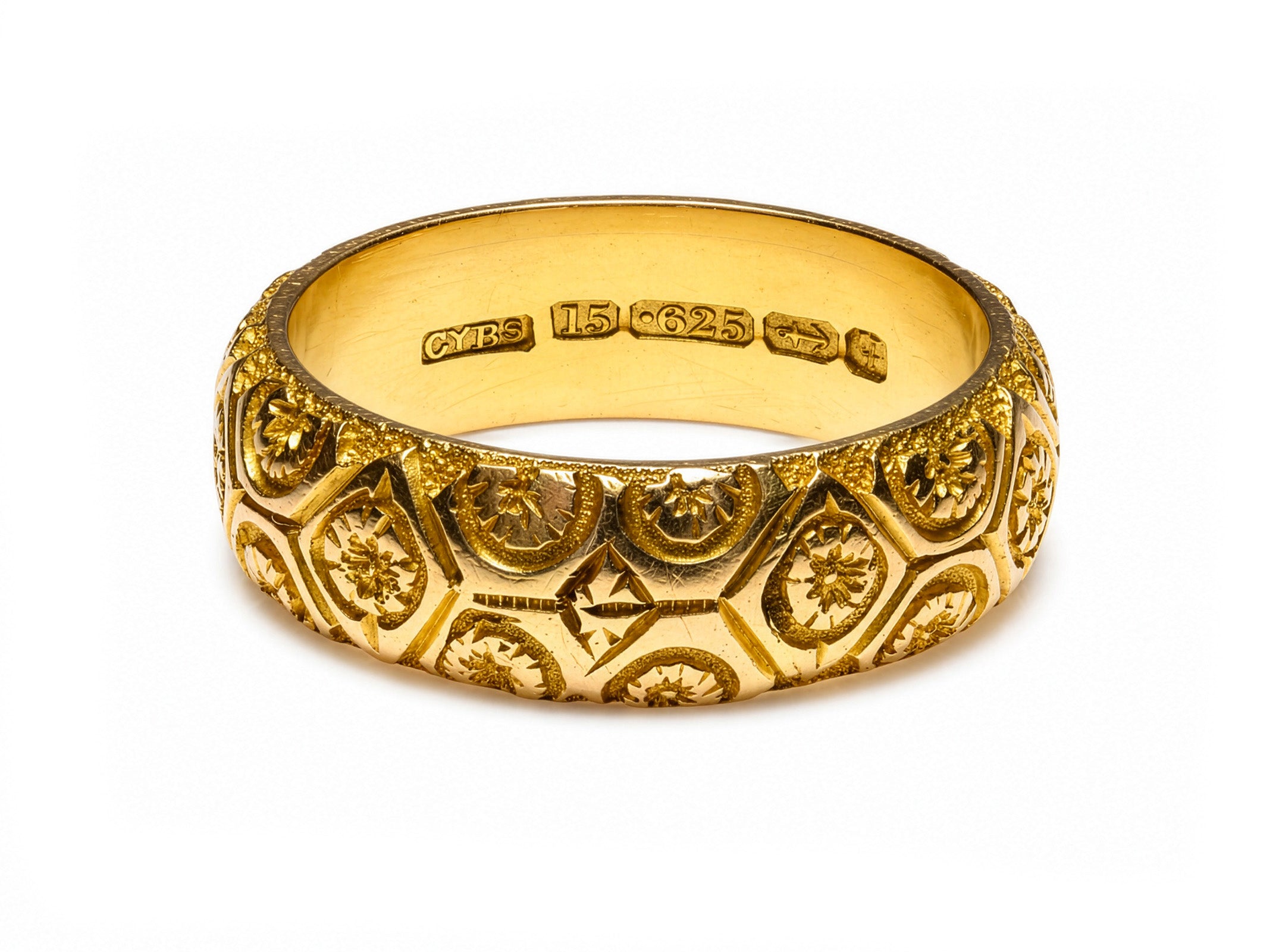
The purity of the precious metal is indicated by its fineness mark, which can be 750 for 18K gold, 375 for 9K gold, or 925 for sterling silver.
Assay Office Mark
Each assay office where the metal was analyzed and marked has its own distinctive sign. For example:
- Anchor in Birmingham
- Leopard's head, London
- Rose, Sheffield
- Castle in Edinburgh

Blue brick sterling lion (silver) "hallmark", one of many, sculpted into the wall on the new Assay Office, Birmingham, Source Wikimedia Commons, Author Oosoom at English Wikipedia
Date Letter
The date letter is a letter that varies annually, according to the year the item was marked.
How to Read a Hallmark
Recognize the Symbols: Examine the jewelry for the various punches or stamps.
Match the Symbols: To determine what each symbol means, use a manual or software, such as the "Help with Hallmarks" app from the Birmingham Assay Office.
Unfolding the Data: Assign the date letter to a year, the assay office mark to a location, the maker's mark to a particular goldsmith, and the fineness mark to a percentage or karat.