Antique Gems in Medieval Times - A Journey through History
During the Middle Ages, antique gems took on new lives, repurposed and reinterpreted through a blend of faith, imagination, and artistry.
As described by Charles William King in his book "Antique gems: their origin, uses, and value as interpreters of ancient history; and as illustrative of ancient art: with hints to gem collectors", the reuse of ancient engraved gems—known as intaglios—throughout the Middle Ages reveals the deep continuity between classical antiquity and Christian Europe.
Long after the fall of the Roman Empire, these small relics of the ancient world retained both material and symbolic value. Medieval artists and patrons, though often unaware of the original pagan meanings of the images carved upon them, found new spiritual interpretations that aligned with Christian belief. The result was a fascinating fusion of classical craftsmanship and medieval faith.
Reinterpreting the Classical Past
By the early Middle Ages, engraved gems from Roman and Greek times circulated widely across Europe. Many had been discovered in ruins or inherited through generations, their origins forgotten. To medieval eyes, the finely cut figures and divine scenes of antiquity seemed mysterious, even sacred.
Lacking knowledge of their classical context, owners reimagined the figures according to Christian symbolism. A gem depicting three faces, for example, was understood as representing the Holy Trinity and was sometimes inscribed “Hæc est Trinitatis Imago”—“This is the image of the Trinity.” Likewise, an image of Isis nursing Horus was readily transformed into the Virgin Mary with the Christ Child, while a Muse holding a mask became Herodias with the head of John the Baptist.

Isis nursing Horus, Source Museo Egizio, via Wikimedia Commons
These reinterpretations reveal not ignorance, but imagination. Medieval viewers did not see these gems as foreign remnants of a lost religion; instead, they wove them into the fabric of their own faith. The bust of the Egyptian god Serapis, characterized by a grave and compassionate expression, was frequently mistaken for a portrait of Christ. In this way, the sacred art of the old world was not rejected, but reborn—absorbed into a new spiritual order.

Bust of Serapis, Museo Pio-Clementino, Sala Rotonda, Source Wikimedia Commons, Author - Jastrow
Sacred and Secular Splendor
The use of antique gems was not limited to personal adornment. Churches and cathedrals across Europe incorporated ancient cameos and intaglios into their treasures. Gold chalices, reliquaries, and crosses glittered with classical stones whose pagan origins were long forgotten. The Shrine of the Three Kings at Cologne, created in the 11th century, is adorned with numerous engraved gems, including one depicting Leda and the Swan—a mythological scene whose meaning must have puzzled the faithful.

The Shrine of the Three Kings at Cologne, Source Wikimedia Commons, Author: Elya
In England, France, and Germany, medieval seals frequently bore impressions from ancient intaglios. Documents preserved in institutions such as Corpus Christi College, Cambridge, show how widespread the practice was. Most of these gems were of late Roman workmanship, often crude by classical standards, yet they served as personal signets and symbols of authority. The blending of old materials with new faith and function illustrates how medieval Europe repurposed the artistic heritage of antiquity without fully understanding it.
Symbolism and Superstition
During the Middle Ages, engraved gems were valued not only for their beauty but also for their supposed magical and protective powers. Lapidaries—treatises on the virtues of stones—claimed that certain images or materials could bring divine favor, health, or victory. These writings often treated carved gems as natural wonders rather than human creations, a belief made plausible by the long disappearance of the art of gem engraving from Europe.
Even emperors and kings were known to wear such stones as amulets. The line between ornament, relic, and talisman was blurred, and belief in the mystical properties of gems endured well into the Renaissance.
The Cross of King Lotharius
This magnificent cross—an authentic work of the Carolingian period—rests upon a later silver-gilt base of exquisite 15th-century craftsmanship. Preserved in the treasury of Aachen Cathedral, it provides an illuminating example of the medieval adaptation of classical art. Its gold surface is richly ornamented with arabesque tracery and densely set with pearls, rubies, sapphires, amethysts (one carved with the Three Graces), and emeralds—further proof of that gem's common use in antiquity.

The Cross of Lothair, Source Wikimedia Commons, Author of the photo: Saiko
At the intersection of the cross's arms gleams a superb onyx cameo, approximately 3 inches high, depicting the laureate bust of Augustus holding an eagle-topped scepter—a masterpiece of Roman art. Beneath it, at the lower end of the stem, lies the true relic of Lotharius himself: his signet, engraved on a large oval piece of rock crystal about 1.5 inches high. It portrays the king in profile, wearing a close-fitting helmet with a slight frontlet in the late Roman style, encircled by the inscription in Roman letters:
† XPE AUDI UVA VA LOTHARIUM REG
“O Christ, defend King Lothaire.”
The Ring of the Great Mogul
Before leaving the subject of ancient jewelry, it is worth describing a remarkable ornament that, though not antique, exemplifies Oriental opulence more completely than any piece I have encountered. This was a colossal ring presented some two centuries ago by the Great Mogul to the only envoy of the Holy Roman Emperor ever to visit his court. Its extravagant design made its origin unmistakable—a dazzling display of Eastern magnificence.
The ring, shaped like a wheel 3 inches in diameter, was composed of several concentric circles joined by radiating spokes. At the center blazed a large round sapphire; at each junction of spoke and circle, a gem was set—rubies, emeralds, topazes, amethysts, and every precious stone known to India except the diamond. The shank was fixed at the back, and when worn, the jewel covered the entire hand like an enormous jeweled mushroom.
Curiously, an ornament of identical design—a Roman gilt-bronze fibula—was discovered at Shefford in Bedfordshire and now resides in the Cambridge Antiquarian Society's collection. Measuring 8 inches across and set with brilliant colored pastes, its form appears unique, yet there is no doubt about its Roman origin, having been found alongside Samian pottery and other relics of that age.
This striking parallel illustrates the enduring continuity of artistic design across civilizations. The same aesthetic spirit that shaped Etruscan and Greek goldwork—its lightness, delicacy, and elegance—reappears centuries later in the jewelry of India, a testament to the persistence of ancient forms in the art of the East.

Gem with Herakles with the Apples of the Hesperides, Source Walters Art Museum, via Wikimedia Commons
Jeweled Gods and Sacred Crowns: From Pagan Rome to Christian Europe
Statues Adorned with Jewelry
In the final centuries of the Roman Empire, a curious and telling fashion emerged—the adorning of divine statues with human jewelry. The once-majestic figures of the gods, carved from marble or cast in bronze, were now draped in necklaces, earrings, and jeweled crowns such as might have graced the salons of the Roman aristocracy. It was a practice unknown in the classical age of Greece and early Rome, when precious materials were woven into the very fabric of sculpture—gold leaf for drapery, inlaid eyes of gem or glass, and ivory flesh. By the time of the late Empire, however, the boundaries between piety and vanity had blurred. The gods themselves were made to glitter like courtiers at a feast.
The historian Zosimus records a haunting tale that illustrates the mood of the age. Serena, the widow of Stilicho—the great general who had once defended Rome—took from the abandoned Temple of Vesta a magnificent necklace, its precious stones gleaming even in the fading light of paganism. When the empire later fell into chaos, Serena was executed by order of the feeble Emperor Honorius. Zosimus, a staunch adherent of the old faith, saw divine retribution in her fate: “The same neck once adorned by the necklace of the goddess was encircled by the rope of vengeance.” In this tragic image, the fading grandeur of Rome seemed to exact its own revenge upon those who plundered its sacred relics.
The Glittering Saints
The instinct to decorate the divine did not perish with paganism. In Christian Europe, the Virgin Mary and the saints soon succeeded the old gods as bearers of earthly jewels. Even today, certain Italian Madonnas—most famously the Madonna dell’Annunziata—appear ablaze with gems, the cumulative gifts of centuries of believers. Yet the priests, wiser perhaps than their Roman predecessors, confess that most of these jewels are imitations. To guard against theft, each genuine offering is replaced with a glass facsimile, while the originals are locked away in the sacristy—or, as local cynics suggest, quietly converted to more practical purposes in support of the “living temples” of the clergy.
Even the treasures of Europe's grand cathedrals are not above suspicion. The sacred vessels of Cologne Cathedral dazzle visitors with their brilliance, yet many experts have judged their stones to be paste rather than gems. The celebrated onyx cameos adorning the Shrine of the Three Kings, long admired as masterpieces of ancient art, are now thought by some connoisseurs to be colored glass—clever substitutions for originals that may have vanished centuries ago. Given that the shrine rests in a dimly lit, guarded chamber, viewable only by lantern light and for a fee, such quiet acts of exchange could easily have gone undetected. Pilgrims kneel before the golden façade that houses the skulls of the Magi, unaware that the jewels glinting above may be nothing more than the ghosts of treasures long since stolen away.
The Fading Gods of Rome
Serena's act of sacrilege opens a window onto the broader decline of Rome's ancient religion. In the last days of the Western Empire, Christian zeal was largely directed against foreign cults—the Egyptian worship of Isis and Serapis, or the Persian mysteries of Mithras—while the venerable Italian deities were treated with a kind of cautious respect. Their temples were closed, their revenues confiscated, but their statues remained standing amid the colonnades, silent witnesses to a world in retreat. Even abstract personifications such as Victory and Fortune retained a certain reverence. When the Roman general Palladius melted down the golden statue of Virtus to pay off Alaric's Gothic army, the Christian citizens of Rome regarded the act as a fatal omen. Pagan symbols might have lost their worshipers, but not their power.
So deeply were the old traditions rooted that, in moments of crisis, even Christians sometimes turned back to them. During the siege of Rome, when famine loomed, the Senate sought to employ Etruscan priests to conjure storms against the enemy—an ancient ritual so desperate that even Bishop Innocentius nearly approved it. The past was dying, but it died slowly, its rituals surviving in memory, its imagery lingering on coins, cameos, and seals long after faith itself had shifted.
The Last Jewels of the Empire
As Rome's spiritual life faded, so too did its art. The once-sublime craft of gem engraving—which had produced the exquisite portraits of Augustus and Hadrian—degenerated into coarse scratches on fine stones. Figures of Roma, Victory, and eagles were roughly etched into amethysts and carnelians, often set in massive gold rings. The contrast between the richness of the setting and the poverty of the engraving tells the whole story: wealth remained, but artistry had fled.
After the reign of Caracalla, imperial portraits in intaglio disappear almost entirely. One rare exception is a remarkable design showing the heads of Diocletian and Maximian united as the two-faced god Janus—an emblem of their uneasy dual rule and a faint echo of Rome's ancient symbolism. Later cameos, such as a laureled bust of Constantine found at Xanten on the Rhine, lack the elegance of earlier works and appear almost lifeless—the final sparks of a dying flame. The art that once celebrated the gods and emperors of the world had dwindled into crude echoes, soon to be reborn in the devotional carvings of the Christian age.

Portrait of Roman Emperor Caracalla, intaglio in amethyst, BnF Museum, Source Wikimedia Commons, Photographer Clio20
The Crowns of the Gothic Kings of Spain
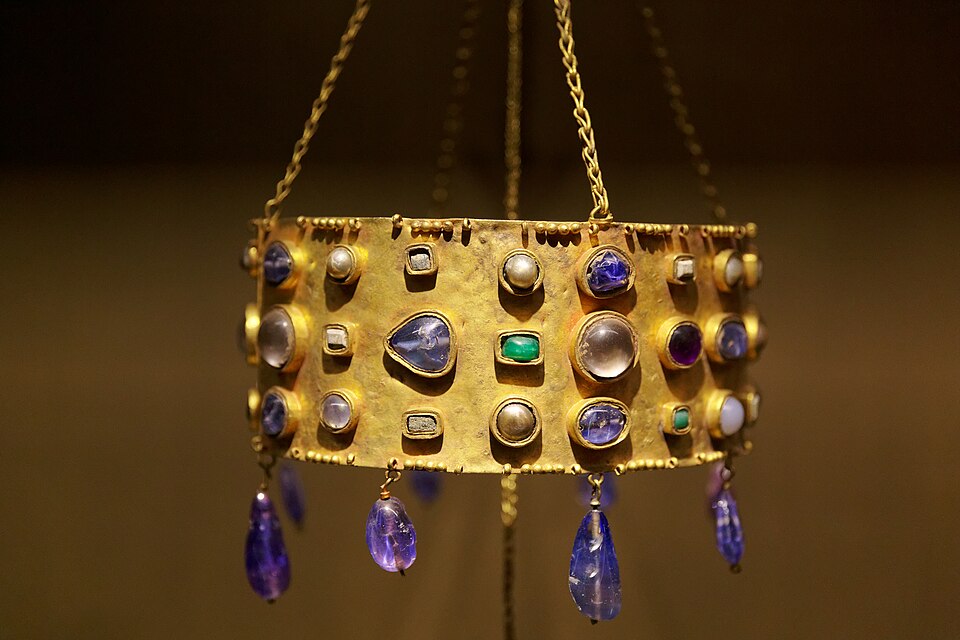
Centuries after the fall of Rome, the old reverence for jeweled majesty found new life in the Christian kingdoms of the West. Among the most splendid relics of this medieval grandeur are the crowns discovered at Guarrazar, near Toledo—treasures that once adorned the kings of the Visigoths.

Treasure of Guarrazar, Source Wikimedia Commons, Author of photography Miguel Hermoso Cuesta
Unearthed in the 19th century from a forgotten cemetery, eight golden crowns were found buried together, their collective worth immense and their craftsmanship astonishing. The most magnificent, belonging to King Reccesvinthus (A.D. 653), forms a broad circlet of pure gold, 12 inches in diameter, set with 30 great rubies, 35 pearls, and alternating sapphires. Its borders are fashioned from tiny Greek crosses inlaid with carnelian cloisonné work—a delicate Byzantine technique that turns metal into a tapestry of glowing color. From the rim hang 24 golden chains supporting jeweled letters spelling the proud inscription:
✢ RECESVINTHVS REX OFFERET
(“King Reccesvinthus offers this gift.”)
From each letter droop pear-shaped rubies and pendants of gold and pearl, creating a fringe of light around the crown. Beneath it hangs a great cross, ablaze with gems—a symbol of royal devotion and triumph.

Crown in treasure of Guarrazar, Source Wikimedia Commons, Author of Photography, Ángel M. Felicísimo from Mérida, España
A second crown, thought to have belonged to the queen, displays rubies, sapphires, emeralds, opals, and large pearls in a gentler, more feminine harmony. The remaining crowns, simpler but still elegant, are believed to have been offerings from noble families. One bears an inscription dedicating it to the Virgin Mary:
“Sonnica offers this to Holy Mary of Abaxo,”
a church that once stood at the foot of Toledo's hill.
These treasures, buried perhaps to protect them from invaders, reveal the continuity of a Roman ideal—the fusion of piety, sovereignty, and splendor—now baptized into the Christian world.
The Crown of Hungary
If the Visigothic crowns speak of devotion in the West, the Crown of Hungary embodies the majesty of the Christian East. This venerable relic of Byzantine art consists of a broad circlet of gold surmounted by four arches supporting a cross. It was sent in A.D. 1072 by the Byzantine Emperor Michael Ducas to Geisa I, Duke of Hungary—styled in the enamel portraits upon the crown as “Geabitras, King of the Turks.”
Each enamel portrait shines like a miniature icon: Christ enthroned, Emperor Ducas, the earlier ruler Constantine Porphyrogenitus, and Geisa himself. Around the circlet appear smaller portraits of saints—Michael, Gabriel, George, and Demetrius—all rendered in the rich blues and golds of Byzantine enamel. At the crown's summit, beneath a gleaming amethyst heart, lies a great uncut sapphire; four more sapphires, equally rough and luminous, are set around the base, each bordered by rows of tightly packed pearls.

The Holy Crown of Hungary, Source hu:Fájl:SzentKorona elol.jpg via Wikimedia Commons, Author of Photography, hu:Szerkesztő:Tolfavi
A 14th-century record lists its treasures: 53 sapphires, 50 rubies, one emerald, and 320 pearls—a staggering inventory of splendor. To hold such a relic is to glimpse the continuity of empire: the gold of Byzantium, the stones of the East, and the faith of Christendom. Even its form—a blend of crown and reliquary—suggests not worldly authority alone, but divine sanction, the visible union of heaven and monarchy.
Continuity in Splendor
From the bejeweled idols of late pagan Rome to the crowns of Christian kings, the use of jewels in sacred art reflects an unbroken thread in human devotion. Gold, sapphire, pearl, and ruby—materials of the earth—have always been employed to hint at the unearthly, to bridge the divide between the mortal and the divine.
In the dim light of a Roman temple, in the glow of a Gothic altar, or beneath the domes of Byzantium, the same impulse endures: to honor the unseen by giving it form, to express faith through beauty. The gods of marble and the saints of gold may have changed their names, but the glitter that adorned them speaks the same eternal language—that splendor is, in itself, a kind of worship.
Cover Photo - Crown originating from Visigothic Spain, Source Wikimedia Commons, Author of Photography: Thesupermat