The Alsdorf Collection: A Story of Renaissance Jewelry
With elaborate gold settings filled with colored enamels, pearls, and valuable gemstones like sapphires and rubies, Renaissance jewelry was a sumptuous display of riches and prestige.
Pendants, rings, and earrings were common accessories, frequently with religious, mythical, or individualized patterns like initials. Craftspeople produced intricate, sculpture-like jewelry that represented the artistic and cultural changes of the time, acting as a symbol of authority as well as an artistic statement.
In this two-part article, we will focus our attention on the wonders of the Alsdorf collection, specifically on some of the Renaissance jewelry included in it.

Antique Renaissance Revival Exceptional Gold Enamel Fob, Source DSF Antique Jewelry
Popular Renaissance jewelry types
Pendants: The most important item, worn on chains or attached directly to clothing, often with elaborate enamel work on the back and jeweled fronts.

Renaissance-Style Pendant with Judith Holding the Head of Holofernes, Walters Art Museum, via Wikimedia Commons
Rings: Both men and women wore them, and they usually have several diamonds placed into them or have secret pockets for perfumed materials or relics.
Earrings: Long pearls or gemstones in the shape of drops are essential for ladies of distinction. They were also worn by men, occasionally with enormous diamonds.

Portrait of Isabella de' Medici, Source http://web.archive.org/web/20160306043211/http://www.palazzo-medici.it/mediateca/en/Scheda_Isabella_di_Cosimo, via Wikimedia Commons
Bracelets: Less often because of the long sleeves of garments, but occasionally presented as love mementos or crafted from carved cameos.

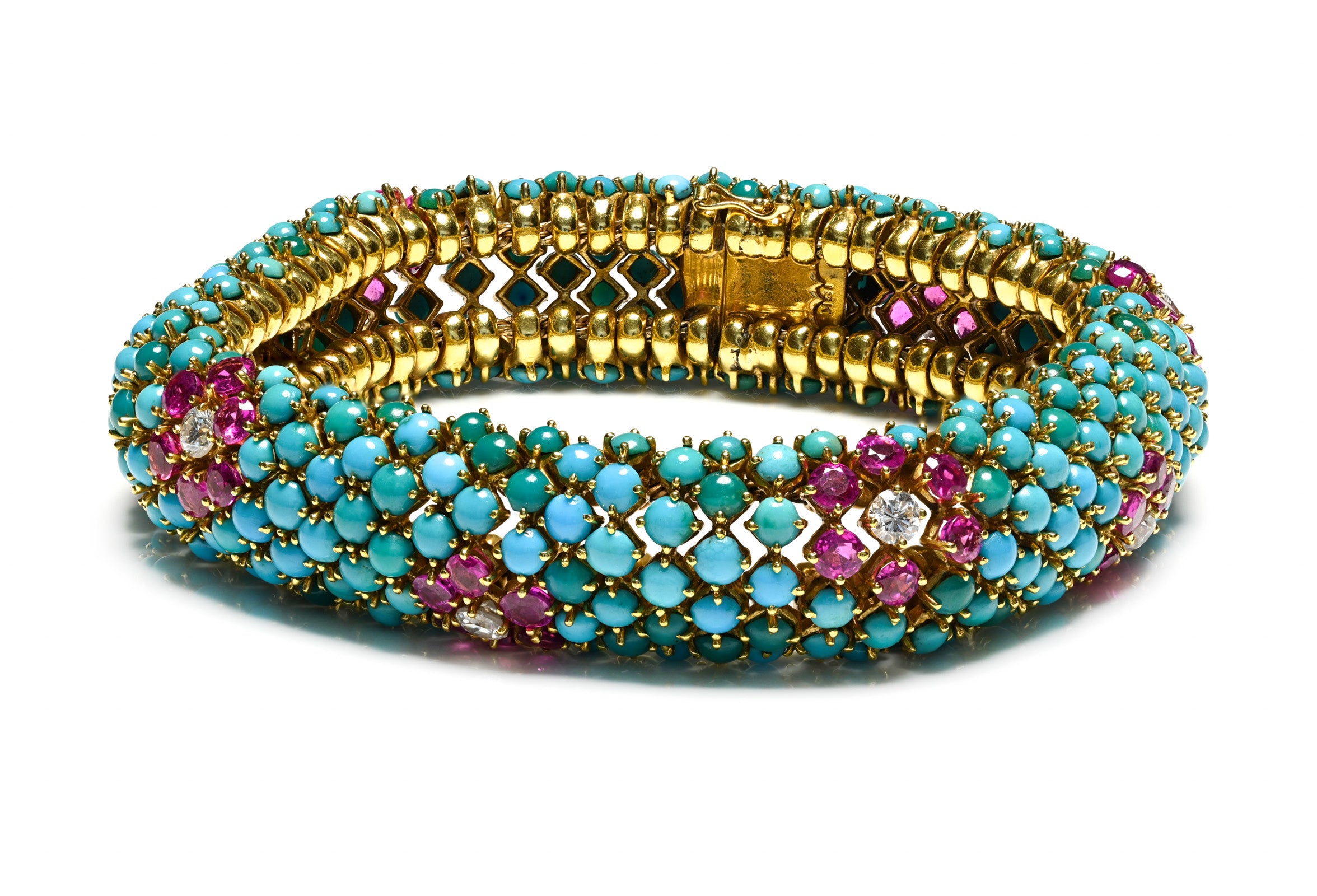
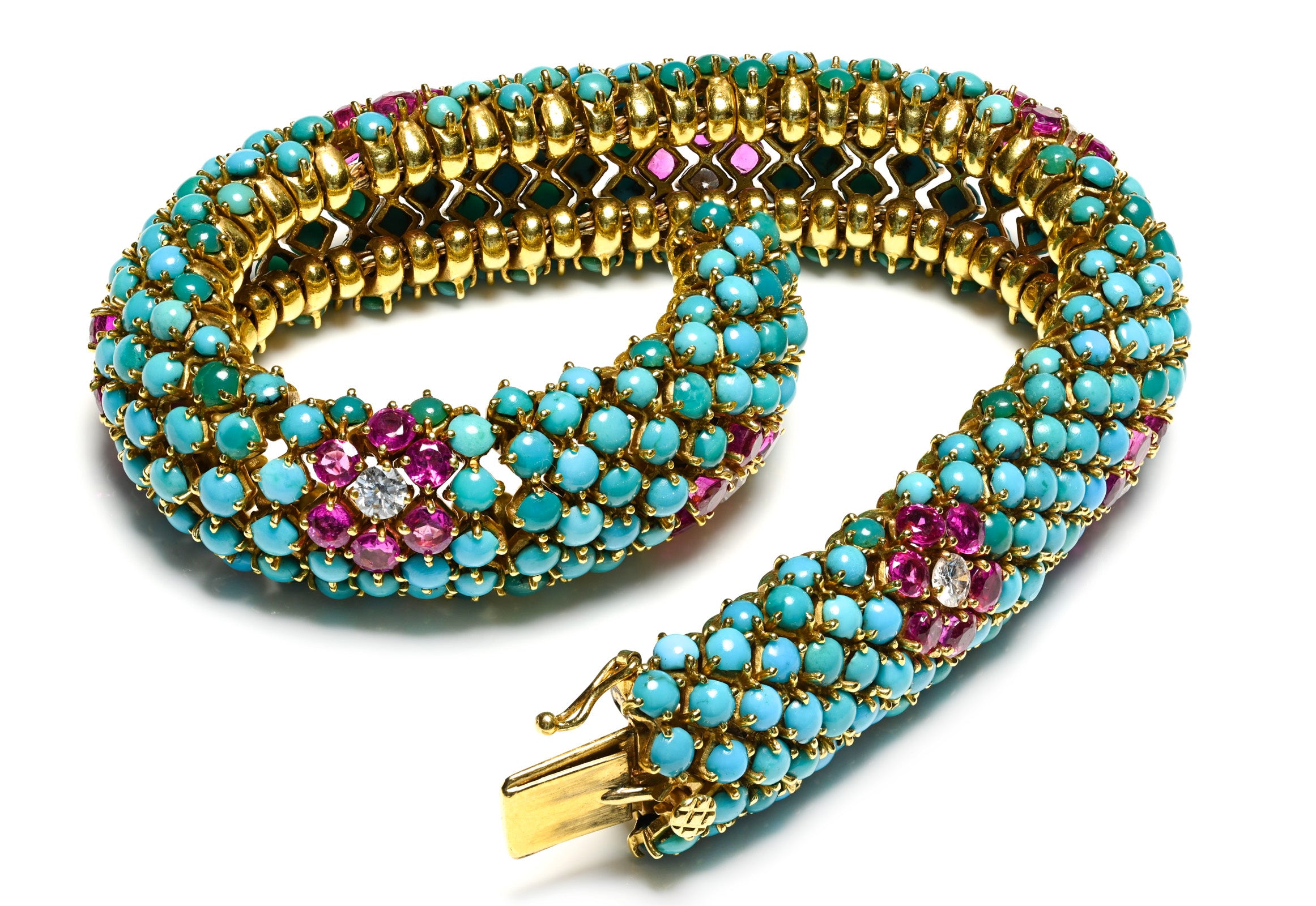
Renaissance Style Bracelet
Materials & Techniques
Metals: The most commonly used metal was gold.
Gemstones: Pearls, diamonds, sapphires, emeralds, and rubies were prized.
Enameling is a crucial ornamental method that is frequently applied to pieces to produce complex and vibrant designs on the front and back.

Antique Gold Diamond Enamel Powder Box crystal romantic scene
Designs & Symbolism
The designs featured a variety of themes, including biblical scenes, devotional monograms, legendary creatures like dragons and nymphs, and personal ones like initials and monograms.
Personal significance: Although few have survived, initials of the wearer and a loved one were frequently seen. Symbolic diamonds and inscriptions were frequently found on marriage bands.
Symbolism: Jewelry was a potent representation of riches, social standing, and even safety. For example, pearls were thought to represent faithfulness and purity.
The Alsdorf Collection
The majority of our knowledge of Renaissance jewelry is derived from either portraiture or the actual jewelry, which was a personal ornament that was fortunately saved in collections like the Alsdorfs.
When examining painted portraits of the era, a museum visitor is astounded by the abundance of jewelry: women exhibit pendants, necklaces, and earrings, while men are shown sitting opulently wearing rings, hat badges, and chains, according to a paper by the Art Institute of Chicago titled Renaissance Jewelry in the Alsdorf Collection.
What can be learned about riches, social standing, and the aesthetic ideals of their day from these glistening decorations? Even though they were small, diamonds were quite important to their Renaissance owners, and they provide students now with a glimpse into the issues and circumstances of this past time period.
The Institute states that a woman believed to be Magdalena of Saxony, the wife of Elector Joachim II of Brandenburg, was painted by the German painter Lucas Cranach the Elder about 1529.

Magdalena of Saxony. Portrait by Lucas Cranach the Elder, c. 1529, Source: Wikimedia Commons
The sitter in Cranach's painting is practically the epitome of luxury: a pearl-studded brooch hangs from an elaborately wrought collar, and a heavy gold and pearl necklace encircles it. Magdalene's jewels, which blend nicely with her ermine, silk, and ostentatious plumes outfit, symbolize immense riches and authority.
This Saxon princess made sure that her appearance would convey her importance by highlighting her expensive jewelry and casting the highly regarded Cranach as her face. A woman whose identity is unknown sat for a portrait painter known only as the Master of the 1540s in 1544, some fifteen years later.
Her jewelry stands out, even if the sitter's dignity and confidence are evident in her facial features. Magdalene of Saxony's modesty is conspicuous.
She wears a black dress with crisp buttons and a nicely stitched collar, and she only wears a ring as jewelry. According to the Institute, the painting's modest size and absence of heraldic elements, together with her straightforward gold band with inset stone, both reflect her middle-class background.
Men and women of the Renaissance were very interested in jewelry as a show of social standing, as well as a sign of cultural awareness and worldliness, as these two images barely hint at. Europe underwent significant social, political, and cultural transformations during this time, which is roughly defined by the years 1400–1600.

Portrait of Constance of Austria, Source Kunsthistorisches Museum Wien, Bilddatenbank, via Wikimedia Commons
In Italy, where antique architecture and sculpture could be seen practically everywhere, the creative and intellectual ferment sparked by a fresh interest in the literature and art of classical antiquity was particularly potent.
Europe was awash in the splendor of the sculpture, paintings, and architecture produced by such great Italian painters as Michelangelo, Raphael, and Bramante.
Humanism
The Institute claims that a significant shift that was reflected in humanism, one of the prevailing schools of thought at the time, was the growing focus on human achievement and power rather than on humanity's relationship with God.
Theological disagreements grew more polarizing among nations and sects, despite the Church's continued dominance. The age's broadening physical and intellectual frontiers are typified by Galileo and Copernicus’s innovations and scientific discoveries, as well as Columbus’s expeditions to the Americas.
Renaissance jewelry reflects all of these social and cultural shifts as well as a general rise in individual wealth.
Jewelry approached and frequently reached the level of art for both men and women throughout the Renaissance, and it was not just a symbol of riches or an item adorned with exquisite craftsmanship.
Jewelry designs were created by several of the best painters of the time, such as Hans Holbein the Younger in England and Albrecht Dürer in Germany.

Portrait of Queen Jane Seymour by Hans Holbein the Younger, Source Google Arts & Culture, via Wikimedia Commons
Media boundaries were brittle: a gifted artist such as Giulio Romano, for instance, created jewelry, decorative arts, and architecture. He also painted canvases and frescoes for the Gonzaga dynasty in Mantua.
Catherine de’ Medici
Patrons of the Renaissance placed a different value on the arts than we do today; they valued tapestry above all else in their collections and appreciated sculpture’s ability to uphold feudal or civic ideals. Jewelry could be ranked on par with, or even higher than, paintings in the Renaissance’s hierarchy of artistic mediums.
We can use Catherine de’ Medici as an example of how media were ranked throughout the Renaissance and how jewelry in particular captivated the upper classes.
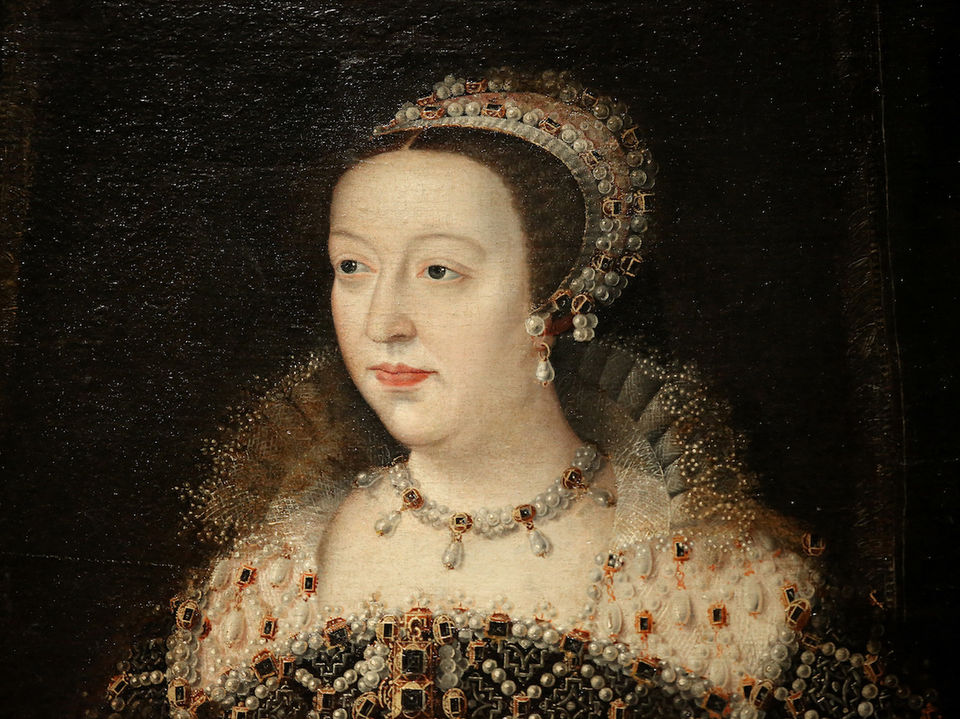
According to the Institute, even a small painting like François Clouet’s 1560 Catherine de’ Medici can shed light on the important role that jewels played in Renaissance society.

Portrait of Catherine de' Medici attributed to Clouet, Source, Hearn, Karen, ed. Dynasties: Painting in Tudor and Jacobean England 1530-1630, Victoria and Albert Museum, via Wikimedia Commons
The portrait of Catherine, Queen of France and Henry II’s wife, by court painter Clouet, portrays the queen’s kind face in a way that seems to contradict the reality of her challenging life.
Over the course of their twenty-nine-year marriage, Catherine suffered years of humiliation at the hands of Henry’s mistress, Diane de Poitiers, even though she finally gave birth to eleven children—three of whom became kings of France and seven of whom survived.
After the death of Henry II in 1559, she ruled a nation split by religious conflict. Although Catherine had many paintings, she was particularly interested in portraits of her family, as well as of kings and other people throughout Europe. By the time of her death in 1589, she had about 341 portraits in various media.
Similar to other affluent people of her era, she valued tapestries for the intricate weaving involved in their creation as well as the worth of the silk, gold, and silver threads that made them up; the Valois tapestries, which honored the queen’s achievements, were some of the most well-known pieces in her collection.
Additionally, according to the Institute, jewelry played a significant role in Catherine’s life. She is believed to have brought the Italian preference for hardstones set within gems, known as commessi, to France. She is also known to have had large amounts of jewelry. Her dowry contained a collection of renowned stones and pearls.
The queen is clearly content with her trendy attire, which includes a matching headpiece, a small necklace known as a carcan, and shoulder chains (cotière), as depicted in Clouet’s painting.
Numerous gems are stitched to Catherine’s bodice and sleeves, and she wears at least one ring. She also carries a jeweled plume for good measure. Catherine’s bodice features a jewel trellising over the shoulders.
Catherine de’ Medici and other patrons were exceptionally knowledgeable about jewelry-making materials and procedures.

Paul Lantuch Gold Renaissance Revival Silver Brooch, Source: dsfantiquejewelry.com
Examine her letter from 1561 to her court jeweler François Dujardin, on the commissioning of a jewel believed to be preserved in the Paris Bibliothèque nationale’s Cabinet des médailles:
"The emerald is a brittle stone which breaks easily, and there are two hands symbolizing faith which enclose the emerald; there must be a motto saying that fidelity and friendship which are the desire of the one who presents this jewel are not like the stone, but like the two hands which are inseparable and the color of enamel on the jewel which is yellow and lasting without growing pale."
According to the Institute's paper, Catherine was so concerned with the creation of a jewel that she described every aspect of its look, demonstrating that she, like other Renaissance patrons, understood both the symbolic significance and the physical characteristics of stones.
Jewelry's connection to nature and antiquity, in addition to the admiration of the jeweler's craft, strengthened its standing as an art form.
Art & Nature
The Renaissance mind was captivated by the interplay between art and nature, as well as artists’ capacity to equal or even transcend the glories of natural forms.

Necklace, Source Walters Art Museum, via Wikimedia Commons
One of Catherine’s favorite ceramists, Bernard Palissy, had a career that reflects the wider interests of his culture: he created glazed earthenware platters using cast flora and fauna, wrote a botanical treatise, and even started building a grotto for the queen that was covered in realistic ceramic snakes and lizards.

Plaque depicting Bernard Palissy, Source, https://www.metmuseum.org/art/collection/search/232263, via Wikimedia Commons
The frequent use of pearls with unusual shapes is a perfect example of how this Renaissance interest in organic forms was readily adapted into jewelry designs. Similar to how clouds’ amorphous, quickly shifting forms might indicate multiple identities, the oyster’s asymmetrical, glossy goods also sparked jewelers’ imaginations.
An enameled gold head and articulated tail completed the body of a fierce dragon made out of several bulbous pearls; a fat pearl was made into a calm domestic cat by adding enameled gold ears and a tail.
The Institute argues that the conversion of inchoate natural material into recognized forms was endlessly interesting to a period that loved Ovid’s Metamorphoses.
Since Renaissance collectors displayed virtuoso instances of human skill alongside natural wonders, the distinction between art and nature was further examined and blurred.
In addition to Venetian glass and Chinese lacquer, Catherine de’ Medici’s Parisian home, the Hôtel de la Reine, had a room dedicated to the exhibition of natural marvels such as stuffed crocodiles and nautilus shells.
Houses of affluent scholars and intellectually inquisitive nobles had such cabinets of curiosity, or Wunderkammern as they were known in Germany. Additionally, pieces of furniture were made especially to hold gems and other valuables.

Large Renaissance Pendant with Star at Centre, Source: National Gallery of Art via Wikimedia Commons
An example of such a showcase cabinet later on is an ebony and ivory cabinet made in Augsburg circa 1640, complete with drawers and concealed compartments. Ancient civilizations’ awareness of jewelry’s position was a major factor in the admiration of jewelry as an art form, which in turn fueled jewelry collecting.
Additionally, the Institute stated that the circulation of diamond cameos and gold pendants was spurred by the discovery of ancient marble statues and bronze statuettes, which in turn fueled the acquisition of these items and encouraged the creation of modern items based on antiques, raising the value of jewelry to a great degree.
Michelangelo was influenced by the renowned collection of ancient cameos that Lorenzo de’ Medici gathered in Florence in the late fifteenth century.
One of Lorenzo’s grandchildren, Francesco de’ Medici, is depicted in a portrait at the Art Institute holding a cameo portrait of a woman, perhaps a picture of his younger sister Lucrezia.
The object in his hand appears to be a gold medallion in two different versions of this picture; whether it is a cameo or a medallion, the portrait’s incorporation of an antique art form to depict a modern individual is a clear indication of the cameos’ and jewelry’s value at the time they were created.
A Reflection
According to the Institute, Renaissance jewelry is a reflection of the civilization that created it as well as a visual treat, like most other art forms. The Alsdorfs’ cross pendant’s emeralds provide witness to the Americas’ economic significance to Europe, and we are in awe of the jeweler’s technical skill in crafting it.
You must be aware of the influence of the ancient world on the Renaissance’s imagination while also appreciating the use of enamels and pearls on the gold frame of Tiberius’ cameo in the collection.
The Alsdorf Collection’s jewelry offers a chance to explore various styles and techniques while also eloquently expressing the tastes and aspirations of Renaissance society.
We invite you to read Part 2 of this article.
Cover Photo: Portrait of Caterine de' Medici, Queen of France, Source https://expo.cleveland.com/life-and-culture/erry-2018/11/39cff5c2f11993/propaganda-and-power-pervade-v.html, via Wikimedia Commons