The ‘Cosmic’ Diamond That May Be Harder Than Anything on Earth
For centuries, natural diamond has occupied a singular position in human culture. It is the hardest material found on Earth, a benchmark against which all others are measured, and a substance deeply intertwined with history, symbolism, and craftsmanship. In fine jewelry, diamonds are not merely materials—they are geological miracles shaped by time, pressure, and rarity.
Yet science has long suspected that nature’s most extreme creations may not be confined to our planet.
Recent research has brought renewed attention to a rare form of carbon known as lonsdaleite, sometimes referred to as hexagonal diamond. Unlike diamonds formed deep within the Earth, lonsdaleite is believed to emerge during violent cosmic events—when meteorites collide with planetary surfaces under unimaginable pressure and temperature.
This discovery does not redefine jewelry. It does, however, redefine our understanding of carbon itself.
Lonsdaleite: A Diamond Born from Cosmic Violence
Lonsdaleite was first identified in the 1960s within meteorite fragments. Unlike terrestrial diamonds, which crystallize slowly over billions of years, this material forms almost instantaneously during high-energy impacts in space.
Its rarity is absolute. Natural lonsdaleite exists only in microscopic quantities, embedded within meteoritic debris, never as gem-quality crystals, and never in sizes suitable for adornment or trade.
For decades, it remained a scientific curiosity—intriguing in theory, inaccessible in practice.
Why Structure Changes Everything
The key distinction between conventional diamond and lonsdaleite lies in crystal structure.
-
Natural diamond forms in a cubic lattice, prized for its symmetry, stability, and durability.
-
Lonsdaleite forms in a hexagonal lattice, altering the way carbon atoms bond and distribute stress.
This subtle rearrangement has dramatic consequences. Theoretical models suggest that hexagonal diamond may distribute mechanical forces more efficiently, potentially making it significantly harder than cubic diamond.
Importantly, this does not make it superior in every sense—only different. Hardness alone does not define beauty, rarity, or cultural value.
The Laboratory Breakthrough—and Its Limits
A recent study published in Nature confirmed that researchers have successfully recreated hexagonal diamond under controlled laboratory conditions. Using carefully calibrated pressure and temperature, they were able to force carbon atoms into the elusive hexagonal structure previously seen only in meteorites.
Advanced techniques such as X-ray diffraction and electron microscopy confirmed the result.
However, several limitations remain critical:
-
The samples are extremely small
-
The structure is not yet fully pure
-
Full hardness testing is still not possible
-
There is no gemological application
This is a scientific achievement—not a commercial one.
Why This Has Nothing to Do with Jewelry
It is essential to draw a clear distinction.
Lonsdaleite is not a gemstone.
It is not a jewelry material.
And it is not a replacement for natural diamonds.
Unlike laboratory-grown diamonds intended for mass production, lonsdaleite remains a material of scientific interest only. Its formation conditions are extreme, its structure unstable at scale, and its applications—if any—are expected to remain industrial and technological.
Natural diamonds, by contrast, derive their value not from hardness alone, but from:
-
Geological age
-
Natural formation
-
Rarity and provenance
-
Cultural and historical significance
-
Human craftsmanship
These qualities cannot be synthesized.
Potential Applications: Industry, Not Adornment
If future research succeeds in producing larger, stable samples, lonsdaleite could influence fields such as:
-
Advanced cutting and drilling tools
-
High-performance electronics
-
Thermal management systems
-
Specialized scientific instruments
These are domains far removed from jewelry—and rightly so.
A Broader Perspective: Nature Still Has the Final Word
The fascination surrounding lonsdaleite is not about surpassing diamonds, but about understanding how far nature can go under extreme conditions. It reminds us that Earth’s treasures, as extraordinary as they are, represent only a fraction of what the universe is capable of creating.
For collectors and connoisseurs of fine jewelry, this realization does not diminish the diamond—it elevates it. Natural diamonds remain unmatched as artifacts of Earth’s deep history, shaped by forces that no laboratory can replicate in meaning, if not in structure.
The “Cosmic” Diamond That Redefines Hardness
The successful synthesis of hexagonal diamond marks a milestone in materials science, expanding our knowledge of carbon and its potential forms. Yet it exists in a realm entirely separate from jewelry, craftsmanship, and cultural heritage.
Diamonds formed beneath the Earth remain what they have always been: rare, natural witnesses to time itself.
Lonsdaleite belongs to another story—one written in meteorites, physics, and the far reaches of space.
Frequently Asked Questions (FAQ)
What is lonsdaleite?
Lonsdaleite is a rare hexagonal form of carbon, structurally related to diamond, believed to form during meteorite impacts.
Is lonsdaleite harder than diamond?
Theoretical models suggest it may be up to 50–58% harder, but full hardness testing has not yet been completed.
Can lonsdaleite be used in jewelry?
No. It exists only in microscopic or experimental forms and has no gemological application.
Is lonsdaleite a lab-grown diamond?
No. It is a structurally distinct material, recreated experimentally for scientific study, not for commercial use.
Does this discovery affect the value of natural diamonds?
No. Natural diamonds derive their value from geology, rarity, history, and craftsmanship—not hardness alone.
Is the “cosmic diamond” a real diamond?
Structurally, lonsdaleite is a form of crystalline carbon closely related to diamond, but it is not the same material as natural cubic diamond. Its hexagonal lattice places it in a distinct scientific category, separate from gemological diamonds.
Why hasn’t lonsdaleite been tested properly for hardness?
Because naturally occurring and laboratory-produced samples are extremely small and often impure. Standard hardness tests require larger, stable crystals that do not yet exist.
Does lonsdaleite occur naturally on Earth?
Only in microscopic traces, usually within meteorite fragments. There are no known terrestrial deposits that produce lonsdaleite in usable or gem-quality form.
Could lonsdaleite ever be sold as a gemstone?
Highly unlikely. Even if larger samples could be produced, the material lacks the optical, structural, and cultural qualities required for fine jewelry. Its relevance remains scientific and industrial.
Is this discovery connected to lab-grown diamonds?
No. Lonsdaleite is not part of the commercial lab-grown diamond industry. It is a separate material created for scientific research, not for jewelry production or consumer markets.
Does higher hardness mean higher value?
Not in jewelry. Value in fine jewelry depends on rarity, natural formation, provenance, craftsmanship, and cultural meaning—not hardness alone.
Could this discovery change how we define a diamond?
Scientifically, it expands our understanding of carbon structures. Culturally and gemologically, the definition of a diamond remains unchanged.
Why is lonsdaleite often called a “space diamond”?
Because it is associated with meteorite impacts and extreme cosmic conditions, not because it is suitable for adornment or trade.
Does this discovery threaten the status of natural diamonds?
No. Natural diamonds remain unique geological artifacts formed over immense time spans. Scientific materials like lonsdaleite exist in an entirely different domain.
Why is this topic relevant on a fine jewelry website?
Because it offers cultural and scientific context. Understanding what lies beyond Earth’s materials deepens appreciation for the natural diamonds formed on our planet.
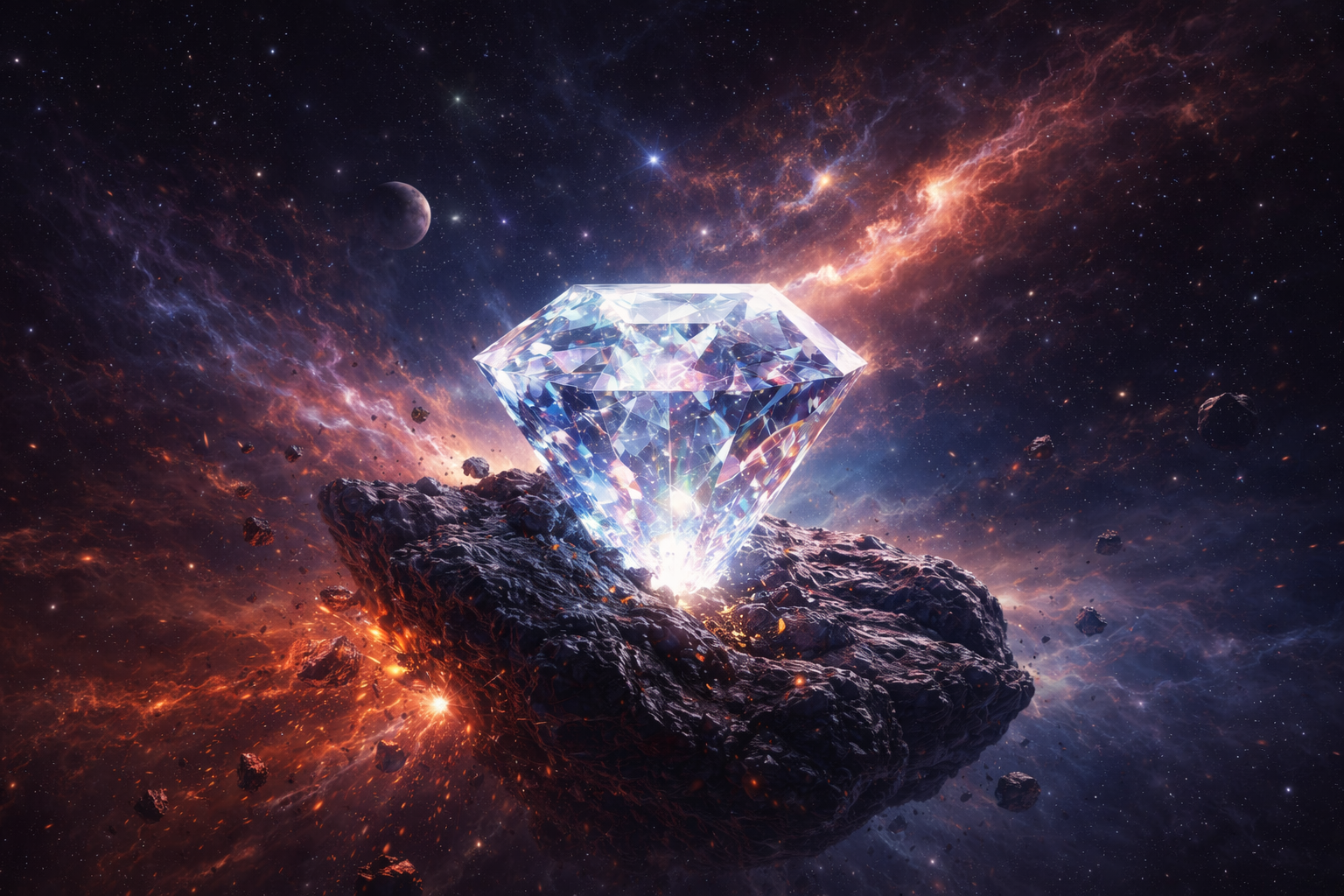
Cover Photo Credit: AI-generated, for illustrative purposes
VIEW OUR COLLECTION OF ANTIQUE & VINTAGE JEWELRY
VIEW OUR JOURNAL & NEWS
READ OUR INTERESTING FACTS ARTICLES