The Olbia Treasure – A Story Of History And Beauty
The renowned Olbia Treasure, named for the location in modern-day Ukraine where it was found in the late 19th century, is said to contain exceptional pieces of jewelry from the Greek colonies in the Black Sea region dating to the first century BCE.
The Olbia Treasure, housed at the Walters Art Gallery, is an example of jewelry found in burials in southern Russia.

Bracelet from Olbia Treasure, Acquired by Henry Walters, Source Walters Art Museum
The treasure combines native and Greek styles, as one might expect in an area where Greek colonists coexisted for generations with local people who continued to speak their own non-Greek language and practice their own customs.
The Olbia Treasure. The Spring of 1891
In the spring of 1891, Russian peasants excavating a small area near Olbia, a former Greek colony on the Crimean Peninsula, discovered an ancient, stone-faced tomb chamber containing a woman's skeleton and the remains of a wooden couch with bronze feet.
Her extravagant jewelry included a wreath, gold and garnet earrings, two necklaces with a butterfly pendant, two gold rings, and a silver medallion depicting Aphrodite with two Erotes.
She had placed a tiny gold coin in her mouth to pay Charon to ferry her across the River Styx in the Underworld. Nearby lay a bronze mirror, a bone spoon, a lamp, many pieces of pottery, including a lead-glazed terracotta mug, and numerous gold trinkets that had likely been sewn onto her clothing.
A Russian newspaper published in 1894 described the discovery and included pictures of the butterfly necklace, earrings, lead-glazed mug, and other gold and ceramic objects.
According to a subsequent Russian report published in 1907, the grave had also contained a pair of silver cups, a silver ladle, a distaff, and a lead-glazed pitcher. Andrew Oliver, Jr., a specialist in Greek and Roman antiquities, discussed these findings in his book Jewelry: Ancient to Modern.
Postnikov
The second report also detailed how the antiquities were dispersed: a local antiquities dealer purchased them from the peasants who had discovered them, and Postnikov, a Moscow collector, subsequently acquired them.

Cazzaniga Zeus greek roman mythology 18K Gold ruby diamond brooch, Source: dsfantiquejewelry.com
Then, in a strange turn of events, Postnikov showed his Olbia treasures to archaeologists from St. Petersburg, who questioned their authenticity despite evidence published to the contrary. As a result, Postnikov decided to sell them.
He sold them, or at least part of the collection, to the London dealer Spink because he was concerned about his ability to sell them in Russia. J. P. Morgan purchased the lead-glazed pitcher, now in the Metropolitan Museum of Art, as well as the silver cups, ladle, and distaff, which are now at the Wadsworth Atheneum in Hartford, from Spink.
According to Oliver, Jr., the lead-glazed mug is housed at the Pushkin Museum in Moscow and has never left Russia. In the early years of the 20th century, a British scholar named E. H. Minns claimed to have seen the butterfly necklace for sale at Spink. Postnikov had probably sent it to London along with the silver objects from Olbia.
The whereabouts of the remaining jewelry and ceramics are unknown.
Henry Walters
Henry Walters purchased the butterfly necklace in the 1920s—not from Spink, but from the Bachstitz Gallery in The Hague—along with a collection of gold ornaments, all purportedly discovered at Olbia.
After presenting his first collection of antiquities to the Berlin Museum in 1912, F. L. von Gans, an industrialist from Frankfurt, began assembling a sizable collection of ancient jewelry and other antiquities. This collection included the group of Olbia objects that came to be known as the “Olbia Treasure.”

Ancient greek Tarentum coin necklace c. 334–330 BC in 18K Gold, Source: dsfantiquejewelry.com
Robert Zahn, assistant director of the Berlin Museum's antiquities department, stated in a folio catalog of the second collection prepared for the Bachstitz Gallery in 1921 that Gans had acquired his Olbia pieces from another collector, Peter Mavrogordato, who had purchased most of the group on the art market in 1913, Oliver, Jr., wrote.
In fact, most of the jewelry subsequently included in the Bachstitz catalog is depicted in a German archaeological report from 1913, which states that the pieces came from a tomb recently discovered at Olbia.
The author of the report claimed to have reexcavated the tomb and recovered a gold ornament identical to those purportedly found there, offering this as evidence of provenance.
The report made no mention of a tomb discovered in 1891, and the earlier Russian descriptions do not include any of the jewelry depicted in the 1913 article.
The Bachstitz Catalogue
It is difficult to say with certainty whether the jewelry Mavrogordato purchased in 1913 came from the tomb discovered in 1891 or from another grave in the same necropolis that had been opened sometime before 1913. This question cannot be resolved without examining unpublished Russian archaeological data.
In his remarks in the 1921 Bachstitz catalogue, even Zahn acknowledged the issue: he considered the connection possible but not conclusive, Oliver, Jr., added.
The butterfly necklace, which served as the principal adornment of the woman buried in the 1891 tomb and is now the centerpiece of the “Olbia Treasure,” must have been purchased directly from Spink in London by Peter Mavrogordato, who was undoubtedly aware of the circumstances surrounding its discovery and knew what it was.
Below, we present some of the jewels included in the famous Olbia Treasure.
Butterfly Necklace
Greek, 1st century B.C.
The necklace's central section consists of five colored inlays set in intricate gold settings: a violet stone in the central oval setting, a modern replacement for the original blue-green glass inlay identified in a 19th-century description and photograph, and blue-green glass in the two rectangular settings and the two outer oval settings.
The butterfly pendant features red, white, and green glass inlays, an emerald for the head, a blue stone for the body, and gold wings adorned with emerald spots. The satellite beads are modern replacements for lost stones, while the flanking pendants feature both modern, teardrop-shaped blue stones and old, round emeralds that replace flat inlays of pinkish glass.

Butterfly Necklace, Acquired by Henry Walters, between 1921 and 1931, Walters Art Museum, Source Wikimedia Commons
The pendants are connected to the outermost oval stones and to one another by chains. Two lynx heads, with rock crystal beads forming their necks, and braided chains terminating in loops make up the necklace's ends. Toggle pins secure the flexible hinges of the animals' heads and the four large settings. The settings' flanges are decorated with granulation, tiny brown glass inlays, and gold-sheet floral motifs, Oliver, Jr., wrote.
Greek jewelry from the third and second centuries B.C. includes elaborate diadems and necklaces with stone-inlaid centerpieces, pendant chains and beads, and beaded chains.
Since this piece was discovered around the deceased woman's neck, it is more appropriately classified as a necklace rather than a diadem. Its bold geometric shapes and emphasis on colored inlays hint at the provincial style of the Roman Empire, which originated on the periphery of the Greek world and evolved into the cosmopolitan taste of the Roman period.
The jeweler drew heavily on his existing repertoire when creating the necklace: the circular and rectangular cushion-shaped inlays were inspired by rings, the lynx heads would have been equally at home on hoop earrings, and the pendants flanking the butterfly were inspired by pendant elements of earrings.
According to Oliver, Jr., the final result is striking but ostentatious, and the craftsmanship is skillful but somewhat shoddy upon closer examination.
Greek Bracelets
1st century B.C.
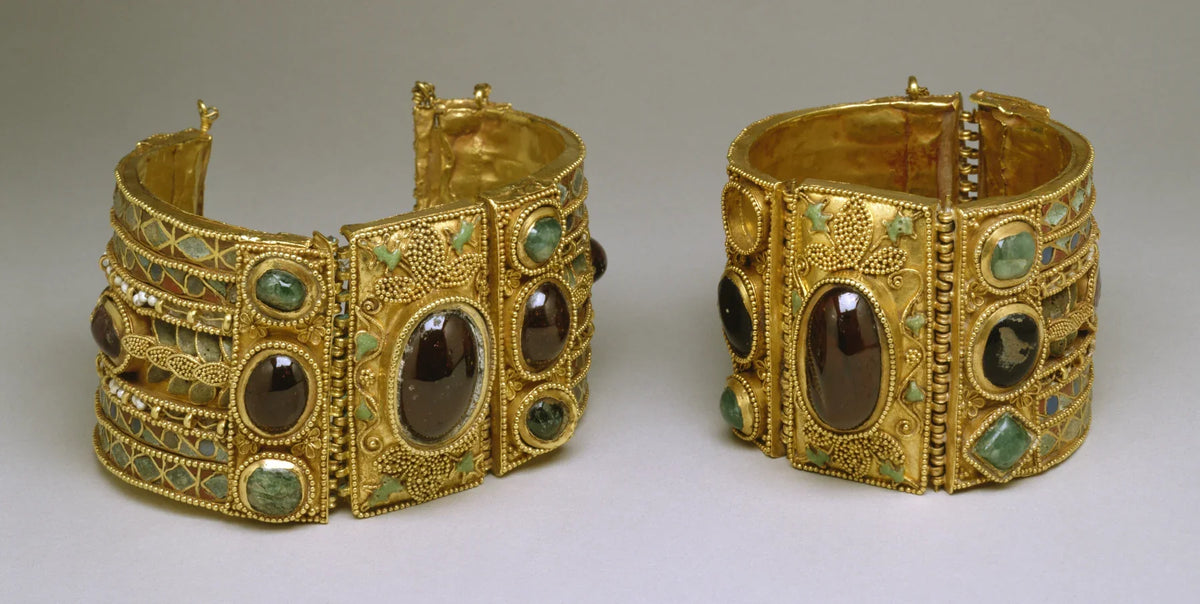
These gold bracelets consist of two curved arms joined by a hinge and a centerpiece. A pin passing through interlocking loops helps secure the articulated arms when the bracelets are closed. To hold the decorative elements in place, each component has a gold-sheet backing folded upward along the sides.
The two centerpieces contain box settings for oval stone or glass inlays; the stones currently in place are modern replacements. Each setting is surrounded by a floral motif made of wire and granulation, featuring green enamel ivy and oak leaves.

Bracelet from Olbia Treasure, Acquired by Henry Walters, Source Walters Art Museum
Three oval or circular stones in box settings adorn each end of the curved arms, which are fitted with sleeve-like coverings. The outer sleeves contain round turquoise stones flanked by oval red stones, although many of the stones appear to be modern replacements. The sleeves around the centerpieces feature oval garnets flanked by green stones.
According to Oliver, Jr., other sections of the arms are decorated with cloisonné work incorporating red, blue, and turquoise inlays arranged in diamond, triangular, and circular settings. Granulation and overlapping turquoise leaves converge at a central box setting.
Pearls are held in place by a wire threaded through loops in the troughs flanking the leaves. Beaded borders outline the main elements of the decoration.
Pin, Greek
1st century B.C.
The gold pin's head is missing, but the molding that once held what were likely its composite elements firmly in place remains. Three pendant cylinders, which may or may not belong to the pin, are attached by three loops soldered to it.
This gold pin features a beautifully crafted lynx head at the top. A small molding on the pin's shaft keeps the conical collar and garnet bead from slipping off. A pin with a looped end holds a setting containing a teardrop-shaped garnet securely in the lynx's jaws. A second teardrop-shaped garnet is attached to the loop by a chain.

Pin with Lynx Head, Acquired by Henry Walters, 1921, Walters Art Museum, via Wikimedia Commons
Pair of Earrings, Greek
1st century B.C.
The gold earrings feature three flanged settings containing brown stones, each surrounded by a frame with a beaded edge. The ear wire is joined to a roughly triangular sheet of gold. Six pendant chains are secured by a pin concealed beneath the transverse bar below the settings.
The tips of the glass beads, originally covered by crumpled caps at the ends of the chains, are now missing, and the beads themselves have long since disintegrated. In addition, one of the pendant chains and several brown stones are missing.

Pair of Earrings, Greek, Acquired by Henry Walters, Walters Art Museum, via Wikimedia Commons
Cosmetic Jar
Pontic, 1st century B.C.
This gold jar has a tall neck and a lid that fits snugly over it. Pairs of twisted wires encircle the upper and lower edges of the lid, the shoulder, and the base of the neck, Oliver, Jr., noted. In addition, the shoulder, front, and back are further decorated with two sets of coiled wires.
The lid features a garnet set within a ring of twisted wire and surrounded by four blue-enameled leaves arranged in a quatrefoil pattern. Pairs of gold loops on the jar and lid can be aligned to accommodate suspension chains.

Greek Cosmetic Jar Pontic, 1st century B.C., Acquired by Henry Walters, Walters Art Museum, via Wikimedia Commons
Although ancient, the braided chains currently attached to the jar—which have loops at one end and dog heads at the other—were not originally part of it.
Over time, these unearthed treasures have left their mark on the world of jewelry, not only because of the mysteries surrounding them but also because of the beauty, complexity, and finesse of the pieces they contain.
It is no wonder that the renowned Olbia Treasure has made its mark and remains highly coveted by collectors of jewelry and art.
Cover Photo: Bracelets from the Olbia Treasure, Acquired by Henry Walters, Source Walters Art Museum