Article: Aquamarine, Pearls and Platinum in Art Deco Jewelry: A Collector’s Eye
Aquamarine, Pearls and Platinum in Art Deco Jewelry: A Collector’s Eye
A large gemstone can draw a collector toward a necklace, but the complete design determines whether it holds the eye. Color, proportion, setting and the movement of strands all play a part. An Art Deco aquamarine and pearl choker offers a useful way to look at these details together: the blue stone provides a focal point, while pearls, diamonds and platinum shape the impression around it.
Why Geometry Matters
Art Deco jewelry often brought crisp outlines and bold contrasts to precious materials. The Victoria and Albert Museum notes how platinum and diamonds helped designers create clean, geometric forms in jewelry of the period. Look closely at a necklace from this era and the framework can be as interesting as the gemstones: a setting may repeat shapes, establish symmetry or guide the eye from the clasp toward the center.
In a multi-strand choker, spacer bars do more than keep the strands organized. They set a visual rhythm and help the necklace maintain its intended silhouette. The meeting point between those strands and a large central stone can reveal how thoughtfully the entire jewel was designed.
Looking Beyond an Aquamarine’s Carat Weight
Aquamarine belongs to the beryl family and is admired for its blue to blue-green color. GIA’s guide to aquamarine quality emphasizes color, clarity and cut as important considerations. The number of carats tells us the stone’s weight, but it cannot describe the experience of looking into it: how even the color appears, how light moves through the facets or whether the cut suits the mounting.
For a large aquamarine in a necklace, consider the stone both in close-up and in the context of the complete piece. Does its color remain expressive against the surrounding materials? Does its shape strengthen the design? A substantial stone can be remarkable, yet the most memorable jewels use that scale with purpose.

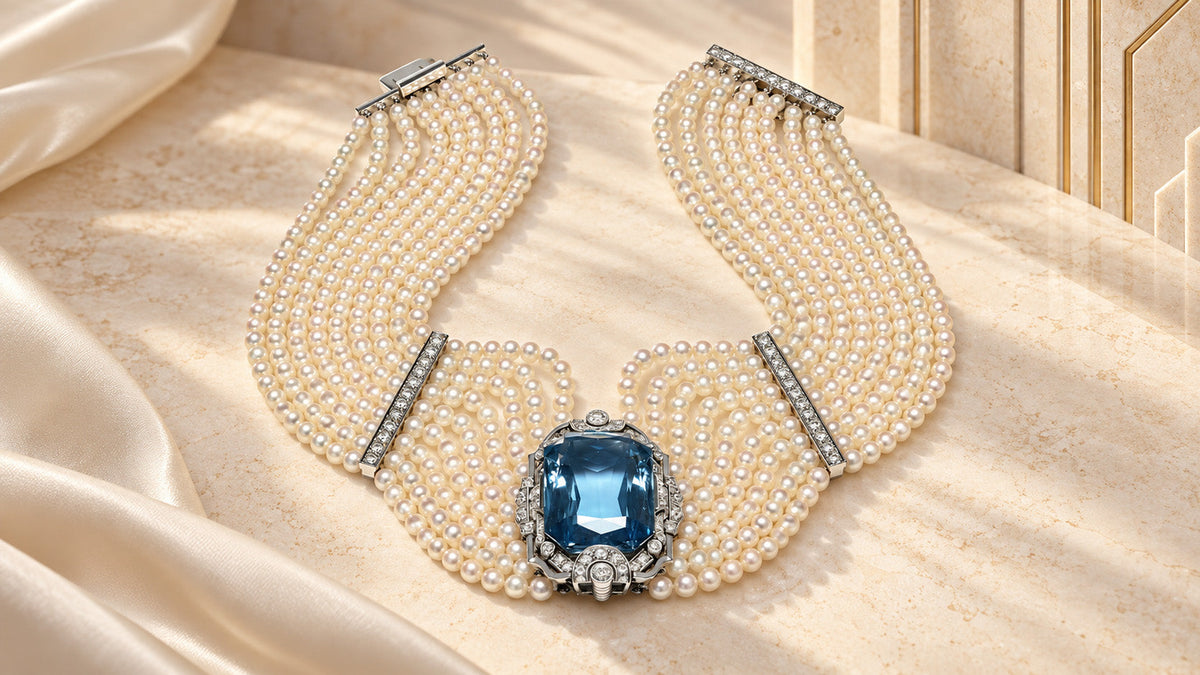
Art Deco aquamarine, cultured pearl and diamond platinum necklace. Photograph: DSF Antique Jewelry.
What Cultured Pearls Contribute
Cultured pearls are genuine pearls formed by mollusks with human intervention. Their appeal involves more than size and roundness. GIA’s pearl quality framework considers factors including luster, surface, nacre and how well pearls match within a strand.
In a necklace that uses several strands, matching creates a sense of continuity. The soft, reflected light of pearls also changes the way a colored center stone is perceived. Where faceted aquamarine can look crisp and transparent, pearls provide a gentler surface and a sense of movement at the neckline.
Examining the Whole Necklace
Photographs of the centerpiece alone cannot show how a choker wears. A collector should also see the full necklace, the alignment of its strands, close-ups of the spacer bars and clasp, and a view that conveys its scale at the neckline. The stringing, condition of the pearls and security of the setting are practical details worth discussing with the seller. Fit is especially important with a choker, so its current length should be confirmed before purchase.
Documentation can add another layer of information, provided it is read for what it actually records. An appraisal may describe gemstones and give approximate weights for a mounted jewel; it does not replace an examination of the necklace’s construction and condition.
A DSF Art Deco Choker in Focus
DSF Antique Jewelry’s aquamarine, pearl and diamond platinum choker brings these qualities together. At its center is a natural aquamarine of approximately 47 carats, framed by diamond-set platinum. Multiple strands of round cultured pearls are held in order by diamond-set spacer bars, while further diamonds accent the clasp. The accompanying AGI New York appraisal records 83 natural diamonds totaling approximately 4.20 carats; the stated gemstone weights and measurements are approximate.
What makes the necklace compelling is the relationship between its parts. The aquamarine supplies concentrated blue color, the pearls create breadth and softness, and the platinum details bring structure to the composition. The result invites the kind of close viewing that a fine Art Deco jewel deserves. Explore the piece in detail, or browse DSF’s wider aquamarine jewelry collection.