Within the beryl family, emerald is accompanied by other well-known varieties, including aquamarine, typically associated with blue to blue-green hues, and other forms of beryl that occur in colors ranging from yellow and green to pink and colorless. Peridot, although also celebrated for its green color, belongs to a different mineral family and is the gem variety of olivine.
“The splendid shades of this stone... remind most of the shades of the sea. When one travels the ocean in its entirety, one is struck by the different colors it presents; sometimes a superb azure blue, which defies the most beautiful sapphires; other times an admirable green: it looks like liquid emerald; then it passes through all the shades one can imagine between these two main tones: dark blue, gray blue, green blue, yellowish green, gray green, dark green, etc.”

Emerald Diamond Flower Clip Brooch Gold 18K Gold
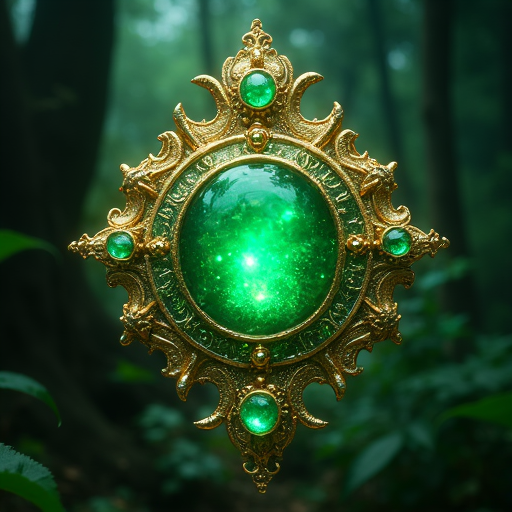
The emerald, then, is not just a gem, but a microcosm of the world’s beauty, a fragment of the ocean, the forest, and the sky caught in stone.
The Art and Trade of Emeralds: From Mine to Market
The journey of an emerald from the earth to the jewel box is fraught with peril and artistry. Emeralds are cut on emery, on a copper wheel, and polished with tripoli; they are often cut in steps, sometimes in pear, oval, or cabochon shapes. The process is delicate, for emeralds are fragile and easily split. A properly cut stone is much simpler than that of diamonds or rubies, yet each stone “is a problem and deserves in-depth study.” A poorly cut emerald can lose half its value, and the lapidary’s skill is paramount.
The rough emerald market has traditionally been centered in London and Paris, while rubies and sapphires are traded in Calcutta. The Indian cut, which seeks to maximize fine material, differs from the European, which prizes symmetry. Indian-cut stones lose only 20 to 40 percent of their rough weight, while European cuts may sacrifice more for perfection. The emerald’s fragility is such that once polished, it may seem to lose its value, but “it is enough to repolish them to restore their original beauty.”
The history of emerald trade is rich with tales of fortune and loss. During the Spanish-American War, emeralds could be bought in Spain for a mere 30 centimes per carat, and fortunes were made and lost on the whims of the market. One dealer bought a seemingly dead stone for 800 francs and sold it an hour later for 15,000; another bought a batch for 1,250,000 francs. The mines themselves, especially those of Muzo in Colombia, have been the scene of intrigue, theft, and adventure, with convoys of mules carrying emeralds across perilous mountains, and whole companies ruined by the clandestine trade of stolen stones.
The Emerald in Ancient and Religious Literature
The emerald’s allure has always been more than material. In ancient Peru, in the valley of Mantu, the natives worshipped a goddess, Emerald, a stone “the size of an ostrich egg,” shown to the people only on great feast days. The priests, ever cunning, persuaded the faithful to offer smaller emeralds to the goddess, amassing a treasure that was seized by the Spanish during the conquest. The mother goddess herself was spirited away and never found again.
The emerald also appears in the Bible and in the lore of kings. The Book of Esther describes the banquet of Ahasuerus, where “beds of gold and silver were prepared for the guests, all set on a pavement of emerald and white marble.” Pliny reports that Nero watched gladiator combats through an emerald, perhaps to protect his eyes from the sun’s glare, while Julius Caesar used an emerald as a sunshade. The fall of an emerald was considered a bad omen; when George III was crowned, a large emerald fell from his diadem, and America was lost during his reign.
The emerald is also a stone of legend in the East. Theophrastus wrote, “The emerald has particular properties. It imparts its color to water: a small part, or a large one if the quality is poor, only to the water that surrounds it. It is good for the eyes. For this reason, there are people who wear seals engraved on emeralds to look at them.” In India, it was said that “at equal weight, a high-quality emerald is worth more than a ruby,” and that it should be worn during study, prayer, and battle, “free of defects, endowed with qualities, and set in gold.”
The Emerald and the Arimaspes: Guardians and Seekers
No account of the emerald would be complete without mention of the Arimaspes, the legendary tribe who, according to ancient texts, battled griffins to seize the emeralds they guarded. In the poetic lines of Marbode, a medieval bishop:
“The Arimaspes, this race,
Love them more than gold and silver
And snatch them from griffins,
Great and treacherous birds...”

A satyr, a griffin and an Arimaspus. Detail from an Attic red-figure calyx-krater, ca. 375–350 BC. From Eretria, Department of Greek, Etruscan and Roman antiquities in the Louvre, Source Wikimedia Commons, Author Jastrow
The Arimaspes, described as a people with a single eye in the middle of their chest, are perhaps a symbol of the dangers and mysteries that surround the quest for precious stones. The griffin, half-lion, half-eagle, is the archetypal guardian of treasure, and the struggle between Arimaspes and griffins is an allegory for the human desire to wrest beauty and wealth from the jealous grasp of nature or fate.
This legend, repeated in countless texts, from Greek lapidaries to medieval Christian writers, became a metaphor for the spiritual struggle as well. The eye of the Arimaspes “signifies that those who have faith have, like them, only one eye, turned toward God, the king of love. And the Griffins are the devils against whom one must fight.” Thus, the emerald’s legend was “baptized,” given a Christian meaning, and woven into the fabric of religious symbolism.
Magical and Medicinal Virtues: The Emerald as Talisman
The emerald has always been more than a jewel; it is a talisman, a healer, and a symbol of virtue. Ancient texts ascribe to it a host of powers: it delights the eye, preserves memory, ensures chastity, reveals adultery, stops hemorrhages, and makes its wearer agreeable, eloquent, and discreet. It is said to break in the presence of impurity or violent illness, to give the power to predict the future, and to be the stone of Venus, goddess of beauty and pleasure.
The Cyranides, a magical text, prescribes that an emerald engraved with a harpy, under whose feet is a moray, and enclosing the root of a certain plant, will “ward off delirious visions, fears, and all that affects lunatics; it also cures colic. It is even better if joined with moray fat. It is a divine amulet.” Such recipes, bizarre and poetic, reflect the deep human desire to find in the natural world a source of protection and power.
Hindu texts warn of the dangers of impure emeralds: “The rough emerald attracts one hundred and eight diseases; bumpy, the blows of a sword to the forehead, the stomach, the head. With a stony emerald, one suffers among one's relatives and friends. Whoever wears a stained emerald quickly becomes deaf and blind. Granular, the emerald brings widowhood and the loss of sons; dull, the danger of fierce beasts. As for the variegated emerald, one must get rid of it without delay; whoever wears it on their finger is doomed to certain death. On the other hand:
Emeralds endowed with five qualities destroy the effect of all poisons...”
Such beliefs, blending superstition, medicine, and magic, persisted into the Middle Ages and beyond. The emerald was believed to “save the eyes and face, also removes storms and lust.
Whoever has it must be of good origin... It cures a very strong fever that brings death to many men... If one wears it around the neck, it is good against the evil eye...”
The Emerald in Poetry: The Princess of Stones
The emerald’s beauty has inspired poets to rhapsody. Rémy Belleau, in a poem dedicated to the “Princess Emerald,” writes:
“It is said that whoever wears it
Always has a certain grace
Proper and easy in their speech,
That they can, without circles or figures,
Predict future things
And those one wishes to hasten;
In short, it is so chaste and so holy
That as soon as it feels the touch
Of any amorous action,
It wilts, it breaks,
Ashamed to see itself taken
By any foul affection.
Good against headaches
And to ward off storms,
Even to give us rest.
It dispels, it moderates
The hot and boiling anger
That Love kindles in our bones.
In powder, it heals the bites
Of snakes and all stings
Of stingers that prick and sting:
Good for giving relief
To the stomach that is delivered
By the discharge of its fruit.
But to preserve its color
And restore its shine,
It must be soaked in wine,
The stone covered
For some time in green oil
To restore its final luster.”
Through such lines, the emerald becomes not just a stone but a living presence, a guardian, and a friend.
The Emerald as Symbol: From Paganism to Christianity
As Christianity spread across Europe, the old pagan symbols were not discarded but transformed. The emerald, once the stone of Venus, became a symbol of faith. “L’émeraude,” writes a Christian lapidary, “signifies the faith of the Trinity, the faith of the four Evangelists, the great greenness of the faith that always endures.” The legend of the Arimaspes and the griffins was reinterpreted: the single eye became the eye of faith, the griffins the devils to be overcome.

Arimaspe and Gryphon. Ancient Roman fresco (60-50 b.C.) from Pompeii, Italy. This fresco comes from the Villa of Mysteries in Pompeii and was reconstructed from fragments, Museo Archeologico Nazionale di Napoli, Source: Wikimedia Commons
This process of adaptation, of “baptizing” the old symbols, is a testament to the enduring power of the emerald. It is a stone that could not be discarded, only reimagined, its legends and virtues woven into the new faith as they had been into the old.
Famous Emeralds and Their Fates
Throughout history, certain emeralds have become legendary in their own right. In the Imperial Cabinet of Saint Petersburg was once exhibited a stone of thirty carats, “its color and clarity perfect,” though sadly “overloaded with lace-like facets, which made it lose some of its value.” In the main church of Mainz, six hundred years ago, hung an emerald “the size of half a melon,” which “shone extraordinarily.” Genoa boasts a flat stone of this kind; Ferdinand Cortez seized five emeralds from the Golden Castle in the New World, each cut into a different shape—a rose, a rattle, a fish, a bell with a pearl clapper, and a cup for which a lapidary offered forty thousand ducats.
Yet the fate of great emeralds is often mysterious. Some are lost, stolen, or destroyed; others, like the goddess Emerald of Peru, vanish into legend. The emerald, it seems, is a stone that resists possession, as elusive as the dreams it inspires.
The Eternal Allure of the Emerald
What is it about the emerald that has captivated humanity for so long? Is it the color, “which surpasses all things green,” as Marbode wrote? Is it the legends, the tales of Arimaspes and griffins, of goddesses and kings? Is it the promise of healing, protection, and eloquence, or the simple delight of beauty that “casts into extreme delight the heart of whoever looks at it”?
Perhaps it is all these things, and more. The emerald is a stone that gathers meaning as it passes through the hands of poets, priests, and princes. It is a fragment of the earth, a drop of the sea, a spark of the divine. It is, in the end, a mirror for our own desires, fears, and dreams—a sumptuous, mysterious princess who, for all our science and history, remains forever just out of reach, dazzling us with her green and secret light.
Biography: Au jardin des gemmes (In the Garden of Gems), by Léonard Rosenthal