
Signed Antique Jewelry from Top Houses: A Smart Investment
Signed antique jewelry has long attracted collectors, connoisseurs, and increasingly, investors seeking assets that combine rarity, craftsmanship, and lasting value. Unlike modern mass-produced pieces, jewels created by historic houses such as Cartier, Tiffany & Co., Van Cleef & Arpels, Hammerman Brothers, and Boucheron carry a distinct identity—one defined not only by materials, but by heritage, design, and provenance.
In recent years, the investment potential of signed antique jewelry has become more evident. Auction results, private collections, and sustained global demand all point toward a clear pattern: exceptional pieces from leading houses tend to appreciate over time, particularly when they are well-preserved and properly attributed.
More importantly, not all signed jewelry holds the same weight. Pieces created by the world’s most respected high jewelry houses occupy a different category—one where craftsmanship, history, and brand legacy converge to create enduring value.
This article explores why signed antique jewelry from top houses is considered a smart investment, and what discerning collectors should understand when entering this refined and highly competitive market.

Boucheron Diamond Emerald Ruby Sapphire 18K Gold Bracelet Earrings Set - DSF Antique Jewelry
What Is Signed Antique Jewelry?
Signed antique jewelry refers to pieces that bear the mark or signature of a recognized maker, workshop, or historic jewelry house. This signature—often discreetly engraved or stamped—serves as a form of authorship, identifying not only who created the piece, but also linking it to a specific tradition of craftsmanship, design, and design philosophy.
In the world of antique jewelry, a signature is rarely just decorative. It represents a connection to a known origin—whether a prestigious Parisian house such as Boucheron, Hammerman Brothers, an iconic American firm like Tiffany & Co., or a master atelier associated with names such as Cartier or Van Cleef & Arpels. These signatures anchor a piece within a historical framework, allowing it to be traced, studied, and understood beyond its materials.
Not all antique jewelry is signed, and many unsigned pieces can still display remarkable beauty and craftsmanship. However, a signed jewel carries an additional layer of certainty. It offers reassurance regarding authenticity, quality, and origin—factors that are essential in both collecting and investment.
This distinction becomes particularly important when evaluating long-term value. While gold and gemstones contribute to intrinsic worth, it is often the signature—the identity behind the piece—that elevates it into a collectible object with lasting demand. In this sense, signed antique jewelry exists at the intersection of art, history, and asset, making it fundamentally different from ordinary decorative jewelry.

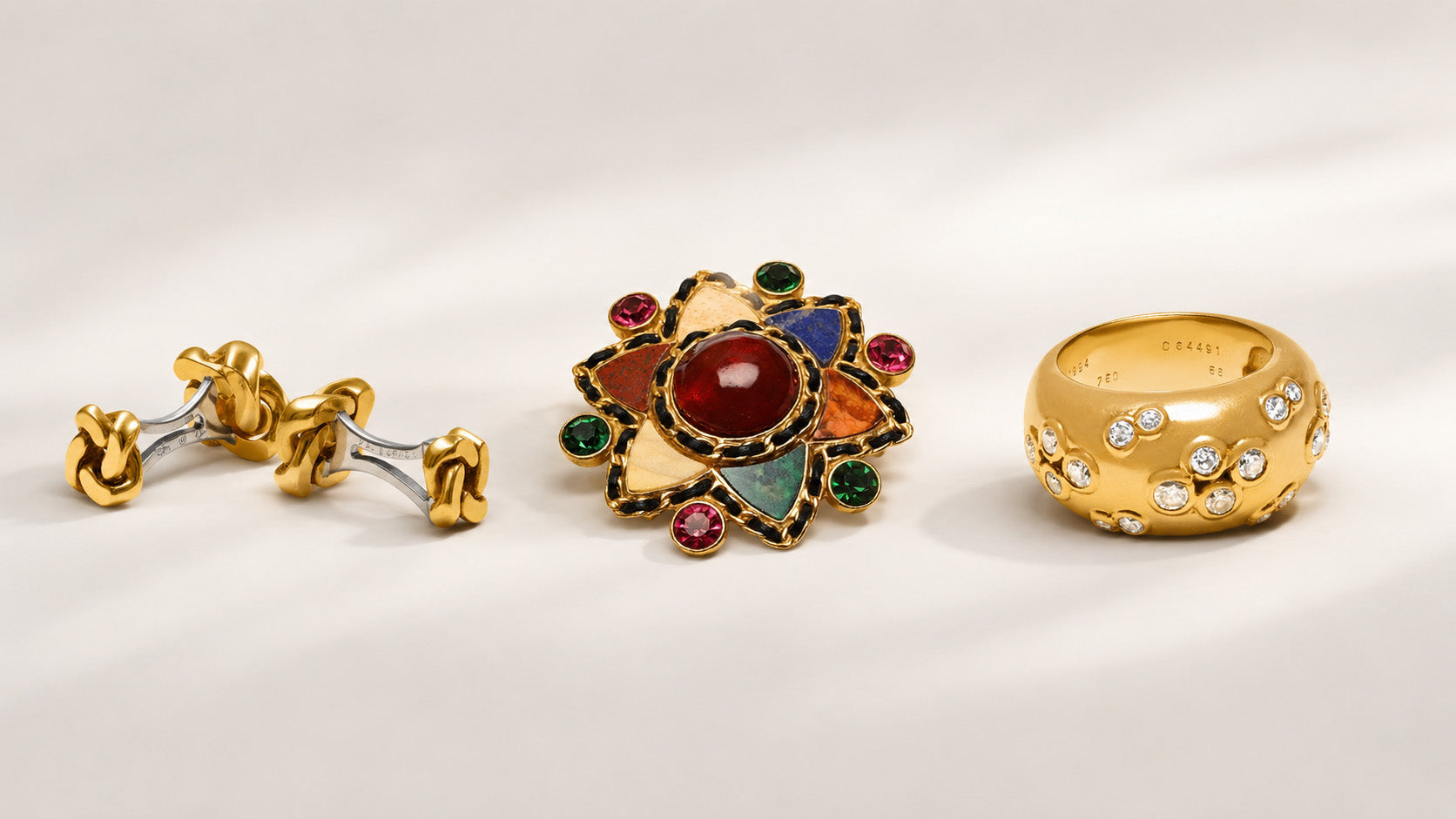
Cartier Gold Cufflinks in Cartier Box Maillon - DSF Antique Jewelry
Why the Signature of a Jewelry House Matters
At first glance, a signature on a piece of jewelry may seem like a small detail—often hidden, sometimes barely visible. Yet in the world of antique jewelry, it is one of the most decisive factors in determining both desirability and long-term value.
A signature is, in essence, a guarantee. It confirms that the piece was created within a specific workshop, under defined standards, and according to a recognizable design language. Houses such as Cartier, Van Cleef & Arpels, Hammerman Brothers, Tiffany & Co.p, and Boucheron did not simply produce jewelry—they established reputations built on consistency, innovation, and exceptional craftsmanship. Their signatures reflect decades, sometimes centuries, of refinement.
This becomes particularly important when comparing pieces that may appear similar. Two diamond brooches, for example, might share comparable materials and visual appeal. Yet the presence of a Cartier or Van Cleef & Arpels signature transforms one of them into something entirely different: a documented object, anchored in a known history, and supported by a global market that recognizes and values that origin.
Collectors understand this instinctively. A signed piece is easier to place, easier to evaluate, and significantly easier to resell. Auction houses, dealers, and private buyers all operate within a framework where attribution matters. A well-preserved Tiffany & Co. jewel from the early twentieth century or a Bulgari piece from the mid-century period carries with it a level of trust that unsigned jewelry simply cannot replicate.
Beyond market dynamics, the signature also represents authorship. Much like a painting signed by an artist, a piece of jewelry bearing the name of a major house is part of a larger creative lineage. It reflects not only materials, but a philosophy of design—whether it is the geometric clarity of Cartier, the technical innovation of Van Cleef & Arpels, or the bold sculptural presence associated with houses like Bulgari and David Webb.
In this sense, the signature is not an addition to the piece—it is central to its identity. It is what transforms jewelry from an object of adornment into something collectible, traceable, and, over time, increasingly valuable.

Van Cleef Arpels Unheated Burma Sapphire Diamond & Unheated Burma Ruby Gold Brooch - DSF Antique Jewelry
The Power of Top Houses: Cartier, Tiffany & Co., Van Cleef & Arpels and Beyond
At the highest level of the jewelry market, certain names carry a weight that extends far beyond aesthetics. Houses such as Cartier, Van Cleef & Arpels, Tiffany & Co., Boucheron, and Bulgari are not simply brands—they are institutions that have shaped the history of jewelry design.
Their importance lies in a combination of factors that few others can replicate: consistent excellence, innovation, and a legacy that has been validated over generations.
Cartier, for example, has long been associated with royalty and elite clientele, earning its reputation as the “jeweler of kings.” Its designs—from early twentieth-century garland-style jewels to bold Art Deco creations—continue to define entire periods of jewelry history. Pieces signed Cartier are immediately recognizable not only for their quality, but for their historical significance.
Van Cleef & Arpels introduced technical innovations that transformed jewelry design, most notably the Mystery Set, a complex setting technique that conceals metal and allows gemstones to appear seamlessly joined. Such innovations elevate their pieces beyond decoration, placing them firmly within the realm of collectible design.
Tiffany & Co., particularly in its earlier periods, represents a cornerstone of American high jewelry. With designers such as Jean Schlumberger, the house produced pieces that combined artistic imagination with exceptional craftsmanship, many of which are now highly sought after by collectors worldwide.
Boucheron, one of the oldest Parisian houses, built its reputation on refined elegance and technical mastery. Its presence on Place Vendôme placed it at the center of European high jewelry culture, and its creations continue to reflect that heritage.
Bulgari, by contrast, introduced a more daring visual language—bold, architectural, and often defined by vibrant colored gemstones. Its mid-twentieth-century pieces are particularly prized for their distinctive identity and strong collector appeal.
Alongside these major houses, other important names such as Buccellati, David Webb, Seaman Schepps, Oscar Heyman, and Hammerman Brothers contribute to the broader landscape of investment-grade jewelry. Hammerman Brothers, in particular, earned recognition in the American market for refined craftsmanship and well-executed diamond and gold jewelry, making signed examples increasingly appealing to collectors.
What unites all these houses is not simply prestige, but consistency over time. Their pieces appear regularly in major auctions, are documented in literature, and are collected internationally. This creates a stable and recognizable market—one where demand is not driven by short-term trends, but by enduring appreciation for craftsmanship and design.
For investors, this consistency is essential. Jewelry from these houses is easier to value, easier to sell, and more likely to appreciate. The name attached to the piece acts as a form of long-term credibility—one that continues to hold weight regardless of changing fashion cycles.
In this context, owning a signed piece from a major house is not just about possessing a beautiful object. It is about holding a fragment of design history—one that has already proven its relevance and is likely to continue doing so in the future.

Buccellati Diamond Ruby Sapphire Emerald 18K Gold Bracelet - DSF Antique Jewelry
Rarity and Supply: Why These Pieces Become More Valuable Over Time
One of the most important factors behind the investment potential of signed antique jewelry is something simple, yet powerful: supply is finite—and constantly shrinking.
Unlike modern jewelry, which can be reproduced, scaled, and reissued, antique pieces from houses such as Cartier, Van Cleef & Arpels, or Boucheron belong to a closed chapter of production. Many were created decades ago, often in limited numbers, sometimes as unique commissions. Once they enter the market, no identical pieces will ever be made again.
Over time, this scarcity becomes even more pronounced. Some jewels are lost, others remain in private collections for generations, and many are absorbed into museums or long-term holdings. As a result, the number of high-quality signed pieces available on the open market gradually decreases.
At the same time, demand does not remain static. On the contrary, it tends to grow. New collectors enter the market, global wealth expands, and interest in tangible, heritage-driven assets increases. This imbalance—declining supply combined with steady or rising demand—creates a natural upward pressure on value.
Another important aspect is that not all surviving pieces are equal. Condition, originality, and documentation play a significant role. A well-preserved jewel with its original signature intact, possibly accompanied by period boxes or papers, becomes even rarer within an already limited pool. These are the pieces that attract serious collectors and achieve the strongest results.
There is also a qualitative dimension to scarcity. Certain periods—such as Cartier’s Art Deco era or Bulgari’s mid-century designs—are particularly sought after because they represent moments of peak creativity. Pieces from these periods are not only rare in number, but also highly desirable due to their design significance.
In practical terms, this means that signed antique jewelry behaves differently from most consumer goods. Instead of depreciating after purchase, it often follows a trajectory closer to that of fine art—where rarity, provenance, and historical importance become increasingly valuable over time.
For collectors and investors alike, understanding this dynamic is essential. It is not simply about owning gold or gemstones, but about acquiring objects that exist within a limited and diminishing supply—objects whose rarity is reinforced with each passing year.

Hammerman Brothers 18K Gold Platinum Diamond Ring - DSF Antique Jewelry
How Signed Antique Jewelry Performs Over Time
Unlike most luxury goods, which tend to depreciate after purchase, signed antique jewelry often follows a different trajectory—one that more closely resembles fine art than traditional retail objects.
Over time, the market has consistently demonstrated a strong preference for signed pieces from established houses and recognized makers. Auction results, private sales, and dealer activity all point toward the same pattern: jewels with clear attribution, strong design, and historical relevance tend to retain—and in many cases increase—their value.
This performance is not accidental. It is supported by several reinforcing factors. First, as discussed earlier, supply is limited and continues to decrease. Second, the reputation of major houses such as Cartier, Van Cleef & Arpels, Tiffany & Co., and Boucheron has only strengthened over time. Their names are now deeply embedded in the history of design, which ensures ongoing interest from collectors across generations.
Certain categories have shown particularly strong resilience. Art Deco pieces, for example, remain among the most sought-after in the market due to their clean geometry and timeless appeal. Similarly, mid-century designs by houses like Bulgari or David Webb continue to attract attention for their boldness and distinctive character.
At the highest level, works by makers such as Fabergé, Lalique, Eugène Fontenay, Carlo Giuliano, Gustav Manz, or Castellani occupy a category where jewelry intersects with museum-quality objects. These pieces are not only collected—they are studied, exhibited, and documented. As a result, their market is supported not just by buyers, but by institutions, historians, and long-term collectors.
Another important aspect is liquidity. Signed antique jewelry from recognized houses is significantly easier to resell compared to unsigned or lesser-known pieces. Whether through auction houses, specialized dealers, or private collectors, there is an established network of buyers who actively seek these objects. This creates a level of market stability that is rarely found in other segments of jewelry.
It is also worth noting that value growth is not always immediate or linear. The strongest pieces tend to perform well over longer periods, particularly when held in good condition and supported by proper documentation. Patience, in this context, is often rewarded.
Ultimately, the long-term performance of signed antique jewelry reflects a combination of trust, scarcity, and cultural relevance. These are not trends that fluctuate rapidly—they are structural elements of the market. And for that reason, high-quality signed pieces continue to be viewed as reliable and increasingly desirable assets within the broader world of collectible luxury.

Eugène Fontenay 18K Gold Enamel Diamond Locket Pendant - DSF Antiquq Jewelry

Archaeological Revival Ancient Greek Coin Brooch Attrib. to Castellani - DSF Antique Jewelry
What Collectors Look for in Investment-Grade Jewelry
Not all antique jewelry is considered investment-grade, even when it is signed. Experienced collectors evaluate pieces through a combination of criteria that go far beyond appearance. Understanding these factors is essential for anyone looking to move from appreciation to informed acquisition.
The first and most important element is the maker. As discussed, names such as Cartier, Van Cleef & Arpels, Tiffany & Co., Bulgari, and Boucheron consistently command attention. Beyond them, highly specialized makers such as Fabergé, Lalique, Castellani, or Oscar Heyman can elevate a piece into a different category altogether. The signature must not only be present, but relevant.
The second factor is design quality and period. Collectors are not simply buying materials—they are buying design. Pieces that clearly represent a defined era, such as Art Deco, Belle Époque, or mid-century modern, tend to perform better. A strong design identity makes the piece recognizable and desirable across markets.
Closely related is rarity. Limited production, unusual motifs, or technically complex constructions increase desirability. For example, a standard diamond ring will rarely attract the same level of interest as a rare signed brooch, an innovative setting, or a piece tied to a specific artistic movement.
Condition also plays a critical role. Originality is highly valued—pieces that retain their original settings, stones, and structure are significantly more attractive than those that have been heavily altered. Even small changes can impact value, especially at higher price levels.
Another key element is provenance and documentation. Original boxes, certificates, archival references, or a traceable ownership history can enhance both credibility and value. In some cases, provenance alone can transform a piece into a highly sought-after object.
Finally, collectors consider market recognition. Some pieces are easier to understand, place, and resell because they belong to well-established categories. Others may be more niche, requiring deeper knowledge. Investment-grade jewelry tends to sit in that intersection between rarity and recognizability—unique enough to be desirable, but familiar enough to have a defined market.
Taken together, these criteria form a framework through which serious buyers evaluate opportunities. They are not looking for decoration alone, but for objects that combine craftsmanship, historical context, and long-term demand.

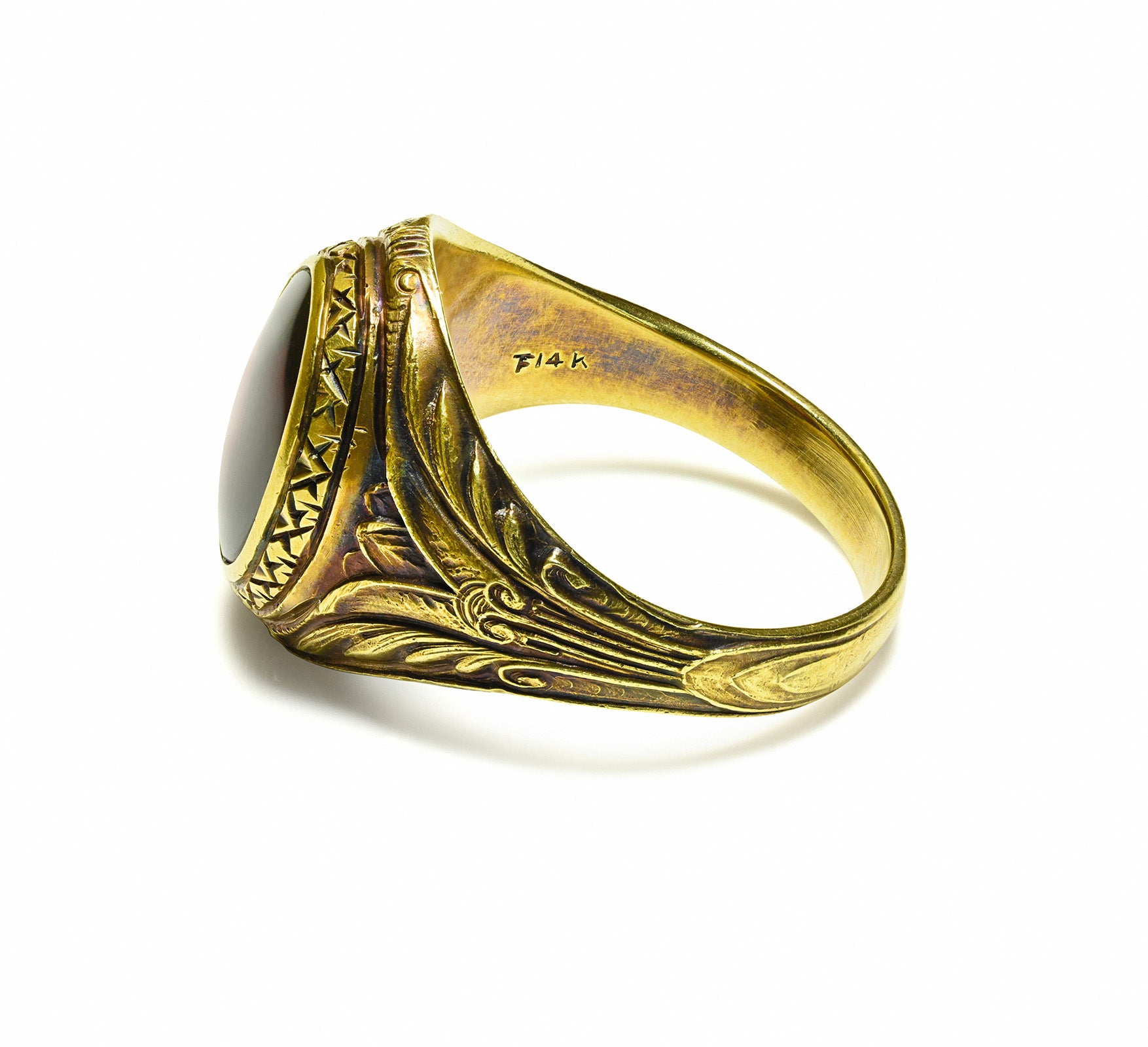
Emerald Sapphire Filigree Gold Ring Attrib. to Louis Comfort Tiffany - DSF Antique Jewelry
Risks and What to Avoid When Investing
While signed antique jewelry can offer strong long-term potential, it is not without risks. Like any collectible market, value depends on knowledge, discernment, and the ability to distinguish truly exceptional pieces from those that are merely attractive.
One of the most common mistakes is assuming that any signed piece is a good investment. As discussed earlier, the name matters—but so does the context. A lesser-known maker or a later commercial piece from a major house may not perform in the same way as a rare, well-documented example from a significant period.
Another key risk is overpaying for retail rather than intrinsic value. Modern jewelry, even when signed, often carries a premium based on branding and current demand. Once it enters the secondary market, that premium can diminish. Antique pieces, by contrast, tend to have already passed through this cycle—but pricing still varies widely depending on quality and rarity.
Condition and alterations are also critical. Repairs, replaced stones, or modified settings can significantly impact value, especially for serious collectors. A piece that appears visually appealing may, upon closer inspection, have lost part of its originality—reducing its long-term desirability.
Closely related is the issue of authenticity and attribution. Signatures can sometimes be misread, worn, or even forged. Without proper expertise, it is possible to misidentify a piece or overestimate its importance. This is why working with experienced dealers or specialists becomes essential.
Another aspect often overlooked is liquidity at different levels of the market. While high-quality signed pieces from major houses tend to resell well, more obscure or borderline items may take longer to place. The stronger and more recognizable the piece, the easier it is to move within the market.
Finally, there is the risk of buying without a clear strategy. Investment-grade jewelry requires selectivity. It is not about acquiring many pieces, but about choosing the right ones—those that combine maker, design, condition, and rarity in a balanced way.
Understanding these risks does not diminish the appeal of antique jewelry as an investment. On the contrary, it reinforces an important principle: knowledge is what transforms a purchase into an informed acquisition.

Fabergé Antique Ruby Diamond Demantoid Basket Brooch by August Holmstrom - DSF Antique Jewelry
How to Start Investing in Signed Antique Jewelry
Entering this market does not necessarily mean starting with the rarest Fabergé object or a major Cartier jewel.
What matters first is understanding that investment-grade jewelry operates within clearly defined price tiers. At the entry level, collectors often begin with smaller signed pieces—brooches, clips, rings, or earrings—from recognized houses. At the higher end, exceptional works by Cartier, Van Cleef & Arpels, Tiffany & Co., Boucheron, Bulgari, and major historical makers such as Fabergé or Lalique can reach six- and seven-figure prices.
The key is not to think of “jewelry” as a single category. A signed antique jewel with strong design, rarity, and provenance behaves very differently from a typical retail piece. In practical terms, buyers should focus on pieces that combine five elements: a respected maker, a recognizable design period, strong condition, originality, and an established market.
What the Market Actually Shows
For collectors considering signed antique jewelry as an investment, theory matters—but market evidence matters more. The clearest way to understand long-term potential is to look at what buyers have already been willing to pay for exceptional signed pieces from the world’s leading houses.
A Belle Époque diamond brooch by Cartier sold for approximately $17 million USD, while another Cartier brooch achieved around $10.6 million USD. Even below the top tier, an Art Deco Cartier necklace reached about $4.8 million USD. These results demonstrate how Cartier pieces can operate at the same level as major collectible art when rarity and design align.
Van Cleef & Arpels follows a similar pattern. A ruby and diamond bracelet realized approximately $4.5 million USD, while an Art Deco emerald and diamond necklace achieved around $4.2 million USD. These figures show consistent demand for high-quality signed pieces from important periods.
Tiffany & Co. also presents strong mid-to-high market performance. A Schlumberger-designed necklace sold for roughly $1.3 million USD, while a sapphire and diamond ring exceeded $1.3 million USD, and a pair of tourmaline and diamond earrings reached approximately $1.27 million USD. This highlights an important point: even outside the ultra-rare category, signed Tiffany pieces can command substantial prices when design and quality are present.
Boucheron, while often more discreet in the market, still delivers strong results. Early twentieth-century pieces, including tiaras and brooches, have achieved prices in the range of $400,000 to $500,000 USD, with certain exceptional examples exceeding that range depending on design and provenance.
At the rarer end of the spectrum, names such as Fabergé and Lalique move into a different category. Here, values are influenced not only by materials, but by historical importance and artistic recognition. Exceptional Fabergé objects, for example, can reach several million dollars, placing them firmly within the realm of museum-level collectibles.
What These Numbers Really Mean
Not every signed jewel will produce dramatic returns—but the market clearly shows where the potential lies. The strongest appreciation occurs when signature, rarity, design, and condition align.
This is why strategy matters. A collector does not need to start at the top of the market—but should think like the top of the market. In practical terms: buy the best name, the best condition, and the strongest design within your budget.
Seen this way, signed antique jewelry is not just a luxury purchase. It is a selective market where the right piece can evolve into a long-term asset—and where historical price performance already demonstrates exactly why.

Cartier Diamond Earrings in Cartier Box - DSF Antique Jewelry
Why Signed Antique Jewelry Offers More Than Financial Return
One of the most compelling aspects of signed antique jewelry as an investment is that it offers something many other assets cannot: the ability to combine financial potential with daily enjoyment, cultural value, and personal meaning.
A share certificate, a bond, or even a gold bar may preserve wealth, but they do not offer the same experience as a signed jewel created by Cartier, Van Cleef & Arpels, Tiffany & Co., or another historic house. These objects can be worn, collected, studied, admired, and passed down. They are assets, but they are also works of design and fragments of history.
This dual character matters. For many collectors, the appeal of signed antique jewelry lies precisely in the fact that value is not purely abstract. A well-chosen piece can hold its market relevance while also becoming part of a personal life—worn on important occasions, kept within a family, or enjoyed as a private object of beauty and craftsmanship.
There is also an emotional resilience in this type of investment. Even when markets fluctuate, the owner still possesses something tangible, portable, and inherently desirable. The value is not dependent on one single function. It rests on materials, authorship, rarity, design, and cultural recognition at the same time.
In that sense, signed antique jewelry occupies a rare position. It is not merely a luxury purchase, nor only a financial asset. It is one of the few categories where beauty, history, and long-term value can exist in the same object—making it especially attractive to collectors who want their investments to be both meaningful and intelligent.
Why High Jewelry Is a Portable Form of Wealth
High jewelry has long held a unique position among tangible assets because it concentrates significant value in a remarkably small and portable form. A signed jewel from Cartier, Van Cleef & Arpels, Tiffany & Co., or Bulgari can embody rarity, craftsmanship, and substantial material worth in an object that can be worn, stored discreetly, and transferred across generations.
This portability has always been part of jewelry’s appeal. Unlike many other collectible assets, important jewels do not require large physical space, specialized display conditions, or institutional ownership to retain meaning and value. They can move easily within private collections and, when properly documented, can also move efficiently within the international market.
For investors, this matters because liquidity is not only about demand—it is also about practicality. Jewelry of this caliber is one of the few categories that combines beauty, cultural significance, and concentrated value in a form that remains highly mobile. That quality has helped explain its enduring appeal among collectors, families, and wealth-preserving buyers for centuries.

Cartier Paris 18K Diamond Earrings Ring - DSF Antique Jewelry
Signed vs Unsigned: Why the Difference in Value Can Be Significant
Two jewels may appear similar in materials, size, and visual impact, yet their market value can differ dramatically depending on whether one is signed by a major house and the other is not.
An unsigned diamond brooch may still be beautiful and well made, but a comparable brooch signed by Cartier, Van Cleef & Arpels, or Tiffany & Co. carries a different level of confidence and recognition. The signed example is easier to authenticate, easier to position within jewelry history, and easier to sell into an established international market.
This difference is not simply about branding. It reflects traceability, authorship, and collector trust. In practical terms, a signature can be the factor that moves a piece from decorative object to documented collectible—and that shift often has a direct effect on price.
For investors, this distinction matters enormously. The market rewards clarity. When origin, maker, and historical relevance are understood, value becomes easier to defend and more likely to grow over time.
The Importance of Provenance and Expertise
In investment-grade jewelry, value does not depend on signature alone. Two signed pieces from the same house can perform very differently depending on provenance, condition, documentation, and the confidence they inspire in the market. This is where expertise becomes essential.
Provenance gives a jewel depth. At its simplest, it may mean an original box, invoice, period certificate, or archival mention. At a higher level, it may involve a traceable ownership history, inclusion in a published collection, or direct association with a known historical figure. These details do more than decorate the story of a piece—they strengthen its position in the market.
Collectors and investors respond to confidence. A signed bracelet is valuable; a signed bracelet that remains in original condition, retains its box, and can be linked to a documented period or collection becomes significantly more compelling. The more complete the picture, the more easily the jewel can be understood, valued, and sold.
Expertise matters for another reason: antique jewelry is rarely straightforward. Signatures may be faint, stones may have been replaced, settings may have been altered, and later repairs can affect originality in ways that are not immediately obvious. Even experienced buyers rely on specialists to assess what is original, what is period-correct, and what has been changed over time.
This is especially important in the upper tier of the market. A Cartier jewel, a Van Cleef & Arpels brooch, or a Bulgari necklace may command strong prices, but only if the piece stands up to scrutiny. Serious buyers want clarity—about authorship, period, condition, and quality. Without that clarity, uncertainty enters the equation, and uncertainty weakens value.
Provenance and expertise also shape liquidity. A well-documented piece from a respected source is easier to place in a collection, easier to present at auction, and easier to resell privately. In other words, they do not merely support value—they help preserve it.
For this reason, the role of the trusted specialist remains central in the world of signed antique jewelry. The best pieces are not simply bought; they are evaluated, contextualized, and understood. And for investors, that understanding can make the difference between acquiring a beautiful jewel and acquiring a truly lasting asset.
A Final Word on Signed Jewelry as an Investment
Signed antique jewelry occupies a rare space in the world of collecting. It is at once wearable, historically significant, materially valuable, and increasingly scarce. That combination is difficult to replicate in any other category of luxury assets.
For the right buyer, the appeal is clear. A well-chosen piece from Cartier, Van Cleef & Arpels, Tiffany & Co., Boucheron, Bulgari, or another major house offers more than beauty alone. It offers authorship, provenance, cultural depth, and the possibility of long-term value growth within an established international market.
Not every jewel will become a major investment piece. But the best examples—those with strong signatures, important design, excellent condition, and real rarity—have already shown why they continue to attract serious collectors. In that sense, signed antique jewelry remains one of the few acquisitions that can be both deeply personal and financially intelligent.

Carl Fabergé Gold Gem-Set Diamond Ruby Sapphire Cufflinks - DSF Antique Jewelry
Frequently Asked Questions About Signed Antique Jewelry as an Investment
Is signed antique jewelry a good investment?
It can be, particularly when the piece comes from a respected high jewelry house, is in strong original condition, and has clear market demand. Signed antique jewelry combines material value with rarity, craftsmanship, and collector recognition, which can support long-term appreciation.
Why does a signature matter so much in jewelry?
A signature confirms origin and connects the piece to a known maker or house. In the case of Cartier, Tiffany & Co., Van Cleef & Arpels, Boucheron, Bulgari, and other major names, that signature represents a long-established reputation for quality, design, and historical importance.
Does all signed jewelry increase in value?
No. The signature alone is not enough. Value depends on the house, the period, the design, the rarity of the piece, its condition, and the level of demand in the market. Some signed pieces remain decorative, while others become highly collectible.
Which houses are considered strongest for investment?
Among the most consistently sought-after are Cartier, Van Cleef & Arpels, Tiffany & Co., Boucheron, and Bulgari. Beyond these, exceptional pieces by Fabergé, Lalique, Buccellati, David Webb, Oscar Heyman, and Castellani can also be highly valuable, especially when rarity and historical importance are strong.
Is antique jewelry a better investment than modern jewelry?
In many cases, yes. Antique jewelry benefits from fixed supply, historical context, and proven collector demand. Modern jewelry may still be beautiful and expensive, but it is often produced within a retail cycle that does not create the same scarcity or long-term market behavior.
What should I look for when buying signed antique jewelry as an investment?
Focus on the maker, design quality, period, condition, originality, and provenance. A well-preserved signed piece with strong visual identity and documentation will usually perform better than a more common or altered piece.
Does provenance really affect price?
Absolutely. Original boxes, invoices, certificates, archival references, or a known ownership history can all strengthen value. Provenance adds confidence, and confidence is one of the most important drivers of demand in high-level collecting.
Can smaller signed pieces still be a good investment?
Yes. Not every investment-grade jewel needs to be a major necklace or tiara. Well-chosen rings, clips, brooches, and earrings from strong houses can offer a much more accessible entry point while still benefiting from signature, rarity, and market recognition.
Is signed antique jewelry easier to resell than unsigned jewelry?
In most cases, yes. Signed pieces from recognized houses such as Cartier, Tiffany & Co., Van Cleef & Arpels, Boucheron, or Bulgari are easier to place in the market because buyers, dealers, and auction houses already understand and value the maker.
Which periods are strongest for investment in signed antique jewelry?
Some of the most sought-after periods include Belle Époque, Art Deco, and important mid-century design. These eras are especially valued because they combine strong visual identity with historical significance and limited surviving supply.
Do original boxes and papers matter?
Yes. Original boxes, fitted cases, invoices, certificates, and archival references can strengthen both credibility and market value. They help support authenticity and make a piece more attractive to serious collectors.
Is condition more important than size?
Very often, yes. A smaller jewel in excellent original condition from a major house can be far more desirable than a larger piece that has been heavily altered, repaired, or stripped of its original character.
Can signed antique jewelry protect wealth over time?
It can help preserve wealth when the piece is chosen carefully. The strongest examples combine intrinsic material value with rarity, authorship, and collector demand, making them more resilient than ordinary luxury purchases.
Are colored gemstone pieces good investments, or only diamonds?
Colored gemstone pieces can be excellent investments, particularly when created by top houses and when the design is strong. Bulgari, Cartier, Van Cleef & Arpels, and Boucheron all produced important jewels centered on sapphires, emeralds, rubies, and other stones that remain highly desirable.
Why do collectors pay more for rare makers such as Fabergé, Lalique, or Castellani?
Because these names carry not only rarity, but artistic and historical importance. Their pieces often occupy a space between jewelry, decorative art, and museum-quality collecting, which can place them in a higher value category.
Should I buy one exceptional piece or several smaller ones?
In most cases, one truly strong piece is the better strategy. Serious collectors tend to focus on quality, maker, condition, and rarity rather than buying multiple average examples.
Can signed antique jewelry outperform gold alone?
In some cases, yes. While gold provides intrinsic material value, signed antique jewelry can command a substantial premium based on maker, rarity, design, and provenance. This means that the value of an important signed piece may rise for reasons that go well beyond metal prices alone.
Is the best investment always the most expensive piece?
Not necessarily. The strongest investment is usually the piece with the best combination of maker, design, condition, rarity, and market recognition. A smaller but exceptional signed jewel may be a far better acquisition than a larger but less important one.
Why do collectors pay premiums for pieces from Cartier, Van Cleef & Arpels, or Tiffany & Co.?
Because these houses represent far more than luxury branding. Their names signal historical importance, design continuity, technical innovation, and proven market demand. Buyers are often willing to pay a premium for that level of confidence and recognition.
Can signed antique jewelry be both wearable and investment-worthy?
Yes. That is one of its greatest advantages. Unlike many other collectible assets, signed antique jewelry can remain personally enjoyable while also functioning as a store of value, provided the piece is chosen carefully and preserved well.