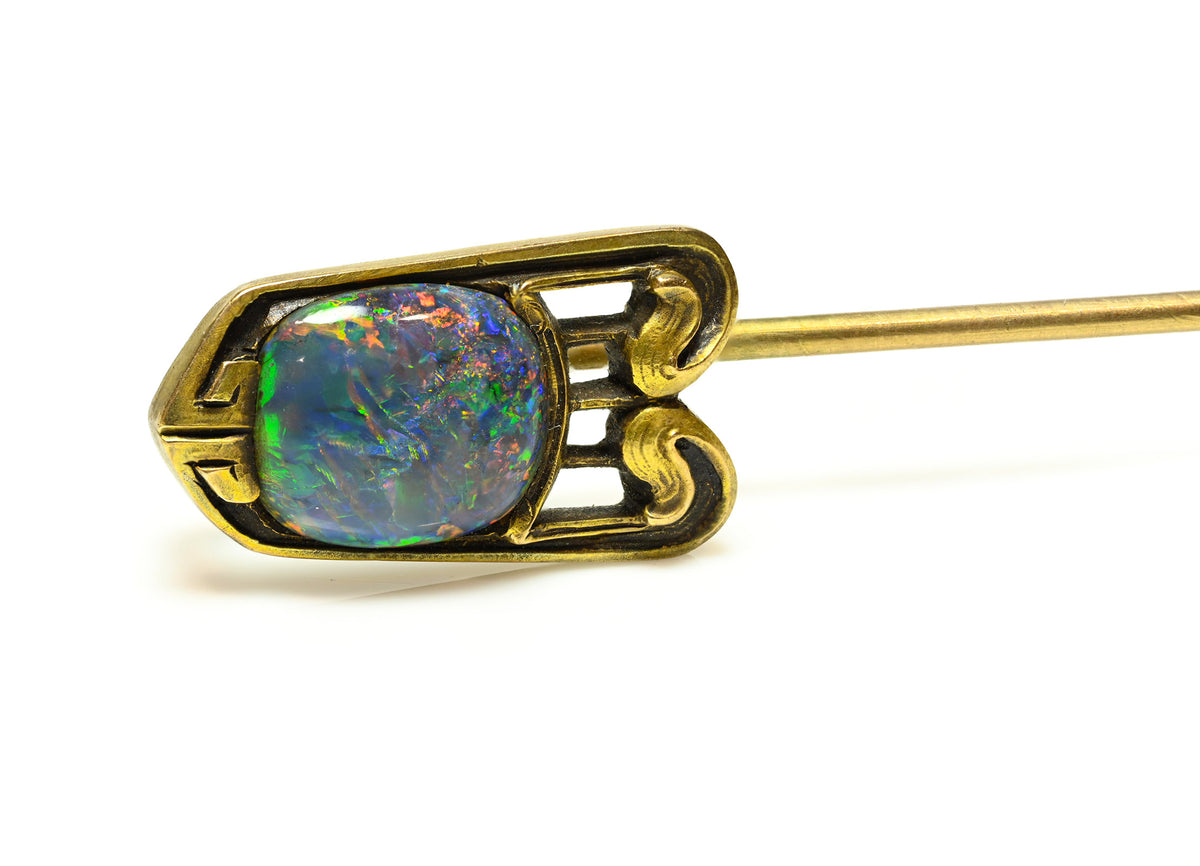
Article: Things You Didn’t Know About Louis Comfort Tiffany Jewelry
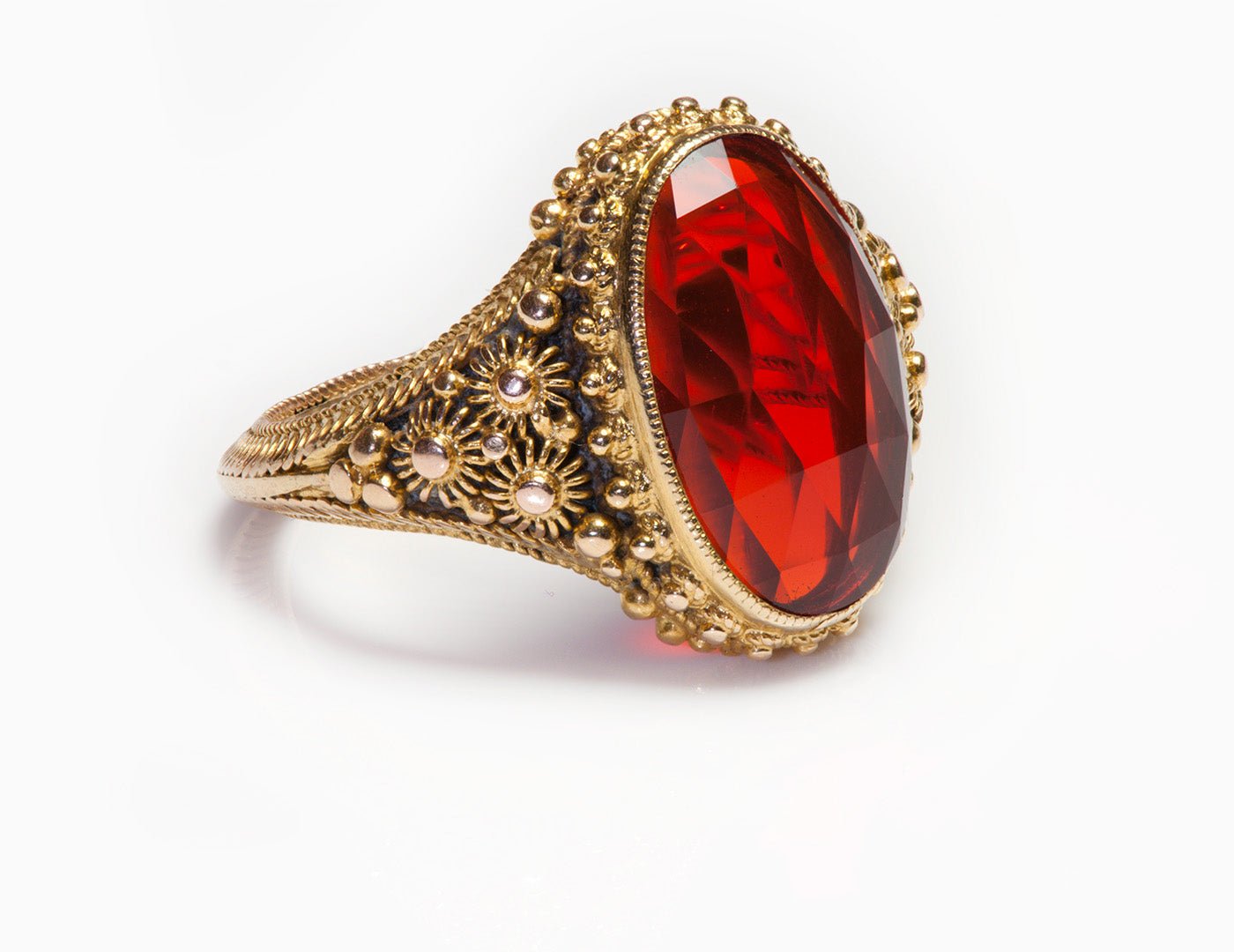
Things You Didn’t Know About Louis Comfort Tiffany Jewelry
Louis Comfort Tiffany did not make jewelry like a man trying to decorate wealth. He made it like a man who had spent his life studying color, glass, flowers, insects, interiors, and light. That difference is the key to understanding his jewels. They are not simply smaller versions of traditional Tiffany luxury. They are fragments of a larger artistic universe, compressed into gold, enamel, stones, and wearable form.
Most jewelry asks to be admired for its materials first. Tiffany’s art jewelry often asks a different question: what can color do? A stone did not need to be the largest or the most conventionally precious to matter. It needed to hold a mood. Enamel could soften metal. Opals could suggest changing light. Garnets, sapphires, moonstones, and other colored stones could become part of a natural scene rather than isolated displays of value. This is why his jewelry still feels difficult to place. It belongs to Tiffany & Co., but it also belongs to the history of American decorative art.
In 1902, after the death of Charles Lewis Tiffany, Louis Comfort Tiffany became the first design director of Tiffany & Co. and established the Tiffany Artistic Jewelry department in the Fifth Avenue store. That moment matters because it placed an artist known for glass, interiors, lamps, and decorative design inside one of the most famous jewelry houses in the world. Tiffany & Co. describes his work as bringing a distinctly American design sensibility to the company’s jewelry and objects.
The result was jewelry with a different kind of presence. It could be botanical, luminous, delicate, exotic, or almost dreamlike. It could use semiprecious stones and enamel with the seriousness usually reserved for diamonds. The Morse Museum makes the contrast especially clear: unlike the extravagant jewelry made under Charles Lewis Tiffany, Louis Comfort Tiffany’s jewelry was distinguished by design and color and was often executed with semiprecious stones and enamels.
That is why the most revealing facts about Louis Comfort Tiffany jewelry are not only biographical. They are hidden in the choices: why he preferred certain colors, why nature became a design language, why enamel mattered, why his jewelry feels connected to glass, and why these pieces seem closer to miniature works of art than ordinary adornment.

At a Glance
- Color mattered more than conventional gemstone prestige.
- Enamel was not background decoration; it helped create atmosphere.
- Nature was treated as a design language, not just a source of motifs.
- His jewelry was connected to his glass, lamps, mosaics, and interiors.
- The Tiffany Artistic Jewelry department gave his vision a formal place inside Tiffany & Co.
- Semiprecious stones were used with unusual seriousness.
- His jewels often feel closer to decorative art than standard luxury jewelry.
- The rarest pieces still attract collectors because they carry an artistic identity, not just a famous signature.
1. He Did Not Enter Jewelry Through Diamonds
Louis Comfort Tiffany did not enter jewelry through the usual door. He was not first known as a diamond merchant, a setter of grand stones, or a designer working inside the strict language of conventional luxury. By the time he gave serious attention to jewelry, he had already built an artistic identity around color, glass, interiors, metalwork, mosaics, lamps, and the decorative possibilities of nature. That background changed the way he understood a jewel.
For many jewelers of the period, the precious stone remained the natural center of gravity. A jewel was often judged by the importance of its diamonds, the rarity of its gems, or the social authority of its materials. Tiffany’s art jewelry moved differently. It did not ignore preciousness, but it refused to let preciousness do all the work. A piece could matter because of color, surface, form, atmosphere, or the relationship between enamel and stone. The jewel did not have to shout value before it could become interesting.
This is one of the reasons his jewelry feels so distinct within the larger Tiffany world. Charles Lewis Tiffany had built a reputation around exceptional luxury, important gemstones, and the authority of one of America’s great jewelry houses. Louis Comfort Tiffany inherited that name, but he did not simply repeat its habits. He brought another discipline into it. The Morse Museum draws the contrast clearly: Louis Comfort Tiffany’s jewelry differed from the extravagant jewelry produced under Charles Lewis Tiffany because it was distinguished by design and color, often using semiprecious stones and enamels.
That difference should not be misunderstood as modesty. Tiffany’s jewelry was not less ambitious because it often turned away from the most obvious forms of luxury. In some ways, it was more demanding. A diamond can dominate a jewel by force. Color has to be composed. Enamel has to be controlled. A semiprecious stone has to be made meaningful through placement, contrast, and mood. Tiffany’s best pieces depend on those quieter decisions. They ask the eye to notice not only what the materials are, but what they are doing.
This is where his work begins to feel closer to decorative art than to ordinary jewelry. The Met describes Tiffany as an artist who excelled across many media, including glass, mosaics, enamels, metalwork, ceramics, and jewelry. That range matters. His jewels were not isolated experiments inside a jewelry department; they were part of a larger artistic system. The same mind that cared about iridescence in glass could care about the glow of an opal. The same eye that understood a stained-glass window could understand how colored stones might create rhythm across a brooch or necklace.
Seen this way, Louis Comfort Tiffany jewelry becomes easier to understand. It was not anti-luxury. It was anti-obvious luxury. It did not reject precious materials, but it refused to make them the only source of meaning. His jewels are most interesting when they behave like small decorative worlds: a flower made of enamel, a stone chosen for atmosphere, a surface that catches light, a natural motif that feels observed rather than merely applied.
That is why the first thing to know about Louis Comfort Tiffany jewelry is not a date or a title. It is a change in attitude. He approached jewelry as a colorist, a designer, and a maker of atmosphere. The jewel was not simply a setting for wealth. It was a place where light, nature, material, and imagination could meet.

2. Color Was the Real Luxury
For Louis Comfort Tiffany, color was not an afterthought. It was not something added once the form had already been decided, nor a pleasant decoration placed around a valuable stone. Color was the central event. It shaped the mood of the jewel, guided the eye, and often gave the piece its reason for existing.
This is one of the most important differences between Tiffany’s art jewelry and more conventional luxury jewelry of the same period. Many jewelers used color to enhance value: a ruby for richness, a sapphire for depth, an emerald for prestige. Tiffany used color more like a painter or glassmaker. He cared about how colors breathed next to one another, how one surface could soften another, how a jewel could feel warm, strange, luminous, or alive before the viewer even began to measure its material worth.
That instinct came naturally from his larger artistic world. Tiffany’s name is inseparable from stained glass, Favrile glass, lamps, windows, and interiors, all of which depend on color behaving with emotional force. The Metropolitan Museum of Art notes that Tiffany is best known for his achievements in glass, especially his vividly colored windows and lamps, but that he also worked across mosaics, enamels, metalwork, ceramics, and jewelry. That matters because his jewelry did not develop in isolation. It belonged to the same lifelong study of light, hue, texture, and surface.
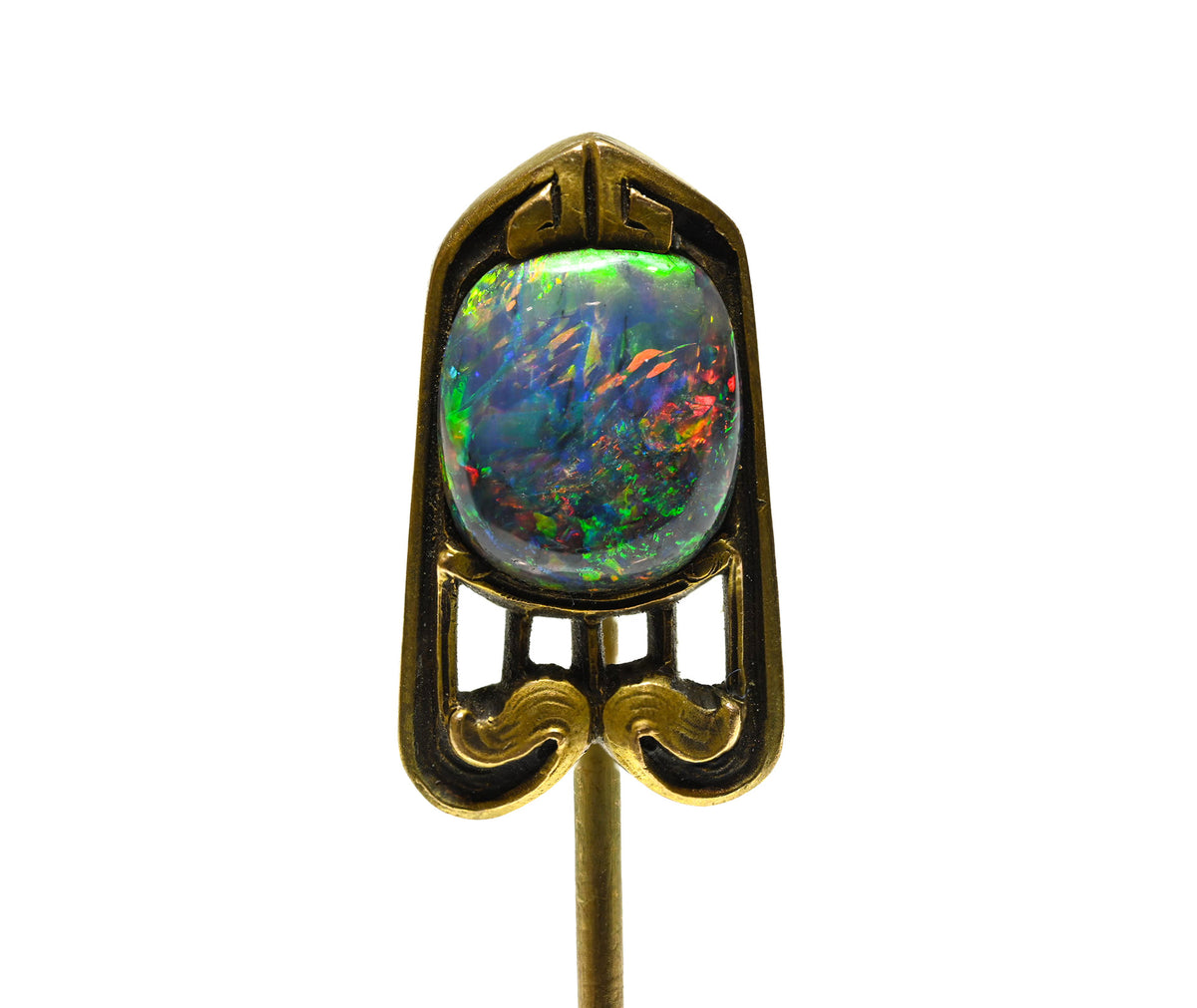
In a Louis Comfort Tiffany jewel, color could come from many places at once. It might come from enamel, from an opal’s shifting fire, from a garnet’s deep red, from amethyst, moonstone, sapphire, or another semiprecious stone chosen less for social rank than for visual character. This made the jewelry feel more atmospheric than declarative. Instead of saying, “Look how expensive this is,” it often seemed to ask, “Look how this color changes the feeling of the whole piece.”
The Morse Museum’s description of his jewelry makes this point especially clear. It contrasts Louis Comfort Tiffany’s pieces with the more extravagant jewelry produced under Charles Lewis Tiffany and states that Louis’s jewelry was distinguished by design and color, often using semiprecious stones and enamels. That single contrast explains much of his originality. He did not need color to support luxury. Color itself became the luxury.
This is why his jewels can feel surprisingly modern. Modern taste often values personality, artistic vision, and material intelligence as much as obvious preciousness. Tiffany was already working in that direction more than a century ago. He understood that a jewel could be powerful without being dominated by diamonds, and that a semiprecious stone could become unforgettable if its color was used with imagination.
There is also a quiet discipline behind that freedom. Color can easily become chaotic. Too many stones, too many tones, too much enamel, and a jewel begins to feel crowded. Tiffany’s best pieces avoid that problem because the color is not random. It is arranged. It has rhythm. A brooch or necklace might combine enamel and stones in a way that feels botanical, exotic, or almost dreamlike, but the effect usually remains controlled. The color is expressive, not careless.
Christie’s describes Louis Comfort Tiffany’s jewelry as characterized by intense colors, unusual stones, and exotic motifs, and notes that these jewels have become highly prized by collectors. That collector appeal is not difficult to understand. These pieces are not merely signed Tiffany objects. They carry a visual identity that is hard to confuse with anyone else’s work.
Color also allowed Tiffany to make jewelry feel connected to nature without simply copying nature. A flower did not need to be rendered in a literal botanical way. It could be suggested through a harmony of greens, purples, blues, or fiery reds. An insect could become a study in iridescence. A fruit or berry could be evoked through stones that looked ripe, glowing, or slightly mysterious. In these moments, Tiffany’s jewelry becomes less about depiction and more about sensation.
That is why color in Louis Comfort Tiffany jewelry should not be treated as decoration. It is structure. It is meaning. It is the link between his jewelry and his windows, between his enamel and his glass, between his natural motifs and his decorative imagination. In his hands, color did not simply beautify the jewel. It gave the jewel its inner life.

3. The Tiffany Artistic Jewelry Department Was a Turning Point
The creation of Tiffany Artistic Jewelry was not just an administrative detail inside Tiffany & Co. It was the moment Louis Comfort Tiffany’s private artistic language entered the structure of the family company in a formal way. Until then, he had largely followed his own path, building a reputation through glass, interiors, mosaics, metalwork, and decorative design rather than simply joining the jewelry business founded by his father. That separation is important. It helps explain why his jewelry did not feel like a continuation of ordinary Tiffany luxury, but like the arrival of a different imagination inside the house.
In 1902, after the death of Charles Lewis Tiffany, Louis Comfort Tiffany was appointed the first design director of Tiffany & Co. In that role, he established the Tiffany Artistic Jewelry department in the Fifth Avenue store. Tiffany & Co. describes this as the place where his innovative designs were created, bringing what the company calls his distinctly American design sensibility to its jewelry and objects.
That phrase, “Artistic Jewelry,” matters more than it may seem. It suggests that these pieces were not meant to be understood only as commercial jewels. They belonged to a category where jewelry could be judged by design, imagination, color, and craftsmanship as much as by the intrinsic value of its materials. This was not a rejection of luxury. It was a widening of what luxury could mean.
The Morse Museum’s collection helps clarify the importance of this department. Its permanent gallery includes pieces of jewelry designed for the new art jewelry division that Tiffany established at Tiffany & Co. after his father’s death in 1902. The museum also highlights a necklace designed for exhibition between 1903 and 1906, featuring a peacock mosaic of opals on the front disc and an enameled flamingo motif on the reverse, describing it as arguably Tiffany’s most important surviving jewelry work.
That necklace reveals exactly why the department mattered. It was not simply a necklace in the ordinary sense. It brought together opal, enamel, bird imagery, color, and exhibition-level ambition. The front and reverse were both treated as meaningful surfaces. The jewel was not just built to sit on the body; it was built to be studied. It belonged to the world of objects that ask for close looking.
This also explains why Louis Comfort Tiffany jewelry can feel rarer than people expect. Tiffany & Co. is one of the most famous jewelry names in the world, but Louis Comfort Tiffany’s art jewelry represents a specific and comparatively narrow creative moment within that larger history. It was tied to his personal artistic direction, to the early years after 1902, and to a department created for a different kind of jewelry than the company’s more conventional production.
The department gave Tiffany a place to translate his larger artistic ideas into wearable form. A lamp could become a study of glowing color; a window could become an arrangement of light and nature; a jewel could become something similar on a smaller scale. The materials were different, but the underlying impulse was the same. He was still asking how color, surface, and natural form could create emotion.
That is why the Tiffany Artistic Jewelry department deserves attention in any serious discussion of Louis Comfort Tiffany jewelry. It marks the point where biography, family legacy, company history, and artistic experiment all meet. Without it, these jewels might seem like a side project. With it, they become something more important: a deliberate attempt to make jewelry part of Louis Comfort Tiffany’s broader decorative art vision.

4. His Jewels Belong to the Same World as His Glass
It is almost impossible to understand Louis Comfort Tiffany jewelry without thinking about glass. Not because the jewels were simply imitations of his lamps or windows, but because they came from the same artistic instinct. Tiffany spent his life exploring what happens when color, light, texture, and natural form are treated as serious design materials. Jewelry gave him another surface on which to continue that experiment.
His glass was never just glass in the plain sense. Favrile glass, stained-glass windows, mosaics, and lamps allowed him to work with color as something alive and changeable. The Metropolitan Museum of Art describes Tiffany’s Favrile glass as having variegated shades, tonal gradations, lines, textures, and densities within the material itself, allowing his craftsmen to use the natural qualities of glass almost like pictorial detail. That idea is essential to his jewelry too. A stone or enamel surface could be chosen not merely for value, but for the way it held light, shifted color, or suggested organic life.
This is why opals appear so naturally in the world of Louis Comfort Tiffany jewelry. They behave almost like miniature pieces of glass: unstable, luminous, layered, and difficult to reduce to a single color. A diamond flashes; an opal changes. For an artist trained by glass, that difference mattered. The Morse Museum highlights one of Tiffany’s most important surviving jewelry works, a necklace designed between 1903 and 1906, with a peacock mosaic of opals on the front and an enameled flamingo motif on the reverse. That is not a conventional way to think about a necklace. It is closer to a tiny decorative panel, with front and back treated as meaningful artistic surfaces.
The connection becomes even clearer when looking at Tiffany’s grape-cluster necklace in The Met collection, one of the earliest known examples of jewelry designed by him. The piece uses tiny black opals to represent clusters of fruit, while green enameling on gold forms delicate leaves. This is jewelry thinking like nature, but also like glass: color becomes structure, surface becomes atmosphere, and the material is chosen for the visual sensation it can create.
That is what separates Tiffany’s jewelry from ordinary naturalistic ornament. Many jewelers used flowers, leaves, insects, and fruit as attractive motifs. Tiffany’s pieces often seem less interested in copying nature than in translating its effects. A grape cluster is not only a grape cluster; it is a study in dark opalescence. A leaf is not only a leaf; it is an excuse for enamel to turn gold into something softer, greener, and more alive. A bird or insect is not only a motif; it becomes a place where color can move.
His jewelry also shares with his glass a fascination with the boundary between material and illusion. In a lamp, pieces of glass could suggest water, petals, twilight, or foliage. In a jewel, stones and enamel could perform a similar transformation on a smaller scale. The body changed, the scale changed, but the ambition remained close: to make material feel atmospheric.
This is why Louis Comfort Tiffany’s jewelry should not be treated as a minor branch of his career. It is one of the most concentrated forms of his imagination. A lamp has space to spread out. A window can fill a room with light. A jewel has only a few inches, sometimes less. Yet within that small space, Tiffany could still create the same kind of world: botanical, luminous, textured, and full of color that seems to come from inside the material rather than simply sitting on top of it.
The best way to read these jewels is not only as jewelry, but as portable decorative art. They carry the logic of glass into gold, enamel, and stone. They show how deeply Tiffany believed that beauty was not just a matter of preciousness, but of perception — how a surface glows, how a color shifts, how nature becomes design, and how light can make even a small object feel alive.

5. Nature Was Not Decoration — It Was the Structure
Nature was everywhere in Louis Comfort Tiffany’s work, but not in a casual way. He did not use flowers, leaves, insects, and fruit simply because they were pretty. For him, nature offered a complete design system: line, color, rhythm, movement, asymmetry, texture, and mood. A vine could suggest the movement of a necklace. A flower could determine the color logic of a brooch. An insect wing could become a reason to study iridescence. A cluster of fruit could organize stone, enamel, and gold into one living surface.
This is one of the reasons his jewelry belongs so naturally to Art Nouveau, while still retaining a very personal identity. Art Nouveau artists often turned to the natural world, but Tiffany’s approach was shaped by his own deep involvement with American landscape, gardens, glass, and decorative interiors. His jewelry does not feel like nature pasted onto metal. It feels like nature translated through an artist who had spent decades watching how plants, light, and color behave.
Tiffany & Co. describes his jewelry and objects as inspired by flowers, foliage, fruits, insects, and the American landscape, and notes that he brought a distinctly American design sensibility to the company after becoming its first design director. That matters because his naturalism was not merely borrowed from European Art Nouveau. It was filtered through his own experience of American decorative art and his lifelong interest in organic form.
His grape-cluster necklace at The Metropolitan Museum of Art is a particularly revealing example. Instead of treating fruit as a simple motif, Tiffany used tiny black opals to form clusters of grapes and green enamel on gold to create leaves. The result is not only a necklace with a botanical subject. It is a jewel whose entire construction depends on the idea of fruit, vine, color, and growth. The motif does not sit on top of the jewel; it organizes it.
That distinction is important. In ordinary naturalistic jewelry, a flower or leaf can remain decorative, almost like an applied ornament. In Tiffany’s work, the natural form often shapes the piece from within. The way a stem curves, the way leaves spread, the way grapes cluster, or the way a wing catches color can determine how the jewel moves across the body. Nature becomes structure, not surface.
This also explains why his jewelry can feel intimate rather than grand in the usual sense. A Louis Comfort Tiffany jewel often asks the viewer to come close and notice small transitions: enamel moving from one shade to another, stones arranged like seeds or berries, a natural form simplified without losing its life. The effect is not botanical accuracy alone. It is botanical atmosphere.
His interest in insects reveals the same logic. Insects had long fascinated Art Nouveau designers because their bodies offered pattern, symmetry, iridescence, and strangeness. Tiffany understood those qualities perfectly. A dragonfly or beetle was not just an exotic creature to be placed on a brooch. It was a vehicle for color, wing structure, shimmer, and delicacy. It allowed jewelry to become both natural and slightly unreal.
Flowers worked differently but just as powerfully. They gave Tiffany a way to soften metal and make color feel inevitable. Enamel could become a petal. A stone could become the center of a bloom. Gold could become a stem, outline, or hidden support. The jewel did not need to declare its value aggressively because its beauty came from the coherence of the natural idea.
This is why Louis Comfort Tiffany jewelry still feels alive. The natural motifs are not frozen symbols. They retain movement. They seem to grow, bend, open, cluster, or shimmer. Even when the object is completely still, the design suggests change: a flower opening, fruit ripening, wings catching light, leaves turning toward the sun.
To say that Tiffany used nature as inspiration is true, but too weak. He used nature as an organizing intelligence. It gave his jewelry its shapes, its colors, its emotional temperature, and often its entire reason for being. In his hands, a jewel was not merely decorated with nature. It was built from the idea of nature.

6. Enamel Gave the Metal a Different Voice
Enamel was one of the reasons Louis Comfort Tiffany’s jewelry could escape the usual language of metal. Gold, by itself, carries weight, shine, and authority. Silver has its own coolness and restraint. But enamel allowed Tiffany to make metal behave differently. It could become softer, greener, stranger, more botanical, more atmospheric. It could turn a hard surface into something that seemed closer to leaf, petal, skin, wing, or colored light.
That mattered because Tiffany was not interested in jewelry as metal plus stones alone. He was interested in surfaces that could hold mood. Enamel gave him a way to place color directly onto metal, not as a secondary accent, but as part of the emotional structure of the piece. A jewel could become less about brilliance and more about tone. The eye would not move only from gem to gem. It would pause over the colored ground, the transitions, the softening of edges, the way enamel changed the temperature of the entire object.
The Morse Museum makes this connection especially important. It notes that Tiffany’s art jewelry and enamel departments were closely allied, and that Julia Munson, who became head of the Tiffany & Co. art jewelry department in 1903 and helped fabricate the celebrated Peacock necklace, began her career with Louis Comfort Tiffany in the enamels area. The same source explains that Tiffany began producing enamelware in 1898 and was drawn to enamel because it offered exciting new color possibilities. That detail tells us a great deal. Enamel was not a decorative afterthought in his jewelry world. It was part of the workshop culture from which the jewelry emerged.
This also helps explain why Tiffany’s jewelry often feels so closely related to his other decorative arts. Enamel sits somewhere between metalwork and glass. It is applied to metal, but its surface can have a glass-like depth and luminosity. For an artist so deeply associated with glass, that must have been irresistible. Enamel allowed him to bring the language of color and light into objects that were smaller, denser, and more intimate than windows or lamps.
In the grape-cluster necklace at The Metropolitan Museum of Art, this becomes visible in a beautifully clear way. The necklace uses tiny black opals to represent clusters of fruit, while finely executed green enameling on gold forms the leaves. The enamel is not just there to fill space. It makes the leaves feel alive. It gives the gold a botanical identity, transforming it from precious metal into something that seems to grow around the stones.
That transformation is one of the keys to Tiffany’s originality. Without enamel, many natural motifs risk becoming merely outlined in metal. With enamel, they gain atmosphere. A leaf can feel shaded. A flower can feel softer. A wing can suggest iridescence. A jewel can move closer to the visual world of glass, painting, and nature without losing its identity as jewelry.
Enamel also gave Tiffany a way to make semiprecious stones feel more important. A modest stone can look isolated if it is placed in a conventional setting with nothing around it except polished metal. But when color surrounds it — when enamel prepares the mood, extends the palette, or echoes the stone’s natural tone — the stone becomes part of a larger composition. This is why his jewels rarely feel like simple arrangements of materials. They feel composed.
The Metropolitan Museum of Art notes that Tiffany’s jewelry gained favorable attention from critics of the period, and that his interest in nature, semiprecious stones, enamel, and handcraftsmanship helped elevate these unusual jewels to the status of art. That statement captures the real role of enamel in his work. It was one of the materials that helped move the jewel away from ordinary luxury and toward decorative art.
There is also something very modern in this use of enamel. It resists the idea that value must always be transparent, faceted, and measurable. Enamel is not valued like a diamond. It depends on color, labor, control, and the sensitivity of its application. It asks the viewer to appreciate surface rather than size. For Tiffany, that was not a limitation. It was freedom.
In his hands, enamel changed the voice of metal. It made gold less hard, less declarative, less fixed. It allowed jewelry to become more painterly, more botanical, more connected to atmosphere. That is why enamel is not a side detail in Louis Comfort Tiffany jewelry. It is one of the reasons these pieces still feel alive.
7. He Made Semiprecious Stones Feel Serious
One of the most revealing things about Louis Comfort Tiffany jewelry is the way it treats semiprecious stones. In much of traditional high jewelry, semiprecious stones can be treated as supporting actors, useful for color but rarely allowed to define the intellectual character of a piece. Tiffany’s jewelry challenged that hierarchy. He did not choose stones only because they were conventionally prestigious. He chose them because they could create an effect.
That was a quiet but important shift. A large diamond or ruby carries inherited authority. Its value is understood before the design even begins. A moonstone, opal, garnet, amethyst, lapis lazuli, or other colored stone has to earn attention differently. It depends on color, placement, texture, glow, and the imagination of the design around it. Tiffany understood this perfectly. He knew that a stone did not have to dominate through price if it could transform the atmosphere of the jewel.
The Metropolitan Museum of Art makes this point directly, noting that Tiffany preferred semiprecious stones, often in ingenious settings, over the large fashionable gems favored by Tiffany & Co. That contrast is essential. Louis Comfort Tiffany was not working against the family house so much as expanding its vocabulary. He showed that a jewel could be important because of artistic intelligence, not only because of gemological rank.
This approach gave his jewelry a different emotional range. Opals could bring instability and shimmer, suggesting light caught inside a living surface. Garnets could become fruit, berries, or deep accents of warmth. Amethysts could introduce a violet gravity that felt more mysterious than showy. Lapis lazuli could carry an ancient or exotic mood. These stones were not chosen as cheaper substitutes for diamonds. They were chosen because they could say things diamonds could not.
The grape-cluster necklace in The Met collection is one of the clearest examples. It is composed of clusters of fruit and leaves, with tiny black opals representing the grapes and green enamel forming the leaves. The point is not simply that the necklace uses opals. The point is that the opals behave visually like fruit: dark, rounded, shifting, and alive with color. The stone becomes part of the idea, not merely part of the inventory.
This is why Tiffany’s use of semiprecious stones feels so sophisticated. He did not ask them to imitate more expensive gems. He let them be themselves. Their irregularities, their softness, their strange color effects, and their atmospheric qualities became strengths. In his hands, a semiprecious stone could feel more poetic than a perfect diamond because it carried mood instead of only brilliance.
The Morse Museum also emphasizes this aspect of his jewelry, describing his innovative creations as largely executed with semiprecious stones and enamels, and distinguished above all by design and color. That combination is crucial. The stones mattered because they worked inside a larger design language. Their importance came from the way they joined enamel, metal, natural motifs, and color into a complete artistic statement.
There is also a collector’s reason this matters today. Louis Comfort Tiffany jewelry does not appeal only because it is rare, signed, or connected to Tiffany & Co. It appeals because it represents a different definition of value. Christie’s describes these jewels as characterized by intense colors, unusual stones, and exotic motifs, and notes that they have become highly prized by collectors. That reputation rests not on conventional gemstone hierarchy, but on visual identity.
In this sense, Tiffany anticipated a more modern way of looking at jewelry. Today, collectors often respond to design, originality, color, provenance, and artistic authorship as much as to carat weight. Tiffany was already working in that spirit. His jewels remind us that a stone can be important because it is expressive, not only because it is rare in the marketplace.
That is why semiprecious stones are not a secondary detail in Louis Comfort Tiffany jewelry. They are central to its intelligence. They allowed him to move away from predictable luxury and toward something more personal: jewelry built from color, nature, surface, and feeling. In his world, a stone became precious not only because of what it was, but because of what it could become inside the design.
8. The Pieces Could Be Small but Never Minor
Louis Comfort Tiffany’s jewelry is often physically small when compared with his lamps, windows, interiors, and architectural commissions. A brooch, necklace, pendant, or hair ornament occupies only a limited space. Yet that smallness can be misleading. In many cases, the jewel is not a reduced version of a larger idea. It is the idea made more concentrated.
This is especially important when thinking about Tiffany as a decorative artist. His better-known works often surround the viewer. A stained-glass window fills a wall with color. A lamp changes the atmosphere of a room. An interior can organize an entire experience of space. Jewelry has none of that scale. It must create its effect quickly and intimately, within the limits of the body. That is why his jewels can feel so intense. There is no room for empty gesture.
The Morse Museum’s description of Tiffany’s peacock necklace makes this point especially clear. Designed for exhibition between 1903 and 1906, the necklace features a peacock mosaic of opals on its front disc and an enameled flamingo motif on the reverse. The museum describes it as arguably Tiffany’s most important surviving work in jewelry and notes that it was one of only two jewelry pieces illustrated in Charles de Kay’s 1914 authorized biography, The Art Work of Louis Comfort Tiffany.
That detail is revealing. A necklace important enough to appear in an authorized study of Tiffany’s art was not being treated merely as accessory. It was part of his artistic record. The front was not the only meaningful surface; even the reverse carried an enameled design. That choice says a great deal about how seriously Tiffany took the medium. A conventional jeweler might hide the back. Tiffany turned it into another place for color and imagination.
The same is true of his grape-cluster necklace in The Metropolitan Museum of Art. It uses tiny black opals for clusters of grapes and green enamel on gold for the leaves. The materials are precious, but the real power of the piece lies in its compression. Fruit, vine, surface, light, and color are all gathered into a single wearable object. The necklace does not need monumental scale because its artistic logic is complete.
This is one of the quiet strengths of jewelry as a medium. It asks for closeness. A lamp can impress from across a room, but a jewel often rewards the person who studies it at short distance. Tiffany understood that intimacy. His jewels are made for looking slowly: the shift of an opal, the edge of enamel, the rhythm of leaves, the way a natural form becomes design without losing its sense of life.
Small scale also intensified the relationship between material and handcraft. The Met notes that Tiffany’s interest in nature, semiprecious stones, enamel, and handcraftsmanship helped elevate his unusual jewelry to the status of art. That phrase matters here because handcraft becomes even more visible in a small object. Every decision is exposed. A misplaced color, a weak line, or an ordinary setting would immediately flatten the effect.
This may be why the best Louis Comfort Tiffany jewels feel so complete. They do not seem like sketches for larger decorative works. They are finished worlds in themselves. A flower, insect, fruit cluster, or bird motif could carry the same seriousness as a window or vase, only in a more private form. The viewer does not enter the work physically, as with an interior, but visually and emotionally.
That is why these pieces should not be treated as side notes to Tiffany’s career. Their scale is modest, but their ambition is not. They show how much of his artistic vision could survive reduction: the love of nature, the belief in color, the use of unusual materials, the patience of handcraft, and the desire to make surface feel alive.
In Louis Comfort Tiffany jewelry, small did not mean secondary. It meant concentrated. The jewel became a private version of his larger world — not a fragment left over from glass and interiors, but a complete artistic statement made small enough to wear.
9. His Jewelry Was Tiffany & Co., but Not Ordinary Tiffany & Co.
Louis Comfort Tiffany jewelry carries one of the most famous names in American luxury, but it should not be confused with ordinary Tiffany & Co. production. That distinction is essential. The name creates immediate recognition, yet the jewelry itself often belongs to a more experimental world than people expect from a major luxury house.
Tiffany & Co. had already become a symbol of refinement, gemstones, silver, and high-end American taste long before Louis Comfort Tiffany took a formal design role. Charles Lewis Tiffany built the company’s reputation through commercial discipline, important materials, and a powerful understanding of luxury. Louis inherited that legacy, but he did not simply continue it in the same direction. His jewelry added a more personal artistic vocabulary to the house.
That is why his work can feel like a meeting point between two identities. On one side stands Tiffany & Co., the great American jewelry firm. On the other stands Louis Comfort Tiffany, the decorative artist of glass, color, interiors, lamps, enamel, and organic design. His jewelry belongs to both, but it is fully explained by neither one alone.
In 1902, after the death of Charles Lewis Tiffany, Louis Comfort Tiffany became the company’s first design director and established the Tiffany Artistic Jewelry department. That department gave his artistic vision a formal place within Tiffany & Co., but the phrase “Artistic Jewelry” already suggests a difference from ordinary commercial jewelry. These pieces were meant to carry design identity, not simply material prestige.
This distinction also helps explain why his jewelry is relatively rare and so closely watched by collectors. Tiffany & Co. produced jewelry in many categories, but Louis Comfort Tiffany’s art jewelry represents a narrower and more specific creative chapter. It was tied to his personal design direction and to a period when the house made space for jewelry that behaved almost like miniature decorative art.
The Morse Museum’s comparison is especially useful here. It notes that Louis Comfort Tiffany’s jewelry differed from the extravagant jewelry produced under Charles Lewis Tiffany because it was distinguished by design and color, and was often executed with semiprecious stones and enamels. That is not a small difference. It marks a change in what the jewelry was trying to accomplish.
A conventional Tiffany jewel might be admired first for its diamond, sapphire, pearl, or fine metalwork. A Louis Comfort Tiffany jewel often asks to be understood through its composition. The color matters. The enamel matters. The natural motif matters. The mood matters. The stone may be important, but it does not always dominate. The piece is less interested in displaying wealth directly than in creating an artistic effect.
This is what makes the work so interesting inside the larger Tiffany story. It expands the idea of what Tiffany jewelry could be. It shows that the house was not only capable of producing luxury objects, but also of becoming a space for artistic experiment. Louis Comfort Tiffany did not erase the prestige of the name; he complicated it.
That complexity is part of the appeal today. Collectors are not looking at these jewels only as Tiffany signatures. They are looking at them as expressions of a particular hand, eye, and philosophy. The jewelry carries the company name, but also the unmistakable atmosphere of Louis Comfort Tiffany’s world: color before convention, nature before formality, surface before spectacle, and design before simple display.
In that sense, Louis Comfort Tiffany jewelry occupies a special position. It is Tiffany & Co., but not ordinary Tiffany & Co. It is luxury, but not predictable luxury. It is jewelry, but it also belongs to the wider story of American decorative art. That tension is precisely what makes it so valuable to understand.
10. Why Louis Comfort Tiffany Jewelry Still Feels Unusual Today
Louis Comfort Tiffany jewelry still feels unusual because it does not fit neatly into one category. It is jewelry, but it is also decorative art. It is Tiffany & Co., but it is not ordinary Tiffany & Co. It belongs to the Art Nouveau period, but it carries a distinctly personal and American sensibility. It uses precious materials, yet often refuses to place conventional preciousness at the center of the design.
That is why these pieces continue to attract attention. They are not only beautiful objects from a famous name. They challenge the viewer to think differently about value. In Tiffany’s jewelry, value is not limited to diamonds, rarity, or scale. It can come from color, enamel, mood, surface, natural form, and the intelligence of the composition. A small jewel can feel important because every element belongs to a larger artistic idea.
This is also why the pieces feel surprisingly contemporary. Modern collectors often look for more than luxury. They look for individuality, authorship, design identity, and a point of view. Louis Comfort Tiffany offered all of that more than a century ago. His jewelry does not feel anonymous. It has a recognizable atmosphere: luminous, botanical, slightly dreamlike, and deeply connected to the decorative arts.
The rarity of the work strengthens that impression, but rarity alone is not the reason these jewels matter. Many rare jewels exist. Fewer carry such a clear artistic philosophy. Tiffany’s jewelry shows a maker thinking across disciplines — glass, enamel, metalwork, gemstones, interiors, and nature — and compressing those interests into wearable objects.
That cross-disciplinary quality is one reason his jewelry remains so rewarding to study. A brooch may echo the color logic of stained glass. A necklace may feel related to mosaic. Enamel may bring the jewel close to glass. A gemstone may be chosen less for rank than for atmosphere. These details make the work feel layered rather than merely decorative.
Louis Comfort Tiffany’s jewelry also asks us to slow down. It rarely gives everything away at first glance. Its beauty often lies in transitions: one color against another, enamel against gold, opal against natural form, surface against light. The longer one looks, the more intentional the choices become. That slow reveal is part of its power.
In the end, what makes Louis Comfort Tiffany jewelry unusual is not one technique or one motif. It is the way all the parts work together. Nature, color, enamel, semiprecious stones, handcraft, and decorative imagination become inseparable. The jewel becomes a small object with a large artistic world behind it.
That may be the best way to understand these pieces today. They are not simply collectible Tiffany jewels. They are evidence of an artist who believed jewelry could do more than decorate the body. It could hold light, suggest nature, carry atmosphere, and turn material into feeling.
What Louis Comfort Tiffany Jewelry Reveals
Louis Comfort Tiffany jewelry reveals something that is easy to miss if one looks only at the Tiffany name. These pieces are not important simply because they belong to a famous American house. They are important because they show a different way of thinking about jewelry. Instead of treating a jewel as a display of wealth first and an artistic object second, Tiffany allowed design, color, nature, and atmosphere to take the lead.
That is the thread running through all of his jewelry. A stone did not have to be conventionally supreme if it had the right color. Enamel did not have to remain a decorative accent if it could shape the entire mood of the piece. A flower, insect, bird, or cluster of fruit did not have to be a pretty motif if it could become the structure of the jewel itself. Tiffany’s great strength was not simply choosing beautiful materials. It was making those materials participate in a larger artistic idea.
This is why his jewelry still feels so distinct. It does not behave like jewelry made only to impress at a distance. It invites close looking. It rewards attention. The more one studies the relationship between enamel, stone, gold, color, and natural form, the more deliberate the work becomes. Nothing feels merely added. The best pieces seem grown rather than assembled.
Louis Comfort Tiffany brought into jewelry the same imagination that shaped his glass, lamps, windows, mosaics, and interiors. That is why his jewels can feel luminous even when they are not large. They carry the memory of light. They carry the logic of nature. They carry the hand of an artist who understood that beauty could come from suggestion as much as from spectacle.
For collectors, historians, and lovers of antique jewelry, this is what makes his work so rewarding. Louis Comfort Tiffany jewelry is not only a chapter in Tiffany & Co. history. It is a chapter in the history of American decorative art. It shows how a jewel can become more than adornment: a small, wearable world of color, craft, and imagination.
Frequently Asked Questions About Louis Comfort Tiffany Jewelry
What is Louis Comfort Tiffany jewelry best known for?
Louis Comfort Tiffany jewelry is best known for its use of color, enamel, nature-inspired motifs, and semiprecious stones. Unlike more conventional luxury jewelry of the period, his pieces often placed artistic design above the simple display of diamonds or expensive gemstones. Flowers, insects, fruit, birds, opals, enamel, and unusual color combinations became part of a jewelry language closely connected to his broader work in glass, lamps, mosaics, and interiors.
Was Louis Comfort Tiffany a jeweler?
Louis Comfort Tiffany was not a jeweler in the narrow traditional sense. He was a major American decorative artist who worked across many media, including glass, interiors, mosaics, metalwork, enamel, ceramics, and jewelry. His importance in jewelry comes from the way he brought this broader artistic background into wearable objects. He approached jewelry less as a conventional goldsmith and more as an artist of color, light, and natural form.
When did Louis Comfort Tiffany become involved with Tiffany & Co. jewelry design?
In 1902, after the death of his father, Charles Lewis Tiffany, Louis Comfort Tiffany became the first design director of Tiffany & Co. He also established the Tiffany Artistic Jewelry department in the Fifth Avenue store, giving his personal artistic vision a formal place inside the famous jewelry house.
What made Tiffany Artistic Jewelry different?
Tiffany Artistic Jewelry differed from ordinary luxury jewelry because it focused strongly on design, color, enamel, nature, and semiprecious stones. These pieces were not built only around diamonds or traditional gemstone prestige. They often felt closer to miniature works of decorative art, with every element — stone, enamel, metal, motif, and surface — contributing to the overall mood of the jewel.
Did Louis Comfort Tiffany use diamonds?
Yes, diamonds could appear in Tiffany jewelry, but they were not always the central point of his artistic jewelry. Louis Comfort Tiffany was especially interested in the expressive power of color, which often led him toward opals, garnets, moonstones, sapphires, amethysts, and other colored or semiprecious stones. He used materials for the atmosphere they could create, not only for their conventional market value.
Why are opals important in Louis Comfort Tiffany jewelry?
Opals suited Tiffany’s artistic vision because they behave almost like light captured inside a stone. Their shifting colors, depth, and iridescence connected naturally to his lifelong interest in glass, luminosity, and surface effects. In pieces such as the celebrated peacock necklace, opals were used not simply as gemstones, but as part of a larger study in color and decorative imagination.
What motifs appear in Louis Comfort Tiffany jewelry?
Common motifs include flowers, leaves, vines, grapes, insects, birds, and other forms taken from nature. These motifs were not merely decorative. In many Tiffany jewels, nature shaped the whole design. A grape cluster, dragonfly, flower, or bird could determine the structure, color palette, and emotional character of the piece.
Is Louis Comfort Tiffany jewelry Art Nouveau?
Louis Comfort Tiffany jewelry is strongly connected to Art Nouveau, especially through its interest in nature, organic forms, color, and flowing design. However, his work also has a distinctly American character. It reflects not only European Art Nouveau influence, but also Tiffany’s own experience with American landscapes, decorative interiors, stained glass, and experimental materials.
Why is Louis Comfort Tiffany jewelry rare?
Louis Comfort Tiffany jewelry is rare because it represents a specific artistic chapter within the larger history of Tiffany & Co. It was closely connected to his personal direction and to the Tiffany Artistic Jewelry department created after 1902. Compared with the broader production of Tiffany & Co., these pieces form a much smaller and more specialized body of work.
Why do collectors value Louis Comfort Tiffany jewelry today?
Collectors value Louis Comfort Tiffany jewelry because it combines rarity, authorship, design identity, and artistic imagination. These pieces are not admired only because they are signed Tiffany. They are valued because they reveal a distinctive vision: jewelry shaped by color, enamel, nature, handcraft, and the decorative arts. That combination makes them important both as jewels and as works of American art.