Erik Kollin – The Jeweler Who Created the First Imperial Egg
Finnish jeweler, silversmith, and goldsmith Erik August Kollin served as the first chief jeweler for Fabergé in St. Petersburg.
He focused on gold and silver items, the majority of which were in the era's archaic style.
His creations include the Terrestrial Globe (1896), which was acquired by Tsar Nicholas II (1897), and the first two Easter eggs, which were commissioned by Tsar Alexander III as gifts for Empress Maria Fyodorovna (1885–1886).
Unless proven otherwise, items made between 1885 and 1899 bearing only the EK mark should be regarded as the work of an independent master.
He focused on gold and silver items, the majority of which were in the era's archaic style.
His creations include the Terrestrial Globe (1896), which was acquired by Tsar Nicholas II (1897), and the first two Easter eggs, which were commissioned by Tsar Alexander III as gifts for Empress Maria Fyodorovna (1885–1886).
Unless proven otherwise, items made between 1885 and 1899 bearing only the EK mark should be regarded as the work of an independent master.

The Hen Egg, the first of fifty Imperial Easter Eggs made by Fabergé (Source: Михаил Овчинников via Wikimedia Commons)
The Journey
Born in 1836 at Brödtorp manor in the municipality of Pohja in southwest Finland, Erik August Kollin was the son of Swedish laborer Karl Gustaf Kollin and his wife Eva Kristina Zachrisdotter.
Kollin left his village as a youth to work in the Tammisaari studio of Alexander Palmén, a goldsmith and silversmith.
After honing his craft by the age of twenty-two, he proceeded to St. Petersburg in 1858, where he joined August Holmström's esteemed workshop right away. Holmström had been appointed Fabergé's Chief Jeweller just a year before.
After twelve years of working for August Holmström, Kollin opened his own workshop in 1870 and later signed a contract to work exclusively for Fabergé.
He was promoted to Chief Workmaster within a few years, a role he maintained until 1886, when Michael Perkhin took his place, according to Wikipedia. Nevertheless, Kollin kept supplying Fabergé even after that.
Kollin left his village as a youth to work in the Tammisaari studio of Alexander Palmén, a goldsmith and silversmith.
After honing his craft by the age of twenty-two, he proceeded to St. Petersburg in 1858, where he joined August Holmström's esteemed workshop right away. Holmström had been appointed Fabergé's Chief Jeweller just a year before.
After twelve years of working for August Holmström, Kollin opened his own workshop in 1870 and later signed a contract to work exclusively for Fabergé.
He was promoted to Chief Workmaster within a few years, a role he maintained until 1886, when Michael Perkhin took his place, according to Wikipedia. Nevertheless, Kollin kept supplying Fabergé even after that.
An Archaic Style
In 1879, Count Sergey Stroganov, the founder and chairman of the Imperial Archaeological Commission, suggested to Emperor Alexander II that a few of the Hermitage's gems and ornaments be made into modern replicas in Russia. This proposal was the turning point in Kollin's style.
Carl Fabergé was given the contract and brought Kollin on board to assist with the project. The two workshops invested considerable effort over the next two years to produce forty pieces for the collection, which debuted at the 1882 Moscow Pan-Russia Exhibition.
The collection was so successful that it was shown at the Metropolitan Museum of Art in New York in 1884, won the gold medal at the Nuremberg Fine Arts Exhibition in 1885, and was displayed at the Great Northern Exhibition in Copenhagen in 1887.
There was a strong undercurrent of the archaic style Kollin produced during this archeological research, even though he experimented with new forms for kovshi, bowls, basins, bonbonnières, egg pendants, and other tiny decorative pieces throughout the rest of his career.
The Hen Egg, the first of fifty Imperial Easter Eggs made for the Russian Imperial Family, was Kollin's other extremely significant commission.
Alexander III ordered this gift from Fabergé in 1885 for his wife, Empress Maria Fyodorovna. The Emperor was so thrilled with the gift that he began ordering these anniversary presents annually.
Carl Fabergé was given the contract and brought Kollin on board to assist with the project. The two workshops invested considerable effort over the next two years to produce forty pieces for the collection, which debuted at the 1882 Moscow Pan-Russia Exhibition.
The collection was so successful that it was shown at the Metropolitan Museum of Art in New York in 1884, won the gold medal at the Nuremberg Fine Arts Exhibition in 1885, and was displayed at the Great Northern Exhibition in Copenhagen in 1887.
There was a strong undercurrent of the archaic style Kollin produced during this archeological research, even though he experimented with new forms for kovshi, bowls, basins, bonbonnières, egg pendants, and other tiny decorative pieces throughout the rest of his career.
The Hen Egg, the first of fifty Imperial Easter Eggs made for the Russian Imperial Family, was Kollin's other extremely significant commission.
Alexander III ordered this gift from Fabergé in 1885 for his wife, Empress Maria Fyodorovna. The Emperor was so thrilled with the gift that he began ordering these anniversary presents annually.

Czar Alexander III poses among members of his family, circa 1888 (Source: Carl Fabergé by Géza von Habsburg)
Today, Kollin's work is included in the collections of several museums, including the Metropolitan Museum of Art, the State Hermitage Museum, and the Fabergé Museum.
In 1898, he set up a workshop at 9 Kazan Street.
Kollin died in 1901 in St Petersburg and his widow, Henrika, continued his work for a few years.
Highlights of his work also include a red and yellow gold cup from 1874 and a rock crystal miniature terrestrial globe that belonged to Tsar Nicholas II in 1897 and was later acquired by Queen Mary in 1928.
The House of Fabergé
In 1842, Gustav Fabergé established the House of Fabergé, a jewelry company in Saint Petersburg, Russia, using the accented name Fabergé. Gustav continued to handle the company until the October Revolution in 1917, with the help of his sons, Peter Carl and Agathon, as well as his grandkids.
The company was well-known for creating intricately detailed and high-quality work, including enormous Fabergé eggs adorned with jewels for Russian rulers.
In 1924, Alexander and Eugène Fabergé, the sons of Peter Carl, established a jewelry company in Paris, France, called Fabergé & Cie. They produced comparable pieces and branded their company with the city's name, FABERGÉ, PARIS.
Samuel Rubin purchased the Fabergé brand name rights in 1951 in order to commercialize perfume under that name.
In 1964, Rubin sold his business, Fabergé Inc., to Rayette Inc., a cosmetics company that rebranded itself as Rayette-Fabergé Inc.

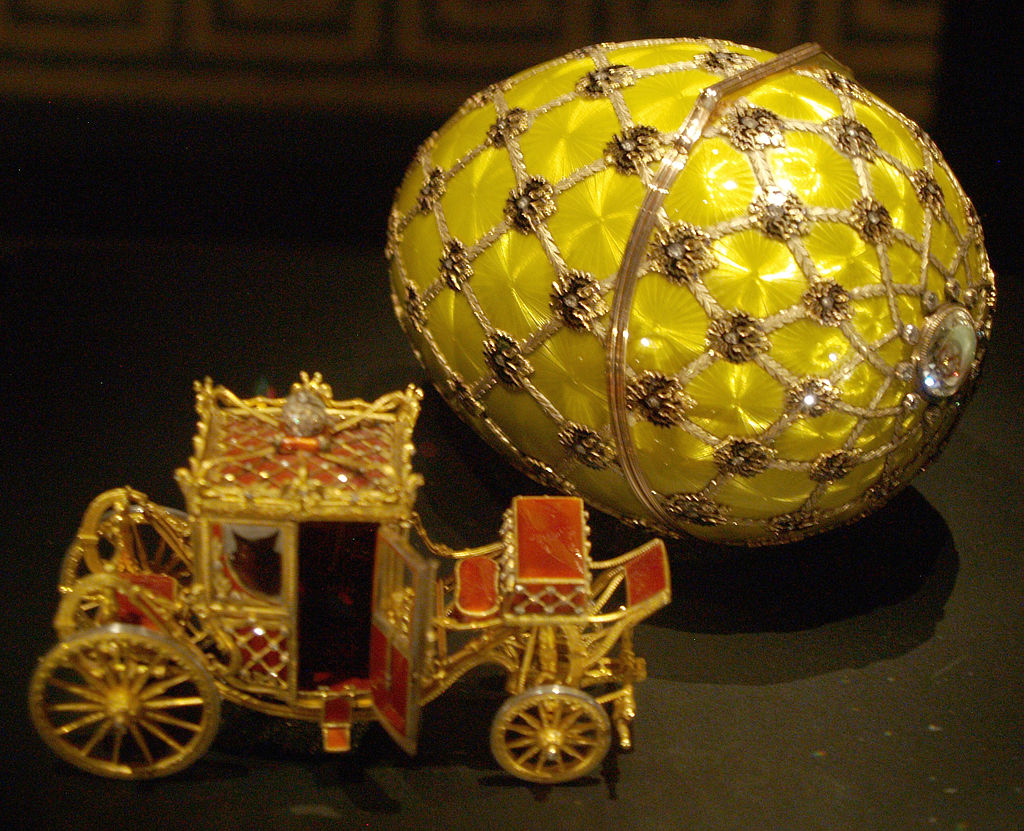
The Imperial Coronation egg made by Fabergé (Source: Miguel Hermoso Cuesta via Wikimedia Commons)
As the brand was resold more frequently, businesses utilizing the Fabergé name started producing films, clothing lines, hair products, the perfume Babe, and the cologne Brut, which at the time was the best-selling fragrance.
After more ownership changes, jewelry was finally reintroduced within the product ranges.
In addition to branded Fabergé products, the global market has been consistently flooded with "Fabergé-style" and fake "Fauxbergé" items.
The business Fabergé Limited currently owns the brand, which is only used for jewelry and gemstones.
With 500 artisans and designers, the House of Fabergé became the biggest jewelry company in Russia and won numerous international honors.
The House of Fabergé's headquarters were relocated to a specially constructed, four-story structure in Bolshaia Morskaia at the beginning of the 20th century. Additionally, branches were established in London, Odessa, Kyiv, and Moscow. The firm traveled to the Far East once a year from England.
European kings were fans of Fabergé's art. Queen Alexandra, who became "Fabergé’s great patroness of the West" and sparked British interest in this Russian jeweler, was one of his most ardent patrons.

Carl Fabergé Gold Gem-Set Diamond Ruby Sapphire Cufflinks (Source: DSF Antique Jewelry)
The Imperial Easter Eggs
The Russian Emperor Alexander III commissioned Fabergé to create a decorative egg for his wife as an Easter present in 1885. Every Easter after that, the Emperor ordered a fresh egg from Fabergé for his wife because the couple loved it so much.
Its enameled "shell" on gold is meant to resemble an ordinary hen's egg. This separates to expose a gold yolk, which then splits apart to reveal a gold chicken, which splits open to reveal a little ruby egg strung from a replica of the Imperial Crown.
This marked the beginning of the renowned Fabergé egg series. Few jewelers have ever achieved Fabergé’s mastery of enamel, a standard that remains unmatched, achieving the pinnacle of enamel technique, which is still unmatched today.
Carl Fabergé seems to have had total control over the Imperial Easter eggs' designs starting in 1887 since they got increasingly ornate. The only requirement, according to the Fabergé Family tradition, was that each egg hold a surprise. Even the Tsar was unaware of the exact shape they would take.
Its enameled "shell" on gold is meant to resemble an ordinary hen's egg. This separates to expose a gold yolk, which then splits apart to reveal a gold chicken, which splits open to reveal a little ruby egg strung from a replica of the Imperial Crown.
This marked the beginning of the renowned Fabergé egg series. Few jewelers have ever achieved Fabergé’s mastery of enamel, a standard that remains unmatched, achieving the pinnacle of enamel technique, which is still unmatched today.
Carl Fabergé seems to have had total control over the Imperial Easter eggs' designs starting in 1887 since they got increasingly ornate. The only requirement, according to the Fabergé Family tradition, was that each egg hold a surprise. Even the Tsar was unaware of the exact shape they would take.
Michael Perkhin, who was directly involved in their invention, is renowned throughout the world for the imperial eggs. Each egg, which often depicts life in the royal court, takes almost a year to make.
The most well-known of the royal eggs, Coronation, was made by Perkhin in 1897. A 10 cm replica of Catherine II's imperial vehicle for Nicholas II's coronation is the surprise. The egg has diamond decorations and a gold coating.

The Uspenski Cathedral Egg (Source: Stan Shebs via Wikimedia Commons)
Of the 54 Imperial Easter Eggs created by Fabergé, 28 were made in Perkhin's workshop. He continued to make jewelry until his death.
Many of the eggs vanished during the tumult of the 1917 October Revolution. The majority of them were later sold after being discovered at a state storehouse. Armand Hammer purchased a number of them.
Eleven Imperial Easter Eggs were once part of the Forbes Collection.
Many of Fabergé's eggs are now in different collections in the United States, while three were owned by Queen Elizabeth II of Britain, five are in the Virginia Museum of Art, and three are in the New Orleans Museum of Art.
Eleven Imperial Easter Eggs were once part of the Forbes Collection.
Many of Fabergé's eggs are now in different collections in the United States, while three were owned by Queen Elizabeth II of Britain, five are in the Virginia Museum of Art, and three are in the New Orleans Museum of Art.