Etruscan Jewelry: The Rich History Behind Timeless Designs
Etruscan culture had already reached a high level of artistic and technical development by 700 B.C. This culture has long confounded scholars, and it is unlikely that we will ever be able to pinpoint its origins.
Scientists and archaeologists rely on the observations of Greek and Roman historians, as well as archaeological evidence, which is neither abundant nor always reliable, because the Etruscans left behind few written records.

Antique Etruscan Revival Pair of Gold Bangles, Source: dsfantiquejewelry.com
The Etruscans
The indigenous Villanovan people of central Italy abruptly moved to the coastal regions of Etruria around 800 B.C.
Trade and communication with other parts of the ancient world increased significantly as a result; however, the reasons for this remain unknown, wrote American classical archaeologist and curator Diana Buitron in the book Jewelry: Ancient to Modern.
As a result, the crosscurrents of several ancient civilizations, including the Phoenician, Greek, and Syrian cultures, gave rise to the artistic style known as Etruscan.
Even with modern tools, it is challenging to replicate the exquisitely crafted jewelry of this era. Granulation was the most significant decorative technique during the earliest period, approximately 700–625 B.C.
Examples include the intricate labyrinth/lozenge design on the horseshoe-shaped band, the necklace pendants, the unusual container pendant with human faces on the bottom, and the feline-head pendants.

Etruscan pendant with swastika symbols from Bolsena, Italy, 720–675 BC. Louvre, Paris, Source Wikimedia Commons
Themes & Styles
Several Eastern themes and styles appear, including Phoenician crescent-and-disk ornaments, the scarab-holder pendant, and Syrian winged bulls, sphinxes, and women with long volute hair depicted on the mitra relief, wrote Buitron.
Greek artistic traditions gradually came to dominate Etruscan art toward the end of the 7th century and throughout the 6th century B.C. During the late 8th and 7th centuries B.C., Greece itself was also heavily influenced by Eastern traditions, which had become fully integrated by the end of the 7th century.
Although they ultimately originated in the East, ornamental floral motifs such as rosettes and palmettes on jewelry came to the Etruscans through Greece.
By this time, finger rings—which had been uncommon during the 7th century B.C.—were primarily Egyptianizing types that were also widespread in Greece, including cartouche rings and scarab rings.
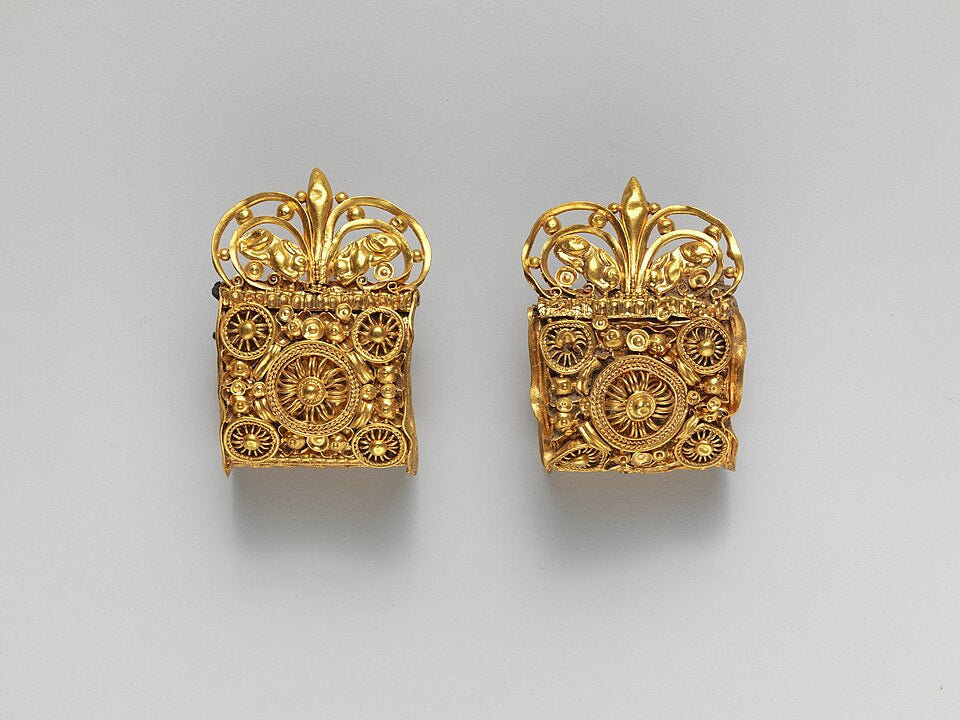
According to Buitron, technically, filigree, a quicker and easier technique, gradually replaced granulation. This transition is illustrated by the leech and baule earrings.

Etruscan; Earring, baule type, Source Metropolitan Museum of Art, via Wikimedia Commons
The Walters Collection
The Walters collection is fortunate to include three exquisite pieces of 5th-century B.C. Etruscan jewelry, including the Daedalus bulla and a pair of bullae decorated with palmettes. The latter is one of the very few pieces of jewelry bearing an inscription in the Etruscan alphabet.
The hoop earring ending in a cat's head, which became especially popular in Greece by the end of the 4th century B.C., is another example from this period.
Large gold surfaces, often worked in repoussé, replaced filigree and granulation in late Etruscan jewelry, a phase generally considered to have begun around 400 B.C.
Although there is little evidence of this period in the Walters collection, the earrings may date to the early 4th century B.C., and a spherical bulla with a mythological motif most likely dates from the same period, Buitron said.
In the 3rd century B.C., jewelry that was fundamentally Hellenistic—a pan-Mediterranean style with regional variations—replaced what could be considered distinctly Etruscan jewelry in Italy.
Etruscan jewelry can be dated by comparing it with objects found in Etruscan tomb groups. Because most tombs were "excavated" by treasure hunters rather than through scientific archaeological methods, this approach carries a significant margin of error. Furthermore, it cannot be assumed that every object found within the same tomb dates to the same period.
Tombs were often reused for subsequent burials for as long as a century, and items such as jewelry may have been treasured heirlooms passed down through many generations, Buitron continued. The Regolini-Galassi Tomb in Cerveteri, one of the best-known Etruscan burials, illustrates some of these challenges.
The Regolini-Galassi Tomb
Alessandro Regolini, the Vicar of Cerveteri, and his associate, General Vincenzo Galassi, opened the tomb in the spring of 1836. Regolini and Galassi were primarily searching for treasures made of gold and silver.
Fearing tomb robbers, they removed all precious metal objects from the tomb as quickly as possible, paying little attention to most of the pottery and the remains of the deceased. However, they did not keep a daily record of their work. Most of the finds were taken to Galassi's home before eventually being transferred to the Vatican, where they remain today.

Gold Plaques with Filigree Decoration, from the Regolini-Galassi Tomb in Cerveteri, c. 675–650 BC, Author Saiko, Via Wikimedia Commons
According to Buitron, a few pieces have since been identified in other museums, and one object from the tomb—an ivory pyxis that the parish vicar recovered 40 years after the tomb's discovery—even found its way to the Walters Art Gallery.
The objects and their original locations are described in summary records kept by the excavators and in reports written by several visitors. However, the accounts differ, making it impossible today to determine exactly how the objects were originally arranged within the tomb.
The tomb was divided by a stone bench into an inner chamber and an antechamber with niches on either side.
According to most written accounts and the evidence provided by the finds themselves, a woman was buried in the inner chamber with an abundance of gold jewelry. A warrior was laid to rest on a bed in the antechamber, with a chariot and weapons placed nearby, while a third burial—a cremation—occupied the niche on the right.

Large Gold Disc-Bow Fibula from the Regolini-Galassi Tomb, Cerveteri, c. 675–650 BC, Author Saiko, via Wikimedia Commons
Fragments of skyphoi, oinochoai, and Proto-Corinthian jugs indicate that the tomb was finally sealed around 625 B.C., Buitron noted. Cypro-Phoenician silver bowls and imported silver jugs from the Near East, along with other artifacts believed to have come from the inner chamber, suggest that the woman was buried during the early part of the 7th century B.C.
The nature of the discoveries and the excavation records make it possible to learn something about the individuals buried in the tomb. The woman's burial was the richest, and her name, Larthia, may have been inscribed on several vessels, Buitron wrote. She was buried with an extraordinary collection of gold jewelry—some pieces strikingly similar to those in the Walters collection—as well as silver and bronze tableware.
Because none of the Etruscan jewelry in the Walters collection has a documented provenance, the finds from the Regolini-Galassi Tomb and comparable archaeological sites provide the primary evidence for dating these pieces, identifying their possible place of manufacture, and understanding their intended function.