Legends of the Gems: The Magic of Rubies and the Eternal Beauty of Emeralds
For millennia, precious stones have held a special fascination for people. They have adorned kings and queens, priestesses, and temples.
Nowadays synonymous with wealth and success, throughout the centuries they have been surrounded by legends and mystery. Today, we invite you to discover the history of two of the most beloved precious stones: the ruby and the emerald, as captured by Frank Shelley in his book, Legends of Gems.
The Ruby
What fairy tale, what enchanted story of princesses in towers or wonders out of the Arabian Nights does not spring to mind with the mere mention of rubies? No gem has been more intimately bound with romance, poetry, and legend.
Few can rival its luster, and fewer still its value. When Solomon proclaimed that “a virtuous woman was more valuable than rubies,” and Job declared that “the price of wisdom is above rubies,” they instinctively reached for what was, in their age, regarded as the most precious gift of the earth. And centuries later, the statement has hardly dimmed. Even today, a perfect ruby of five carats commands at least five times the value of a diamond cut to equal size and brilliance. Flawless specimens are so rare as to be nearly legendary, which is why the Persians named the stone with reverence, calling it Lord of the Rubies.

Crimson Ruby Gem, Source DSF Antique Jewelry
In Burma, the most famous source of ruby mines, such gems were guarded with near-religious zeal. All stones over a certain size were decreed the property of the king, and the mines themselves were closed to foreign eyes. One can readily imagine the vast hoards of sparkling red fire thus gathered into royal treasure chambers, generation upon generation. Indeed, tradition persists that certain kings of Burma possessed stones of extraordinary size. One tale insists on a ruby “as large as a hen’s egg,” though suspicion falls that this wonder was no true ruby at all, but rather one of the lesser varieties known to gem lore: either a Balas ruby or a Spinel.
Legends from East and West
Travelers, too, have recounted marvels of the ruby. That indefatigable Venetian Marco Polo tells of the King of Ceylon owning what he called the greatest ruby ever seen. He describes it as “four inches long, as thick as a man’s arm, and without a flaw.”

Mosaic of Marco Polo, Municipal Palace of Genoa: Palazzo Grimaldi Doria-Tursi, Source http://urbanesalonanddayspa.com/15fa8o-marco-polo.org-cheap via Wikimedia Commons, Author - Salviati
Kublai Khan himself, astonished by the sight, offered the wealth of a city for it. The king’s reply is recorded: he would not part with it even if “all the treasures of the world were laid at his feet.” Yet here again, suspicion arises that this monstrous gem was less than a true corundum—more likely one of the Balas family, or else an ancient carbuncle.
Other regions, too, have yielded glowing stones. On the slopes of the Oxus and among the highlands of Tartary, rubies have occasionally been uncovered. From Tartary emerges a curious superstition: that rubies always appear in pairs. Many a seeker, it is said, concealed his first find until discovering the elusive companion gem, fearful that the solitary ruby would never bring fortune without its match.

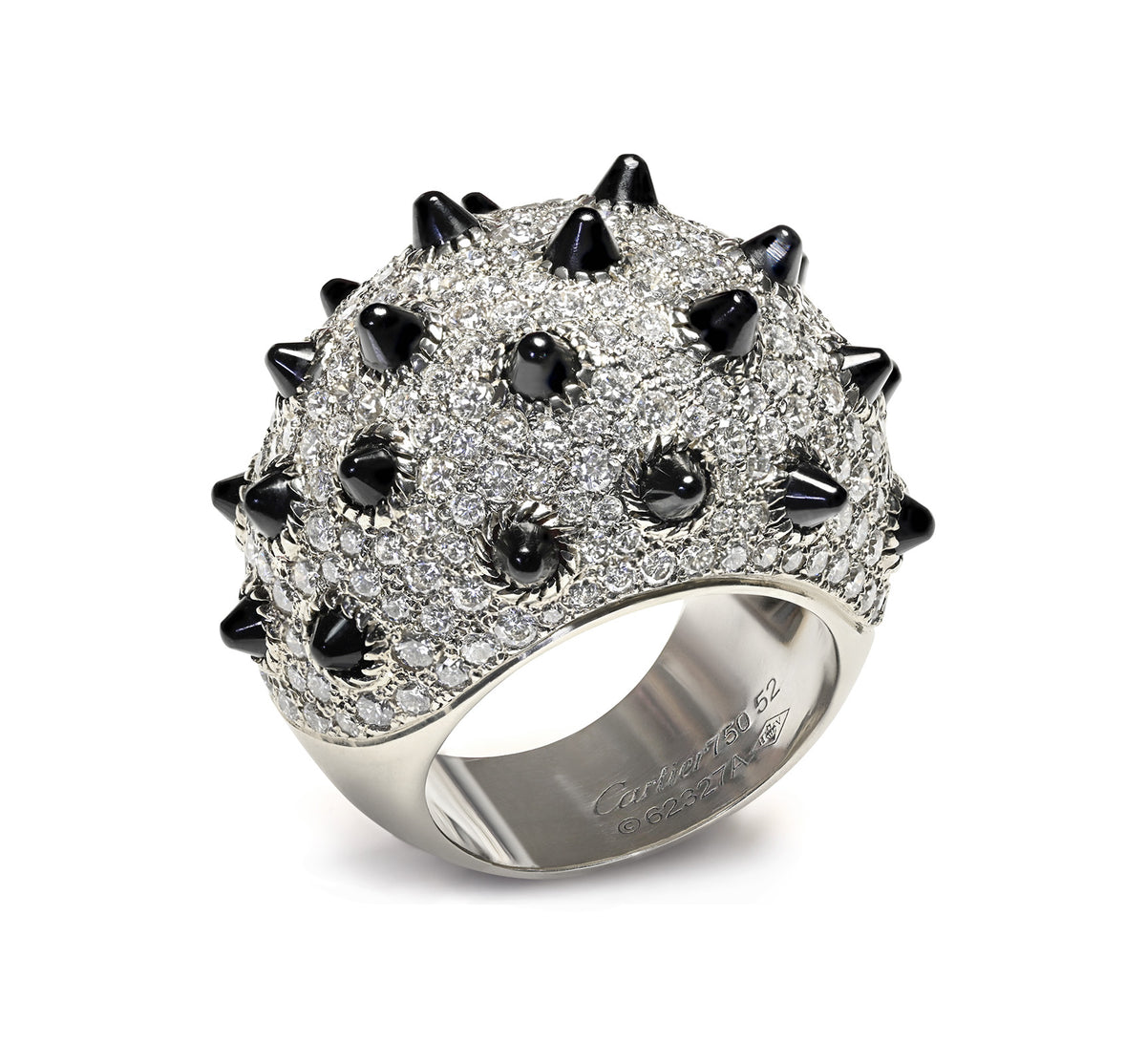
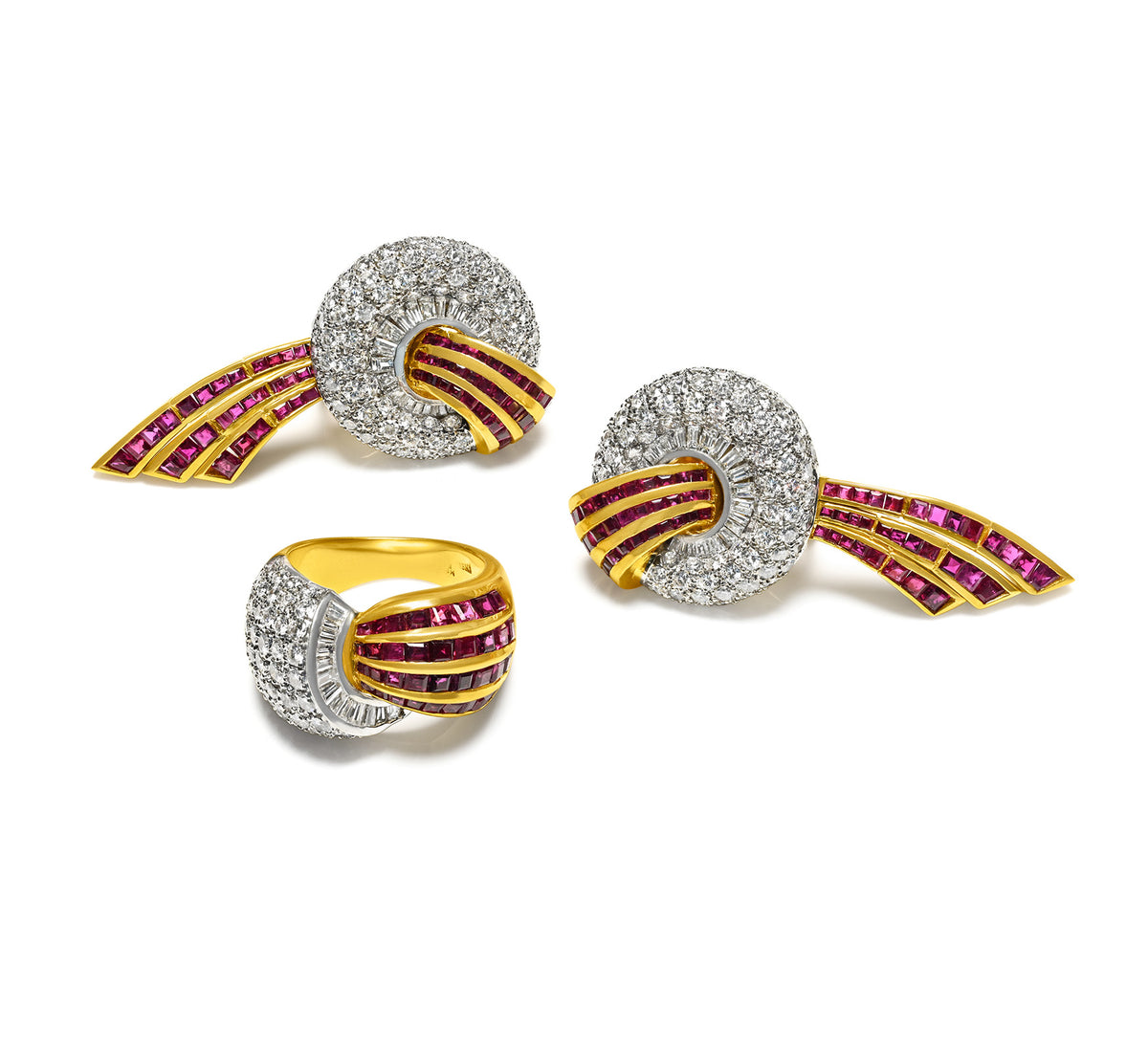
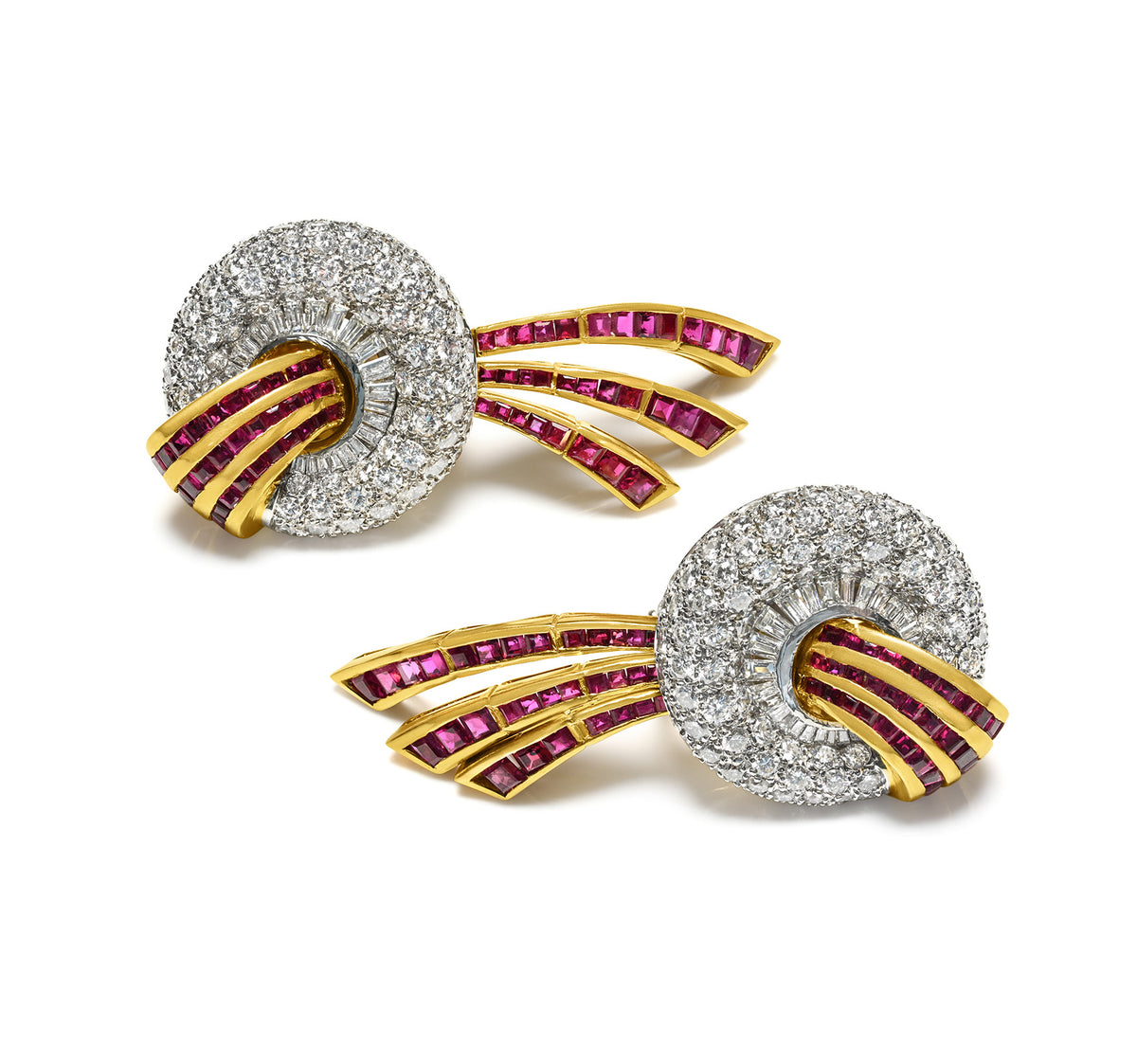
Burma Ruby Diamond Dome 18K Ring gold, for sale at DSF Antique Jewelry
Europe’s own annals are marked with rubies of renown. Perhaps the most famous is the one presented by Gustavus Adolphus to Catherine I of Russia in 1777, a stone reputedly the size of a pigeon’s egg. But even such marvels bow before the historic ruby of Castile: given by Dom Pedro to England’s Prince of Battle, Edward the Black Prince, and worn by Henry V upon his crown during the triumph of Battle of Agincourt in 1415. To this day, it blazes in the very heart of the diamond cross at the front of Queen Victoria’s state crown.
Ruby as Love and Reward
The ruby has long served as a jewel of affection and devotion. Sir Walter Scott built his novel The Talisman around a wondrous ruby, and in medieval Europe, no gem was more renowned as a gage d’amour. Tales speak of knights receiving ruby rings from their ladies before crusades. The Chevalier Bayard himself was once awarded a ruby ring worth a hundred ducats by a “Queen of the Tournament.” Elizabeth I, too, frequently bestowed ruby rings upon her noble followers, most notably the earls of Suffolk and Essex.

The Armada Portrait of Elizabeth I of England, Queen's House, Royal Museums Greenwich, Via Wikimedia Commons
An oft-repeated medieval story deserves retelling. “A certain widow,” writes an old chronicler, “had tended a young stork, which, having fallen from its nest before it was fully fledged, broke its leg. The grateful bird, on returning from its annual migration, immediately visited its benefactress (who happened to be sitting at her door) and dropped into her lap a precious stone surpassing in brilliance. Upon examination, this turned out to be a matchless ruby.” Real or fabled, the tale lingers because it enshrines the ruby as a symbol of gratitude and of love returned.
Among the most precious ruby jewels preserved into modern times is the Lennox or Darnley jewel, now kept among the treasures linked to Queen Victoria.
It passed through the collection of Horace Walpole but was originally commissioned by Lady Margaret Douglas, mother of the ill-fated Lord Darnley, husband of Mary, Queen of Scots. The jewel, shaped as a golden heart two and one-eighth inches across, is engraved with a crown, azure enamel, fleur-de-lis, three rubies, and an emerald. Opening it reveals two hearts bound with a blue enamel buckle, entwined with a true-love knot, and pierced with arrows feathered with white enamel and barbed with gold. Above is a motto: “What we resolve.” It remains a masterpiece worthy of the greatest goldsmiths, even of Benvenuto Cellini.
Ruby in Poetry, Myths, and Crowns
Poets never grew weary of likening the ruby to lips. Herrick sings:
“Goddess, I do love a girl
Ruby-lipped, and tooth’d with pearl;”
and elsewhere proclaims:
“No deeper rubies than compose thy lips,
No pearls more precious than inhabit them.”
Edmund Spenser, with quaint imagery, wrote:
“And twixt the pearls and rubies softly brake
A silver sound, that heavenly musicke seemed to make.”
Emerson, too, in modern verse, renewed the ruby’s fire:
“They brought me rubies from the mine,
And held them to the sun;
I said, ‘They’re drops of frozen wine,
From Eden’s vats that run!’”
Ruby’s influence stretched even into royal ritual. The English coronation ring, engraved with the cross of St. George, was long set with a ruby. By tradition it traveled in the messenger’s hand when carrying word of accession to a sovereign’s heir. So it passed when Elizabeth succeeded Mary, and again when James I succeeded Elizabeth. James II was said to have carried it even in his ill-fated flight from England, the stone hidden upon his person. From Charles I it passed to Bishop Juxon, thence to Charles II, to George IV, and finally among the relics of the last of the Stuarts, Cardinal York. Today it rests as part of the collection at Edinburgh Castle.

Elizabeth II wearing the Imperial State Crown and hold the Sovereign's Sceptre and Orb after her coronation day in 1953, Source BiblioArchieves from Canada, Via Wikimedia Commons
Ruby’s Ancient Power
Ancient lore credits rubies with magical powers. They were believed to darken with warning should misfortune or illness approach their wearer. The Chinese placed small bags of rubies beneath the foundations of new houses to appease spirits and protect the structure. In India and Ceylon, where many fine rubies originate, the gem is revered almost as a fragment of crystallized fire.
The early kings of England, beset with costly wars, pawned many of their treasures. Among the records, we find Henry III pawning a magnificent ruby ring, once the property of Edward the Confessor, to the Abbot of Westminster for a “good round sum.” Even in times of desperation, kings leaned upon the ruby’s value and repute.
Eternal Flame in Stone
From the secret mines of Burma to the treasure-halls of Europe, from tales of birds dropping crimson gems into the laps of kindly widows, to mighty kings refusing kingdoms in exchange for their stones, the ruby has remained a symbol of beauty, devotion, sovereignty, and burning passion. More than a mineral, more than a jewel, it is fire made flesh—a crystallized flame carrying with it the heart of poetry, the crown of empires, and the legends of ages.
Emeralds
Throughout history, countless intriguing legends about magnificent emeralds have been passed down, chiefly drawn from the accounts of early travelers who regarded every translucent green stone as an emerald.

Rare Cartier Tutti Frutti Emerald Sapphire Diamond Stick Pin, for sale at DSF Antique Jewerlry
The ancients treasured emeralds not only for their stunning beauty but also for their supposed mystical powers, particularly their remarkable ability to heal all eye ailments. It was even believed that if a serpent’s eyes met the gleam of an emerald, it would instantly become blind. This superstition is poetically captured by Moore in the lines:
Blinded like serpents when they gaze
Upon the emerald’s virgin blaze.
The short-sighted Emperor Nero owned an emerald eye-glass, through which he would watch and revel in the brutal spectacles of the arena.
Pliny chronicles an extraordinary tale highlighting the fiery brilliance of a flawless emerald:
“In the island of Cyprus stands the tomb of King Hermias, on which is carved the life-size figure of a lion with large emerald eyes—when the sun shone upon them they were so excessively brilliant that all the fish were frightened away. The fishermen, fearing for their livelihood, removed the lion, and the fish returned to their accustomed haunts.”
Scholars suggest the shadow of this lion’s emerald eyes cast upon the water caused this phenomenon. A lion sculpture resembling this story, though missing its emerald eyes, now resides in the British Museum, lending some credence to the legend.
True flawless emeralds of large size remain exceedingly rare, so much so that the phrase “An emerald without a flaw” has evolved into a proverb symbolizing unattainable perfection.
Among the treasures seized by Cortez during his conquest of Peru were five extraordinary emeralds of exceptional beauty and intricate design. These gems were hailed as masterpieces of lapidary art—one carved into a rose, another shaped like a horn, a third into a fish with golden eyes, the fourth fashioned as a bell with a pearl clapper, and the fifth a delicate tiny cup. Cortez’s refusal to sell these jewels to the empress cost him favor at court, and soon after, these emeralds were lost when he was shipwrecked near the Barbary coast.
Before Peru's conquest, the finest emeralds hailed from Egypt and Burma, and were rare in Europe. However, the great influx brought by Spanish adventurers in Mexico and Peru made them far more plentiful. To grasp the magnitude, the traveler Joseph D’Acosta reported that on his return ship to Spain, there were two chests, each weighing one hundred pounds, filled with fine emeralds. Among the Mexicans, it was customary to offer emeralds to the goddess Esmeralda—worshipped in the form of a giant emerald shaped like a hen’s egg. This reverence allowed Spaniards to claim centuries of votive offerings in one sweep by seizing the accumulated emeralds from her shrine.

DEEP emerald green color, prismatic Atacamite crystals, Source http://www.mindat.org/photo-164043.html, via Wikimedia Commons, Author Rob Lavinsky, iRocks.com
The value of emeralds hinges largely on their color, transparency, and flawlessness. The most prized emeralds exhibit a deep velvety-green hue and can command prices between two hundred and three hundred US dollars per carat when flawless. By contrast, lighter greens might bring less than ten US dollars per carat.
Many tales about gigantic emeralds are best taken cum grano salis; for instance, Herodotus mentions emerald pillars several cubits high in the Temple of Hercules at Tyre, although these were likely not emeralds but green jasper or glass.
In the Imperial Treasury at Constantinople is a turban crowned with a diadem adorned by three emeralds of the purest quality and immense worth, originally owned by Sultan Murad II, conqueror of Baghdad. A similarly lustrous emerald once graced the crown of the Virgin in Toledo Cathedral until Marshal Junot, commanding in Spain, paid it a visit. After admiring the flawless beauty of the gem, he audaciously twisted it off with fingers, declaring, “This belongs to me,” before departing with the emerald tucked safely into his waistcoat pocket.

Crown of the Virgin of the Sagrario in the treasury of Toledo Cathedral, Source, Wikimedia Commons, Author: Jocelyn Kinghorn from Christchurch, New Zealand
In Napoleonic times, an anecdote tells of Empress Josephine. When the painter Isabey asked what jewels she wished to wear, she tearfully said, “I am about to change my state, and have heard it said the custom in England is that when a true heart is severed from one it loves, the women wear green to denote to their friends that they are forsaken. Paint me in emeralds, to represent the undying freshness of my grief; but let them be surrounded with diamonds, to portray the purity my love.” Soon after, Isabey understood this cryptic message—as Napoleon had just informed Josephine of his alliance plans with the Austrian princess Maria Louisa.
Among the Shah of Persia’s most precious treasures is a small gold box, studded with exquisite emeralds, said to have been blessed by Mahomet. Legend holds it can render its bearer invisible, provided he remains “celibate.” However, since the Shah is anything but celibate, this power seems of little use.
The emerald ring of Polycrates of Samos is famed as one of the most legendary jewels of ancient times. His astonishing streak of good fortune unnerved his ally, Amasis, King of Egypt, who feared the luck might turn against him as well. To appease the gods, Amasis advised Polycrates to offer his most prized possession. The king agreed and cast the emerald into the sea. Soon after, a fish was caught bearing the king’s ring in its stomach. This superstition broke their alliance, and Amasis soon witnessed his worst fears come true as Polycrates was captured and crucified.
The name “Emerald Isle” for Ireland is said to originate in the reign of Henry II when Pope Adrian sent him a magnificent emerald ring symbolizing his investiture over the island.
Charlemagne's tomb once housed an emerald ring worn by him as a talisman, which Napoleon later donned on two famous battlefields—Austerlitz and Wagram—before gifting it to Queen Hortense.
The extraordinary number and value of the Shah of Persia’s jewels are nearly legendary. To illustrate, the Shah recently commissioned a two-foot-high globe covered entirely with jewels. The sea is represented by emeralds, while kingdoms are distinguished by gems of various colors...
It is a gem that hath the power to show
If plighted lovers keep their troth or no.
If faithful, it is like the leaves of spring;
If faithless, like those leaves when withering.