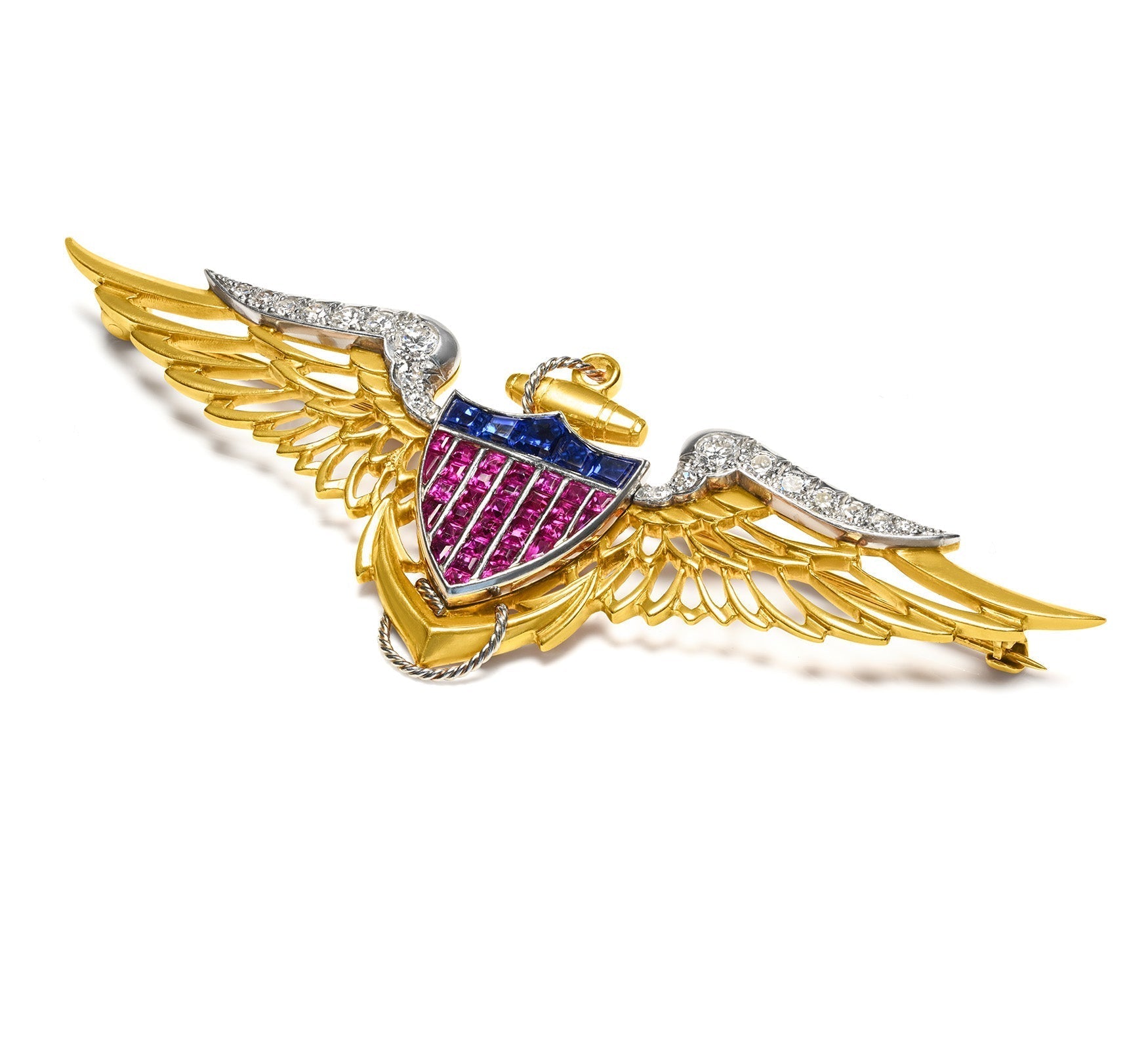
No ornamental pattern was more sought after than the American bald eagle, selected as the emblem of the Great Seal of the United States in 1782. The stars and stripes of the American flag also became design features. These symbols were gladly incorporated into jewelry alongside traditional icons such as the dove of peace, fruit baskets, cornucopias, and representations of Hope and Justice. It was through the choice of designs from the vast array of examples offered abroad that the unique taste of Americans began to emerge. Their selection of motifs reflected what held significance for Federal Americans and what they embraced as symbols of ambition.

Badge of the Society of the Cincinnati, Exhibit in the Cincinnati Art Museum, Cincinnati, Ohio, USA, Source Wikimedia Commons, Author Daderot
Despite the heavy influx of imported jewelry during the initial decades of the Federal era, an increasing amount of jewelry was being crafted domestically. Novel personal accessories such as miniatures and hairwork were being produced on a grand scale. Although diamonds had temporarily fallen out of favor due to conflicts both at home and abroad, some diamond craftsmanship continued in American cities. By the 1800s, American artisans were vigorously challenging British manufacturers in creating exquisite pearl, jet, and filigree pieces. Nevertheless, complete sets of jewelry featuring topaz and amethyst, along with watches and chatelaines, were still frequently brought in from England and France.
Whether sourced from abroad or made on American soil, jewelry was expected to embody more than mere adornment. The desire to possess pieces that captured likenesses of loved ones or held tangible links to cherished individuals deeply resonated. The motifs and engravings selected to decorate these treasures were chosen with great care, reflecting personal ideals and meaningful symbolism. Many items also carried religious connotations, providing owners with justification for such luxury. Leading figures, including early presidents and their spouses, as well as influential political and social elites, pioneered these trends. They typically favored styles that were elegant yet understated, combining fashion with tasteful moderation.

Louisa Catherine Johnson Adams, Gift of Robert Homans, Jr., Lucy Aldrich Homans, and Abigail Homans, in memory of their father, Robert Homans, source https://diplomaticrooms.state.gov/Pages/Item.aspx?item=30, via Wikimedia Commons
Pearls
Beading, often called ‘pearling,’ was a key decorative element in neoclassical design. It was used as edging on everything from buildings to furniture and silverware. Small pearls were strung into bracelets, and half-pearls formed borders on lockets and clasps. Tiny pearls, less than a quarter of a grain in size and imported from India and China, were sometimes drilled and strung on horsehair—preferably from a live white horse. These delicate pearl ropes were attached in openwork patterns to thin mother-of-pearl templates, mainly depicting flowers, leaves, fretwork, and flourishes. During the Federal period, bracelets, brooches, headpieces, earrings, and necklaces were crafted this way and sold either individually or as matching sets.
One of the earliest jewelry styles made this way was the earring. Cluster earrings made of seed pearls had become popular by the end of colonial times. Often, a slightly larger second rosette hung from the cluster, creating a top-and-drop earring with added movement. In the 19th century, the size difference between the two rosettes grew, with the drop becoming noticeably larger. Another favored Federal period style was the simple hoop earring, made of a single line of pearls.

Washington and Custis jewelry, Source National Society of the Daughters of the American Revolution, via Wikimedia Commons
The combination of gold and white was natural in an era when these colors frequently appeared together in architecture and interiors. Other stones like cornelian and paste were also common. For example, in 1810, the Boston jeweler Fletcher & Gardiner offered a set featuring cornelian and pearls—including a necklace, bracelets, four brooches, a tiara, clasps, and three pairs of earrings—that could be worn in three different ways.
Amethysts were also featured in seed-pearl sets. On June 17, 1822, Thomas Pearsall gave Lavinia Coles an amethyst and pearl parure that came in a heart-shaped red leather case. The set included a festoon necklace, earrings with detachable pendants, and a small brooch. Later, a finer amethyst was added to the necklace clasp, along with a paste ring.
Pearl jewelry came in many shapes and sizes. One unusual type of hair ornament was shaped like an arrow, made in two parts: one with the arrowpoint and the other with the fletching and a pin. A safety chain connected the two parts, which were fastened by passing the pin through the hair and into the arrow shaft. Crescent-shaped pins were made similarly. Boston jewelers sold pearl-adorned arrow and crescent slides.
Small pairs of pearl pins were often worn on each shoulder where the sleeves met the bodice of high-waisted dresses. Dyer & Eddy advertised ‘Pearl set and Gold Twin Breast Pins’. Abigail Adams favored pearl jewelry for court events.

Abigail Adams portrait, Source Wikipedia Commons, Uploaded by user:Mwanner
While her husband John was the U.S. envoy in London, she bought three pearl pins and a pair of pearl earrings. Writing to her niece in 1786, she said, “The cost of them—no matter what; less than diamonds, however.” She also mentioned purchasing jewelry from a Quaker jeweler named Savory in Cheapside, London.