
Ancient Roman Bronze Coin 18K Gold Cufflinks, Circa 300 AD
Probable Coins of Constantine and Crispus in Antique London Gold Mounts
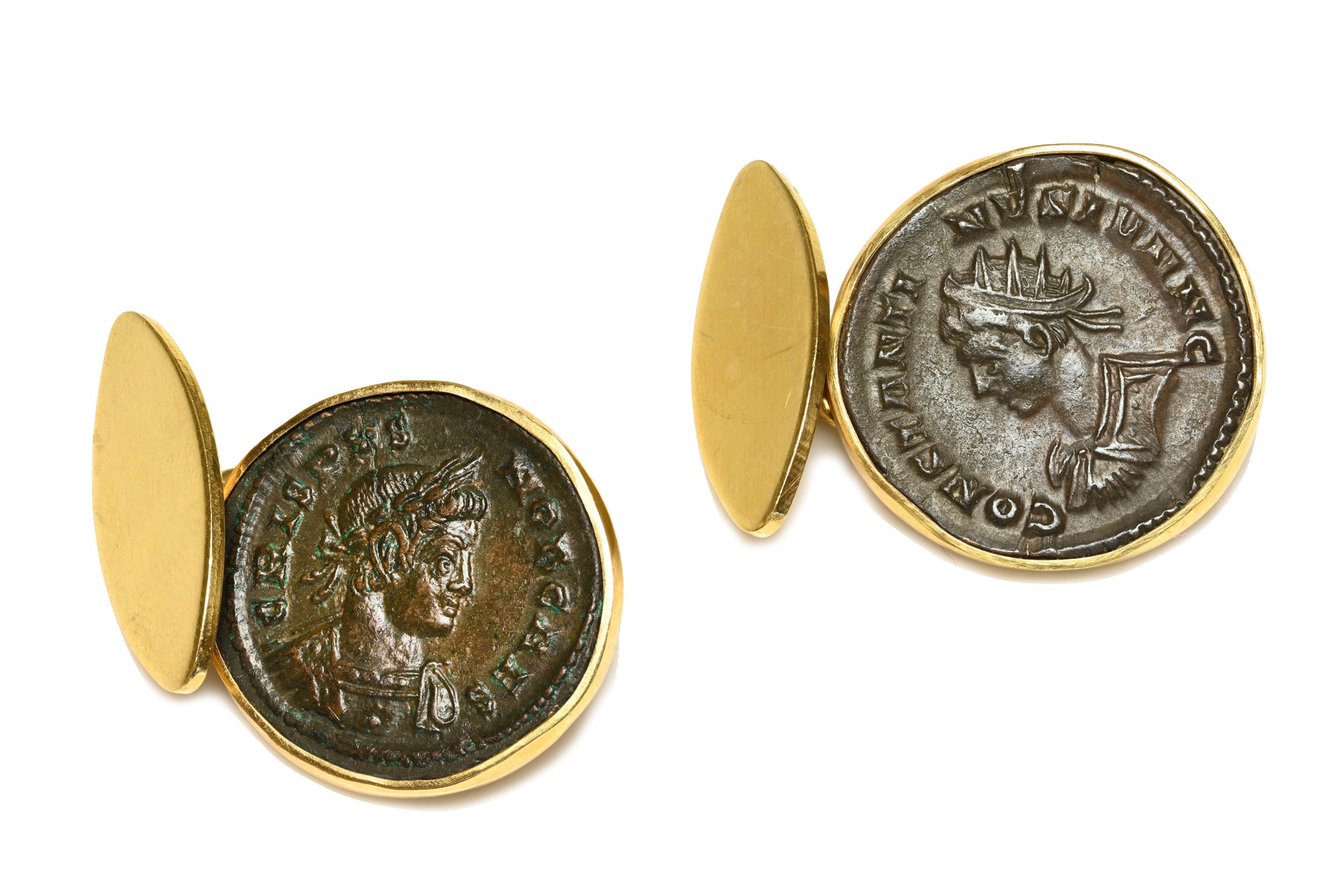
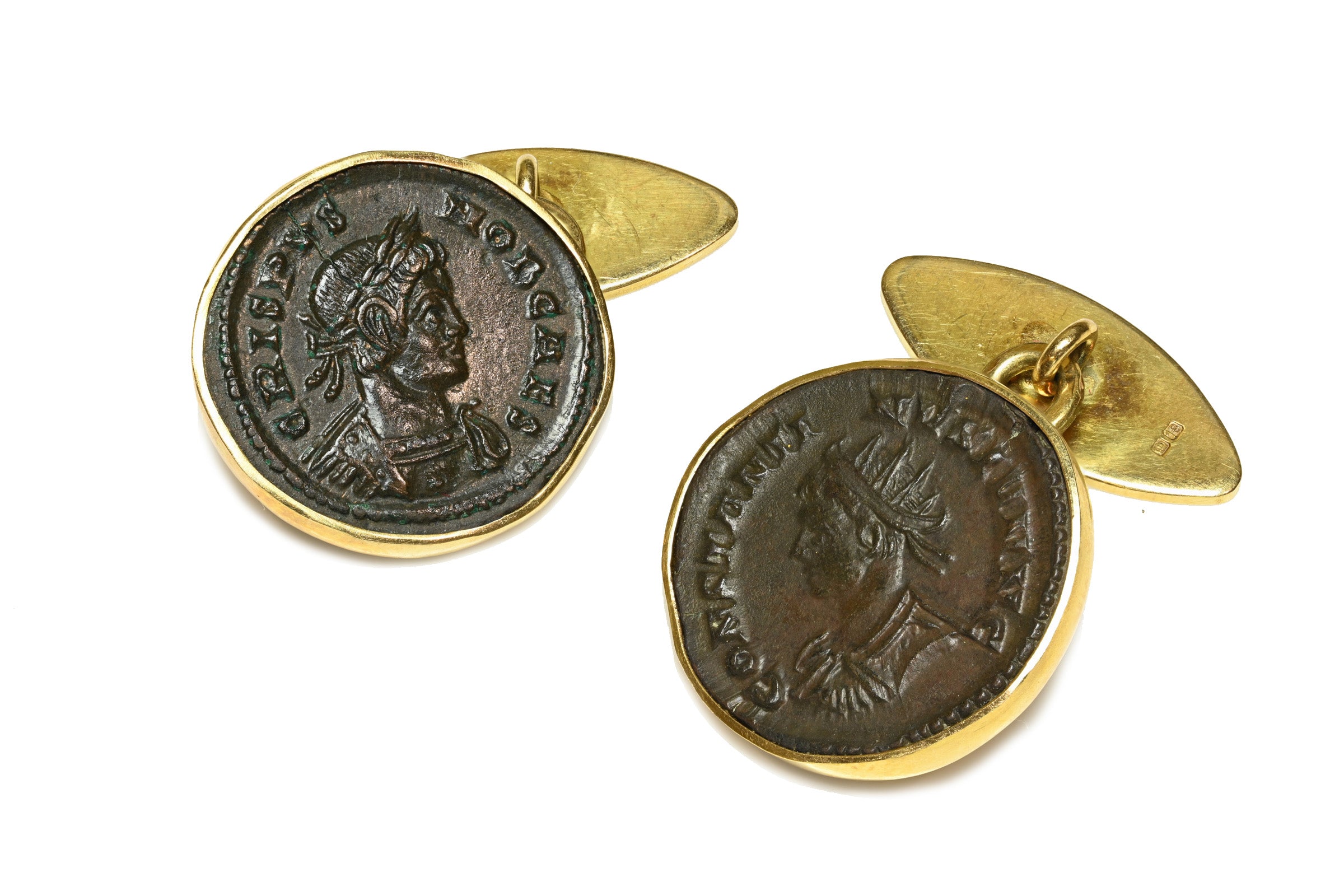
An extraordinary pair of cufflinks spanning approximately sixteen centuries of history. Each cufflink is centered with an authentic ancient Roman bronze coin, later individually mounted in finely crafted British 18K yellow gold.
Information accompanying the cufflinks from the specialist from whom they were acquired dates the coins to approximately 300 AD. Based on the surviving portraits and inscriptions, the coins appear to date more specifically from the early 4th century AD, during the Constantinian period.
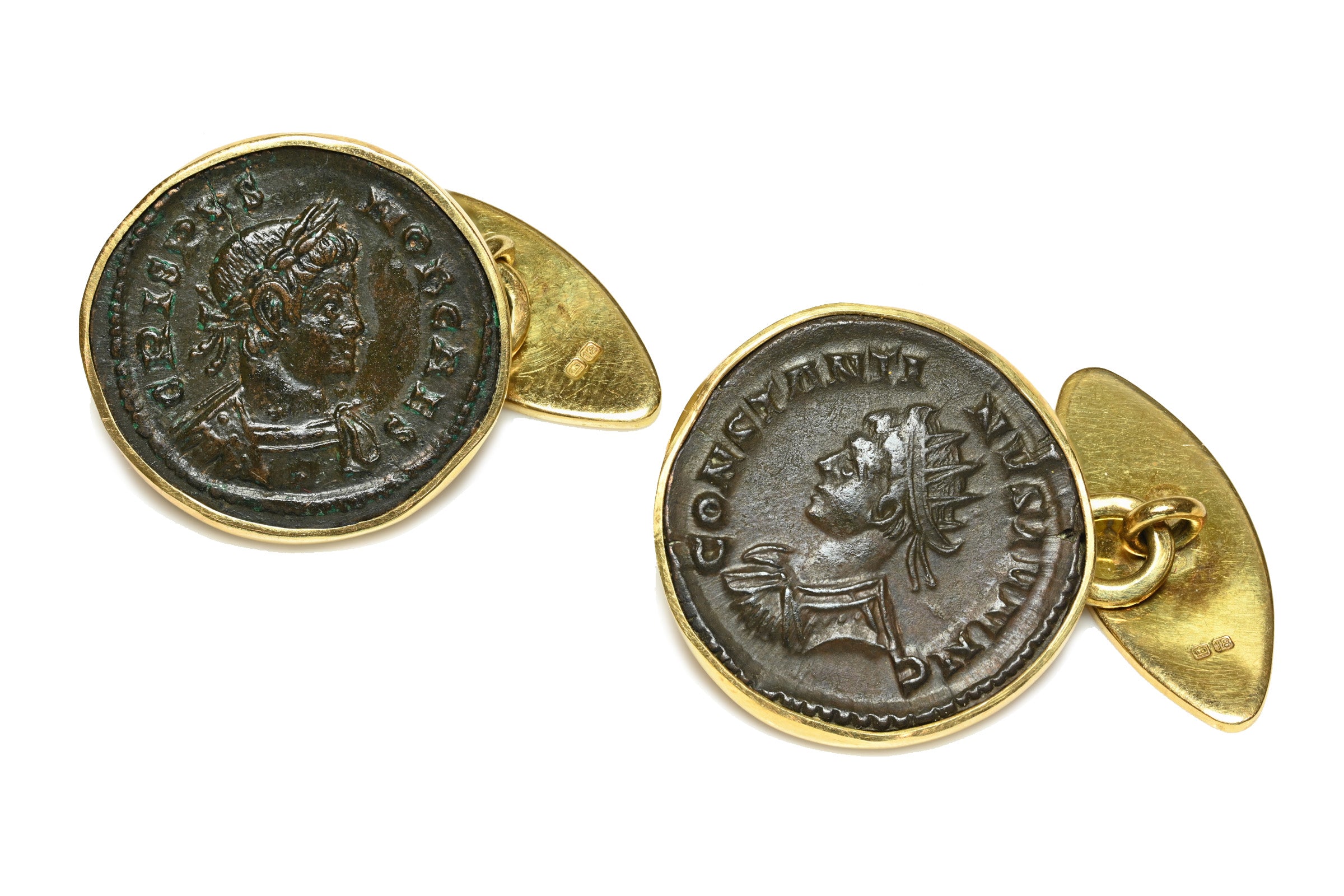
One coin bears the clearly visible inscription CRISPVS NOB CAES, identifying Crispus, the eldest son of Emperor Constantine the Great. The inscription translates approximately as “Crispus, Most Noble Caesar.” Crispus served as Caesar under his father and appeared on Roman coinage between AD 317 and AD 326.
The companion coin appears to depict Constantine I, known as Constantine the Great, creating a particularly compelling father-and-son pairing. Constantine ruled during one of the most consequential periods in Roman history, and his reign marked a profound transition in the political and religious life of the Roman Empire.
The Roman Coins
The coins retain substantial original detail, including imperial portraits, portions of their Latin inscriptions and ancient reverse imagery.
The Crispus coin appears consistent with a bronze nummus struck at the Roman mint of Londinium, present-day London, around AD 317–318. Comparable examples carry the reverse inscription SOLI INVICTO COMITI, with the radiate sun god Sol standing while raising one hand and holding a globe in the other. The visible inscription and portrait correspond closely with documented London-mint issues of Crispus.
The Constantine coin also appears to belong to the SOLI INVICTO COMITI series. The inscription is generally understood as a dedication to Sol Invictus, the Unconquered Sun and companion of the emperor. Constantine-era London issues bearing this reverse type were produced during the early 4th century, commonly between approximately AD 312 and AD 317.
Because portions of the coins are covered by their later gold settings, the complete mint marks and inscriptions cannot be examined without removing them. The Constantine attribution and precise numismatic classifications should therefore be regarded as informed visual identifications rather than independent certified attributions.
Edwardian London Gold Mounts
Many centuries after the coins were struck, they were transformed into distinguished cufflinks using substantial 18K yellow gold mounts.
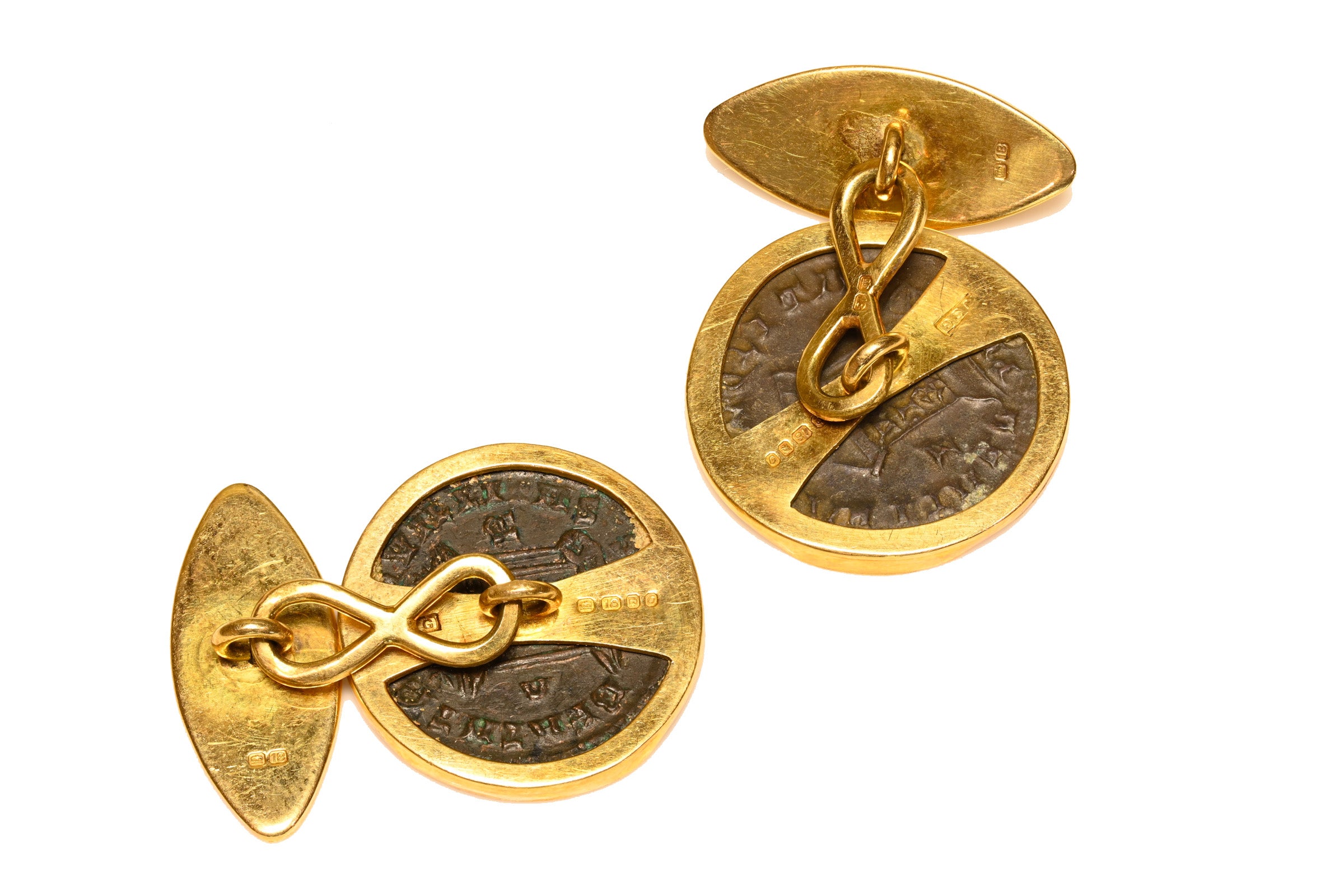
Each ancient coin is surrounded by a fitted circular gold bezel. The open-backed construction allows portions of the reverse sides to remain visible, preserving the archaeological character of the coins rather than concealing them completely.
Traditional figure-eight connectors join the coin fronts to elegant marquise-shaped gold terminals. The warm tone of the yellow gold provides a striking contrast against the deeply patinated bronze surfaces.
The British hallmark sequence appears to include:
• JSG sponsor’s mark
• Crown traditional British gold mark
• 18 indicating 18-carat gold
• Leopard’s head for the London Assay Office
• Lowercase “o” date letter
The leopard’s head confirms that the mounts were assayed in London, while the crown and “18” marks denote 18-carat gold. British sponsor’s marks identify the individual or business that submitted an article for assay and do not always identify the actual craftsman who made it. The identity connected with the JSG mark has not been independently confirmed.
Based on the style of the lowercase “o” and the surrounding hallmark group, the date letter appears consistent with the London assay year 1909–1910, placing the gold mounts in the Edwardian period. Since exact British hallmark dating depends on the letter’s font and surrounding shield shape, the date is most accurately recorded as apparently London 1909 unless formally confirmed by the Goldsmiths’ Company Assay Office.
Key Features
• Coins: Two authentic ancient Roman bronze coins
• Specialist dating: Circa 300 AD
• More specific probable date: Early 4th century AD
• Probable rulers: Constantine I and Crispus
• Probable mint: Londinium, Roman Britain
• Visible inscription: CRISPVS NOB CAES
• Reverse type: SOLI INVICTO COMITI
• Metal: British hallmarked 18K yellow gold
• Gold mounting period: Edwardian, apparently London 1909
• Sponsor’s mark: JSG
• Assay mark: Leopard’s head for London
• Gold standard marks: Crown and 18
• Design: Ancient coin fronts with marquise-shaped gold terminals
• Construction: Open-backed settings with traditional figure-eight connectors
• Measurements: 0.7"
• Total weight: 15.7 Grams
• Condition: Excellent overall antique condition
Condition
The ancient bronze coins retain rich brown surfaces with areas of naturally developed green patina, softened details, irregular coloration and surface variation consistent with their considerable age.
These characteristics are inherent to ancient bronze and form an important part of each coin’s historical appearance. They should not be regarded as damage or manufacturing defects.
The later gold mounts display light surface marks and wear consistent with age and previous use. The ancient coins remain securely held within their fitted gold bezels, and the articulated figure-eight connectors function as intended.
Collector’s Note
These cufflinks are especially compelling because they combine two distinct historical periods.
The coins originate from the Roman Empire during the age of Constantine and Crispus, when Roman Britain was still integrated into the wider imperial world. Approximately sixteen centuries later, the coins were mounted in hallmarked Edwardian London gold and transformed into wearable historical objects.
The apparent pairing of Constantine the Great and his son Crispus gives the cufflinks additional historical resonance. Rather than featuring two identical coins selected solely for appearance, the pair appears to preserve a relationship between two important figures from the Constantinian dynasty.
A remarkable acquisition for a collector of ancient coins, Roman history, archaeological jewelry, Edwardian goldwork or unusual gentlemen’s accessories.
Email us or give us a call: (929) 316-2746. For our shipping and refund policy please see our terms & conditions.

The DSF Promise
Buy with confidence. Every piece is backed by:
• Authenticity — examined and verified before listing
• Condition — carefully inspected and honestly described
• Insured shipping — fully insured, signature required
• 32-day returns — available on eligible, unaltered items
• Private appointments — available in New York
• Experience — over 50 years of fine jewelry expertise
How do I know a piece is authentic, and can I trust DSF?
Buying fine jewelry online takes trust, especially at this level. DSF Antique Jewelry is a New York–based dealer with over 50 years of fine jewelry expertise. Every piece is examined for authenticity and condition before it is listed — we assess hallmarks, maker's marks, metal content, gemstones, and construction consistent with the stated period or designer. For signed pieces such as Cartier, Buccellati, or Van Cleef & Arpels, we verify maker's marks and signatures. We're glad to send additional photographs of any hallmark, or speak with you directly, before you decide.
Why does antique gold look different, and is surface wear normal?
Antique pieces were often made in gold standards less common today, such as 15ct (used in Britain only between 1854 and 1932), 9ct, or higher-karat continental gold, which give a warmer tone than typical modern 14k. Light surface wear, softened edges, and a gentle patina are normal and expected on antique jewelry — they reflect the age and authenticity of the piece, not flaws. We describe the true condition of every item honestly in its listing.
What do the hallmarks and maker's marks mean?
Hallmarks are small stamped marks that identify the metal standard, and often the maker, assay office, and date. They are one of the best tools for authenticating antique jewelry. We identify and explain the marks we find on each piece in its description, and we're happy to send close-up photographs of any hallmark on request so you can see exactly what you're buying.
Can pieces be resized or adjusted?
It depends on the piece. Many antique rings can be resized, but bands with all-around engraving, thin shanks, or gemstones near the base may be limited in how far they can safely go, and some pieces are best left as-is to preserve their integrity. We list each item's measurements as they currently are. If you're unsure whether something can be safely adjusted, contact us before buying and we'll give you an honest assessment for that specific piece.
How should I care for and store fine jewelry?
Clean gently with a soft cloth, avoid harsh chemicals, ultrasonic cleaners, and chlorine, and store pieces separately so they don't scratch one another. Remove rings and bracelets for heavy manual tasks. Antique gold is softer than modern alloys, so period pieces are best enjoyed with normal care. Treated well, fine antique jewelry lasts for generations — many of our pieces are already a century or more old and still beautiful.
Choose options
Proud Member of Respected Jewelry Industry Organizations
These memberships reflect DSF Antique Jewelry’s commitment to integrity, education, and responsible practices within the jewelry trade.


Please wait...
Make An Offer
Thank you for your interest. Please submit your offer, and we’ll get back to you.
