
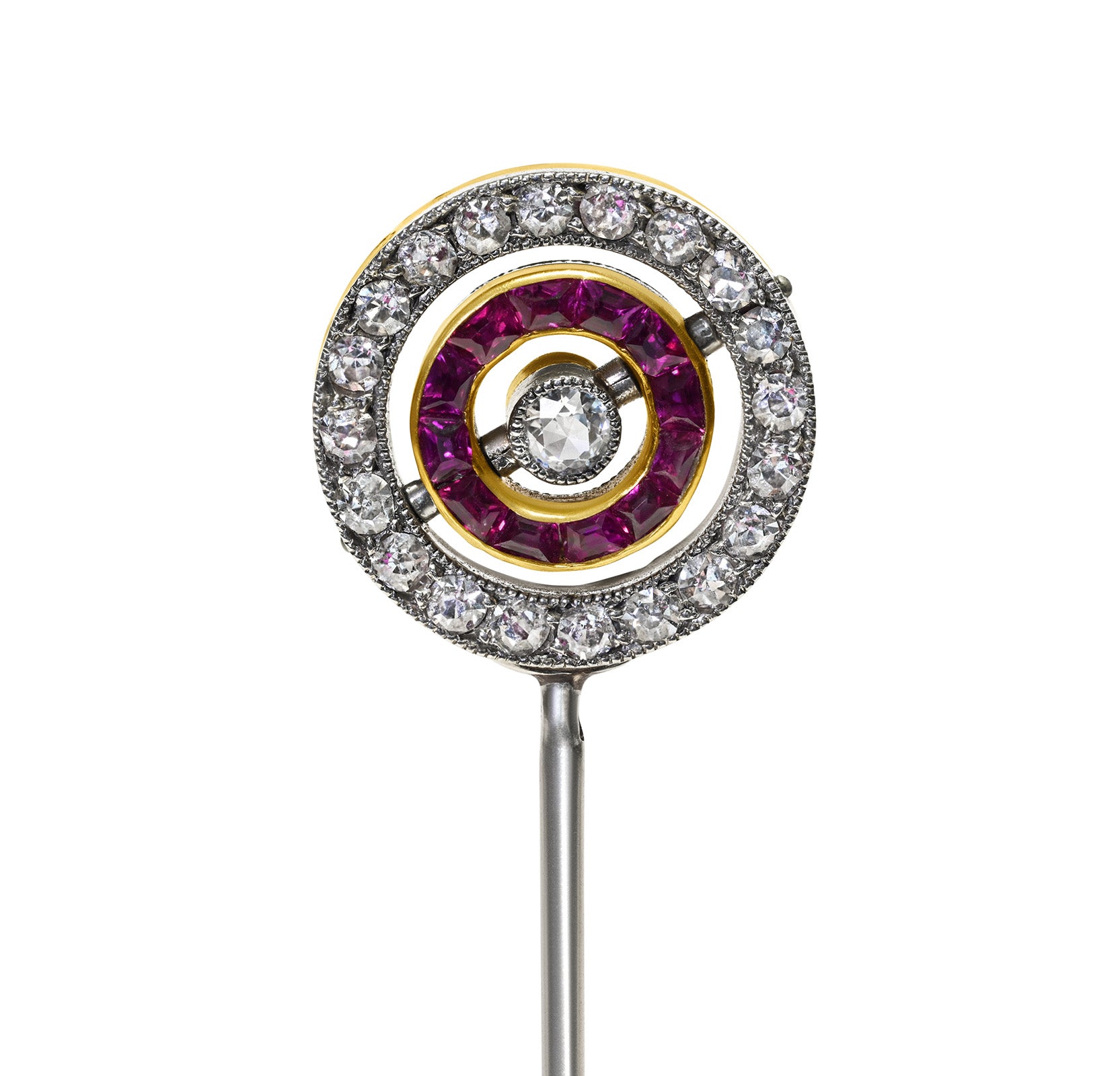
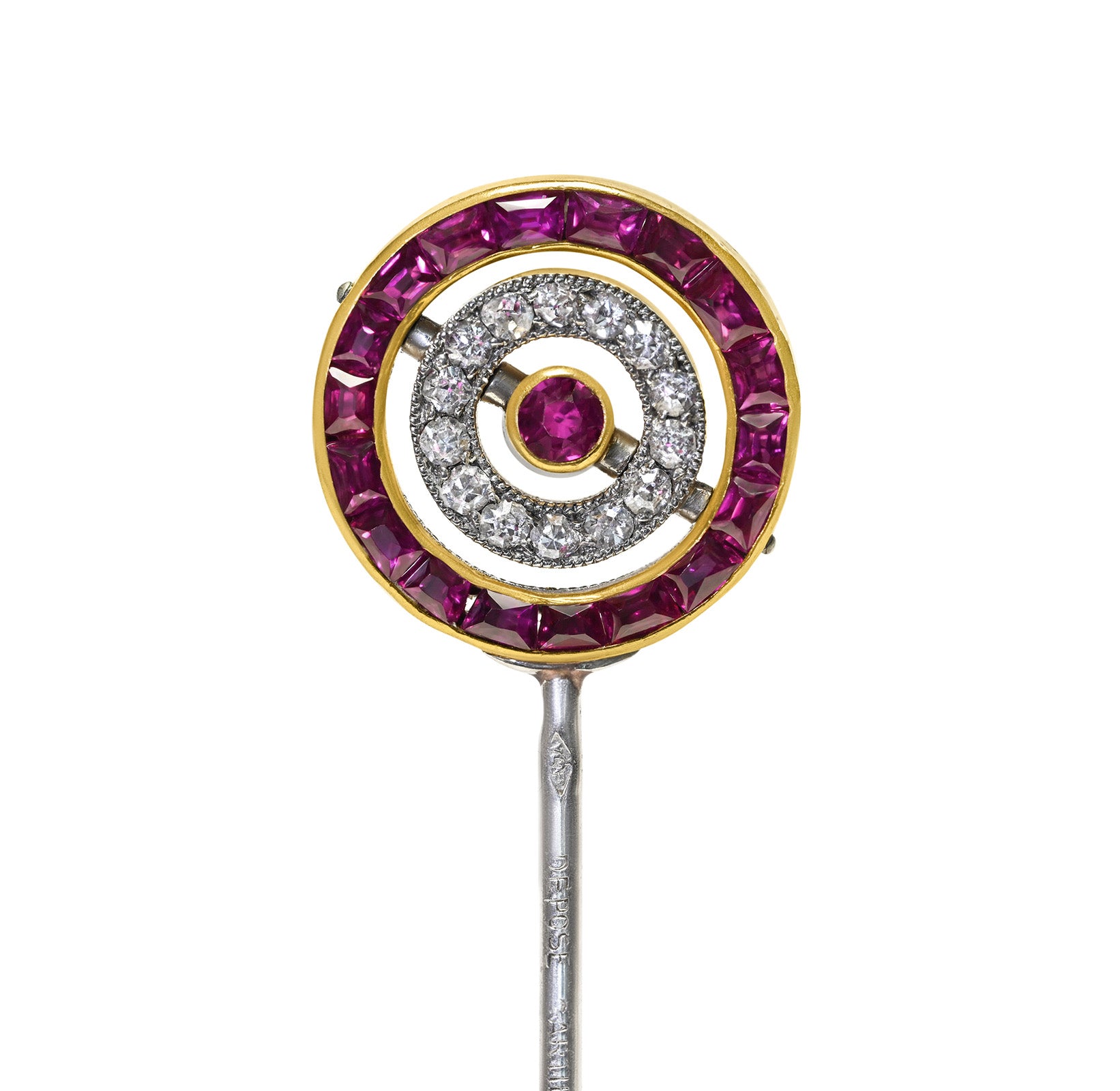


Cartier Belle Époque Diamond and Ruby Double-Sided Swivel Stick Pin
Cartier Belle Époque Diamond & Ruby Double-Sided Swivel Stick Pin by Georges Andrey
This extraordinary Cartier Belle Époque swivel stick pin represents a rare meeting of mechanical ingenuity and refined design, illustrating the innovative spirit that defined Cartier jewelry at the beginning of the twentieth century. Created during the celebrated Belle Époque period, the jewel reflects the technical mastery and artistic elegance that established Cartier as one of the most influential jewelry houses in the world.
The circular head presents a striking geometric composition of concentric rings, a motif associated with the emerging modern aesthetic of the early 1900s. On one side, the jewel reveals a luminous arrangement of old-cut diamonds set in platinum. The diamonds form radiating circular bands surrounding a central stone, creating a brilliant “target” design enhanced by delicate milgrain detailing, a signature feature of refined Cartier craftsmanship during this era.
The reverse side offers a dramatic transformation. Through an ingenious swivel mechanism, the head rotates to reveal an equally captivating composition of calibré-cut rubies mounted in warm yellow gold. The rubies form concentric circles surrounding a central ruby, producing a vibrant and richly colored counterpart to the diamond side. The contrast between the platinum-set diamonds and the yellow-gold ruby arrangement reflects the sophisticated design sensibility that distinguished Cartier jewels of the Belle Époque.
This ingenious reversible construction was made possible through the work of Georges Andrey, the renowned inventor and jeweler whose patented mechanisms allowed Cartier to create jewels with rotating or transforming elements. The jewel bears the hallmark of Georges Andrey, along with the inscriptions “DEPOSE CARTIER NEW YORK,” indicating a patented design associated with Cartier’s New York branch.
Mechanical jewels of this kind are particularly admired because they combine artistry with engineering. The rotating head allows the wearer to transform the jewel instantly, creating different visual expressions within a single piece—an approach that perfectly reflects the innovative creativity that defined Cartier jewelry during the Belle Époque.
A Jewel of Remarkable Versatility
One of the most fascinating aspects of this Cartier swivel stick pin is its versatility. Thanks to its rotating construction, the jewel can be styled in multiple ways depending on the occasion.
The wearer may choose to display the diamond side, offering refined brilliance ideal for formal or evening wear. Alternatively, the ruby side provides a bold and vibrant expression of color. The mechanism also allows the head to be positioned between rotations, revealing both diamonds and rubies simultaneously, creating a striking interplay of light and color.
This playful yet sophisticated versatility embodies the spirit of Cartier design, where elegance, ingenuity, and individuality were seamlessly combined.
Today, jewels such as this Cartier Belle Époque swivel stick pin are particularly prized by collectors. The combination of Cartier authorship, the hallmark of Georges Andrey, a patented rotating mechanism, and the harmonious use of diamonds and rubies makes this jewel a compelling example of the creativity that established Cartier as the “Jeweler of Kings and the King of Jewelers.”
Key Details
• Maker: Cartier
• Designer / Mechanism: Georges Andrey
• Period: Belle Époque, early 20th century
• Signature: CARTIER NEW YORK
• Patent mark: DEPOSE
• Cartier serial number: 1152
• Assembly / fitting mark: 6
• Design: Double-sided swivel stick pin with rotating head
• Gemstones: Old-cut diamonds and calibré-cut rubies
• Metal: Platinum and yellow gold
• Special feature: Reversible mechanism allowing two distinct designs
Historical Context
Several details visible on the jewel help place this remarkable Cartier swivel stick pin within the innovative early years of twentieth-century jewelry design.
The inscription “DEPOSE – CARTIER – NEW YORK” indicates a registered or patented design. Its presence alongside the Cartier New York signature reflects a moment when the New York branch was already active while remaining closely connected to Parisian technical development.
The ingenious rotating construction is characteristic of mechanisms associated with Georges Andrey, whose swivel mounts allowed a jewel to transform in appearance. Combined with the geometric concentric design, old-cut diamonds set in platinum with delicate milgrain and calibré-cut rubies in yellow gold, these elements strongly suggest a production period circa 1905–1910.
Email us or give us a call: (929) 316-2746. For our shipping and refund policy please see our terms & conditions.

The DSF Promise
Buy with confidence. Every piece is backed by:
• Authenticity — examined and verified before listing
• Condition — carefully inspected and honestly described
• Insured shipping — fully insured, signature required
• 32-day returns — available on eligible, unaltered items
• Private appointments — available in New York
• Experience — over 50 years of fine jewelry expertise
How do I know a piece is authentic, and can I trust DSF?
Buying fine jewelry online takes trust, especially at this level. DSF Antique Jewelry is a New York–based dealer with over 50 years of fine jewelry expertise. Every piece is examined for authenticity and condition before it is listed — we assess hallmarks, maker's marks, metal content, gemstones, and construction consistent with the stated period or designer. For signed pieces such as Cartier, Buccellati, or Van Cleef & Arpels, we verify maker's marks and signatures. We're glad to send additional photographs of any hallmark, or speak with you directly, before you decide.
Why does antique gold look different, and is surface wear normal?
Antique pieces were often made in gold standards less common today, such as 15ct (used in Britain only between 1854 and 1932), 9ct, or higher-karat continental gold, which give a warmer tone than typical modern 14k. Light surface wear, softened edges, and a gentle patina are normal and expected on antique jewelry — they reflect the age and authenticity of the piece, not flaws. We describe the true condition of every item honestly in its listing.
What do the hallmarks and maker's marks mean?
Hallmarks are small stamped marks that identify the metal standard, and often the maker, assay office, and date. They are one of the best tools for authenticating antique jewelry. We identify and explain the marks we find on each piece in its description, and we're happy to send close-up photographs of any hallmark on request so you can see exactly what you're buying.
Can pieces be resized or adjusted?
It depends on the piece. Many antique rings can be resized, but bands with all-around engraving, thin shanks, or gemstones near the base may be limited in how far they can safely go, and some pieces are best left as-is to preserve their integrity. We list each item's measurements as they currently are. If you're unsure whether something can be safely adjusted, contact us before buying and we'll give you an honest assessment for that specific piece.
How should I care for and store fine jewelry?
Clean gently with a soft cloth, avoid harsh chemicals, ultrasonic cleaners, and chlorine, and store pieces separately so they don't scratch one another. Remove rings and bracelets for heavy manual tasks. Antique gold is softer than modern alloys, so period pieces are best enjoyed with normal care. Treated well, fine antique jewelry lasts for generations — many of our pieces are already a century or more old and still beautiful.
Choose options
Proud Member of Respected Jewelry Industry Organizations
These memberships reflect DSF Antique Jewelry’s commitment to integrity, education, and responsible practices within the jewelry trade.


Please wait...
Make An Offer
Thank you for your interest. Please submit your offer, and we’ll get back to you.
