

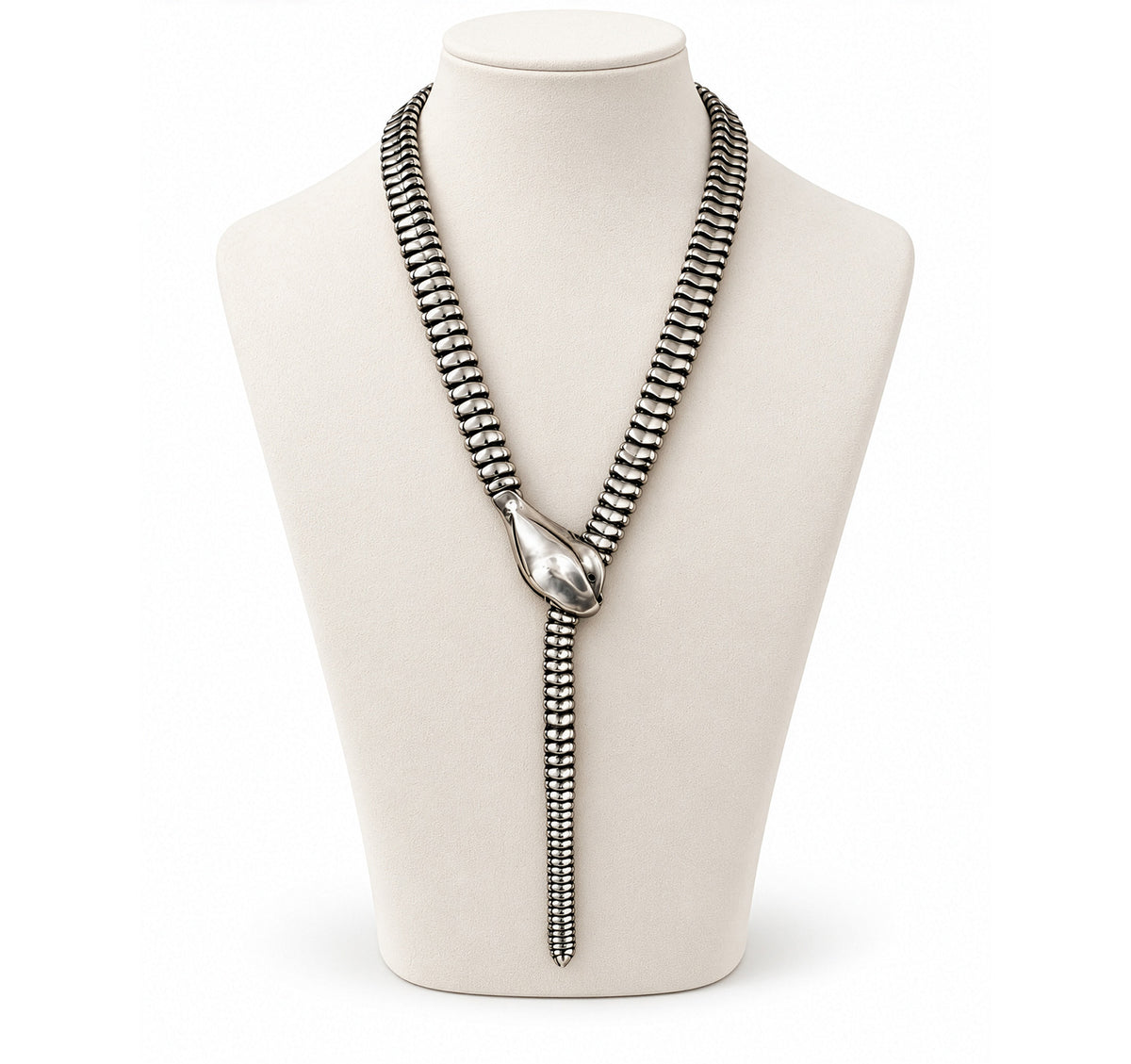


Early Elsa Peretti Silver Snake Belt Necklace, Xavier Corberó Workshop, circa 1973
Part of the DSF Antique Jewelry Permanent Collection. Retained for research and historical reference. Not offered for sale.
A Rare Articulated Serpent from Elsa Peretti’s Formative Pre-Tiffany Period
This exceptionally rare Elsa Peretti sterling silver snake belt necklace represents an important early chapter in the celebrated designer’s career. Dating to approximately 1973–1974, the piece originates from the formative period immediately preceding Peretti’s renowned collaboration with Tiffany and reflects the organic, tactile design language that would become her signature.
Designed during the period when Peretti was creating jewelry and accessories to complement the fluid fashions of Halston, this extraordinary piece transforms sterling silver into a remarkably lifelike articulated serpent. Its body is composed of numerous graduated, individually joined links that move fluidly and naturally around the wearer.
A substantial sculptural snake head creates the dramatic focal point, complete with contrasting dark eyes that lend the serpent an expressive presence. The snake’s ingeniously constructed jaw opens to receive and secure its articulated body at different points. This mechanical design allows the piece to be worn in multiple configurations—as a dramatic lariat-style necklace or as an adjustable belt.
The piece bears an X.C. workshop mark associated with Xavier Corberó, the renowned Catalan sculptor who was Elsa Peretti’s early artistic collaborator. Corberó introduced Peretti to metalworking and helped translate some of her earliest jewelry concepts into finished objects before her celebrated relationship with Tiffany began.
The combination of sculpture, movement and functional versatility exemplifies Peretti’s ability to transform forms found in nature into exceptionally wearable works of art. Unlike later Tiffany-signed editions, this early workshop-associated example offers a direct connection to the experimental period in which Peretti was first developing her distinctive approach to silver and the human form.
An example of this articulated sterling silver snake design, dated 1973–1974, is preserved in the permanent collection of the Metropolitan Museum of Art’s Costume Institute.
Rare, versatile and historically significant, this snake belt necklace is both a striking piece of wearable sculpture and an exceptional acquisition for a serious collector of Elsa Peretti, artist-designed jewelry or twentieth-century fashion.
Key Features
- Designer: Elsa Peretti
- Workshop: Associated with Xavier Corberó
- Maker’s Mark: X.C.
- Period: Circa 1973–1974
- Historical Association: Created during Peretti’s early Halston period
- Material: Sterling silver
- Design: Fully articulated snake or serpent
- Details: Sculptural head with contrasting dark eyes
- Construction: Numerous graduated, individually joined links
- Closure: Opening jaw designed to receive and secure the articulated body
- Wearability: Convertible lariat-style necklace and adjustable belt
- Style: Organic modernist / wearable sculpture
- Condition: Excellent vintage condition, with light surface wear and natural patina consistent with age
- Museum Connection: The articulated snake design is represented in the Metropolitan Museum of Art’s Costume Institute collection
Historical Significance
Elsa Peretti’s early creative relationship with Xavier Corberó helped establish the sculptural and organic vocabulary that would later define her career. This X.C.-marked example comes from the period immediately before Peretti’s association with Tiffany and offers an unusually direct connection to the beginnings of one of the most influential careers in modern jewelry design.
Email us or give us a call: (929) 316-2746. For our shipping and refund policy please see our terms & conditions.

The DSF Promise
Buy with confidence. Every piece is backed by:
• Authenticity — examined and verified before listing
• Condition — carefully inspected and honestly described
• Insured shipping — fully insured, signature required
• 32-day returns — available on eligible, unaltered items
• Private appointments — available in New York
• Experience — over 50 years of fine jewelry expertise
How do I know a piece is authentic, and can I trust DSF?
Buying fine jewelry online takes trust, especially at this level. DSF Antique Jewelry is a New York–based dealer with over 50 years of fine jewelry expertise. Every piece is examined for authenticity and condition before it is listed — we assess hallmarks, maker's marks, metal content, gemstones, and construction consistent with the stated period or designer. For signed pieces such as Cartier, Buccellati, or Van Cleef & Arpels, we verify maker's marks and signatures. We're glad to send additional photographs of any hallmark, or speak with you directly, before you decide.
Why does antique gold look different, and is surface wear normal?
Antique pieces were often made in gold standards less common today, such as 15ct (used in Britain only between 1854 and 1932), 9ct, or higher-karat continental gold, which give a warmer tone than typical modern 14k. Light surface wear, softened edges, and a gentle patina are normal and expected on antique jewelry — they reflect the age and authenticity of the piece, not flaws. We describe the true condition of every item honestly in its listing.
What do the hallmarks and maker's marks mean?
Hallmarks are small stamped marks that identify the metal standard, and often the maker, assay office, and date. They are one of the best tools for authenticating antique jewelry. We identify and explain the marks we find on each piece in its description, and we're happy to send close-up photographs of any hallmark on request so you can see exactly what you're buying.
Can pieces be resized or adjusted?
It depends on the piece. Many antique rings can be resized, but bands with all-around engraving, thin shanks, or gemstones near the base may be limited in how far they can safely go, and some pieces are best left as-is to preserve their integrity. We list each item's measurements as they currently are. If you're unsure whether something can be safely adjusted, contact us before buying and we'll give you an honest assessment for that specific piece.
How should I care for and store fine jewelry?
Clean gently with a soft cloth, avoid harsh chemicals, ultrasonic cleaners, and chlorine, and store pieces separately so they don't scratch one another. Remove rings and bracelets for heavy manual tasks. Antique gold is softer than modern alloys, so period pieces are best enjoyed with normal care. Treated well, fine antique jewelry lasts for generations — many of our pieces are already a century or more old and still beautiful.
Choose options
Proud Member of Respected Jewelry Industry Organizations
These memberships reflect DSF Antique Jewelry’s commitment to integrity, education, and responsible practices within the jewelry trade.


Please wait...
Make An Offer
Thank you for your interest. Please submit your offer, and we’ll get back to you.
