Brüder Frank Vienna: A Collector’s Guide to Austrian Silver and Enamel
The Viennese Workshop Known for Silver Cases, Guilloché Enamel and Decorative Objects
An antique silver case may measure only a few inches, yet it can contain an extraordinary concentration of craftsmanship.
The silver body had to be formed precisely. The hinge and closure needed to operate smoothly. Decorative patterns were engraved into the surface, enamel was carefully applied and fired, and the interior was often finished with gilding.
In more elaborate examples, a miniature painter added a detailed landscape, historical composition or figural scene.
Few objects demonstrate this combination of artistry and technical skill more effectively than the silver and enamel cases associated with Brüder Frank of Vienna.
The firm is also identified in European references as Gebrüder Frank. In English-language searches and auction listings, the name is frequently simplified to Bruder Frank when the umlaut is omitted.
DSF Antique Jewelry has assembled a dedicated Brüder Frank Vienna Silver and Enamel collection, bringing together available pieces and selected archival examples previously handled by DSF.
Studied as a group, these objects reveal the workshop’s range of silverwork, enamel techniques, subject matter and international retail connections.
Who Was Brüder Frank?
Brüder Frank was a Viennese gold and silversmithing firm rather than the name of one individual craftsman.
The name translates approximately as “Frank Brothers.” The more formal name Gebrüder Frank is also found in European references.
The firm is generally recorded as having been established in Vienna in 1887. It operated during an important period in Austrian decorative arts, when traditional historicist design existed alongside Jugendstil and the early development of modern Viennese design.
The surviving work associated with Brüder Frank demonstrates considerable versatility.
Some objects are richly decorated with historical figures, tapestry-inspired scenes and elaborate enamel. Others are more restrained, relying on carefully proportioned silver forms, engraved patterns and precise construction.
This range suggests a workshop capable of adapting its production to different clients, retailers and international markets.

Vienna and the Decorative Arts
Vienna underwent significant artistic change during the late nineteenth and early twentieth centuries.
Traditional Renaissance, Baroque and Rococo influences remained popular, particularly in luxury silver intended for established European and international clients.
At the same time, Jugendstil introduced more fluid forms, naturalistic ornament and new approaches to surface decoration. Later Viennese designers moved toward geometric patterns and a cleaner visual language.
Brüder Frank worked across this changing environment.
For this reason, not every object by the firm should automatically be described as Art Nouveau.
A case depicting medieval figures may be better described as historically inspired or Renaissance Revival. A piece with flowing botanical ornament may show Jugendstil influence. A later silver box may have a more restrained or geometric appearance.
Each object should be evaluated according to its individual design, hallmarks, construction and approximate period.
More Than a Maker of Enamel Cases
Collectors frequently encounter the Brüder Frank name on silver cigarette cases, compacts and small decorative boxes.
These portable objects are among the workshop’s most visually appealing creations, but the firm’s production extended well beyond them.
Documented Brüder Frank objects include:
• Silver and enamel cases
• Compacts and powder cases
• Decorative boxes
• Dressing and toilette accessories
• Bowls and presentation objects
• Silver-mounted glass
• Coffee and tea services
• Table silver
• Desk and household objects
The variety of surviving pieces confirms that Brüder Frank was not simply a manufacturer of enamel cases.
It was an established Viennese silver workshop capable of producing both intimate personal accessories and substantial household objects.
The smaller cases remain especially collectible because they concentrate several demanding techniques within a compact format.
Why Brüder Frank Cases Are So Distinctive
A finely made Brüder Frank case may combine a substantial silver body with detailed decorative work.
Features can include:
• Precisely fitted hinges and closures
• Engraved or engine-turned surfaces
• Translucent guilloché enamel
• Hand-painted enamel scenes
• Engraved silver borders
• Gilt interiors
• Cabochon stones or hardstone panels
• Austrian assay marks
• International retailer marks
The front and reverse may be decorated in completely different ways.
One side might display a woodland landscape, military subject or historical scene. The reverse might be covered with a radiating guilloché pattern that changes in appearance as it catches the light.
This contrast gives the object two separate visual identities.
One side functions almost like a miniature painting. The other emphasizes pattern, color and the reflective qualities of the metal beneath the enamel.
Understanding Guilloché Enamel
Guilloché begins with a repeating pattern engraved mechanically into a metal surface.
The patterns were traditionally created using specialized equipment such as an ornamental lathe. Translucent enamel was then applied over the engraved metal and fired.
Because light passes through the enamel, the engraved pattern remains visible beneath the color.
The effect can appear remarkably dynamic. A surface that looks dark from one angle may become luminous when the object is tilted.
Common guilloché patterns include:
• Radiating sunbursts
• Concentric circles
• Waves
• Parallel lines
• Zigzags
• Basket-like patterns
• Repeating geometric fields
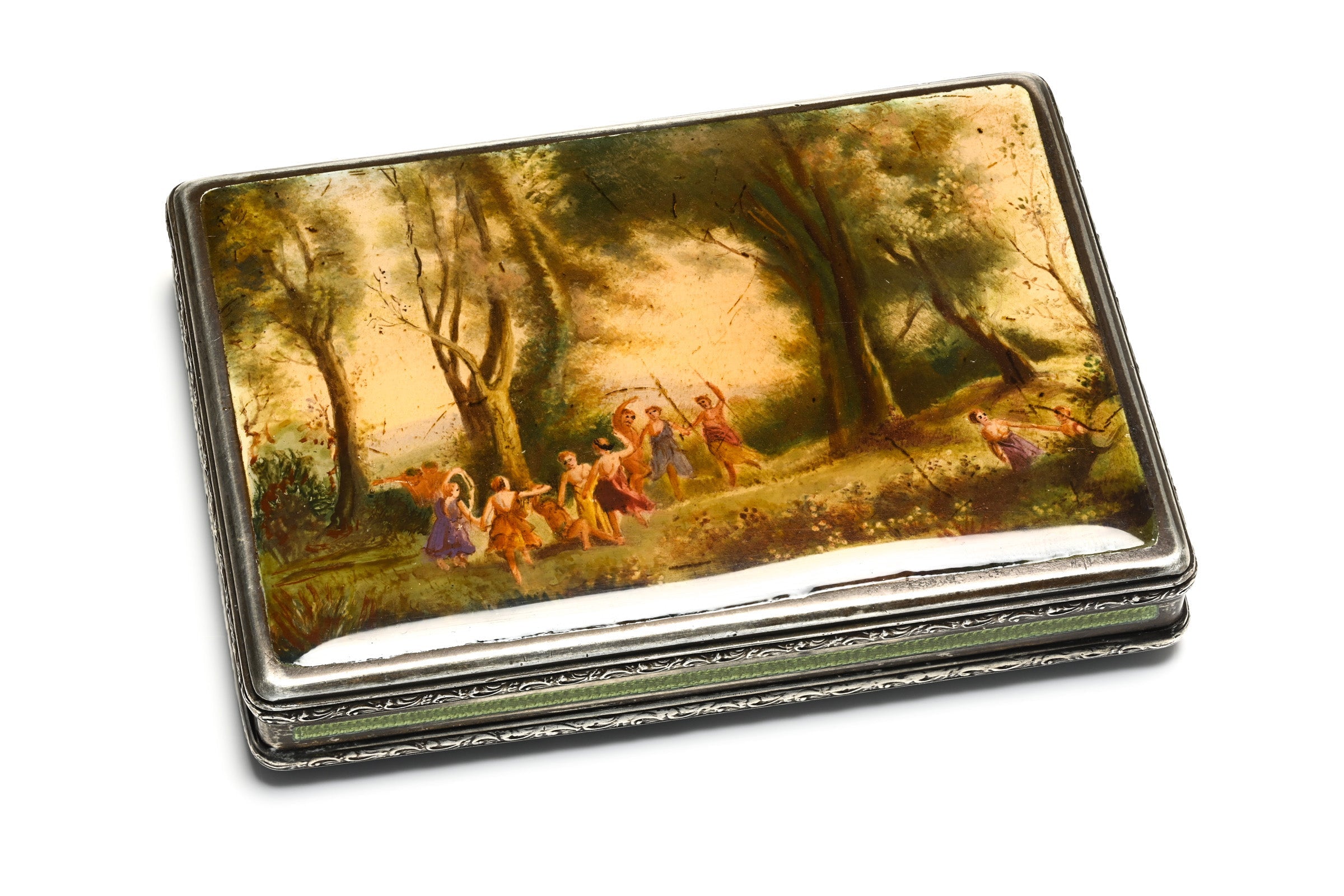
One particularly strong example in the DSF collection is the antique Brüder Frank 935 silver painted enamel case.
The front presents a finely painted woodland gathering with figures beneath tall trees. The reverse is decorated with deep green guilloché enamel in a radiating pattern.
The two surfaces demonstrate distinct enamel techniques within a single object.
Painted Enamel as Miniature Art
Painted enamel required a different approach from guilloché.
Rather than allowing an engraved pattern to show beneath translucent color, the artist created a miniature pictorial composition.
Figures, clothing, landscapes, architecture and foliage had to be reduced to a very small scale without losing their visual character.
The artist also had to anticipate how the colors would respond during firing. Multiple firings could be required to build detail and tonal variation.
Subjects found on Brüder Frank and related Austrian cases include:
• Romantic landscapes
• Woodland gatherings
• Military scenes
• Courtly interiors
• Historical figures
• Medieval imagery
• Renaissance-inspired compositions
• Designs influenced by European tapestries
The finest examples are more than decorated accessories.
They function as miniature paintings framed in silver.
Medieval and Tapestry-Inspired Designs
Several Brüder Frank pieces represented in the DSF collection feature imagery inspired by medieval and Renaissance tapestries.
These objects may include richly patterned red grounds, stylized trees, animals, ceremonial figures and architectural details.
Examples depicting a lady, lion and unicorn reflect the continuing influence of celebrated European tapestry subjects.
The saturated colors and formal compositions differ considerably from the naturalistic woodland scene found on the painted 935 silver case.
Together, these pieces demonstrate that Brüder Frank did not rely on one decorative formula.
The workshop adapted its cases to historical subjects, landscapes, romantic scenes and textile-inspired designs.
The BF Maker’s Mark
The hallmark most frequently associated with Brüder Frank consists of the initials BF, often enclosed within an oval.
Depending on the date and intended market, the BF mark may appear with:
• A numerical silver standard
• The word STERLING
• An Austrian assay mark
• A Viennese Diana’s head mark
• An import mark
• A retailer or distributor’s signature
The BF initials should not be evaluated alone.
A reliable attribution also considers the silver standard, construction, decoration, style, apparent age and accompanying assay marks.
Clear photographs of the marks are particularly important. They allow collectors to examine how the different stamps appear together.
The DSF painted enamel case is marked BF, STERLING and 935, providing a useful example of the workshop’s identifying marks and silver standard.

What Does 935 Silver Mean?
A mark of 935 indicates an alloy intended to contain approximately 93.5 percent pure silver.
This is slightly higher than traditional sterling silver, which contains 92.5 percent silver.
Some Brüder Frank objects carry both the number 935 and the word STERLING. This may have made the silver standard easier to recognize in international markets.
Not every Brüder Frank object was made in 935 silver.
Documented pieces associated with the workshop have been found in several standards, including:
• 800 silver
• 935 silver
• 950 silver
The silver standard alone does not determine the value of an object.
Condition, enamel quality, subject matter, construction, rarity, retailer associations and visual appeal may be considerably more important.
The Viennese Diana’s Head Mark
Some Brüder Frank objects from the Austro-Hungarian period carry the Diana’s head assay mark.
This hallmarking system was used on Austrian silver during the late nineteenth and early twentieth centuries.
The mark can assist with identifying the place of assay and the silver standard when it remains sufficiently clear.
Not every authentic Brüder Frank object will have the same group of stamps.
Hallmarking systems changed over time, and pieces intended for export may also carry foreign import marks or retailer signatures.
This is why the complete group of marks should be examined rather than relying on one symbol.
Brüder Frank and International Retailers
Brüder Frank objects were sold beyond Austria and sometimes carry the names of prominent international retailers.
A documented 935 silver, enamel and agate case made by Brüder Frank was imported into London in 1927 and retailed by Alfred Dunhill.
The case combined silver, hardstone, guilloché enamel, plique-à-jour enamel and a gilt interior.
DSF Antique Jewelry also offers a Brüder Frank silver and enamel box retailed by Abercrombie & Fitch, New York.
The box is decorated with a military scene and marked BF, 935, STERLING and Abercrombie & Fitch New York.
These retailer associations demonstrate how Viennese decorative objects reached customers in cities such as London and New York.
A recognized retailer can contribute additional provenance and collector interest.
The retailer’s name should not replace the examination of the object itself. Craftsmanship, rarity, condition and design remain fundamental.
Plique-à-Jour and Mixed Materials
Some Brüder Frank objects incorporate techniques beyond painted and guilloché enamel.
Plique-à-jour enamel is created within open metal cells without a solid backing.
Light passes through the enamel, producing an appearance similar to miniature stained glass.
Certain documented Brüder Frank cases combine plique-à-jour enamel with guilloché decoration, agate, carnelian or other hardstones.
These mixed-material pieces required considerable precision.
The silver frame, enamel and stone elements had to fit together correctly while allowing the case or box to remain functional.
Surviving examples demonstrate the workshop’s ability to coordinate several specialized crafts within one object.
The Brüder Frank Collection at DSF Antique Jewelry
The DSF collection presents several different areas of Brüder Frank production.
Painted and Guilloché Enamel
The woodland case combines miniature painting with green radiating guilloché enamel.
Its substantial silver construction, gilt interior and clearly photographed hallmarks make it an especially useful example for studying the firm’s craftsmanship.
Renaissance and Medieval Imagery
The Renaissance Revival compact and tapestry-inspired cases demonstrate the workshop’s interest in historical European subjects.
Figures, animals, patterned grounds and architectural details create complex compositions within relatively small surfaces.
Restrained Silver Design
The rectangular Brüder Frank silver box shows that the firm’s work was not limited to colorful enamel.
Its tightly patterned exterior emphasizes texture, proportion and precise silver construction.
International Retail Connections
The Abercrombie & Fitch box connects Viennese manufacture with the American luxury market.
Its retailer signature, military scene and substantial scale distinguish it from the smaller personal cases.
Available and Archival Pieces
Selected sold objects remain visible as part of the DSF archive.
For a specialized maker, these archival examples help demonstrate the range of designs DSF has handled. They also allow collectors to compare past pieces with those currently available.
Were All Brüder Frank Objects Art Nouveau?
No.
Brüder Frank operated during the Jugendstil and Art Nouveau period, and some objects reflect those influences.
Other pieces employ Renaissance Revival, medieval, historicist or later geometric decoration.
Each object should be described according to its actual design.
It is more accurate to identify a piece as early twentieth-century Austrian, Jugendstil, Renaissance Revival, historically inspired or Art Deco influenced when the individual object supports that description.
The maker’s location and period should not be used to assign every object to the same artistic movement.
What Collectors Should Examine
Enamel Condition
Look for chips, hairline cracks, scratches and restored areas.
Corners, edges, hinges and closures are particularly vulnerable.
Painted Details
On figural compositions, examine faces, hands and central subjects carefully.
Wear in these areas may have a greater effect on the appearance than a small mark in the background.
Guilloché Surfaces
The translucent enamel should reveal the patterned metal beneath it.
Cloudiness, uneven color or changes in texture may require closer examination.
Hinges and Closures
The case should open and close correctly without forcing.
A distorted frame can place pressure on the enamel and may eventually contribute to cracking.
Interior Gilding
Many cases have gilt interiors.
Some wear is expected, but the extent and consistency of the gilding should be recorded.
Hallmarks
Maker’s marks, assay symbols, silver standards and retailer signatures should be photographed clearly whenever possible.
Original Fittings
Compacts may originally have contained mirrors, powder compartments or removable fittings.
Cigarette cases may once have had interior straps.
Missing fittings should be disclosed, although they do not necessarily prevent an object from being collectible.
Restoration
Older enamel repairs can be difficult to identify.
Differences in color, transparency or surface texture may indicate later restoration.
How DSF Evaluates Brüder Frank Objects
DSF Antique Jewelry evaluates each Brüder Frank object as a complete work.
The review may consider:
• Maker’s and assay marks
• Silver purity marks
• Import and retailer signatures
• Construction and hinge quality
• Enamel technique
• Subject matter
• Interior finish
• Measurements and weight
• Overall condition
• Possible evidence of restoration
• Consistency with the stated period
No single hallmark should be considered in isolation.
The maker’s marks, silver standard, construction, materials and style should support one another.
This approach is especially important when examining enamel objects. A painted scene may create the first impression, but the marks, silver construction and condition complete the historical picture.

Why Collect Brüder Frank?
Brüder Frank objects appeal to collectors across several categories.
They can be appreciated as:
• Austrian silver
• Antique enamel
• Objects of vertu
• Miniature painted works
• Historic luxury accessories
• Jugendstil or historicist design
• Retailer-signed objects
• Examples of Viennese craftsmanship
Their relatively compact scale also makes them easy to display.
A small group of cases can demonstrate an impressive variety of color, technique and subject matter without requiring the space needed for large table silver.
The strongest examples combine recognizable marks, sophisticated enamel, substantial construction, good condition and compelling imagery.
Frequently Asked Questions
Are Brüder Frank and Gebrüder Frank the Same Maker?
Yes. Both names appear in references to the Viennese firm.
Brüder Frank is the preferred name used by DSF. Gebrüder Frank is also found in European auction and historical references.
Bruder Frank is the simplified spelling often used when the umlaut is omitted.
When Was Brüder Frank Established?
The firm is generally recorded as having been established in Vienna in 1887.
What Does the BF Hallmark Mean?
On appropriately marked Austrian silver, BF in an oval may represent Brüder Frank.
The attribution should also be supported by the silver standard, assay marks, construction, style and apparent period.
Did Brüder Frank Use Only 935 Silver?
No.
Documented pieces associated with the workshop appear in several silver standards, including 800, 935 and 950.
Did Brüder Frank Make Only Cigarette Cases?
No.
The workshop also produced table silver, toilette accessories, bowls, decorative boxes, silver-mounted glass, tea services, coffee services and other objects.
Are All Brüder Frank Pieces Art Nouveau?
No.
Some pieces reflect Jugendstil or Art Nouveau influence. Others feature Renaissance Revival, medieval, historicist or later geometric decoration.
Do Retailer Marks Add Value?
A recognized retailer such as Alfred Dunhill or Abercrombie & Fitch can contribute provenance and collector interest.
Value still depends on the complete object, including its design, materials, rarity, craftsmanship and condition.
How Should an Antique Enamel Case Be Stored?
Store the case separately in a soft, dry environment where it cannot strike another object.
Avoid abrasive polishing, sudden temperature changes, ultrasonic cleaning and harsh chemicals.
Enamel is glass fused to metal and may chip if the object is dropped or subjected to pressure.
The Lasting Appeal of Brüder Frank
Brüder Frank represents a fascinating chapter in Viennese silver and decorative arts.
Established during the final decades of the Austro-Hungarian Empire, the workshop produced objects across changing design periods for European and international clients.
Its surviving work ranges from substantial table services to compact silver cases decorated with translucent enamel and miniature painting.
The smallest objects often contain the most concentrated artistry.
Within only a few inches, silver construction, engraving, gilding, enamel and mechanical precision come together in an object designed to be both useful and beautiful.
For collectors, the BF mark is the beginning of the investigation rather than the end.
Silver standards, assay marks, retailer signatures, condition, subject matter and craftsmanship all contribute to understanding an individual object.
Through its dedicated Brüder Frank Vienna Silver and Enamel collection, DSF Antique Jewelry brings together available and archival examples that reveal the workshop’s impressive range.
The collection includes romantic painted landscapes, luminous guilloché enamel, tapestry-inspired compositions and restrained silver design.