Elsa Peretti’s Snake Necklace: The Early Story Behind an Icon
Among Elsa Peretti’s many designs inspired by the natural world, the Snake occupies a particularly intriguing place. Its appeal lies not only in the recognizable form of the serpent, but in the way Peretti transformed that form into an object that responds almost instinctively to the body.
Made from articulated sections of metal, the Snake can curve around the waist, coil around the neck and change its appearance according to how it is worn. It is jewelry, but it also behaves like sculpture.
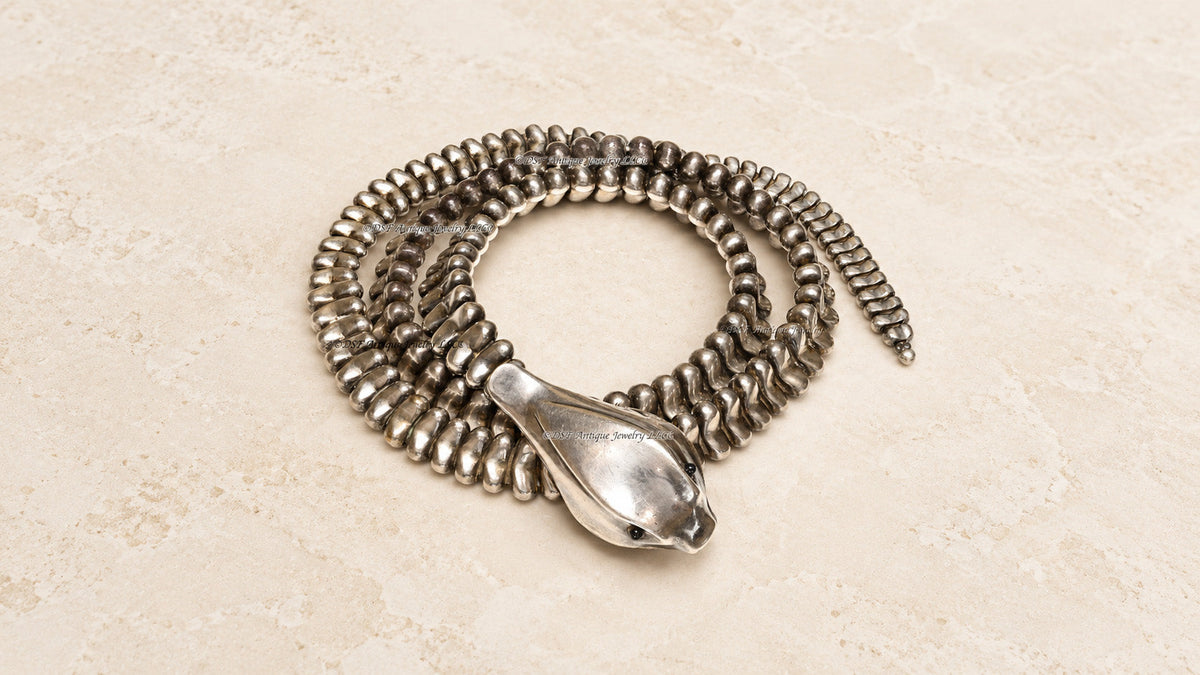
An articulated sterling silver example bearing an X.C. maker’s mark, now in the DSF Antique Jewelry collection, prompted a closer look at the history of the design. Its construction and X.C. maker’s mark lead directly into the period when Elsa Peretti was developing her ideas between Spain and New York, creating accessories for Halston and beginning the body of work that would eventually become inseparable from Tiffany & Co.
Today, the Snake is often discussed primarily as a Tiffany design. Its history, however, reaches back to the years immediately before Peretti formally joined the house in 1974. Surviving museum pieces, runway photographs and archival material show that the serpent was already an established part of her visual language by 1973.
That earlier history is what makes the Snake particularly interesting.

Before Tiffany: Peretti, Spain and the Beginnings of Her Jewelry
Elsa Peretti arrived in New York in 1968 after working as a model in Europe, but the beginnings of her jewelry career can be traced to Spain. In Barcelona she became part of an artistic circle that included Catalan sculptor Xavier Corberó, who introduced her to the possibilities of working in metal. The Nando and Elsa Peretti Foundation describes Corberó as an important figure in the development of her earliest objects: he helped her understand how the forms she imagined could be translated into metal and connected her with craftsmen capable of realizing them.
One of her earliest successful jewelry designs was the small silver Bottle pendant, created in 1969. Giorgio di Sant’Angelo saw the design and incorporated it into a fashion show, after which Peretti began producing other silver accessories for both Di Sant’Angelo and Halston.
The importance of this period goes beyond biography. Many of the ideas that would later define Peretti’s work were already present: a fascination with organic forms, an interest in the tactile qualities of metal and, above all, an understanding that a piece of jewelry should be designed in relation to the person wearing it. Rather than treating the body simply as a place from which a jewel could hang, she made the contours and movement of the body part of the design itself.
The Snake is one of the clearest expressions of that philosophy.
A Snake That Could Become a Belt or a Necklace
At first glance, the early Snake appears surprisingly simple. Its long body is constructed from articulated elements that allow the metal to flex, while the head functions as part of the fastening system. The jewel can therefore be adjusted and wrapped in different ways rather than being fixed into a single configuration.
The Metropolitan Museum of Art holds an Elsa Peretti Snake dated 1973–74, made in sterling silver and enamel. The museum describes how the snake’s jaw can clamp onto its own articulated body at the point selected by the wearer, leaving the end of the tail to hang freely.
That mechanical ingenuity explains why historical photographs sometimes show what appears to be a necklace and at other times a belt. It is not necessarily a contradiction. Adaptability was built into the concept.
Technically, it’s a belt, but she uses it here as a necklace.
The observation is particularly relevant when looking at photographs of Peretti herself. She did not treat the piece as an object with a single prescribed use. Wrapped tightly around the neck, it could become a dramatic articulated necklace; positioned lower on the body, the same basic principle could produce a sculptural belt.
Even contemporary Tiffany descriptions of the extended Snake emphasize that versatility, with versions designed to move with the wearer and to be styled around the neck or waist.
The Snake Enters Halston’s World
Peretti’s friendship and creative relationship with Halston was crucial during these years. She modeled his clothes, moved within his close circle and designed jewelry and accessories that suited his increasingly spare approach to American fashion.
The pairing was unusually natural. Halston’s clothes were often defined by fluidity, simplicity and the absence of unnecessary structure. Peretti’s jewelry could be visually powerful without relying on elaborate ornament. Silver, smooth surfaces and organic forms provided a sculptural counterpoint to the fabric without overwhelming it.
By 1973, the Snake had entered this world.
One of the most significant documented appearances came at the Battle of Versailles on November 28, 1973, the celebrated benefit fashion show that brought five American designers together with five major French couturiers. During Halston’s presentation, Peretti herself appeared in a white crepe jersey dress accessorized with her own Snake belt, Bone cuff and shell bag. The Nando and Elsa Peretti Foundation describes the evening as an international preview of the design language she was developing.
This date matters. It establishes the Snake as part of Peretti’s work before her formal Tiffany collaboration began the following year.
It also helps correct a common simplification in the history of the design. The Snake did not suddenly appear at Tiffany in the mid-1980s. By 1973, Peretti was already presenting the Snake as part of her work, while The Metropolitan Museum of Art dates an articulated sterling silver example to 1973–74.
The X.C. Mark and Xavier Corberó
The early silver Snake that inspired this article carries another clue to Peretti’s formative period: the X.C. maker’s mark, associated with Xavier Corberó’s workshop.
Corberó taught her about working with metal and introduced her to craftsmen in Spain who could execute the forms she conceived. The Peretti Foundation describes this network of metalworkers as fundamental to the transition from Peretti’s ideas and models to finished objects.
For collectors, however, the X.C. mark should be interpreted carefully rather than used as an automatic shorthand for “pre-Tiffany.” Documented Peretti pieces from the early Tiffany period also carry the X.C. mark. A documented circa-1975 Tiffany & Co. Bone cuff, for example, carries the marks X.C., STERLING, PERETTI and TIFFANY & CO. and is identified as having been produced in Corberó’s workshop in Spain.
The X.C. mark is therefore significant because it connects a jewel with the Spanish workshop tradition at the foundation of Peretti’s career, but dating an individual example requires more than one stamp. Construction, additional markings, scale, material, provenance and comparison with documented pieces all need to be considered together.
That distinction is important, particularly with a design whose early and later histories overlap.
The Rattlesnake Behind the Design
Like many of Peretti’s most memorable objects, the Snake began with something found in the real world rather than with a conventional jewelry motif.
Tiffany records that Peretti was given the tail of a Texas rattlesnake as a good-luck charm while skiing in Switzerland during the late 1960s. The segmented structure and sinuous shape stayed with her and eventually informed the Snake collection. Tiffany dates the conception of the collection to the 1970s.
What Peretti did with that inspiration is more revealing than the anecdote itself. She did not simply reproduce a rattlesnake in silver. Instead, she translated its movement and structure into jewelry. The technical construction of the articulated body became as important as the recognizability of the animal.
Peretti acknowledged how dependent that effect was on craftsmanship. Speaking of the Snake, she said: “The expertise of excellent craftsmen, and my will, brought the snake to life.”
The remark captures an essential aspect of her work. Her designs often appear effortless precisely because the technical complexity is concealed. The wearer sees a fluid line; underneath it lies careful engineering.

Elsa Peretti Wearing the Snake in 1974
One of the most evocative records of the early Snake comes from photographer Jill Krementz, who photographed Peretti at home in New York in October 1974.
Peretti appears in a red Halston caftan with her King Charles spaniels. Around her neck is an enormous articulated Snake, fastened close to the throat before the scaled body descends along the front of the dress. Town & Country identified the photograph while examining the history of the design during the 50th anniversary of Peretti’s relationship with Tiffany.
What makes the portrait so effective is the absence of ceremony. Peretti is not photographed as if she were presenting an important jewel in a formal setting. The Snake is integrated into the way she dresses and lives. Its scale is dramatic, yet the way she wears it looks entirely natural.
The photograph also happens to date from a pivotal year. In February 1974, Halston introduced Peretti to Tiffany executives, and Tiffany launched her first collection later that year. Vogue records the launch in September 1974 and the extraordinary public response that followed.
Krementz’s portrait therefore captures Peretti at an extraordinary moment: the design language developed through Spain, New York and Halston was about to reach a much wider audience through Tiffany.
From Halston to Tiffany
Peretti’s collaboration with Tiffany would become one of the defining partnerships in modern jewelry, but it is important to understand that she did not arrive at the company as an artist waiting to find her vocabulary. Much of that vocabulary was already in place.
She had already worked in silver. She had already developed the Bone cuff and Bottle pendant. She had already explored the serpent. She had already demonstrated that jewelry could be sensual, sculptural and suitable for everyday life rather than confined to formal occasions.
Tiffany gave those ideas an extraordinary international platform. Peretti, in turn, helped broaden the house’s definition of luxury. British Vogue notes that her work helped reintroduce sterling silver into Tiffany’s jewelry offering and appealed particularly to women purchasing jewelry for themselves rather than waiting to receive it as a traditional gift.
The Snake fits naturally within that change. Its value as a design never depended primarily on gemstones or conventional preciousness. What mattered was the idea, the craftsmanship and the experience of wearing it.
Why 1985 Is Not the Beginning of the Snake
In 1985, a yellow-gold version of the Snake was designed for Tiffany & Co.’s Blue Book collection. That later jewel has become one of the best-known interpretations of Peretti’s serpent.
It should not, however, be mistaken for the origin of the design.
The documented timeline is considerably earlier. Peretti wore a Snake belt at Versailles in 1973; the Metropolitan Museum dates its articulated sterling silver Snake to 1973–74; and Jill Krementz photographed Peretti wearing a large articulated example in October 1974.
Seen in that context, the 1985 gold Snake is better understood as a later development of an idea Peretti had already been exploring for more than a decade.
For anyone studying an early example, that chronology is particularly important. The interest lies not simply in owning an old version of a familiar Tiffany design, but in understanding a jewel produced close to the period when Peretti was first working out what the Snake could be.
Why the Early Snake Matters
The early Snake brings together several strands of Peretti’s story at once: her years in Spain and her connection with Xavier Corberó; her transition from model to designer; her creative relationship with Halston; the appearance of her jewelry at the Battle of Versailles; and, finally, the beginning of the Tiffany partnership in 1974.
Its versatility also reveals something deeper about the way she thought. A jewel was not complete merely because it was beautiful on a table. It had to make sense when it met the body.
More than half a century later, that principle is what keeps the Snake remarkably contemporary. Its articulated structure still feels ingenious, its scale remains adventurous and its ability to shift from belt to necklace resists the conventional categories of jewelry design.
The early sterling silver example discussed here is therefore interesting not simply because it is rare, but because it brings us unusually close to the period in which Elsa Peretti’s visual language was taking shape. Before the later gold interpretations and before the Snake became firmly embedded in Tiffany history, the essential idea was already present: a natural form reduced to movement, line and metal, engineered to become part of the person wearing it.
The early articulated sterling silver Snake discussed in this article is in the DSF Antique Jewelry collection.
Sources and Further Reading
- The Metropolitan Museum of Art. Elsa Peretti: Necklace, 1973–74. The Costume Institute. Museum collection record documenting the articulated sterling silver Snake, its 1973–74 dating and construction.
- The Nando and Elsa Peretti Foundation. Elsa Peretti and Halston. Historical material on Peretti’s creative relationship with Halston, including her appearance at the 1973 Battle of Versailles wearing the Snake belt, Bone cuff and shell bag.
- The Nando and Elsa Peretti Foundation. Peretti Perennial. Biographical and historical material on Peretti’s early years as a designer, her work in Barcelona and her relationship with sculptor Xavier Corberó and Spanish craftsmen.
- Tiffany & Co. Remembering Elsa Peretti and the Inspiration Behind Some of Her Most Iconic Designs. Tiffany archival material on Peretti’s design inspirations, early career, work in sterling silver and the origins of the Snake.
- Tiffany & Co. Elsa Peretti Snake Jewelry. Official material on the Snake collection, its natural inspiration, articulated construction and Peretti’s comments on the craftsmanship behind the design.
- Town & Country. Stellene Volandes. The Secret History of the Elsa Peretti Snake Necklace. August 13, 2024. Historical account of the Snake, including Jill Krementz’s 1974 photographs of Peretti and the yellow-gold interpretation created for Tiffany & Co.’s 1985 Blue Book.
- Vogue. Everything You Need to Know About Elsa Peretti. Biographical background on Peretti’s modeling career, relationship with Halston and the beginning of her collaboration with Tiffany & Co. in 1974.
- Simpson Galleries. Elsa Peretti for Tiffany & Co. Sterling Silver Bone Cuff, circa 1975. Auction record documenting an early Tiffany & Co. Peretti piece marked X.C., STERLING, PERETTI and TIFFANY & CO., useful for understanding the X.C. maker’s mark and its connection with Xavier Corberó’s workshop.