The Journey To The Edwardian Era (Part 2)
The exquisite craftsmanship and delicate grace of Edwardian jewelry are well known. In contrast to the heavy Victorian traditions, these jewels adopted lighter, more intricate designs that exuded sophistication.
Additionally, Edwardian jewelry often displayed a rich yet delicate appearance, with airy, lacy patterns made possible by new advancements in platinum fabrication.
Both Art Nouveau and ancient antiquity influenced these designs, which featured recognizable motifs such as bows, garlands, and elaborate flowers.
In the first part of this article, we took a few steps into the complex and fascinating world of the Edwardian era, using Nancy Armstrong’s 1976 book Victorian Jewelry as our guide.
Next, we will delve even deeper into the process of transformation that propelled society into the Edwardian era.

Antique Edwardian Platinum Moonstone Cameo Diamond Ruby Ring, Source: DSF Antique Jewelry
Platinum
American scientist Robert Hare created the oxy-hydrogen blowpipe in 1847, making it possible to work with platinum more easily due to the higher temperatures that could be achieved.
Most people are already familiar with palladium and rhodium, two of the six related metals in the platinum group.
Despite being lighter and less expensive than platinum, palladium is not especially popular among jewelers and is primarily used for diamond ring settings. Palladium was first isolated in 1802.
Rhodium is whiter and harder than platinum, and because of its exceptional reflective properties and extreme hardness, it is frequently used to plate white gold jewelry.
Around the turn of the century, platinum and the other metals in the platinum group suddenly gained enormous popularity. Because these metals were so strong, less metal was needed to secure the stones, and the "frost" look—in which the stones appeared to be suspended in midair without any visible support—became popular.
The gleaming white color also had a lighter, airier appearance, which was much more appealing than the dense, opulent look of gold. In addition to diamonds, spinels, tourmalines, peridots, and the exquisite hues of pale sapphires surrounded by diamonds were used to create some amazing parures.

Antique Edwardian Platinum Diamond Quizzing Glass, Source: DSF Antique Jewelry
These stones accommodated both traditional and unusual cuts exceptionally well, and they could be quite large and lustrous.
They were available in an enormous range of colors, many of which had never been seen before, and they could be set à jour, without any supporting metal.
Evolving Styles
With their evolving styles, jeweled combs, pins, or even delicate tiaras in their hair (free of lacquer or dye), parures of pale stones and diamonds, and dog collars of creamy pearls, women must have looked stunning and unforgettable by night.
Even though the silhouette remained the same—corseted and controlled—their clothing was beginning to take on a more masculine look every day, yet never excessively so. Because women were suddenly much more active—they enjoyed sports and rode buses—fabrics became more durable, and colors became more practical.
They had an entirely separate wardrobe for daytime wear because their evening jewelry would simply never have been appropriate during the day.
For daytime jewelry, the Edwardian lady might wear a small gold model of a riding crop, a tiny bicycle, or a fox mask on a new bar brooch to demonstrate her love of hunting. She was modest, petite, and constantly innovative.
There were tiny horseshoes made of gold or diamonds to commemorate a riding achievement, as well as tiny diamond picks to mark a rock-collecting excursion.
Wishbones, gold-mounted tiger teeth and claws, countless tiny gold bees, butterflies, dragonflies, and owls, as well as jewelry fashioned from mother-of-pearl carved into leaf shapes for necklaces or ivory carved into every conceivable design, were all worn.

King Edward VII of the United Kingdom, Source: W&D Downey via Wikimedia Commons
Art Nouveau Jewelers
With all of this richness and glitz, Art Nouveau jewelers were unable to keep up. In competition with ropes of pearls and rivières of diamonds, they were unable to attract enough customers willing to wear their exceptional and costly handmade one-of-a-kind creations.
Art Nouveau could not be properly mass-produced because it relied entirely on individual brilliance. The entire movement became diluted after attempts were made to do so, following the year 1900 and an exhibition in Paris where Bing included an entire house (aside from the kitchen) designed in the new style.
Manufacturers traveled from all over the world to see it; they marveled, made sketches, and then hurried back to their factories to begin churning everything out by machine.
However, it was all completely wrong; they were unable to capture the will-o'-the-wisp effect of objects appearing to have been brought together by fairy fingers rather than by mortal hands.
The movement's leaders in France, Belgium, Germany, and England were suddenly confronted with copies of their own work, so poorly executed that they could hardly believe it. They walked away in despair and began working on other projects out of contempt, and the Art Nouveau movement abruptly started to fizzle out.
The jewelry industry benefited greatly from Art Nouveau, which also propelled design away from the restrictive and exaggerated norms of the mid-Victorian era. Some of it is simply too beautiful to be appreciated only in a museum; it must be seen in person.
Georg Jensen (1866–1935) was the only designer who survived, adapted his designs for machine production, and remains a significant name today. Although Jensen jewelry is instantly recognizable and his stores are located all over the world, the game was up for everyone else.
With the Edwardian dandy, this was also a great era for men's jewelry. A monocle or lorgnette made of exceptionally fine gold, perhaps with sapphires or rubies set into the handle, might easily adorn a stylish cane at his club. Fabergé produced lorgnettes for both men and women, and so did Lalique.

Antique Edwardian Diamond Platinum Horseshoe Brooch, Source: DSF Antique Jewelry
Many delicate lorgnettes by Lalique still retain their original spring mechanisms, although they now have tiny, outdated lenses to look through. Sometimes the monocle case was made of gold to match a stamp case or, for example, a propelling pencil, each set with a gemstone.
A Malacca cane, a walking stick, or a swordstick would most likely be carried by the Edwardian gentleman. It would be both sophisticated and practical if tipped with brass at one end and silver at the other. If he could afford it, he would purchase a stick from Fabergé or one of its imitators, or at the very least, a handle for his parasol or cane.
A Wide Variety
They came in a wide variety of colors and forms. Some of the sticks themselves were made from unusual and exotic woods. Some were covered in exceptionally fine leather, while others were made from traditional blackthorn. The handle, which might be crafted from carved hardstone, textured gold, or chased silver, offered even greater variety.
All had to fit comfortably in the hand and have no cutting edges, spikes, or sharp corners that could damage delicate leather gloves. Most gentlemen would wear a gold "Albert" chain running from one side of the waistcoat to the other, holding a watch and perhaps several fobs or seals.

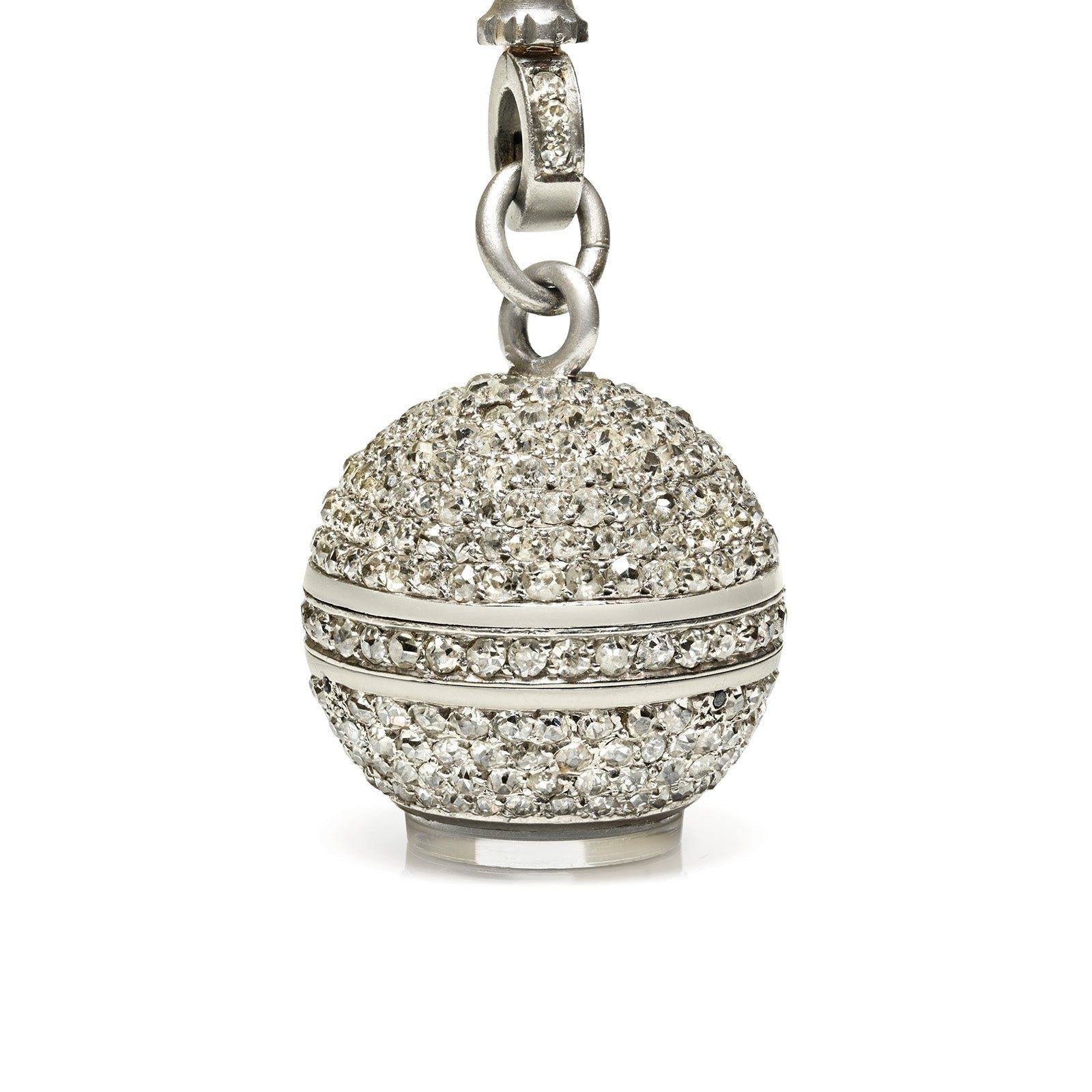
Black Starr & Frost Antique Edwardian Platinum Pearl Diamond Pendant Watch, Source DSF Antique Jewelry
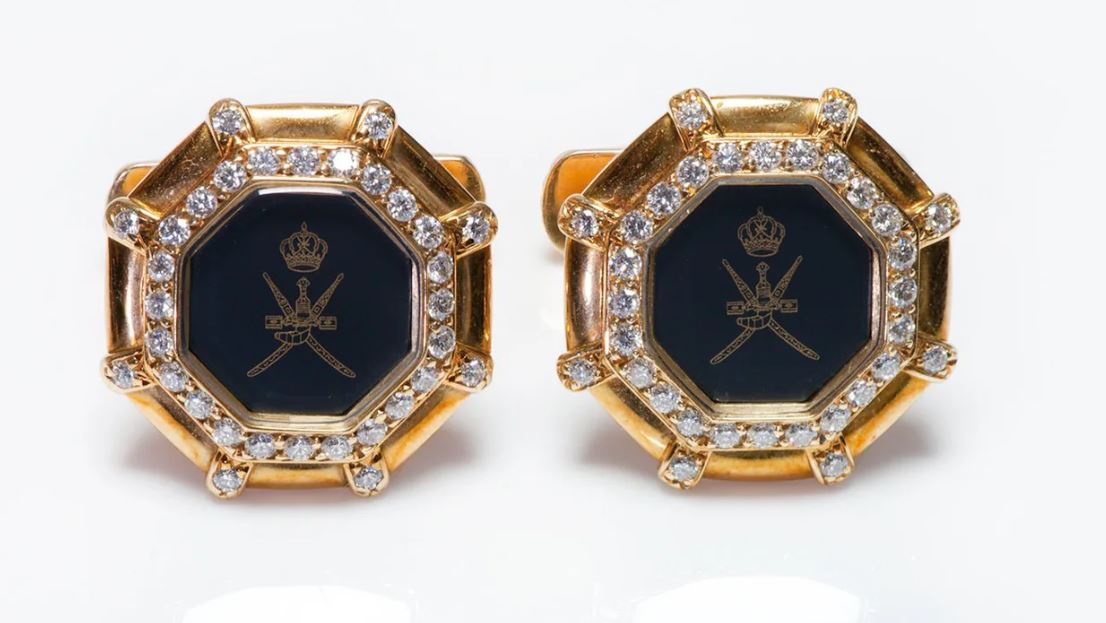
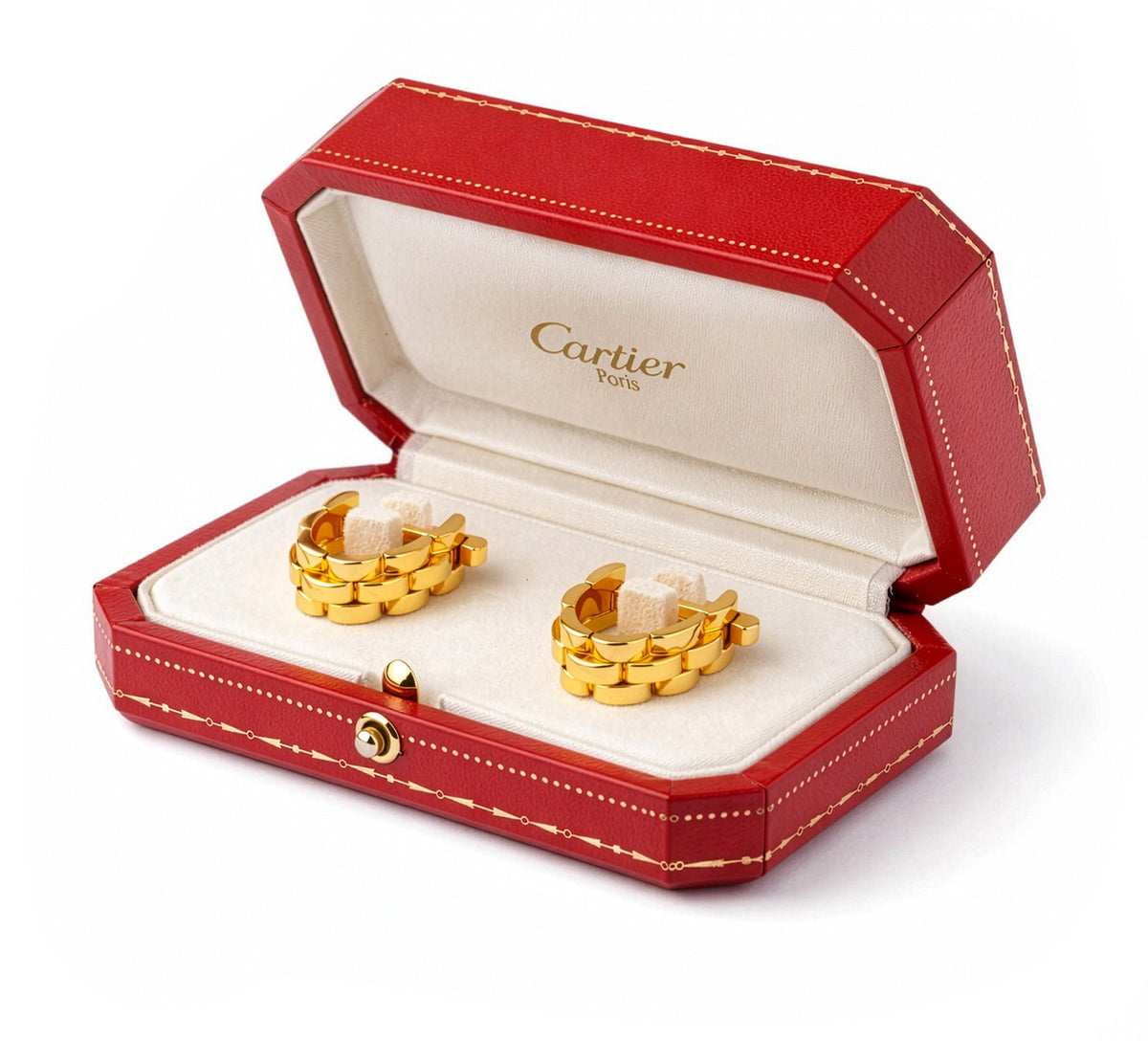
Additionally, they wore shirt studs, cuff links, signet rings, tie rings, tie pins, and cravat pins. Sometimes these were chosen specifically to be flashy, while at other times superior taste prevailed, and they were almost unnoticed because of their understated elegance.
Almost all of these items were made of gold, which required little maintenance and neither tarnished nor stained clothing.
The most understated examples occasionally featured a small pearl or diamond in the center of a cuff link, for example, or onyx or bloodstone set into gold. The tie or cravat pin was where there was the greatest variety on a small scale (except for men like Diamond Jim Brady, who never believed in doing anything by halves).
A Textured Look
To create a textured appearance and help hold the metal in the fabric, the pins were made of gold, highly polished, and featured an engraved line spiraling down the center.
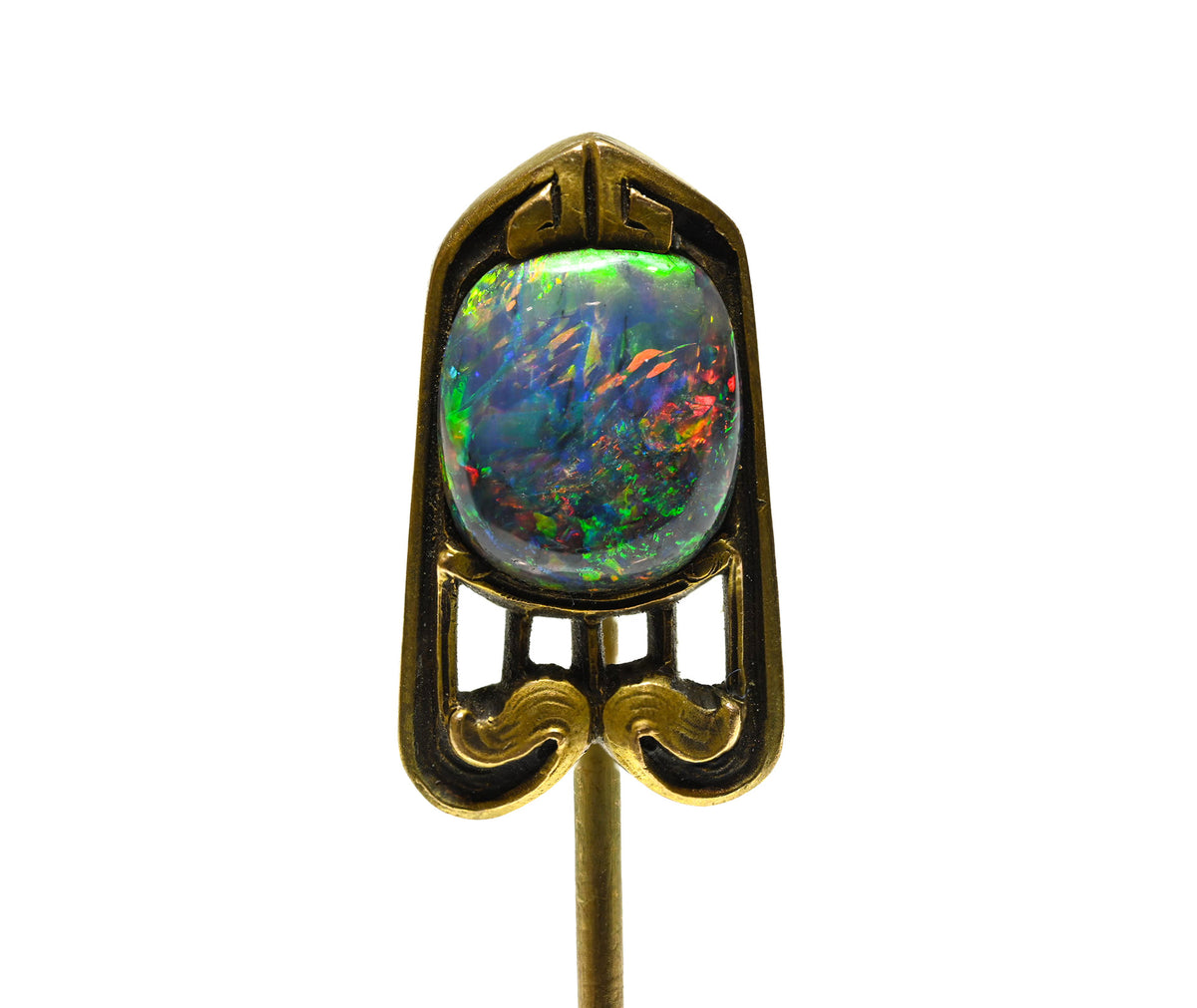
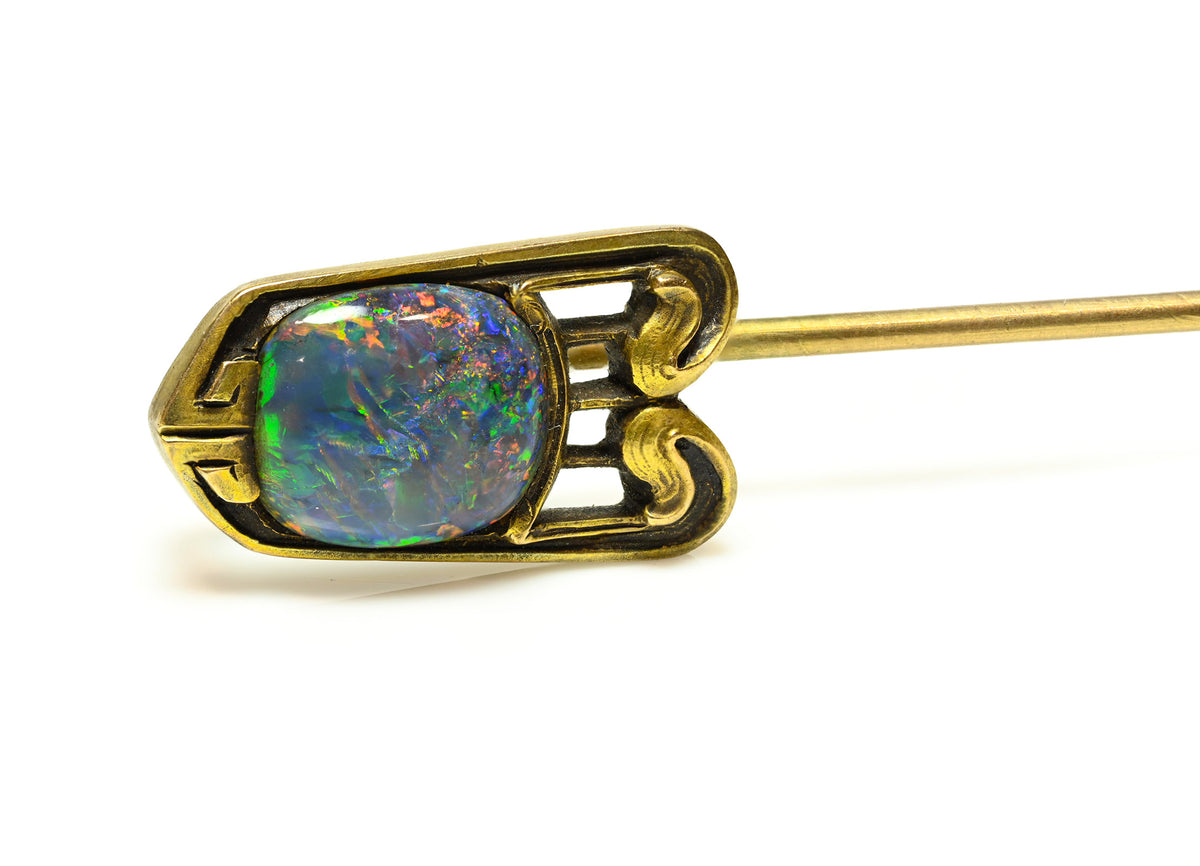
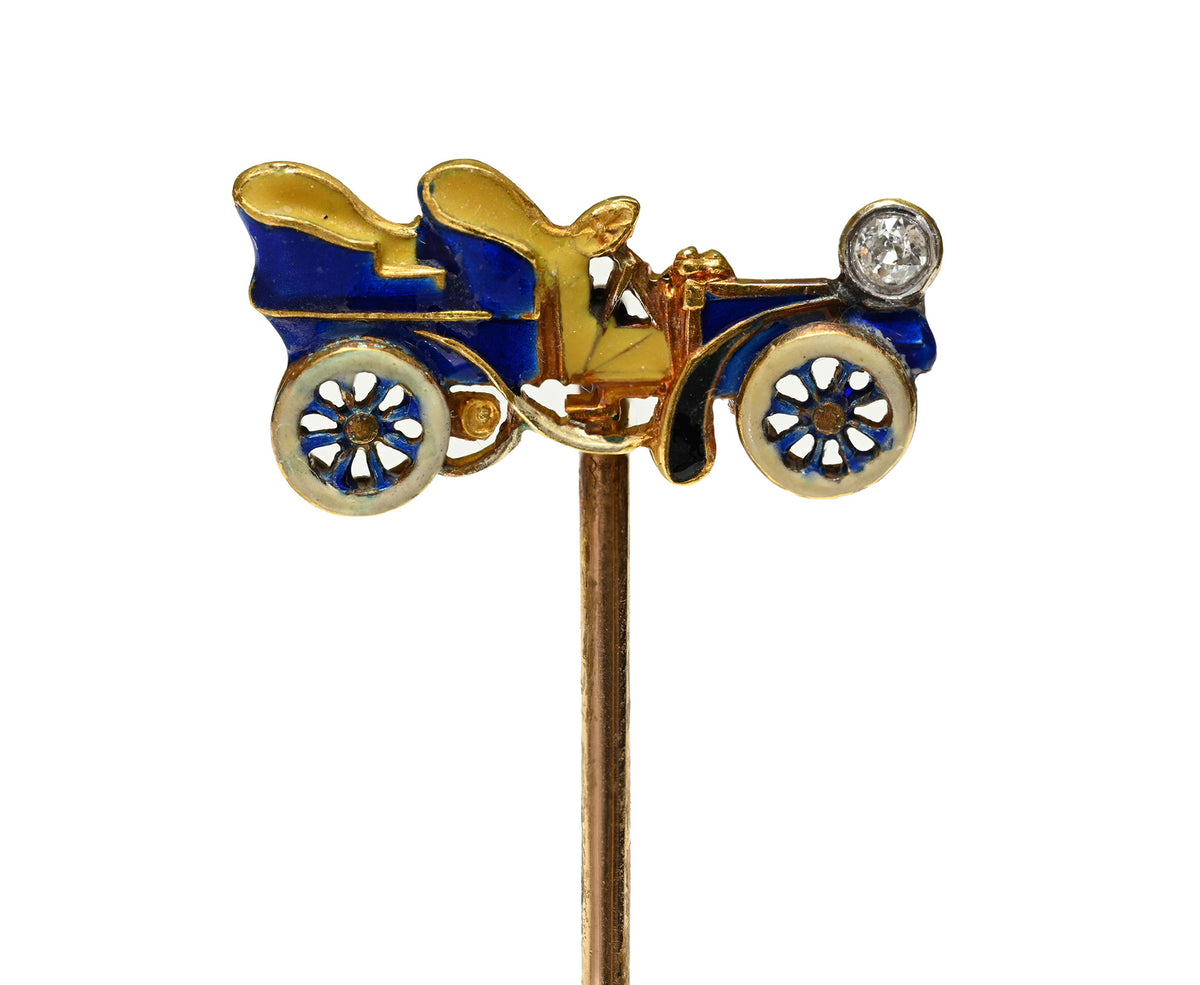
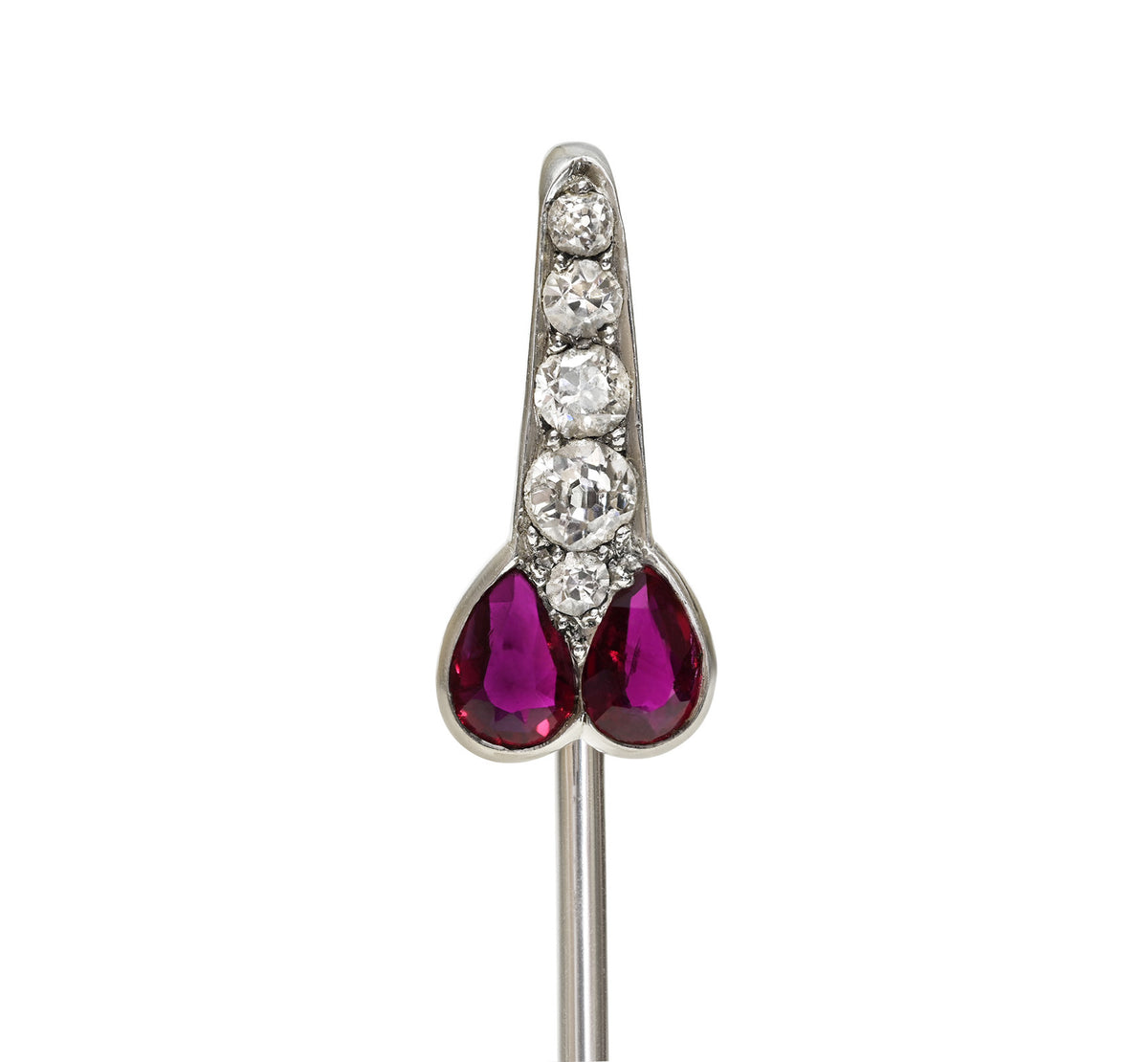
The head of the pin served as the main focal point. It might consist of a single colorful gemstone, such as a diamond, or it could be fashioned from morganite or kunzite.
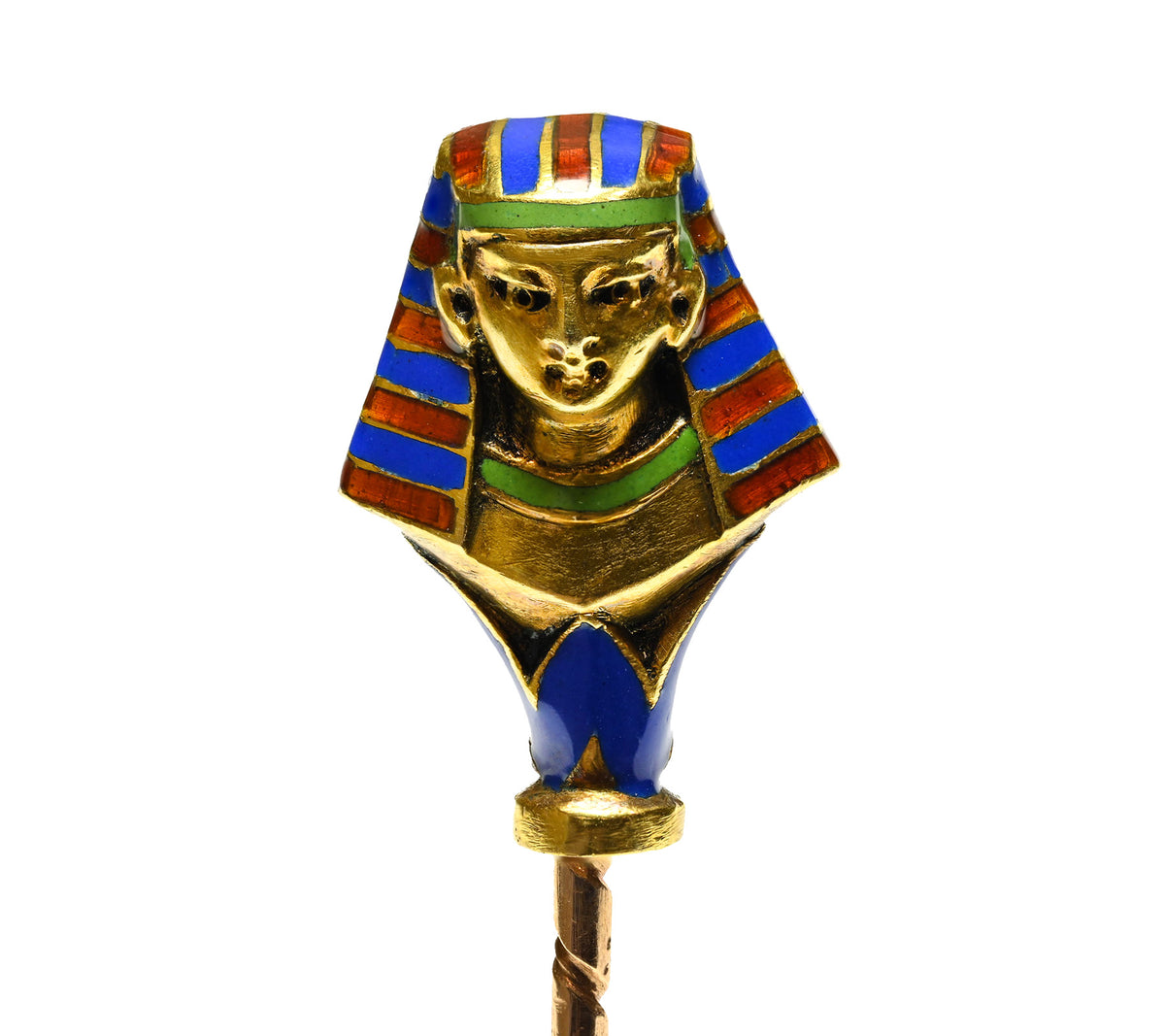
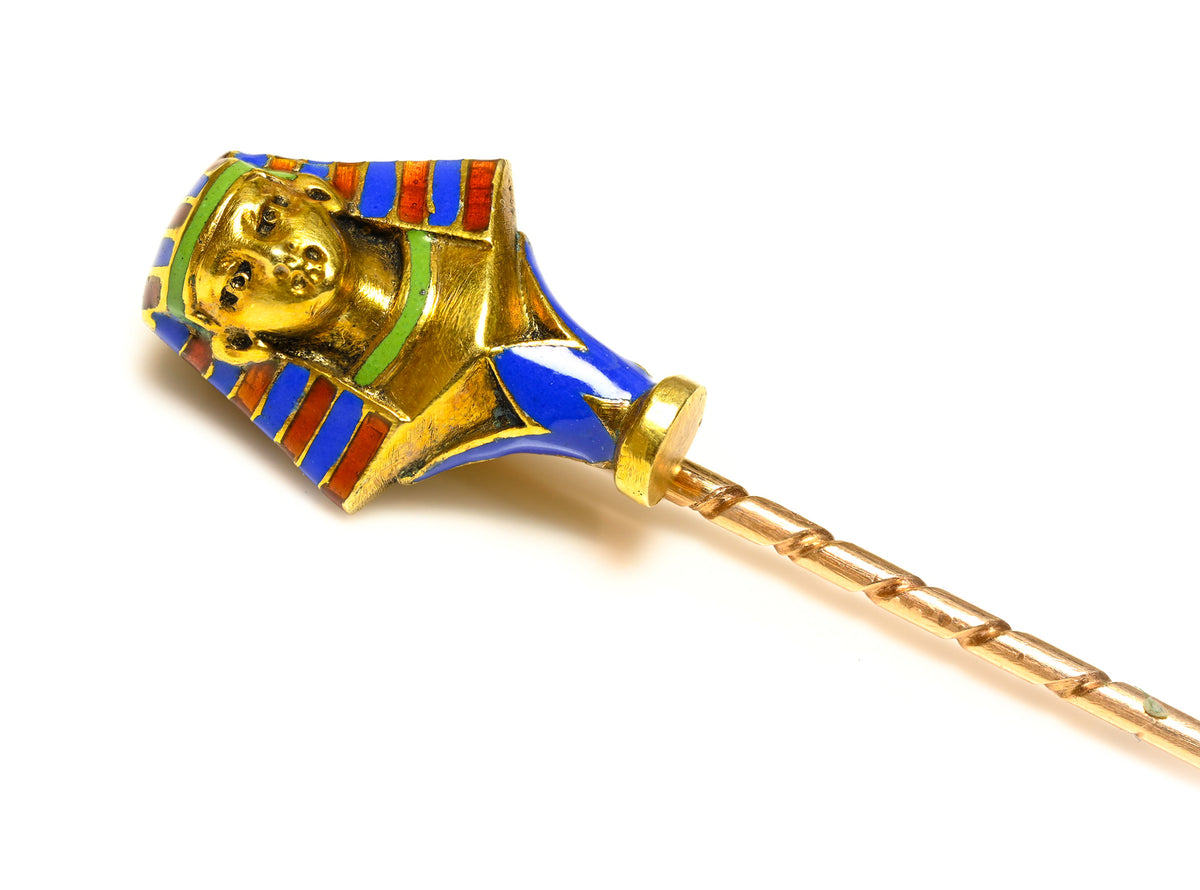
Alternatively, the slender gold pin, set with coral, turquoise, jadeite, or nephrite, might feature a carved human or animal head depicting an alligator, Napoleon, the Pope, or a deity.
Quartz was frequently used for tie pins, either in the form of the mysterious polished cat's-eye variety or as opaque bloodstone.
The latter, a green stone flecked with red, could occasionally be mistaken for jade. Cat's-eye quartz contains tiny fibers of amianthus, a form of asbestos, which give the stone its remarkable appearance, while the red "drops of blood" in bloodstone were traditionally believed to represent Christ's blood falling onto a green stone at the Crucifixion.
Thousands of diamond horseshoes, tiny gold nuggets that may have been dug up by their owners, and small coins, such as a half dollar or a half sovereign, occasionally appeared as motifs on tie pins.
Sailors' knots twisted in the wind, snails curled within their shells, serpents slithered away, and ship or society flags were engraved into rock crystal. Even during periods of mourning, when tie and cravat pins had to be bordered with black enamel, their decorative variety never ceased.

Antique Edwardian Platinum & Gold Sapphire Cufflinks, Source: DSF Antique Jewelry
Kunzite
In the late nineteenth and early twentieth centuries, a number of gemstones were used in jewelry. Among them were kunzite and morganite, both associated with George Kunz, Tiffany's mineralogist. These contrasted with the pink topazes that the Victorians typically foiled to preserve the consistency of their color.
An extremely rare gemstone, kunzite is a variety of spodumene. It was first discovered in North Carolina, where it was later developed, but it is now mined in California, Brazil's Minas Gerais region, and Madagascar.
Morganite, a pink variety of beryl, was named by Kunz in honor of Pierpont Morgan, the well-known financier and gem collector. It also originates in Madagascar, although another important source is near Pala, California.
When faceted, both stones truly shine. Morganite displays a delicate, beautiful pink color, while kunzite has a subtle orchid hue. Both were remarkable in their own right and became topics of conversation during the late Victorian period.
Because of their historical associations, other stones were valued for different reasons, particularly turquoise and jade. Although few people realized it at the time, jade was actually a general term for two different minerals: nephrite and jadeite.
Jade
Jade was frequently carved into "Oriental" shapes and symbols and was prized for both its color and aesthetic qualities.
A spray of white jade carved into flowers and buds, accented with frosted gold and once worn as a wedding ornament, can occasionally still be found today. Another popular stone during this period was turquoise, particularly after Queen Victoria was proclaimed Empress of India in 1876.
It could be cut and polished into cabochons, and its name was derived from the French pierre turquoise, meaning "Turkish stone," a term dating from the thirteenth century. The name was misleading, however, because the stones actually originated in Iran.

Antique Edwardian Diamond Demantoid Ruby Gold Lizard Brooch, Source: DSF Antique Jewelry
Turquoise has been used as a gemstone since ancient times, and because it is found close to the earth's surface, it has been collected and worn as an amulet for hundreds of years. Turquoise jewelry has been discovered in Sumerian and Egyptian graves, as well as in Tibet and Mexico. It is both durable and soft enough to be carved.
The best-known mines are located in Khorasan, Iran; others are found in Turkestan south of Samarkand and on the Sinai Peninsula, while the oldest mines in the United States are located near Santa Fe, New Mexico.
The Victorians admired turquoise because of its long history and because they mistakenly believed they were supporting India, then part of the British Empire, through which some of the material was traded. A Roman emperor's head carved into turquoise was considered both fashionable and sophisticated, and the Romans themselves were fond of the stone.
During this period, onyx was frequently worn as mourning jewelry and was believed to repel love. Like bloodstone and cat's-eye, it is a variety of quartz and occurs in both black and white forms. Its Greek name appears to mean "fingernail." Two other varieties of quartz, banded agate and moss agate, were also highly prized in Victorian men's jewelry.
Book of Exodus
Coral and garnets were two common red gemstones in the nineteenth century. In fact, garnets occur in every color except blue. However, the most highly prized Victorian variety was red, whether faceted as a garnet or cut en cabochon as a carbuncle.
Because a carbuncle was one of the stones mentioned in the twenty-eighth chapter of the Book of Exodus as adorning the breastplate of Aaron, the High Priest, many men valued owning one.
Owning such a stone, glowing as brightly as blood, seemed to place its wearer within the "holy" range of colors and into a mythical realm alongside Moses.
Coral was believed to protect against the Evil Eye, which explains why so many coral charms continued to be produced in superstitious Italy. The gemstone is formed from the calcareous skeletons of countless tiny polyps that live in colonies in warm, shallow waters.
It is available in a range of colors, from white to deep red. The pale pink shade known as angel skin was highly prized, as it still is today, and coral jewelry was primarily intended for children because it was believed to reduce fever. Small pieces also made excellent tie pins because the material is relatively soft and easy to carve.
Tourmaline offers an even greater range of colors than garnet, including colorless, brown, red, green, blue, and violet varieties, as well as stones displaying two colors within a single crystal, shifting from pale pink to pale green.
Historic Gems
It is a somewhat hard stone that looks best when displayed as large, step-cut gems about an inch across, surrounded by diamonds and linked together in a necklace.
Spinels can produce nearly the same effect. They are more durable than tourmalines, exceptionally brilliant, and highly transparent. These stones, found in Ceylon (Sri Lanka) and other countries, have a crystalline structure but are composed of different metals and compounds.
Additionally, both have often been passed off to unsuspecting buyers as more valuable gemstones. Many of the fine "historic" gems found in crowns and reliquaries in cathedrals are actually the more common tourmaline or spinel.

Edwardian Platinum Sapphire Diamond Ring, Source DSF Antique Jewelry
By 1900, however, these stones were being sold for what they truly were.
Aquamarine was the last gemstone to be highly prized for its color and translucence. Officially a member of the beryl family, it occurs in enormous crystals, is exceptionally clear, and comes in a wide range of blue hues—clearly an ideal color to wear during the pastel Edwardian era.
During the mid- and late-Victorian periods, many parures were set in gold with cannetille work (very fine Neo-Etruscan granulation) to provide additional texture.
By the end of the century, however, these stones were prized instead for their remarkable simplicity and were set in the lightest platinum tracery with Rococo scrollwork design.