Skip to content

Cart

Your cart is empty

Article: A British Story: Reading The Hallmarks

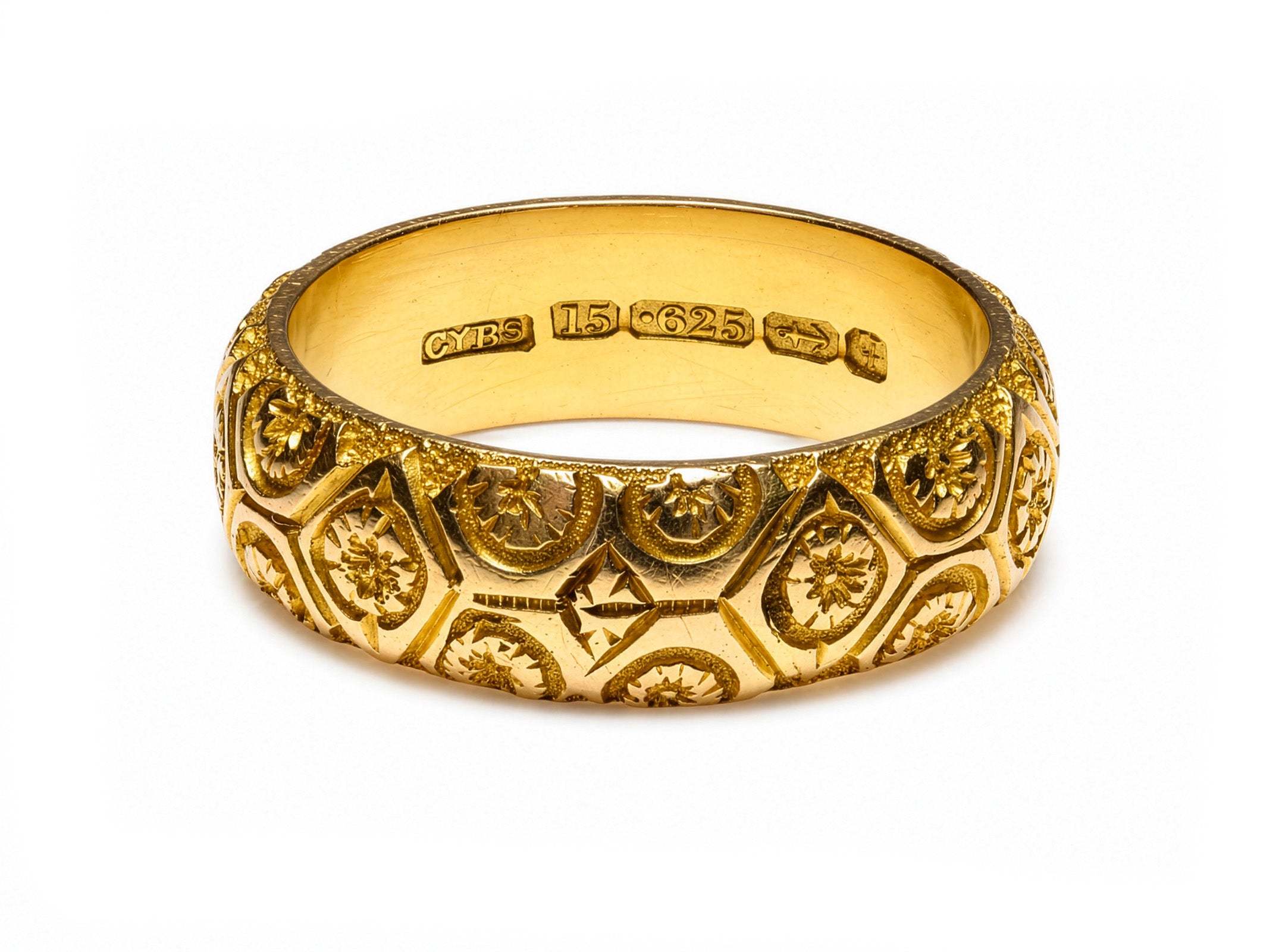
Antique Victorian Ring
#AntiqueJewelry

A British Story: Reading The Hallmarks

Reading silver and gold hallmarks can tell you a lot about your item, including the purity, where it was assayed, in whose factory it was created, and the year in which the item was assayed.

British hallmarks are truthful. They have been created over 700 years to support the organizations in charge of ensuring the well-being of the goldsmithing trade.

By giving the consumer the assurance that they are getting what they paid for and by giving these organizations access to information that is now extremely valuable to collectors, hallmarks support the trade.

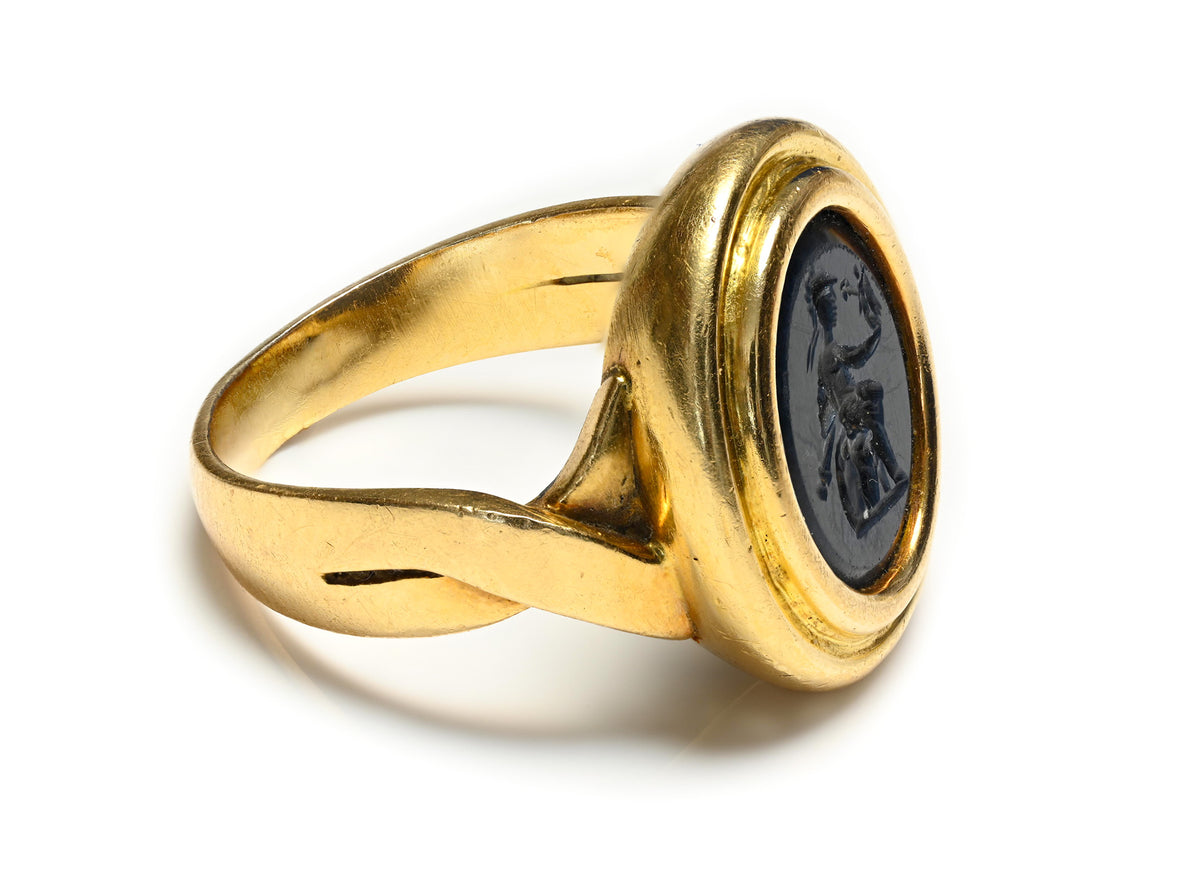
Antique Victorian 18K Gold Shield Signet Ring

Victorian antique ring for sale at DSF Antique Jewelry


London

Simple information is provided, such as the name of the maker or makers, the location of the assay, and the year of the assay, which makes it simple to identify the assay master, said Wynyard R.T. Wilkinson in his book A History of Hallmarks.

Seven towns were established as assay towns, presumably due to their significance as communication hubs that facilitated the delivery of plates to them. They are Bristol, Coventry, Lincoln, Newcastle-upon-Tyne, Norwich, Salisbury, and York.

This is best demonstrated by examining the marks used in Edinburgh, where, up until 1759, the initials of the assay master were still employed as a punch. Silver hallmark reading is a learned skill that becomes easier with practice.

It is quite useless to sit down and try to study the numerous date-letter cycles for each town without comprehending the subtleties and distinctions between parallel series of date letters used in different places. The simplest method for learning to read hallmarks is probably to begin with a known quantity.

London has seen more plate tested and marked than any other place in Britain. A London hallmark is far more likely to be found than one from another assay town. Prior to 1780, all London marks were obvious punches.

They typically have high-relief symbols and are large. They are frequently found in the same locations on many objects, such as jugs or vessels with handles, either directly to the right of the handle or beneath it, and close to the spoon's bowl on the rear of the stem (also called bottom marked).

Marks are typically seen underneath, but occasionally at the top on the side, if there is no handle. The marks became faded and are now hard to read because they were in a vulnerable place (for example, on the underside of a salt cellar fashioned like a cauldron).

Spoon holder

British, Birmingham or London; Spoon holder, Purchase, Gift of J. Pierpont Morgan, by exchange, 1988, Source https://www.metmuseum.org/art/collection/search/20775 via Wikimedia Commons

Blow hard on the piece over the mark to make it easier to read. Condensation will form on the cold metal as a result, temporarily matting the surface. Any minor relief will then be easy to read.

Finding a town mark is the first step in the identifying process. London must be the first option if none is obvious, according to Wilkinson.

Components of a Hallmark

The initials of the business or person in charge of sending the item for testing are one of the essential elements of a hallmark maker's or sponsor's mark.

The purity of the precious metal is indicated by its fineness mark, which can be 750 for 18K gold, 375 for 9K gold, or 925 for sterling silver.

Assay Office Mark

Each assay office where the metal was analyzed and marked has its own distinctive sign. For example:

  • Anchor in Birmingham
  • Leopard's head, London
  • Rose, Sheffield
  • Castle in Edinburgh
sterling lion

Blue brick sterling lion (silver) "hallmark", one of many, sculpted into the wall on the new Assay Office, Birmingham, Source Wikimedia Commons, Author Oosoom at English Wikipedia

Date Letter

The date letter is a letter that varies annually, according to the year the item was marked.

How to Read a Hallmark

Recognize the Symbols: Examine the jewelry for the various punches or stamps.

Match the Symbols: To determine what each symbol means, use a manual or software, such as the "Help with Hallmarks" app from the Birmingham Assay Office.

Unfolding the Data: Assign the date letter to a year, the assay office mark to a location, the maker's mark to a particular goldsmith, and the fineness mark to a percentage or karat.

The Variable Date Letter

According to Wilkinson, the variable date letter should be examined in detail. Is it a lowercase or uppercase letter? What is the letter’s script? How does the letter fit into a shield? It is time to consult the table when these issues have been resolved. Is there a comparable series? Are all the markings in agreement?

Does the mark in the table resemble the mark in question if it bears a king’s head duty mark? Does the lion wear a shield of the same shape? An attribution can only be made if and when everything is in agreement.

A mark that does not match the tables cannot be forced to be included in an attribution under any circumstances. It needs to be examined again. London marks created after 1780 are often found struck in a straight line with equal spacing.

Instead of being applied one at a time as previously, all marks—aside from the maker’s mark—were applied to a piece at once. The octagonal intaglio king’s head duty mark, which was used in 1784 when duty was reinstated, is an exception to this rule.

Spoons and forks created after 1782 have marks placed at the top of the back of the stem. Items like cream jugs were weakened and warped by the new bar system of punching, wrote Wilkinson in his book.

Today, it is common to find the impressions on the outside of the foot or on the underside of the lip.

The straight-line criterion does not apply to teapots or objects with flat bases. The maker’s mark in the center is surrounded by the four primary marks on the bottom of many pieces.

Up until 1773, all provincial assay towns used their town mark on pieces that were marked. Since the assay offices in Exeter and Newcastle did not survive until 1891, when the monarch’s head duty symbol was removed, this greatly simplifies precise attribution.

However, the basic guidelines still need to be followed. No matter how much a piece’s castle punch resembles an Edinburgh town mark, it must be English and most likely Exeter if it is additionally marked with a lion.

Also, as Wilkinson continued, provincial markings created after 1773 are harder to read, particularly on smaller pieces.

Makers tended to omit the town mark, just as in London, where, prior to 1782, teaspoons were only marked with the lion passant sterling mark in addition to the maker’s mark.

The Lion

The process of elimination is the method used to accurately interpret the markings on these pieces. The item was most likely produced in London and created after 1780.

Once again, it is important to keep in mind that the date letter shield will have a rounded base and that the London marks will be in a straight line with equal spacing. But at Exeter, the king’s head duty mark was struck separately, and the shields were completely rectangular.

On the other hand, there is just a lion on an oval shield with a stippled background, the maker’s mark, and the king’s head. This lion was in use from 1797 to 1808.

A poorly shaped lion with the corners of the shield cut off, or subsequently a very narrow shield, is the Chester equivalent. Georgian Chester is extremely rare and hard to find. Following 1821, both Exeter and London began using the town mark to identify even the smallest items, such as sauce bottle collars and bottle tickets, said Wilkinson.

Hallmark close up

An incomplete machine pressed / deep drawn silver thimble, of Early Modern dating, The Portable Antiquities Scheme/ The Trustees of the British Museum, Source https://finds.org.uk/database/ajax/download/id/408610,  via Wikimedia Commons

Beginning around 1790, the date letter was frequently omitted in favor of the town mark in Newcastle. This continued until roughly 1840. When dating a piece approximately, it may cause confusion.

Prior to 1820, it was common for pieces to have the duty mark to the right of the other marks. This serves as a clue for dating. The king’s head is located to the left after 1820. A Birmingham-made item is rarely found without its full set of hallmarks; however, they are frequently not all struck in the same place.

One of the more popular items produced in Georgian Birmingham was vinaigrettes, which were small boxes with a grille and a sponge soaked in smelling salts kept underneath. On the lid, examples are frequently identified by two assay marks.

The fact that the remaining three are on the base (or vice versa) suggests that the item was considered a whole (an extra lion should be used to indicate the grille). Due to the large number of small pieces that were brought to Sheffield for assay, the producers there employed the ingenious technique of a mark that included the date letter and the town mark.

Over the date letter, the crown can occasionally be inverted. This set the punch apart from previous series. York has not yet been mentioned. There are some very challenging issues in this area that can sometimes even defeat those who have worked with silver for a long time.

The marks used were comparable to those in use in London after the reopening of the assay office in 1776. The use of the town mark was the exception rather than the rule.

According to Wilkinson, the maker’s marks, which are highly distinguishable, are the best way to identify the silver being tested here (see list before the tables). The passant lion can be found facing to its right on small pieces that were marked between 1790 and 1810.

The accompanying punches, particularly the one of the leopard’s head, are frequently poorly rendered. The duty mark and lion passant are the only markings found on most mother-of-pearl fruit knives and forks. The fact that these small pieces were not manufactured and tested in Sheffield is highly unusual.

Hallmarks on British sterling, lion passant

Hallmarks on British sterling (L-R): Crown signifying city of Sheffield, lion passant, Source Wikimedia Commons,The original uploader was Mrs rockefeller at English Wikipedia

No matter how many options there seem to be, it is crucial to keep in mind that there is only one proper attribution. Practical logic and adherence to basic rules are the only ways to arrive at this accurate attribution.

A piece bearing a king’s head duty mark could not have been produced before 1784. A piece featuring a queen’s head will have been created prior to 1891, when the duty was abolished, and after 1837, the year Queen Victoria took the throne.

The majority of the Chester silver discovered was produced between 1890 and 1930. Before 1784, punches were struck individually rather than in a straight line with equal spacing on Birmingham silver, wrote Wilkinson.

The Makers & Their Marks

The significance that provincial manufacturers and their businesses played in the community makes studying them and their markings intriguing, in addition to the fact that they were never very numerous.

Large and mostly unexplored, the field is enormous, said Wilkinson. Finding unique content about the goldsmiths, their craft, workshops, transgressions, or accomplishments is an added motivation. The data is available and just needs to be located and connected. The goldsmiths are one step closer to reality thanks to current understanding.

There is no justification for the silversmith whose mark is on an English plate to have ever physically handled the plate, much less touched it. To learn his art, a goldsmith in Scotland and England had to complete a seven-year apprenticeship.

After completing his apprenticeship, he would most likely work as a journeyman in his master’s workshop for a daily wage. Journeyman goldsmiths, whose names are known but never connected to their work, produced the majority of the fine silver of the eighteenth and early nineteenth centuries.

After that, the young goldsmith would attempt to establish himself independently. This clearly required the kind of capital that was hard to come by.

However, after gaining independence, joining the Goldsmiths’ Company, which has numerous benefits, and hopefully having a loyal customer base, the goldsmith would begin hiring others to help him with his craft, such as a polisher, a turner, and possibly even other journeymen.

So the business would grow until he was likely only doing order-taking and bookkeeping. Order collection and design concepts were closely related.

The Fate of the Silversmiths

A widow who inherited her husband’s business without having any prior knowledge of the silversmithing trade was another way for people to register a mark, according to Wilkinson. This was especially prevalent in the eighteenth century, when the widow of the former master preserved some of the most successful silversmithing family fortunes.

The fate of the silversmiths from the Courtauld family serves as a good example of this. Augustine Courtauld established the company using his son Samuel as an apprentice. After his father passed away in 1751, Samuel inherited the company and continued to run it until his own death in 1765.

Soup tureen and cover, by Samuel Courtauld

Soup tureen and cover, by Samuel Courtauld I, 1751-1752, silver - Courtauld Institute of Art, London, Source Wikimedia Commons, Author Daderot

Until her son Samuel Jr. was old enough to participate in the business, his widow took over management and, for a brief period, George Cowles, Samuel’s apprentice and son-in-law, did.

Despite the fact that it was uncommon, there are a few instances of women taking up goldsmithing apprenticeships.

Sarah Cooke, who began a seven-year apprenticeship in 1733, is one example. In 1747, she decided to become independent.

The function of the goldsmith evolved during the seventeenth century. The independence of form, which had been established around 85 years prior, persisted until 1770, wrote Wilkinson. This led to the creation of works like Nicholas Sprimont’s few pieces from 1742 to 1745, whose design concepts were novel for their time.

Various insects, shells, stones, leaves, and other natural objects were used to adorn the pieces. He is even credited with creating salt cellars by casting feet from smaller replicas of the same shell onto a large, appropriately trimmed shell that served as the main form.

Unfortunately, he left the trade in order to take an interest in what was to become the “Chelsea” porcelain factory, where it is not difficult to detect the same preoccupation with nature.

Hester Bateman is arguably the most well-known English woman silversmith; even people who are not interested in silver will recognize her name.

The Bateman family specialized in creating small items, such as bottle tickets, sugar tongs, and other items that could be effectively embellished with “bright cutting”—a technique for engraving that was common from roughly 1780 to 1805 and involves using a single-sided chisel to leave a bright facet after each cut.

Silver Coffee Pots and Ewer by Hester Bateman

Georgian silver ewer and two coffee pots by Hester Bateman. Each hallmarked London, 1780s, Source Wikimedia Commons, Author Chwada123

There is a lot of creativity in the design of the small pieces, particularly the bottle tickets. They are sought-after collectibles due to their often entirely unique forms, said Wilkinson. Unfortunately, both in terms of craftsmanship and the weight of metal used, the remaining goods created in the Bateman workshop are of mediocre quality.

Cover Photo: Antique Victorian Ring for sale at DSF Antique Jewelry


The bridal jewelry. Venetian women in the 16th century
#AntiqueJewelry

The History of Hallmarks in Europe – Part I

This article offers a clear, country-by-country overview of the history of European silver hallmarks, tracing how marking systems developed across Austria, Belgium, Bulgaria, Denmark, Eng...

Read more