Hopi Hallmarks – A Journey From Past To Present
The history of hallmarks is rich and full of stories that intertwine the past and present in a complex matrix.
One of the chapters that arouses particular interest is that of the hallmarks used by the Hopi for their jewelry.
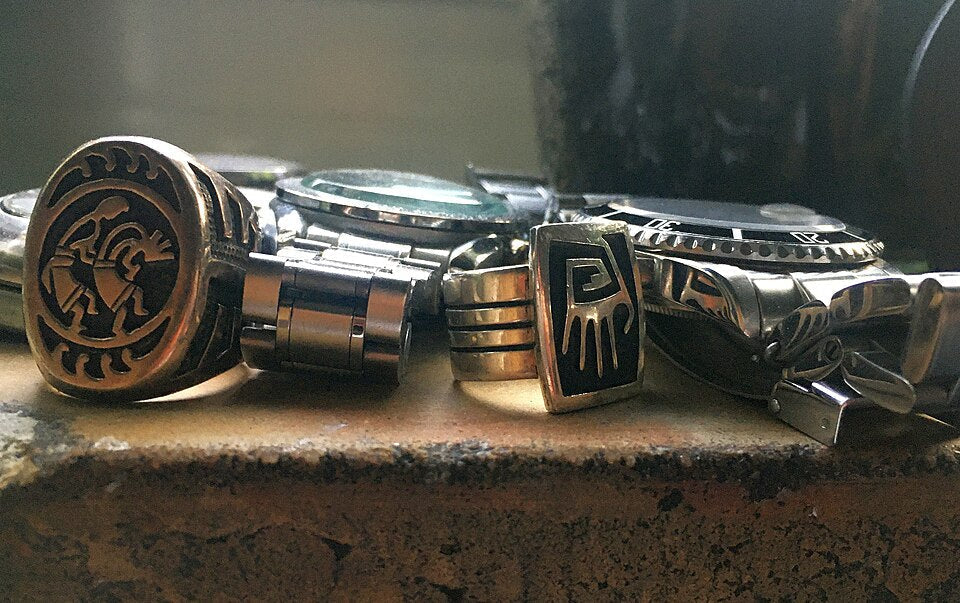
Nowadays, a lot of Hopi silver has the smith’s personal emblem etched on the back.
Hopi Hallmarks
Hallmarks became widely used on Hopi silver during the veterans’ classes in 1949.
In the 1930s, several of the older smiths marked their silver. Interestingly, in her 1939 letter, American artist, writer, educator, ethnographer, and curator Mary-Russell Ferrell Colton also asked them to do so, as Margaret Nickelson Wright wrote in her book Hopi Silver: The History and Hallmarks of Hopi Silversmithing.
It is unlikely that many products were marked with the “U.S. Hopi” stamp, which was approved by the Indian Arts and Crafts Board in 1938. The sun emblem, the Hopi Silvercraft Guild’s logo, and the mark of the individual smith are used to identify silver made under its auspices.
Someone might purchase silver on his own, produce several pieces, and sell them because connections with the guild were not always consistent. He would be employed by the guild at the same time.
Therefore, jewelry bearing both the guild mark and the smith’s stamp, as well as pieces bearing just the smith’s mark, may have been purchased during the same time period.
Except for a few unique pieces, Hopicrafts employees used to mark their silver solely with the company’s insignia.
Later, a few of the smiths frequently engraved their initials on the Hopicrafts items. In most cases, the silversmiths’ marks are clan-specific emblems.

The Clan
Theoretically, a clan is a group of individuals who have a common progenitor. Since this line is passed down through the women among the Hopis, every child is a member of their mother’s clan.
According to Wright, there have been attempts to classify Hopi clans and clan membership. Clans tend to “go together.” A symbol from any one of them is regarded as one’s own clan symbol in certain situations.
Some of the groups are Rabbit and Tobacco; Badger and Butterfly; Sun, Sun’s Forehead, and Eagle; Waterhouse (Patki) and Young Corn (Pikyas); Snake and Lizard; Bear, Strap, and Spider (Antelope is also a member of this group); Snow and Fog; Kachina and Parrot. The father’s clan insignia was employed in at least one known case.
Given that a smith may select any mark he desired, other hallmarks were selected for no apparent reason.
In certain cases, a trademark might be reused. For example, Vemon Mansfield doubles Willard Nuvayauom’s feather mark.
Based on the information that is now accessible, the smiths are presented in roughly chronological sequence. To help with their identification, the marks are listed by type after the list of silversmiths and their hallmarks.
Hopi jewelry can be easily identified thanks to the inclusion of several shop marks.
Since the practice did not start until the 1930s, many of the early smiths do not have hallmarks listed. Hopi names are written in their traditional form, without accents or hyphens, for the sake of conciseness, as Wright wrote.
 ''All Things Hopi Belt'', 2005, by Gail Bird and Yazzie Johnson in the Heard Museum Collection, Source Wikimedia Commons, Author Schmiebel