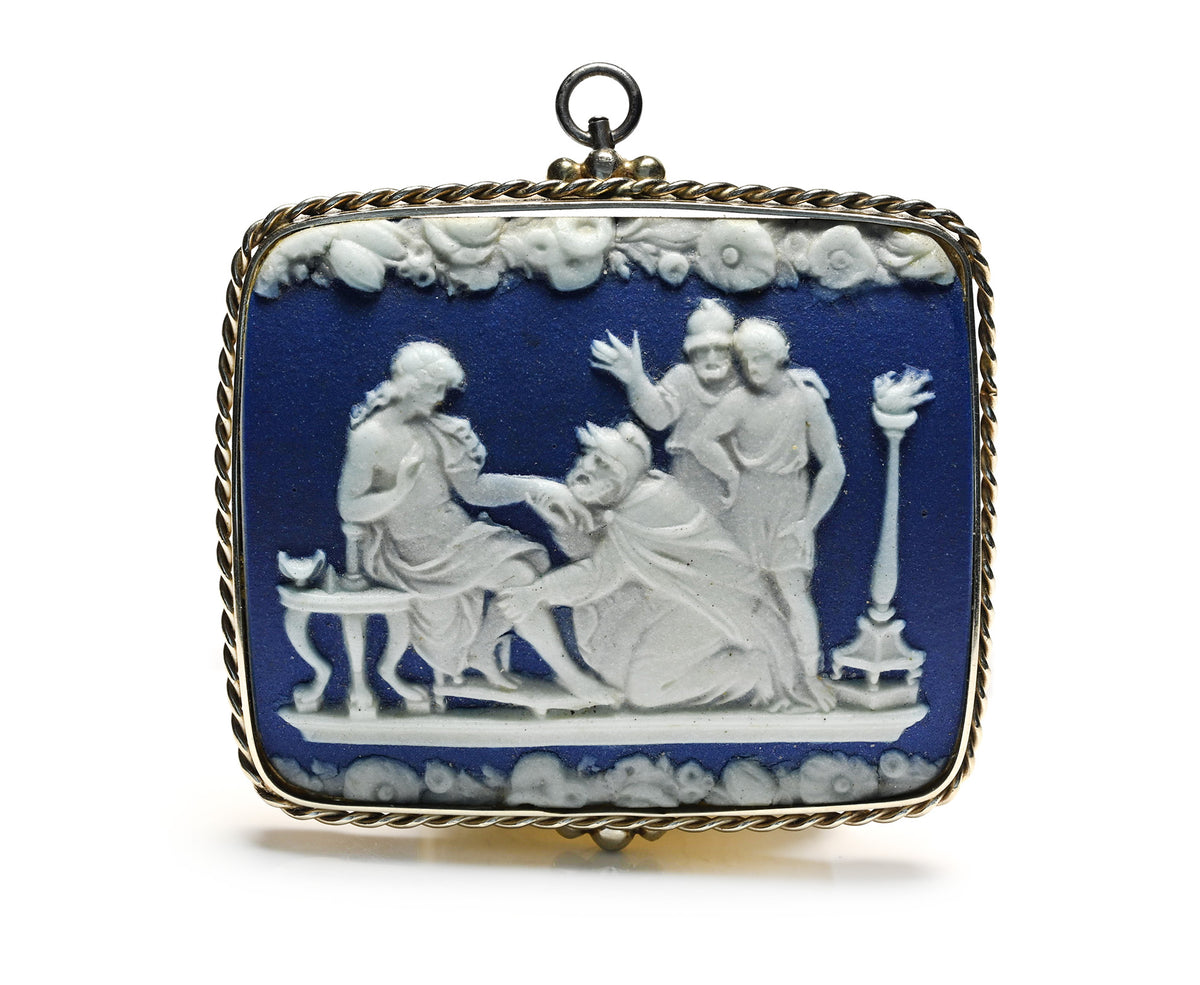
Ancient Rings - Between History and Fascination
Across the ancient world, rings carried meanings far beyond ornament—shaping identity, signaling power, and embodying belief in forms of gold, iron, and stone that traveled from Etruscan workshops to Greek and Roman hands. Their history unfolds as a continuous dialogue between craftsmanship and symbolism, as recorded in the antiquarian studies of Charles William King.
His main book, "Antique gems: their origin, uses, and value as interpreters of ancient history; and as illustrative of ancient art: with hints to gem collectors", delves not only into the artistry and craftsmanship of rings from various ancient cultures—Etruscan, Greek, Roman, and beyond—but also into the social, symbolic, and even moral meanings these personal ornaments carried through the ages.
Drawing in particular on the wise counsel of Clemens Alexandrinus, the text contemplates how rings were worn and chosen, with attention to their practical, aesthetic, and ethical dimensions in antiquity. From hollow gold signets to the iron bands of Roman senators, and from poison-filled receptacles to pious emblems, the narrative weaves together artistry, history, and philosophy, all stitched into the story of the ring.
The Rings
In the serene austerity of early Christian life, Clemens Alexandrinus*, the famous theologian and philosopher, offered the faithful of the second century counsel that was at once moral and ornamental—a meditation upon the ring, that subtle band which binds vanity and sanctity within a single golden circle.
In his Paedagogus III.2, he admonished: let not men wear their rings upon the top joints of their fingers, for such is the vanity of effeminate display; rather, place them low upon the little finger, where the hand remains nimble, the gesture modest, and the signet secure. The stone’s engraving, he advised, should evoke purity and faith—a dove, a fish, a vessel borne by the divine wind, or a lyre, emblematic of harmony. Let there be no idol nor weapon, for we are disciples of peace, wrote Clemens, whose words breathe with the same moral fire that tempered the gold of those early rings.
The First Rings: Etruscan and Greek Marvels
The earliest rings shimmer forth from the Etruscan dawn—thin shells of pure gold, light as breath, hollow as though enclosing a mystery. One magnificent example once rested in the collection of Prince di Canino: a creation wrought from golden lions whose joined bodies formed the shank and whose heads supported a small sard scarab carved with a lion regardant.
The craftsmanship was archaic yet delicate, every curve a frozen echo of lost majesty. Another, fashioned by Greek hands, displayed the fluid play of two dolphins leaping toward one another, their tails entwined to form the circlet’s band. The setting held a round crystal, as though the sea itself had congealed between their lips.
The Roman Ideal: Power and Simplicity
The Romans, inheritors of both beauty and austerity, first preferred lightness—hollow rings easily crushed in the hand of a soldier. Cicero tells of L. Piso, praetor in Spain, whose ring broke during a military exercise. Before the people of Cordova, he summoned a goldsmith to fashion another on the steps of the judgment hall itself, weighing the gold openly to show that Rome’s justice took not even a half ounce from the treasury. One imagines the craftsman hunched at his brazier in the dust of the forum, striking the thin metal until it sang—annulus ut fiat primo colliditur aurum—“the gold is beaten before the ring is born.”

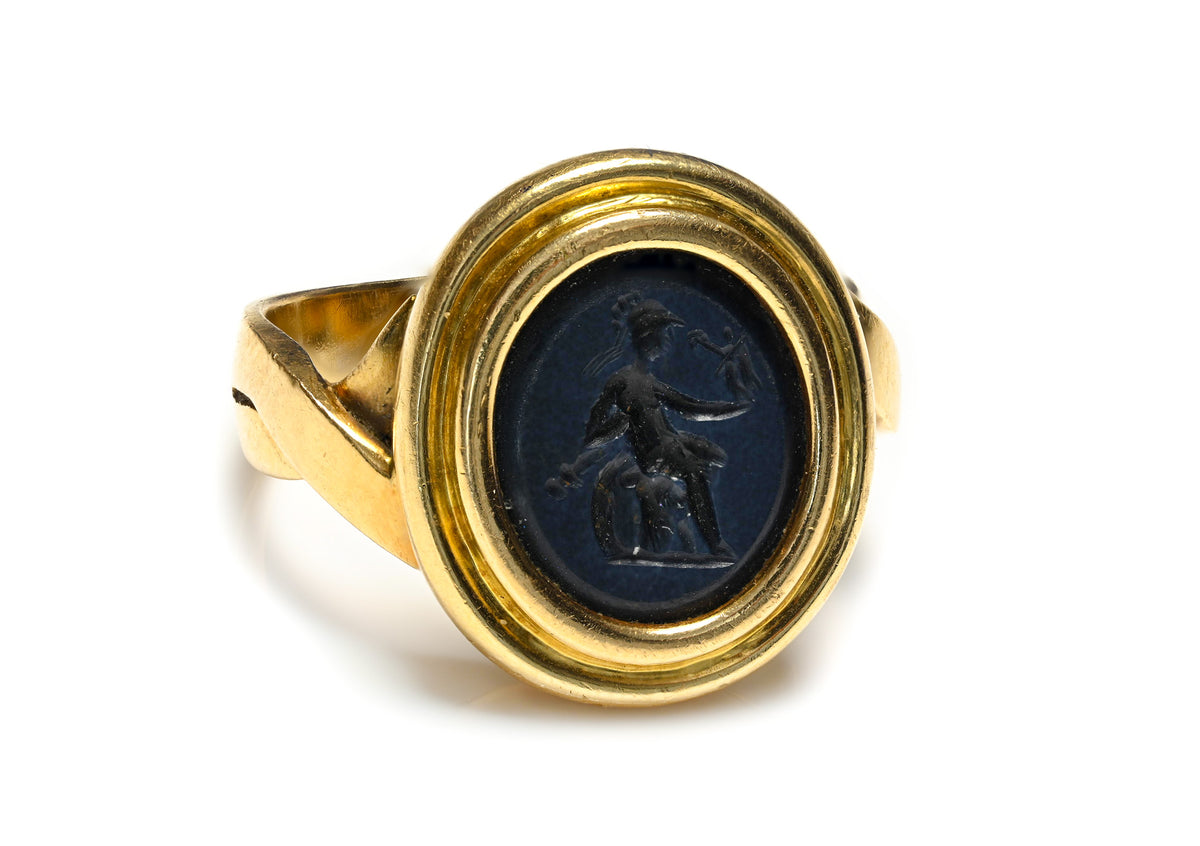
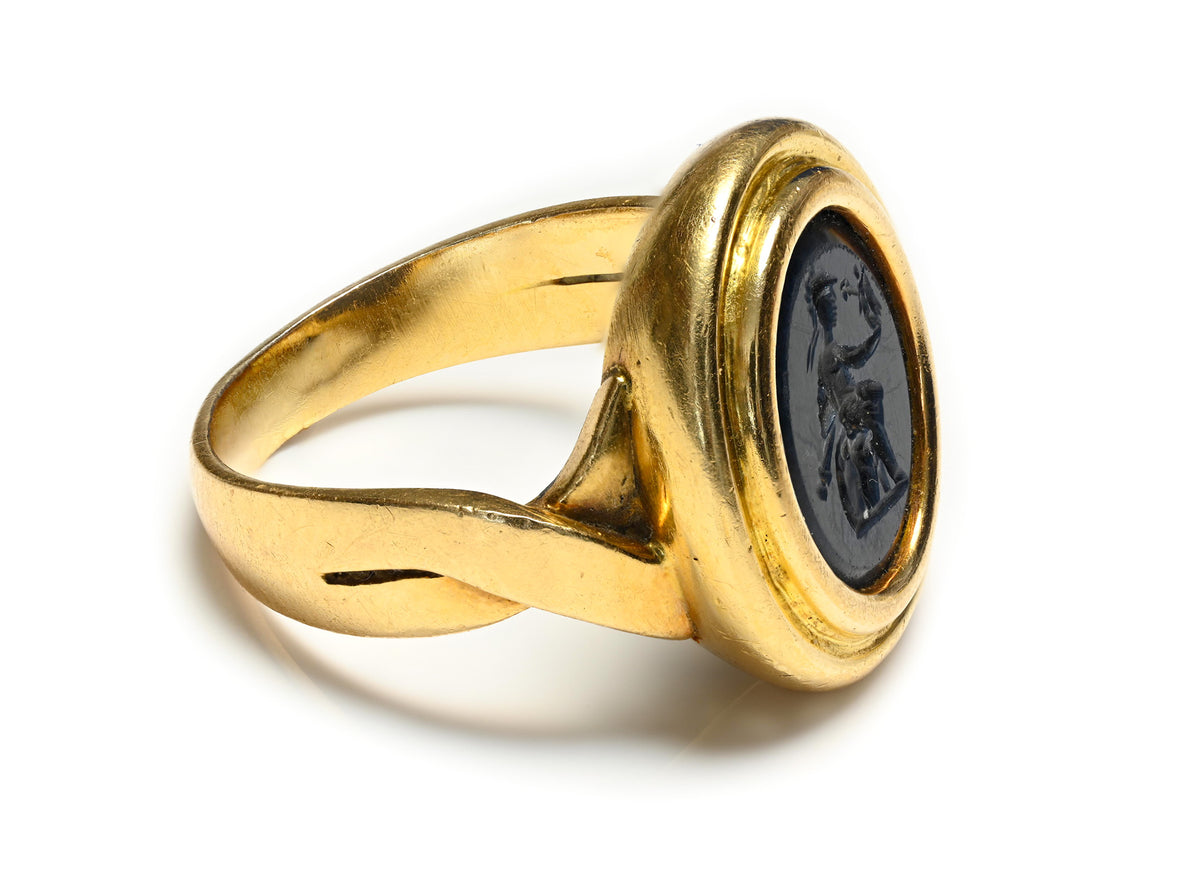
Roman ring, gold-plated bronze with blue agate bezel engraved with a Goddess of Fortune, Photograph by Rama, Wikimedia Commons
Yet these fragile hollows bore a darker secret. Their empty spaces became receptacles for poison—the silent ally of the desperate. Hannibal, Demosthenes, and the nameless traitor of the Capitol all found in such rings their final draught. The ancients practiced the art of concealment as perfectly as the art of beauty; their soldering was invisible, their alchemy refined. They joined their plates with santerna, a mystical compound of copper salts, natron, verdigris, and even the urine of a child—its fusion imperceptible, its craft seemingly divine.

Illustration from Antique Gems: Their Origin, Uses, and Value as Interpreters of Ancient History by Charles William King (public domain). Source: Internet Archive
The Evolving Signet of Empire
Under Claudius, fashion solidified—literally—for the engraving was cut into the metal itself. The emperor’s visage adorned many a loyal hand, though such rings could be worn only by those favored within the courtly sphere. In the Florence Gallery gleams a noble relic where Marcus Aurelius and Lucius Verus gaze eternally into one another’s faces upon a single circlet of gold. Macrobius, citing Aetius Capito, reminds us that this was a return to older virtue: once, the image had always been carved into the ring’s body itself, not set upon some gem of luxury.
In Pliny’s age, the custom dictated one ring only, worn humbly upon the little finger. Earlier Romans had placed it upon the ring finger of the left hand, believing a secret vein pulsed there directly from the heart—the vena amoris. But as empire turned to ostentation, the fingers of Rome grew heavy. Quintilian chided orators not to burden their gestures with too many ornaments, while Macrobius described nobles glittering digitis sicut metatis, their fingers mapped out by gold from joint to joint. Clemens’ pious moderation had yielded to opulence.
The Weight of Gold and the Decay of Taste
In the twilight of Roman taste, rings ceased to be symbols of art and became testaments of weight. Some boasted of their heaviness, as if mass could replace meaning. A ring from Hungary, designed for the little finger yet weighing three ounces, sets a large onyx without a single engraving—its blank perfection a quiet admission that substance had triumphed over soul. In the author’s own collection gleamed another, fifteen pennyweights in mass, its onyx crudely etched with a dancing girl—an echo of Clemens’ warning that even the devout might carry temptation upon their hands.
These might also have served as insignia of office. Valerian decreed to Claudius Gothicus a provision of jewels as marks of rank: brooches, chains, and a double-gemmed ring of one ounce in weight. Perhaps the term bigemmus referred to those two-toned Nicolo stones so favored in that epoch, blue and brown, like earth and sky entangled.

Roman Gold Jewelry, Source Wikimedia Commons, Photograper Gary Todd from Xinzheng, China
The Metals of Nations
Among the Gauls and Britons, rings adorned the middle finger—barbarians, Pliny would sneer, though their land was rich in gold. Caesar’s campaigns there brought so much of the metal to Rome that its value fell by one third. Some of their large bronze hoops and “ring money,” dull yet luminous with use, speak of an age when ornament and currency were one.
Bronze, indeed, proved the most democratic of substances. Roman bronze rings, often set with colored glass pastes, bore inscriptions of affection or luck. One, preserved at Canterbury, bears the monogram F.E. and the legend “Septimius Amato N.”—a lover’s message cast into eternity. Bronze differed from the later latten of medieval artisans by its tone and hardness: bronze was the deep brown of old autumn leaves; latten gleamed like false gold.
Even rarer were the rings of lead—weighted illusions meant to masquerade as gold when gilt. One such deception lived in King’s collection: a hollow ring of ancient Cyrenean work, golden but cunningly filled, set with a sard intaglio of Jupiter Ammon. In that city, said Eupolis, the poorest man’s signet was worth ten minas—proof that even devotion had its price.
Iron and the Spirit of the Republic
Most Roman of all were the rings of iron: simple, martial, unadorned. They told the story of Prometheus redeemed, for when Jupiter forgave him, he bade the Titan wear forever a ring forged from his chains—a symbol of liberty tempered by memory. The senators and soldiers of the Republic bore such rings proudly, until corruption gilded iron into gold. Marius, even in triumph, wore his rough iron circlet—and so did the slave who stood behind his chariot, whispering the reminder of mortality.

Illustration from Antique Gems: Their Origin, Uses, and Value as Interpreters of Ancient History by Charles William King (public domain). Source: Internet Archive
By Tiberius’ time, laws divided rank by metal. Only free men of proper birth might wear gold; the rest, mere iron or bronze. Thus authority materialized upon the hand—the finger became a ledger of lineage, the ring a silent proclamation of worth.
Rings of the Faithful
Centuries later, faith reshaped this ornament again. The medieval decade rings bore ten small bumps in place of jewels, each a prayer, each a bead of devotion fashioned into metal. One could count the Ave Marias by touch in the night, the round seal engraved with I.H.S. standing for the Pater Noster. The circle had come full circle—a band once of vanity reborn as an instrument of piety.
So from Clemens’ restrained instruction to the gilded extravagance of emperors, from poison’s deceit to prayer’s whisper, the ring has told mankind’s story in miniature. In its circlet lives the rise and fall of taste, of empire, and of faith: a golden history wound, like the jewel itself, into endless return.
Papal and Episcopal Rings
From the earliest centuries of the Middle Ages, the ring stood as the enduring emblem of episcopal investiture—a symbol of office and authority, traditionally set with a sapphire or ruby and worn upon the forefinger. The precise origin of this custom remains obscure, though it most likely traces back to the Roman Empire. In imperial practice, a ring was bestowed upon a newly appointed military tribune as a token of rank, and by the time of Juvenal it had already become a visible sign of office. From the letter of Valerian, we even learn that such rings adhered to an established “regulation” of weight and design.
The notion that a bishop’s ring represents his mystical union with his diocese is a later, more poetic interpretation—the kind of allegory favored by medieval theologians such as Durandus, who could discern spiritual symbolism in even the simplest objects, such as a bell rope. Equally fanciful is the medieval explanation for the choice of sapphire as the episcopal gemstone, recorded by Vossius in De Physiologia Christiana (Book VI, Chapter 7): “The sapphire,” he writes, “grows dull and loses its color when worn by an adulterer or lascivious person.” He later adds that “the sapphire, whether set in a ring or worn otherwise, restrains lust—and for this reason is most fitting for the priesthood and for all who have vowed perpetual chastity.”
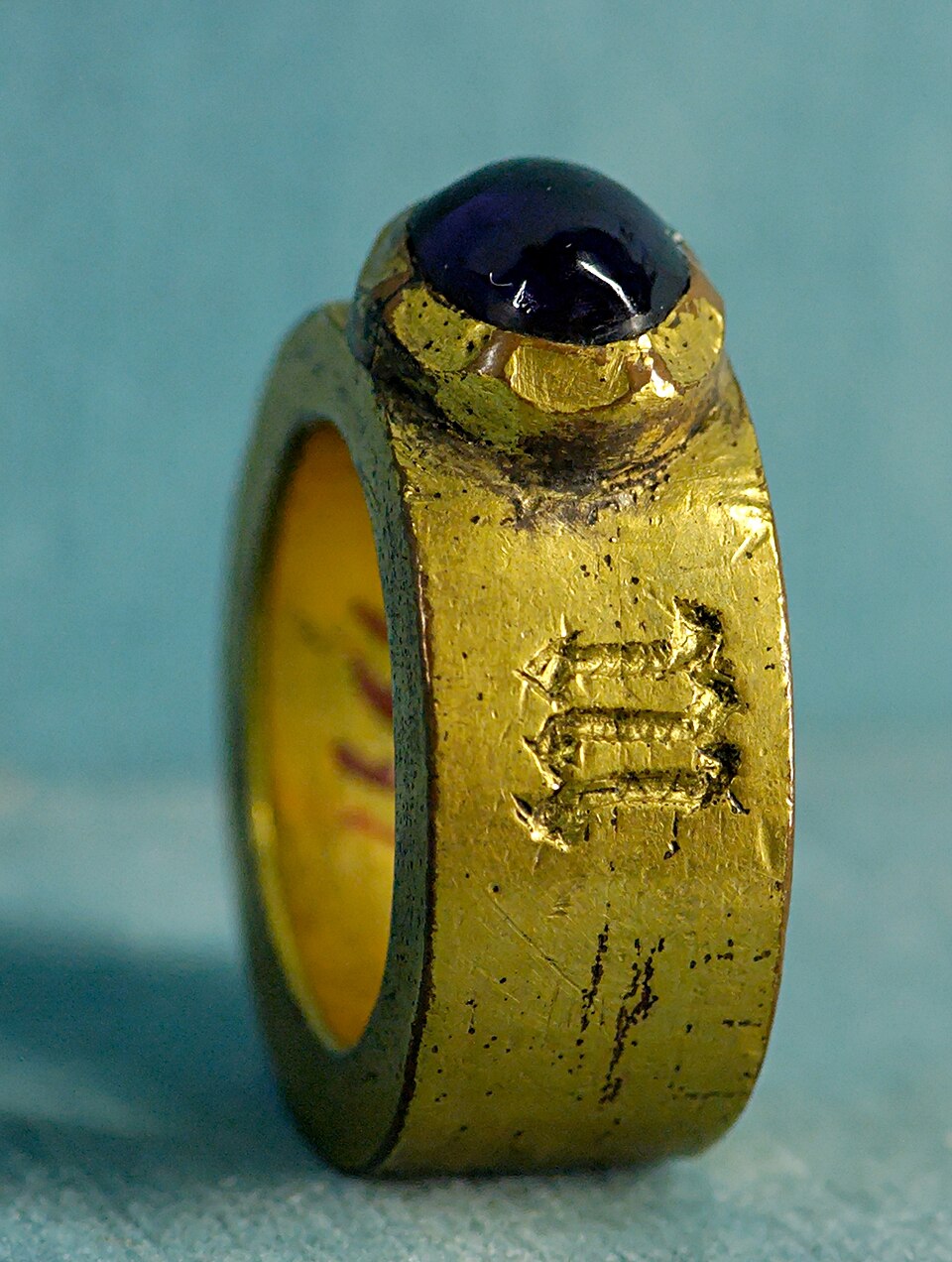
Yet the true reason for selecting the sapphire (the ancient hyacinthus) likely lies elsewhere—in its celestial hue, echoing the heavens themselves, as noted by Solinus, and in its association with Apollo, god of light. Its violet-blue tone harmonized beautifully with episcopal vestments, themselves symbolic of authority and piety.

Papal ring, Acquired by Henry Walters, Walters Art Museum, Via Wikimedia Commons
The bishop’s violet, in fact, corresponds to the hyacinthina or lesser purple (conchyli) of the Romans—a deep, stormy hue that Pliny likened to “the angry sea,” recalling the dark violet waves of the Mediterranean in rough weather. By contrast, the scarlet robes of cardinals derive from the true Tyrian dye—“the color of clotted blood; dark when viewed directly, but brilliant when held to the light.” The “purple ink” used by emperors to sign documents, as seen in surviving Byzantine charters, was of a vivid scarlet shade. Hence, in the Gospels, one Evangelist describes the robe of Christ during the Passion as “purple,” while another calls it “scarlet.” It is therefore reasonable to suppose that when medieval episcopal rings are found set with rubies instead of sapphires, they may have belonged to prelates who were at once bishops and cardinals.

Ring of Pope Sixtus IV, Former collection of Eugène Piot; purchase, 1873, Photographer Jastrow, via Wikimedia Commons
Rings in the Grave
Such rings were often—perhaps invariably—buried with the bishops to whom they belonged. Two were discovered in the coffins of ancient Bishops of Hereford; others rest in the library of York Cathedral. Many examples found in private collections were likely recovered from disturbed episcopal tombs. One remarkable specimen, unearthed from the stone coffin of a Bishop of St. Omer, was entirely of gold, the bezel formed of three trefoils intricately interlaced—a masterpiece of medieval craftsmanship.
The custom of burying ecclesiastics with their insignia endured deep into the Middle Ages. Boccaccio, in his Decameron, recounts the adventures of Andreuccio da Perugia, who, in desperation, joins a band of thieves to plunder the tomb of the Archbishop of Naples—interred the previous day in all his splendid vestments and wearing a ring valued at 500 scudi. Two groups of robbers, the second led by a priest of the cathedral, arrive almost simultaneously, and by this strange coincidence Andreuccio escapes death and departs with the precious ring, his fortune thus restored.
The Rise of Imitations
It once seemed plausible that this very practice—the looting of episcopal tombs, often by those charged with their protection—gave rise to the large gilt-metal rings frequently seen in antiquarian collections, bearing the names or arms of popes and bishops. As none predates the fifteenth century, one might surmise that the repeated desecration of tombs compelled the friends of deceased prelates to substitute such counterfeit insignia for the genuine ones, sparing the true jewels from theft.
Indeed, evidence supports this notion. Palatin records in Gesta Pontificum Romanorum (Book III, p. 653): “In the year 1607, in the sepulchre of Sixtus IV was found the ring of Paul II, inscribed PAVLVS II.” That very ring appeared in Roby’s celebrated collection and was sold by Christie and Manson in May 1855 for seven guineas. Another, a large gilt-bronze ring set with amethyst, richly chased and adorned with figures in high relief, was listed in Major Macdonald’s collection (Sotheby & Wilkinson, April 1857) as “formerly belonging to Pope Boniface, taken from his tomb during the Roman insurrection of 1849.”

Illustration from Antique Gems: Their Origin, Uses, and Value as Interpreters of Ancient History by Charles William King (public domain). Source: Internet Archive
Form and Function
These monumental rings, often exceeding practical size—some weighing nearly one pound—were clearly never intended for the finger. Their shanks are typically four-sided, with a square bezel set with crystal, pale amethyst, or colored glass. One side usually bears the owner’s coat of arms; the other, a sacred device such as the emblems of the Evangelists. The designs are cast in bold Gothic relief and richly gilded. Inscriptions, often in Gothic letters, sometimes appear along the narrower band, giving titles such as EPS. LUDGUN. (Bishop of Lyon), though many examples lack any inscription at all.
One eminent archaeologist has proposed that these were not rings of investiture but rather credential rings—objects of authority used to authenticate the missions of papal or episcopal envoys. This theory gains strength from the existence of duplicate rings belonging to the same prelate—a circumstance improbable if they were made solely for burial. The Archaeological Journal once illustrated such a ring, plain in design yet inscribed ROGERI REGIS—likely belonging to a Neapolitan king named Roger—suggesting that the custom may have originated in secular administration before being adopted by the Church. Curiously, apart from such exceptions, nearly all known examples belonged to ecclesiastics.
Today, these rings—along with medieval seals and signets—are widely forged in Germany, driven by their desirability among collectors of medieval relics. Their manufacture requires little skill for a competent metalworker, and their market value provides strong temptation. For this reason, any specimen lacking well-documented provenance should be examined with the utmost scrutiny and caution.
He is celebrated for his efforts to reconcile Greek philosophy with Christian teachings, attracting educated pagans to Christianity and influencing the intellectual development of the early Church. Clement authored several important works, including Protrepticus, Paedagogus, and Stromata, which addressed topics related to faith, moral life, and knowledge. His teachings laid the groundwork for later Christian monasticism, and he was a major figure in integrating Hellenistic thought into Christian doctrine. Clement died around 215 AD, most likely outside Egypt, after fleeing persecution
Cover Photo: Pastoral ring. Gilt bronze and amethyst, Musée de Cluny, Photographer: Jastrow, Source Wikimedia Commons