
The Florentine Diamond: The Lost Treasure Hidden in a Canadian Bank for a Century
After more than a hundred years of mystery, one of Europe’s most famous diamonds — the Florentine Diamond (also known as Il Fiorentino) — has resurfaced.
The discovery, recently announced by members of the Habsburg family and documented by several international publications, ends a century of speculation about the fate of the gem, reports People.com.
What Is the Florentine Diamond?
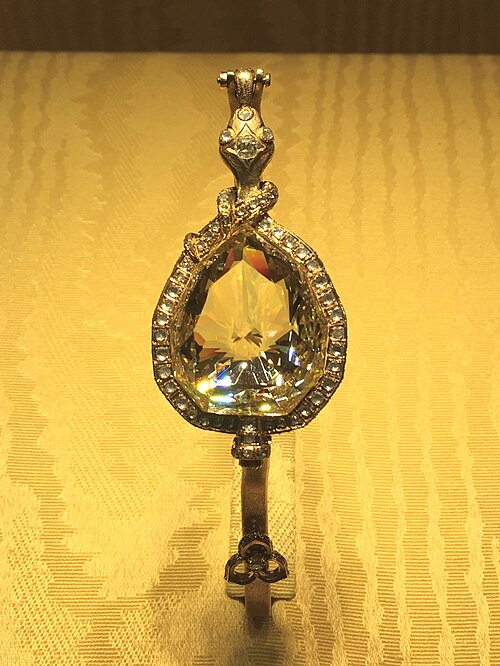
The diamond is a pale yellow stone, cut in a drop/pear shape, with a historical weight of about 137 carats (approximately 27–28 grams, or about 0.95–0.99 ounces) and a large number of facets — described in historical sources as having an old-style cut, typical of large Indian stones of the time.

Glass replica of the Florentine Diamond. Natural History Museum Vienna (NHM), inventory no. Ay755. Photo: Gryffindor / Creative Commons Zero (CC0)
According to Wikipedia, over the centuries it has borne several names: Diamante Toscano, Granduca di Toscana, Florentine/Florentiner.
A Noble Journey: From India to the Medicis and Then to the Habsburgs
The origin of the stone remains partly shrouded in the commercial legends of its era: it was probably mined in India and entered the great European collections as early as the Middle Ages.
By the 17th century, it had come into the possession of the Medici family of Florence — hence its name — and was described in detail by the traveler and gem merchant Jean-Baptiste Tavernier.
Later, it passed into the imperial treasury of the Habsburgs, where it remained until the collapse of the Austro-Hungarian Empire after World War I.
Timeline of Ownership
15th/16th century (legend):
Charles the Bold, Duke of Burgundy — according to one legend — is said to have worn the diamond at the Battle of Nancy (1477), after which it was found by a peasant, etc., according to Encyclopedia Britannica and Wikipedia.
Note: This stage is more legend than firmly documented history.
c. 1601:
Ferdinando I de’ Medici, Grand Duke of Tuscany — according to some sources, purchased the diamond (or the rough crystal) from the Castro-Noronha family (Portugal/Goa) for about 35,000 gold scudi, according to Finestre sull’Arte.
1615:
The cutting of the stone for the Medici family (by Ferdinando I’s son, Cosimo II de’ Medici). Records show that the cutting was entrusted to Venetian jeweler Pompeo Studentoli in Florence.
17th century until 1737:
The Medici family (Tuscany) — continuous ownership. For example, in 1657, gem trader and traveler Jean-Baptiste Tavernier noted the diamond in the possession of Ferdinando II de’ Medici, reports Artnet News.
1737–1738:
The House of Habsburg-Lorraine (through the marriage of Maria Theresa of Austria and Francis I of Lorraine). When the Medici line ended (the last Grand Duke, Gian Gastone, died in 1737), Tuscany’s treasures passed to the Habsburg-Lorraine dynasty; thus, the diamond became part of the Habsburg treasury, according to Encyclopedia Britannica.
19th century:
Franz Joseph I of Austria (Emperor of Austria) and the Imperial House of Austria. Sources list the diamond among the Austrian Crown Jewels after its relocation to Vienna.
1918–1922:
Charles I of Austria (the last Austro-Hungarian emperor). When the empire collapsed in 1918, Charles I and his family took the royal treasures (including the diamond) with them into exile.
1922–1990+:
Zita of Bourbon-Parma (wife of Charles I) and the heirs of the House of Habsburg-Lorraine. Zita is said to have taken the diamond with her family into exile (Switzerland, Belgium, then Canada during World War II) and deposited it in a Canadian bank vault, requesting that its existence be kept secret for 100 years after her husband’s death, according to Blessed Karl of Austria.
Disappearance and Legend
After 1918, the stone’s trail was lost in official records: many historians and collectors assumed it had been stolen, secretly sold, or recut into smaller diamonds in the early 20th century. The lack of color photographs or public inventories deepened the mystery, turning the diamond into a favorite subject of conspiracy theories and gemological investigations (Wikipedia).
The Revelation: Hidden in Canada
According to recent reports, the truth is simpler yet more dramatic: the diamond was not lost or sold, but protected.
Empress Zita, wife of the last Austro-Hungarian emperor, Charles I, is said to have taken measures to safeguard the family’s jewels during their exile. As World War II broke out, the family relocated to North America, and part of the treasure was stored in a Canadian bank vault.

Princess Zita of Bourbon-Parma, Photo: Országos Levéltár, Original source: Koronázási album, via Wikimedia Commons
The location and existence of these assets remained secret, known only to a few trusted heirs, in accordance with Zita’s wishes. This story was confirmed in recent public statements made by members of the Habsburg family.
Authentication and Current Status
Independent specialists and renowned jewelers have been consulted for expert verification. A.E. Köchert, the former Austrian court jeweler, reportedly confirmed the authenticity of several recovered pieces, including the Florentine Diamond, by comparing them to historical sketches and catalogs.
The Habsburg family has stated that they do not intend to sell the diamond but plan to display it publicly (there is talk of a possible exhibition in Canada, as a gesture of gratitude for the protection offered during exile).
Historical and Cultural Significance
The diamond is not only valuable for its size and color; it symbolizes the connections between dynasties (Medici, Habsburg), the transfer of power across Europe, and the ways in which luxury objects have endured major historical events — wars, exile, and the fall of empires.
Its reappearance offers a rare opportunity for researchers and the general public to reassess the journeys of royal collections and to reconstruct parts of Europe’s material history.
Possible Controversies
Although the public information comes from statements by descendants and journalistic investigations, the diamond’s reemergence is expected to spark legal and moral debates:
Who holds rightful ownership — the family’s heirs, the Austrian state, or another entity?
Did the royal family’s handling of the assets during exile comply with international laws?
And what role should such artifacts play — national heritage or private property?
Sources such as The Guardian have already noted the potential for ownership disputes.
What Lies Ahead
According to reports, plans include a full expert assessment of the recovered pieces, potential exhibitions, and decisions regarding the public custody of the treasure. The Habsburg family has said they intend for at least some of the items to be visible to the public, while gemologists and historians continue to study and reconstruct the diamond’s full journey.
Conclusion
The reappearance of the Florentine Diamond weaves together legend, dynastic and political history, and the emotion of rediscovering an almost mythical artifact.
For lovers of history, gemology, and material culture, this represents a rare opportunity — not only to see an exceptional gem, but also to understand how objects can carry — and conceal — entire chapters of history.
Cover photo: Reproduction of the Grand Diamond of Tuscany by Paolo Penko (2021). Photo: Manuelarosi, Source Wikimedia Commons
VIEW OUR COLLECTION OF ANTIQUE & VINTAGE JEWELRY
VIEW OUR JOURNAL & NEWS
READ OUR INTERESTING FACTS ARTICLES



%20%E2%80%94%20has%20resurfaced.%0AThe%20discovery,%20recently%20announced%20by%20member...)