
Art Nouveau – A Glimpse Into A Not So Distant Era (Part 1)
Art Nouveau is a global movement in architecture, fine arts, and the applied arts, particularly the decorative arts. Natural forms, such as the flowing curves of flowers and vegetation, frequently served as sources of inspiration.
Additional characteristics of Art Nouveau included the use of modern materials—especially iron, glass, ceramics, and later concrete—to create unconventional forms and larger open spaces, as well as a sense of movement and dynamism that was often conveyed through asymmetry and whiplash curves.
During the Belle Époque, from 1890 to 1910, Art Nouveau emerged as a response to the academicism, eclecticism, and historicism that dominated 19th-century ornamental art and architecture.

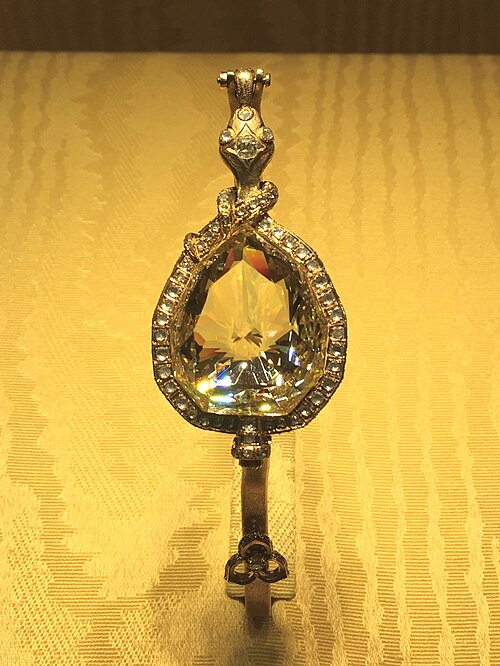
Art Nouveau Gold Diamond Griffin Bangle Bracelet , Source: DSF Antique Jewelry
The Machines
Power-operated machines began mass-producing jewelry in 1853, and anything bearing the label "machine-made" was sure to attract attention and sell. As with furniture design, however, machines imposed limitations and disciplines that traditional hand craftsmen could never have imagined.
For example, instead of the light, elegant settings that had been popular in previous years, the simplest designs to produce by stamping thin sheets of metal into molds were scrolling patterns and foliage.
Most of the factories were located in Sheffield and Birmingham. Although they did employ individual designers, those designers were rarely credited by name because the originality of the machine itself was considered more important.
After hundreds of metal settings had been produced, they were shipped elsewhere, usually to retail stores that purchased them in bulk at discounted prices, where the stones were then set by hand and the pieces finished, according to author Nancy Armstrong in her 1976 book Victorian Jewelry.
By the 1870s and 1880s, machine production had become so commonplace—and new, interesting designs were being introduced every week—that advertisements no longer bothered to mention it.
Japan
Then came the art of Japan. What, one might wonder, was so unexpected about that? Today, Japanese cameras, cars, and all kinds of machinery are everywhere, so what made this different? The answer lies in history, particularly the events of the 17th century.
Unfortunately, many Japanese Christians who had been converted by Western missionaries joined a civil rebellion against cruelty and misrule. As a result, in 1637 Japan closed itself off to foreigners and foreign influence.
According to Armstrong, only the peace-loving Dutch were permitted to maintain a trading post on one of the offshore islands, while rebels seeking assistance were executed and foreign trade missions were suppressed.
The country then experienced a long period of peace. Free from outside influences, the Japanese were able to cultivate their own artistic traditions, learn to live within their own means, and strengthen their cultural identity.
However, toward the end of the 18th century and the beginning of the 19th, an increasing number of foreign ships began appearing off Japan's coast.
Eventually, in 1853, Japan was forced to sign a treaty under pressure from an American expedition led by Commodore Matthew Perry. That treaty, followed by additional agreements, brought an end to Japan's long period of isolation. Japan was now compelled to trade with other nations in order to preserve any semblance of independence.
"The West was fascinated by the small works of art coming out of Japan, which were carried aboard trading ships to determine whether they had commercial value," Armstrong wrote.

Jewelry design by Philippe Wolfers exhibited at the Art & History Museum, Brussels, in December 2018, King Baudouin Foundation, Source Wikimedia Commons
Europe had long been familiar with the blue-and-white porcelain and earthenware imported from China, but it knew very little about contemporary Japanese craftsmanship. What people saw had a profound impact on the art world.

Vase with Japanese wild carp, form by Arnold Emil Krog and Soren Bech Jacobsen, 1887, decor by August F. Hallin, 1888, Konigliche Porzellanmanufaktur Kopenhagen, porcelain - Bröhan Museum, Berlin, Author: Daderot, Source: Wikimedia Commons
France, enjoying a brief period of peace, quickly stepped in with offers of substantial financial support to help build ships, shipyards, docks, iron foundries, and mines, while England, the United States, and Russia were occupied with wars and other conflicts.
In return, Japan exported the finest examples of its artistic craftsmanship—the greatest wealth it possessed. These included prints, embroidered textiles, ceramics, lacquerware, inrō, netsuke, and sculptures crafted from a variety of materials.
Paris
When these artifacts first appeared in Paris, eager collectors and merchants rushed to Japan to see them firsthand and purchase their own consignments, Armstrong wrote in her book. At the time, most wealthy collectors relied on reputable dealers, who were delighted to discover these new sources of revenue.
This entirely new phenomenon of Japanese art and artifacts first captivated Paris, then all of France, and eventually the rest of Europe.
By the 1870s, the avant-garde art world had grown tired of reworking earlier European styles, finding them dull and overly ornate.
As so often happened, the French adopted the best ideas from another culture, distilled their essence, and transformed them into something uniquely their own. Around this time, color became the dominant element in art.
The rich, dark, opaque colors favored by Pugin and his followers had a dense, flat appearance. The deep sapphire blue of a stained-glass Madonna's robe, the ruby red of a sanctuary lamp, and the dark green of an altar frontal all complemented the Neo-Gothic style, in which light fell upon and revealed the subject from a mysterious yet external source.

Antique Art Nouveau Gold Watch Fob, Source: DSF Antique Jewelry
Japanese blues flowed gently into greens, yellows into reds, and golds into silvers. Everything appeared to be bathed in light, as though each object possessed an inner radiance that naturally shone from within.
Most inanimate objects glistened and shimmered, suggesting an inner life of their own and reflecting the Japanese belief that everything possesses a spirit.
The mysterious shifting colors and the subtle silvery inner glow—silvery because it was usually a moonlit translucence rather than a golden radiance—continued to influence the decorative arts, especially jewelry.

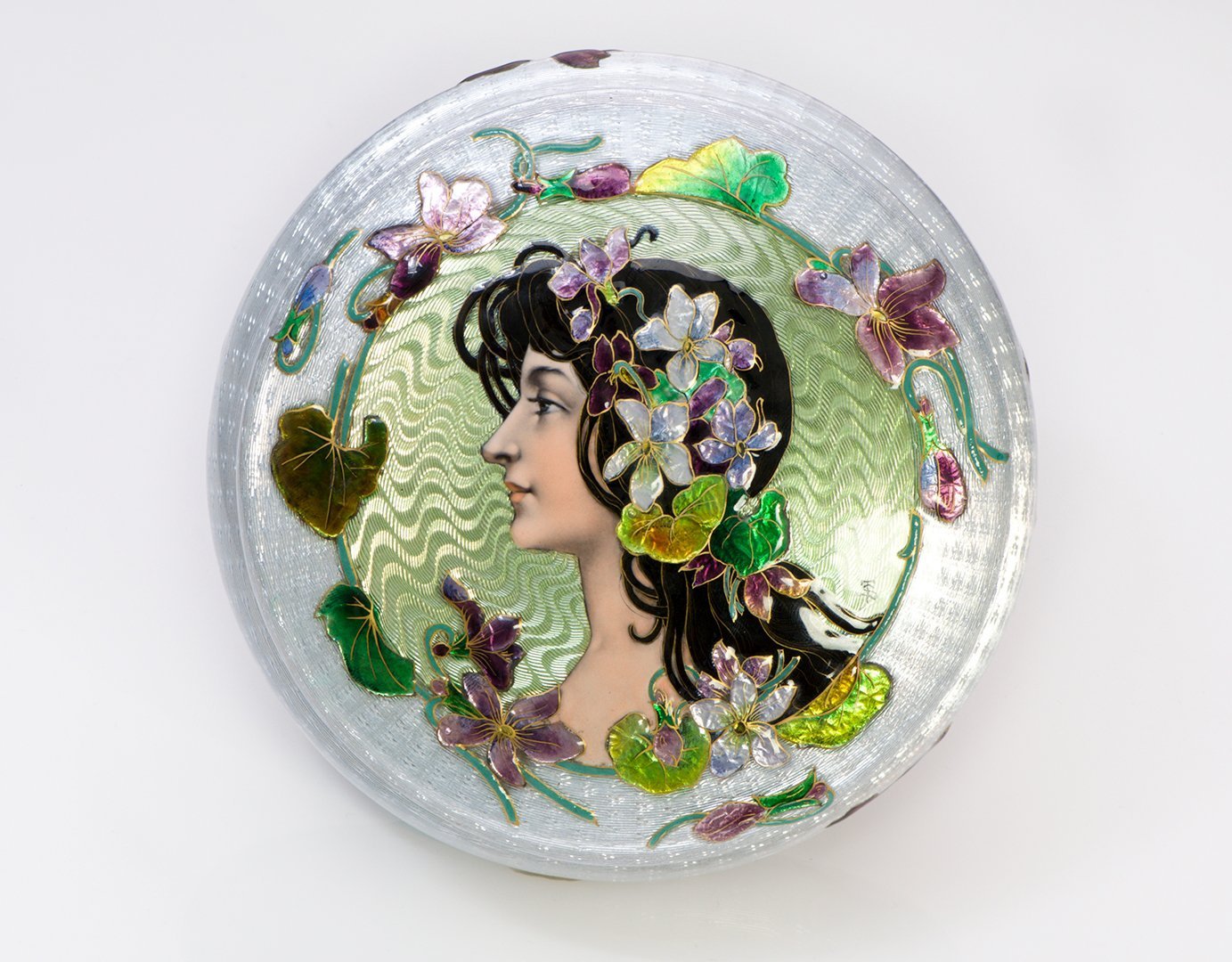
Japanese Satsuma Bowl, Source: DSF Antique Jewelry
Silver quickly returned to prominence alongside the richer golds, and its influence even extended to textiles. To create an attractive shot-silk effect with a silvery sheen, certain dyes were applied to anodized metals—metals that had undergone an electrochemical process to strengthen the protective oxide layer that naturally forms when exposed to air.
According to Armstrong, artists also successfully experimented with pale marble, pieces of rock crystal, and glass shaped to resemble dripping ice instead of the heavy onyx, dark marble, and mahogany that had traditionally been used for lamp bases and sculpture pedestals.
They used gold sparingly, if at all, perhaps only to emphasize a subtle shift in an object's design and reinforce the impression of continuous movement.
It is nearly impossible to fully capture the essence of Japanese art, but its themes are rooted in two fundamental principles: a profound love of nature and an extraordinary ability to combine colors in innovative ways. The Japanese possess a deep reverence for nature that has few parallels in Western art.
When creating floral landscapes, they never felt compelled to rely on repetitive patterns because they saw themselves as part of nature rather than separate from it. Unlike the repeating designs favored by William Morris and his followers, and by Victorian England in general, a single blossom was considered sufficient.

Japanese Earrings, Source DSF Antique Jewelry
"The Japanese artist might present only one significant image rather than attempt to depict an exact and objective scene; it was a refinement that nevertheless remained both truthful and vibrant," Armstrong wrote.
Art Nouveau
Because the Japanese traditionally believed that no plant occupied a higher place than another and that all forms of nature were equal, Art Nouveau jewelry frequently featured ordinary plants and flowers. Species with tongue-shaped leaves, elegantly pointed petals, and curling tendrils were especially popular.
It is therefore no surprise that Art Nouveau jewelry reached its finest expression in France, where designers were able to absorb the influx of Japanese art firsthand and where the French public eagerly embraced their jeweled fantasies.
It is important to remember, however, that the French avant-garde did not adopt the endless pattern-making associated with England's Arts and Crafts movement. Instead, they adapted Japanese ideas to suit the exotic image of the French woman of the stage.
According to Armstrong, their aim was to shock, titillate, and attract those drawn to experimentation—whether Symbolist poets, drug users, or individuals exploring unconventional lifestyles. They created striking jeweled masterpieces for the relatively small but influential circle of people who embraced excess and were happy to wear Art Nouveau jewelry because it attracted attention.
Much of it would likely have been dismissed by the Japanese as excessive or even absurd, while traditionalists in every country regarded it with alarm. Some pieces were as flamboyant as the exuberant can-can, while others were as dark and unsettling as whispers from the criminal underworld.
Yet it proved to be the perfect expression of the dramatic world inhabited by fashionable society women and stage performers who were unafraid to live boldly and publicly, which explains why Art Nouveau became so popular in France.

René Lalique collection in the Calouste Gulbenkian Museum, Author: Saiko, Source Wikimedia Commons
René Lalique
René Lalique (1860–1945), the leading figure among Art Nouveau jewelry designers, achieved international fame after Sarah Bernhardt commissioned him to create the jewelry she wore on stage.
His exquisitely beautiful creations were deliberately dramatic and theatrical. He incorporated naturalistic motifs, flowing female forms, and sensual imagery—women being stung, swallowed, or pierced—creating works that were intentional, provocative, utterly irreligious, always unexpected, and never repetitive, Armstrong wrote.
"There is, at times, something almost sinister in this wondrous beauty and exquisiteness; in this super-subtle fancy that disdains the common earth and seeks to tear out the heart of nature's beauty—but also her never-ending pain and struggle," stated the catalogue for the Grafton Gallery in 1903, when Lalique held his first solo exhibition in London.
Lalique often incorporated sculpted female faces with dreamy expressions, hooded eyes, and flowing hair cascading over their shoulders like breaking waves—frequently intertwined with birds around their necks—into his floral jewelry designs.

Lalique Pendant, Photo by Ángel M. Felicísimo from Mérida, España, via Wikimedia Commons
These works possess a strange, mysterious, and faintly menacing aura, as though the figures were willingly surrendering themselves to an unseen force.
"One is led involuntarily to think of mysterious rites, of priestesses of some strange worship that is beauty—but not godliness—of a strange type of perfection, gladdening the eyes but grieving the heart," was another contemporary description of these remarkable French jewelers and their sculptural representations of nude young women.
According to Armstrong, many of Lalique's contemporaries and admirers—including Eugène Feuillâtre, Georges Fouquet, Eugène Grasset, Lucien Gaillard, Paul and Henri Vever, among others—also produced exceptional work.
She also pointed to Philippe Wolfers in Brussels, who worked for the Belgian royal court and achieved nearly equal acclaim, and to Georg Jensen in Denmark, who successfully carried the movement forward in an entirely different style.
British Art Nouveau jewelry should not be confused with the Arts and Crafts movement, whose jewelry was more commonly described as "artistic."
Although Arts and Crafts jewelers embraced certain theoretical principles—including handcrafted work, individually designed pieces, and traditional techniques—their emphasis was far more on linear design than on sensuality or erotic expression.
While the Celtic Revival exerted a significant influence, and many of the leading designer-craftsmen worked independently rather than through formal schools, Britain produced relatively few Art Nouveau jewelers who could rival the French, with the possible exception of C. R. Ashbee.
The Arts and Crafts Movement
According to Armstrong, some books on jewelry devote far too much attention to the Arts and Crafts movement, giving it greater importance than it actually held in British jewelry fashion during the period.
Although the movement as a whole played a vital role in the development of the decorative arts and in restoring respect for skilled craftsmanship, it produced relatively little jewelry, and much of it lacked broad appeal.
The Arts and Crafts movement was, above all, a protest against industrialization and mass commerce. However, much of its jewelry was made from subdued metals and modest gemstones, making it visually restrained. The pieces were expensive to produce and difficult to sell, and many were created by enthusiastic amateurs rather than professional jewelers.
Nevertheless, several designers distinguished themselves, including Sir Alfred Gilbert, Alexander Fisher, Henry Wilson, and Arthur Gaskin.
The movement drew much of its inspiration from the Pre-Raphaelite Brotherhood and from the ideas of William Morris, which led to the founding of the Arts and Crafts Society in 1886 and the Guild of Handicraft in 1888.
"It is unfortunate that Art Nouveau jewelry in England was so unimaginative when it should have been playful, provocative, or both," Armstrong observed. She argued that British jewelers were unable to create anything truly extraordinary because they could not embrace sexuality as a source of artistic inspiration.
They were perfectly capable of producing beautifully crafted, delicately executed jewelry inspired by nature, but that was generally the limit of their ambitions. Victorian society was simply too reserved, and customers lacked the confidence to purchase or wear jewelry that expressed overt sensuality.
Even so, their creations stood in striking contrast to the heavily ornamented commercial jewelry in gold and diamonds typically worn by the wives of wealthy businessmen.
Following William Morris's principles, these pieces were designed and crafted by the same artist-artisan in a deliberate effort to revive the medieval workshop tradition, with its emphasis on craftsmanship and its conscious rejection of machine production.
A Potpourri of Stones
It is clear that British designers approached their work with restraint, placing greater emphasis on painted enamels and metalwork, while French designers employed an extraordinary potpourri of gemstones—often including diamonds—to create their fascinating and highly original pieces.
According to Armstrong, British jewelers were far more interested in creating metalwork and gemstones for the Church, whereas the French focused on the glamorous woman who would wear the jewelry and the occasions on which she would wear it.
British ecclesiastical pieces were dramatic, restrained, and rich in religious symbolism. A silver or gold morse, or cloak clasp, adorned with cabochon gemstones needed to make a strong visual impression as it caught the flickering candlelight and emerged through the "censer-made mists." Artists of the period seemed most at ease when working within a religious context.
Their everyday jewelry was refined and understated. Even decades later, many Britons still believed that wearing jewelry that appeared even slightly sensual simply "wouldn't be done." Nevertheless, Britain produced a number of remarkable jewelers.
Although Sir Alfred Gilbert (1854–1934) created some exceptional work, he disliked being openly associated with the Art Nouveau movement, according to Armstrong. He benefited greatly from his early stay in Paris and from his training as both a metalworker and a sculptor.
One of his best-known creations is the badge and chain of office for the Mayor of Preston, an intricate design featuring countless interwoven forms executed in silver-gilt, enamel, and moonstones.
Cover Photo: "Broches" de René Lalique, Source, Hotel de la Marine, Paris, Author Jean-Pierre Dalbéra, via Wikimedia Commons
We invite you to read Part 2 of this article