Muzo Emeralds: The Legendary Green Gemstones of Colombia
Among the world’s great colored gemstones, few names carry the historical resonance of Muzo. Located in the mountains of Boyacá, Colombia, the Muzo emerald region has been associated with remarkable green stones for centuries. Its emeralds have passed through royal courts, historic trade routes, important jewelry houses, and generations of collectors.
Yet the significance of Muzo cannot be explained by geography alone. The name evokes a particular combination of color, rarity, history, and natural character. A fine Muzo emerald may possess a green that appears vivid without becoming harsh, deep without looking overly dark, and luminous even when the stone contains the internal features commonly seen in natural emerald.
For collectors of antique and important gemstone jewelry, understanding Muzo means looking beyond the name. Color, transparency, treatment, documentation, provenance, craftsmanship, and condition must all be considered together.
Where Are Muzo Emeralds Found?
The historic Muzo mines are situated in the Boyacá department of Colombia, northwest of Bogotá, within the western emerald belt of the country’s Eastern Cordillera.
Colombia has several important emerald-producing districts, including Muzo, Coscuez, Chivor, La Pita, and Peñas Blancas. Muzo, however, remains the most internationally recognized name among them.
Emerald mining in this region predates Spanish colonization. Indigenous communities already knew and valued the green crystals found in the mountains, incorporating them into local traditions and systems of exchange. Following the Spanish arrival in the sixteenth century, Colombian emeralds entered European and international markets in increasing numbers.
From Europe, many traveled farther east through established trade networks, eventually reaching Persia, the Ottoman world, and the Mughal courts of India. There, Colombian emeralds were frequently carved, inscribed, mounted in ceremonial objects, or incorporated into extraordinary jewels.
Readers interested in the broader history of Colombian emeralds may explore the GIA historical reading list devoted to emeralds from Colombia.
Why Are Muzo Emeralds So Celebrated?
Muzo emeralds are especially admired for color. Fine examples may display a saturated green with a lively, luminous quality and an appealing balance between blue and yellow secondary tones.
This reputation does not mean that every emerald recovered from Muzo is of exceptional quality. Like every gemstone deposit, the region produces material across a broad spectrum. Some crystals are pale, heavily included, fractured, or unsuitable for fine jewelry. The name of a prestigious source cannot replace an individual assessment of the gemstone itself.
When examining a fine emerald, collectors generally consider:
- The richness and evenness of its green color
- Its transparency and visual liveliness
- The position and visibility of inclusions
- The quality and symmetry of the cut
- Its carat weight and physical proportions
- The presence and degree of clarity enhancement
- Supporting laboratory documentation
- The quality, period, and condition of the jewel in which it is mounted
A beautifully colored emerald in an important antique setting may be compelling even when it contains visible inclusions. Emeralds are not normally judged by the same clarity expectations applied to diamonds. Their internal features are part of their geological formation and, in many cases, part of their visual identity.

The Geological Character of Colombian Emeralds
Emerald is the green variety of the mineral beryl. Its color is produced principally by trace elements such as chromium and vanadium.
Colombian emeralds formed under unusual geological conditions involving mineral-rich hydrothermal fluids and sedimentary rock. This formation differs from the geological environments associated with many emerald deposits elsewhere in the world.
The result can be material with relatively low iron content and a bright, open green appearance. Nevertheless, appearance alone cannot prove Colombian—or specifically Muzo—origin. Emeralds from different countries can sometimes share similar colors, inclusions, and chemical characteristics.
Modern origin determination may therefore involve microscopic examination, spectroscopy, and trace-element analysis. The GIA study of emerald geographic-origin determination explains why several forms of evidence may be needed before a laboratory can issue an origin opinion.
Inclusions: The Natural Landscape Within an Emerald
Natural emeralds frequently contain inclusions and fissures. Under magnification, these may appear as fluid-filled cavities, crystals, growth structures, or complex internal scenes.
The traditional French term jardin, meaning “garden,” is often used to describe this internal landscape. The word reflects the organic, moss-like appearance that may be visible inside certain emeralds.
Inclusions can provide valuable gemological information, but they should not be romanticized without considering their effect on durability and transparency. A fine emerald may have visible inclusions while still presenting excellent color and brilliance. Conversely, inclusions that are extensive, poorly positioned, or surface-reaching may affect the stone’s appearance and structural stability.
The goal is not necessarily to find an emerald with no internal characteristics. Untreated, highly transparent emeralds with very few fissures are extraordinarily rare. The more practical question is whether the stone’s inclusions allow its color, light, and personality to remain visually compelling.
Treatment and Clarity Enhancement
Because emeralds commonly contain surface-reaching fissures, clarity enhancement has a long history within the gem trade. Oils or other transparent substances may be introduced into fissures to make them less visible.
This does not transform a natural emerald into a synthetic stone. It is, however, an important treatment that should be disclosed and evaluated.
Gemological reports may describe the amount of clarity enhancement using terms such as minor, moderate, or significant. In important emeralds, the degree and type of enhancement can influence rarity, desirability, and market value.
Collectors should pay close attention to:
- Whether the emerald is natural or synthetic
- The geographic-origin opinion, when available
- Whether clarity enhancement is present
- The degree of enhancement
- The identity of the filling substance, when tested
- Whether the report applies to the loose gemstone or to the mounted jewel
GIA provides an accessible overview of emerald quality factors and clarity-enhancement reporting.
Does “Colombian” Automatically Mean “Muzo”?
No. Muzo is one of several important emerald sources in Colombia.
An emerald may be identified as Colombian without being attributable to one specific mine. Likewise, a stone with a desirable green appearance should not be called Muzo solely because its color resembles emeralds historically associated with that district.
A laboratory may provide an opinion concerning geographic origin, while a more specific mine attribution can depend on additional provenance, historic records, traceability, or documentation connected to the original source.
When the description of an antique jewel uses language such as “believed to be from Muzo,” that distinction should be retained unless stronger documentation becomes available. Responsible descriptions preserve both the significance of the jewel and the limits of what can be established.
Muzo Emeralds in Antique Jewelry
Emeralds from Colombia began circulating internationally centuries ago, making their way into European, Middle Eastern, and Indian collections. Over time, they appeared in rings, brooches, necklaces, ceremonial objects, aigrettes, turban ornaments, dress clips, and small personal jewels.
In antique jewelry, the emerald must be considered as part of a complete object. A collector should examine not only the stone, but also:
- The age and construction of the setting
- Metal hallmarks and maker’s marks
- Evidence of repairs or later alterations
- Whether the mounting is consistent with the stated period
- The relationship between the emerald cut and the design
- The condition of the claws, bezel, gallery, and supporting structure
- Any available provenance or laboratory documentation
An emerald of notable color mounted in a finely made period setting may have significance beyond its carat weight. The jewel represents a meeting of geological rarity, craftsmanship, design history, and personal use.
DSF explores the broader cultural history of this gemstone in The Emerald: The Mysterious Princess of Gems.
A Muzo Emerald Jewel at DSF Antique Jewelry
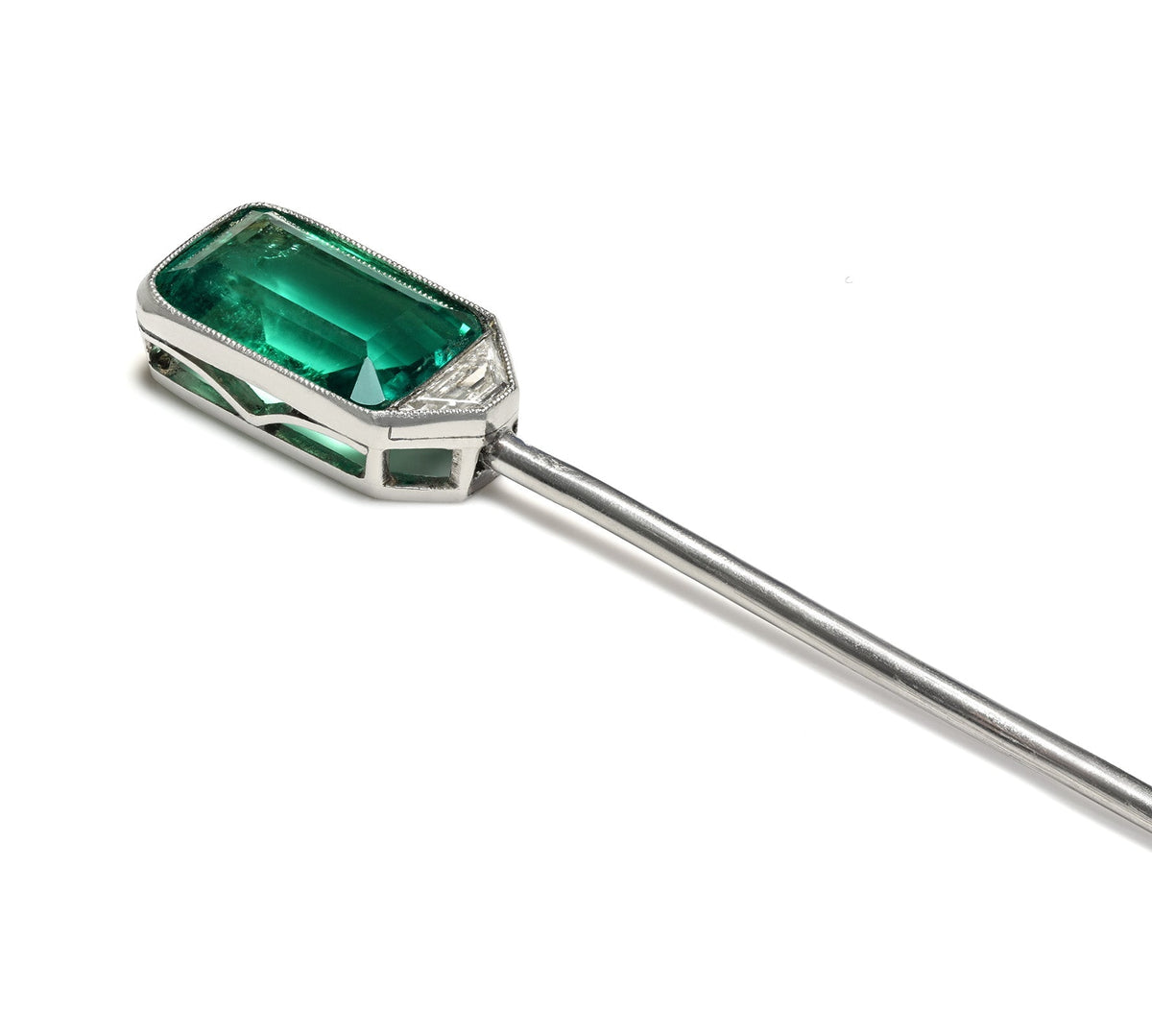
One jewel in the DSF collection brings these qualities together in a particularly refined form: an antique Colombian emerald and diamond stick pin in platinum.
The pin features an approximately 2-carat rectangular emerald described as Colombian and believed to originate from the Muzo Mine. The stone is framed by diamond accents and mounted in an architectural platinum setting with openwork details.
A French dog’s-head hallmark appears on the reverse, a mark traditionally associated with platinum. The geometry of the mounting gives the jewel an Art Deco sensibility, while the restrained diamond work allows the emerald’s green color to remain the principal focus.
Its stick-pin format also contributes to its collector appeal. Originally worn on a tie, lapel, scarf, or cravat, antique stick pins offered jewelers a small but sophisticated format in which to combine rare gemstones with precise metalwork.
Today, they may be worn traditionally, adapted to contemporary styling, or preserved as miniature examples of historical jewelry design.
A Collector’s Approach to Muzo Emerald Jewelry
The Muzo name is important, but it should be the beginning of the evaluation rather than its conclusion.
A collector considering an emerald jewel should ask:
- What is the basis for the stated origin?
- Is there an independent gemological report?
- Does the report identify any clarity enhancement?
- How does the emerald appear in natural and controlled lighting?
- Are its inclusions attractive, distracting, or potentially structural?
- Is the setting original or substantially altered?
- Are the metal marks and construction consistent with the attributed period?
- Has the emerald been protected appropriately within the mounting?
- Is the jewel’s condition compatible with its age?
- Does the complete object possess beauty and distinction beyond the reputation of its gemstone source?
DSF’s important rare gemstone jewelry collection presents jewels selected with attention to the relationship between gemstone quality, design, craftsmanship, condition, and collector interest.

How to Care for an Emerald Jewel
Emeralds require thoughtful care. Although emerald is reasonably hard, natural fissures may make it less resistant to impact than ruby, sapphire, or diamond.
Avoid ultrasonic and steam cleaning, particularly when the treatment history is unknown. Heat, strong chemicals, and sudden temperature changes can affect filling substances and may extend existing fissures.
The safest general method is gentle cleaning with lukewarm water, mild soap, and a soft brush, followed by careful drying. Antique emerald jewels should be stored separately from harder gemstones and examined periodically to make sure the setting remains secure.
The GIA emerald care and cleaning guide provides additional guidance.
Frequently Asked Questions About Muzo Emeralds
What is a Muzo emerald?
A Muzo emerald is an emerald associated with the historic Muzo mining region of Boyacá, Colombia. The designation refers to origin, not simply to a particular shade of green.
Are all Muzo emeralds exceptionally valuable?
No. The Muzo mines have produced emeralds of many different qualities. Color, transparency, size, treatment, cut, documentation, and overall beauty determine the importance of an individual stone.
Are inclusions normal in Muzo emeralds?
Yes. Inclusions and fissures are common in natural emeralds. Their effect on beauty, transparency, durability, and value depends on their character and location.
Are Muzo emeralds treated?
Some are untreated, while many emeralds in the broader market have undergone clarity enhancement. The presence and degree of enhancement should be evaluated by a respected gemological laboratory whenever possible.
Can color alone prove that an emerald came from Muzo?
No. Similar-looking emeralds may originate from different deposits. Reliable origin opinions require gemological testing, and mine-specific attribution may require further provenance or traceability.
Are antique emerald jewels suitable for regular wear?
They can be worn, but their age, setting, inclusions, and treatment history should be considered. Avoid impact, chemicals, ultrasonic cleaning, steam, and unnecessary heat.
The Enduring Appeal of Muzo
The fascination of Muzo emeralds lies in the meeting of nature and history. Each crystal began as a rare geological event within the Colombian mountains. Once recovered, it entered another history shaped by cutters, merchants, jewelers, collectors, and the people who wore it.
The finest examples are admired not simply because they carry a celebrated name, but because they possess a quality that can be immediately felt: color with depth, light with softness, and an individuality that resists perfect repetition.
For additional photographs, condition information, hallmark images, or details concerning an emerald jewel in the DSF collection, collectors may arrange a private consultation with DSF Antique Jewelry.