When a Kashmir Sapphire Becomes a Work of Art: A Rare Antique Intaglio
At first glance, the eye registers blue. A moment later, a profile appears: a helmeted classical figure carved into the sapphire itself. That gradual discovery is part of what makes this jewel so compelling. It is not simply an important gemstone set as an antique stick pin; it is a miniature image created through light, depth and the skill of the gem engraver.
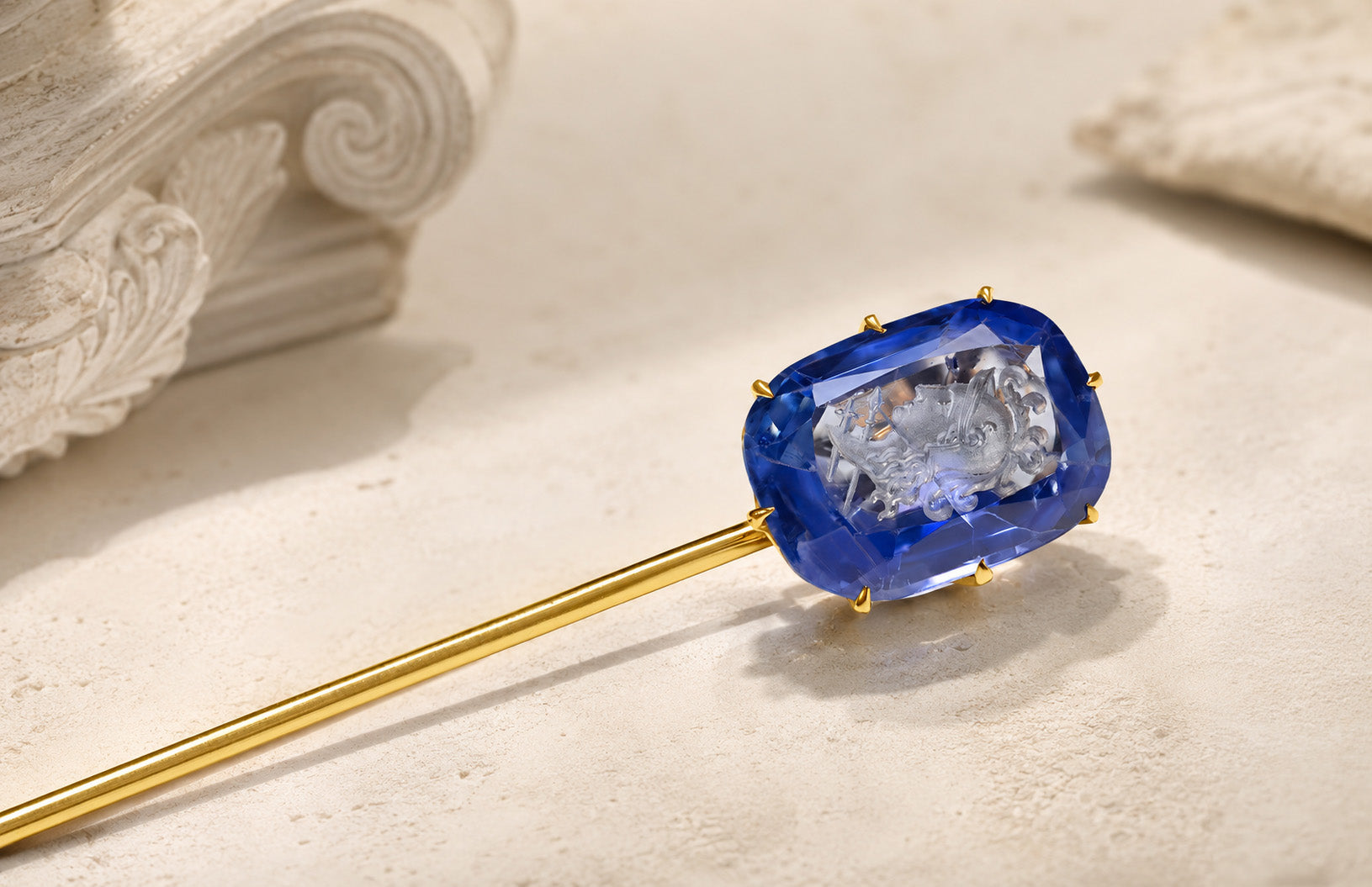
Recently acquired by DSF Antique Jewelry, this 5.20-carat natural unheated Kashmir sapphire intaglio stick pin brings together several qualities rarely encountered in a single jewel. The sapphire is documented as natural and of Kashmir origin, with no gemological evidence of heat treatment. It is accompanied by an AGL Prestige Report and mounted in gold, yet its most distinctive characteristic is the antique intaglio carved within the stone.
The engraving transforms the sapphire from a valuable natural material into a work of lapidary art. Its subject, a helmeted classical figure shown in profile, appears almost suspended inside the blue gem. Viewed from different angles, the image moves between clarity and reflection, revealing new details as light travels through the stone.
Why Kashmir Sapphires Hold Such a Distinctive Place
Kashmir sapphires occupy a singular position in the history of colored gemstones. Their reputation is connected not only to their admired blue color, but also to the limited history of the deposits from which they originated.
GIA’s research on Kashmir sapphires describes an initial period of mining activity followed by production that slowed dramatically. The difficult terrain and limited output helped make fine examples from this origin increasingly scarce.
For collectors, however, the name Kashmir should never be considered in isolation. A gemstone must still be evaluated individually according to its color, transparency, cutting, condition, treatment status and the integrity of the jewel in which it is mounted. Geographic origin is an important part of the story, but it is not a substitute for examining the stone itself.
In this example, the sapphire’s significance is strengthened by the convergence of several characteristics: Kashmir origin, an untreated condition, a weight of 5.20 carats, antique intaglio carving and respected gemological documentation. Each element contributes something different to the jewel’s identity.

What Is an Intaglio?
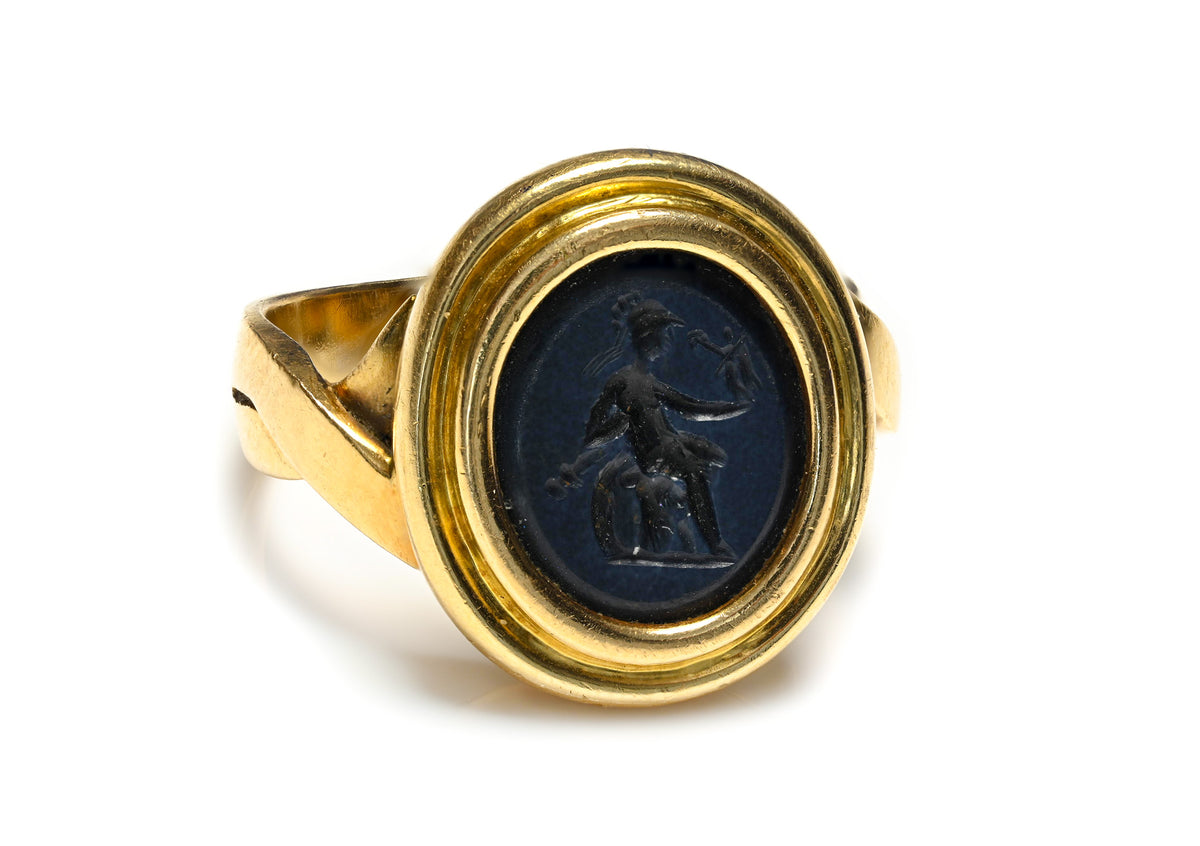
An intaglio is an image cut below the surface of a gemstone. This distinguishes it from a cameo, where the design is carved in relief and rises above the surrounding material.
Historically, intaglios could serve as seals, personal emblems, portraits, symbols or protective objects. When pressed into wax or clay, a negatively engraved image could create a raised impression. Not every intaglio was intended to function as a seal, however. Many were collected, worn as personal ornaments or admired as miniature works of sculpture.
The Metropolitan Museum of Art’s study of antique engraved gems describes how carved stones were valued in antiquity as signatures, seals, amulets and personal adornments. They later became prized by Renaissance collectors, who appreciated both the natural beauty of the gemstone and the skill of the artist who engraved it.
That dual appreciation remains central to the appeal of an intaglio today. The collector is not looking only at the material or only at the image. The fascination lies in the relationship between the two.
A Classical Profile Held Within Blue Sapphire
The intaglio at the center of this jewel depicts a helmeted classical figure in profile. The design evokes the visual language of ancient coins, engraved gems and historical portraiture without overwhelming the sapphire surrounding it.
The face, helmet, flowing details and ornamental elements are incised into the stone with remarkable precision. A faceted blue border surrounds the engraved center, creating a natural frame around the image. The polished and carved areas interact differently with light: the sapphire’s outer facets produce flashes of blue, while the engraved portions appear softer and more sculptural.
From a direct angle, the profile is immediately visible. Turned slightly, parts of the image seem to dissolve into the depth of the sapphire before returning as the light changes. This shifting effect gives the jewel a quality that cannot be fully conveyed in a single still photograph.
Sapphire is also an exceptionally hard material. While that hardness makes it highly suitable for jewelry, it makes controlled engraving particularly demanding. The carver must create recognizable facial contours and fine decorative details without sacrificing the balance or structural integrity of the gemstone.
The result is an object that occupies several categories at once. It is a rare sapphire, an engraved gem, an antique jewel and a miniature classical portrait.

When Carat Weight Is Only Part of the Story
Important colored gemstones are often discussed first in terms of carat weight. Weight matters, but in a carved gemstone it tells only part of the story.
Creating an intaglio requires removing material. Rather than preserving every possible fraction of the original stone, the engraver used the sapphire as an artistic medium. The surviving 5.20-carat weight is substantial, but the greater distinction lies in how that material was used.
The carving introduces composition, symbolism and the hand of an artist into the evaluation of the gemstone. The sapphire is no longer appreciated only for its geological origin or blue color. It must also be considered in terms of line, depth, proportion and the visual relationship between the figure and the surrounding facets.
This is one reason carved gemstones often appeal to more than one kind of collector. A gem collector may be drawn to the Kashmir origin and untreated condition. A collector of antique jewelry may respond to the mounting and form. A collector of intaglios or classical imagery may be most interested in the engraved subject. The jewel brings those interests together.
The Importance of an AGL Prestige Report
The sapphire is accompanied by a Prestige Report from American Gemological Laboratories. The report identifies the gemstone as a natural sapphire of Kashmir origin and states that there is no gemological evidence of heat treatment.
These details cannot be reliably determined from appearance alone. Color may inspire an initial response, but geographic origin and treatment status require specialized gemological examination.
American Gemological Laboratories explains that its Prestige reporting services may address gemstone identification, enhancement and, where applicable, country of origin. For a significant colored gemstone, this documentation provides an important independent record of the gemological characteristics reported by the laboratory.
Documentation should still be understood within its proper role. A laboratory report confirms or records gemological information; it does not replace evaluation of the mounting, carving, condition, historical character or overall quality of the jewel. Those elements require a broader examination.
DSF’s approach to gemstone reports and jewelry documentation considers laboratory findings alongside craftsmanship, construction, design, condition, period and the presentation of the jewel as a whole.
In this case, the AGL Prestige Report supports the characteristics that cannot be judged solely by eye, while the intaglio and antique gold mounting provide the artistic and historical context.
Two Kashmir Sapphires, Two Very Different Expressions
This intaglio follows another significant Kashmir sapphire recently added to the DSF collection: an approximately 2.50-carat natural unheated Kashmir sapphire antique stick pin, also accompanied by an AGL Prestige Report.
Although the two jewels share Kashmir origin, untreated status and the stick pin format, they express the sapphire material in entirely different ways.
The earlier 2.50-carat sapphire has a cushion-shaped pyramidal cabochon cut. Its appeal is centered on the gemstone’s color, volume, geometry and softly polished surface. It presents the sapphire as a concentrated field of blue.
The 5.20-carat intaglio uses the sapphire in a more pictorial manner. Its blue color becomes both the setting and the atmosphere for the engraved figure. The stone is simultaneously gemstone and image.
Comparing the two demonstrates why carat weight and origin alone cannot describe the full character of a jewel. Cut, carving, design and artistic intention can result in entirely different experiences, even when the gemstones share a celebrated geographic origin.
Together, the two pieces broaden DSF’s presentation of documented Kashmir sapphires rather than repeating it. One emphasizes the natural presence of the stone; the other explores what happens when that material is entrusted to the hand of a skilled engraver.

The Intimate Scale of the Antique Stick Pin
The stick pin is an especially appropriate form for a jewel of this character. Unlike a large necklace or formal ring, a stick pin presents an important gemstone on an intimate scale. It can be worn on a lapel, cravat, tie or scarf, allowing the object to function as a personal detail rather than an overt display.
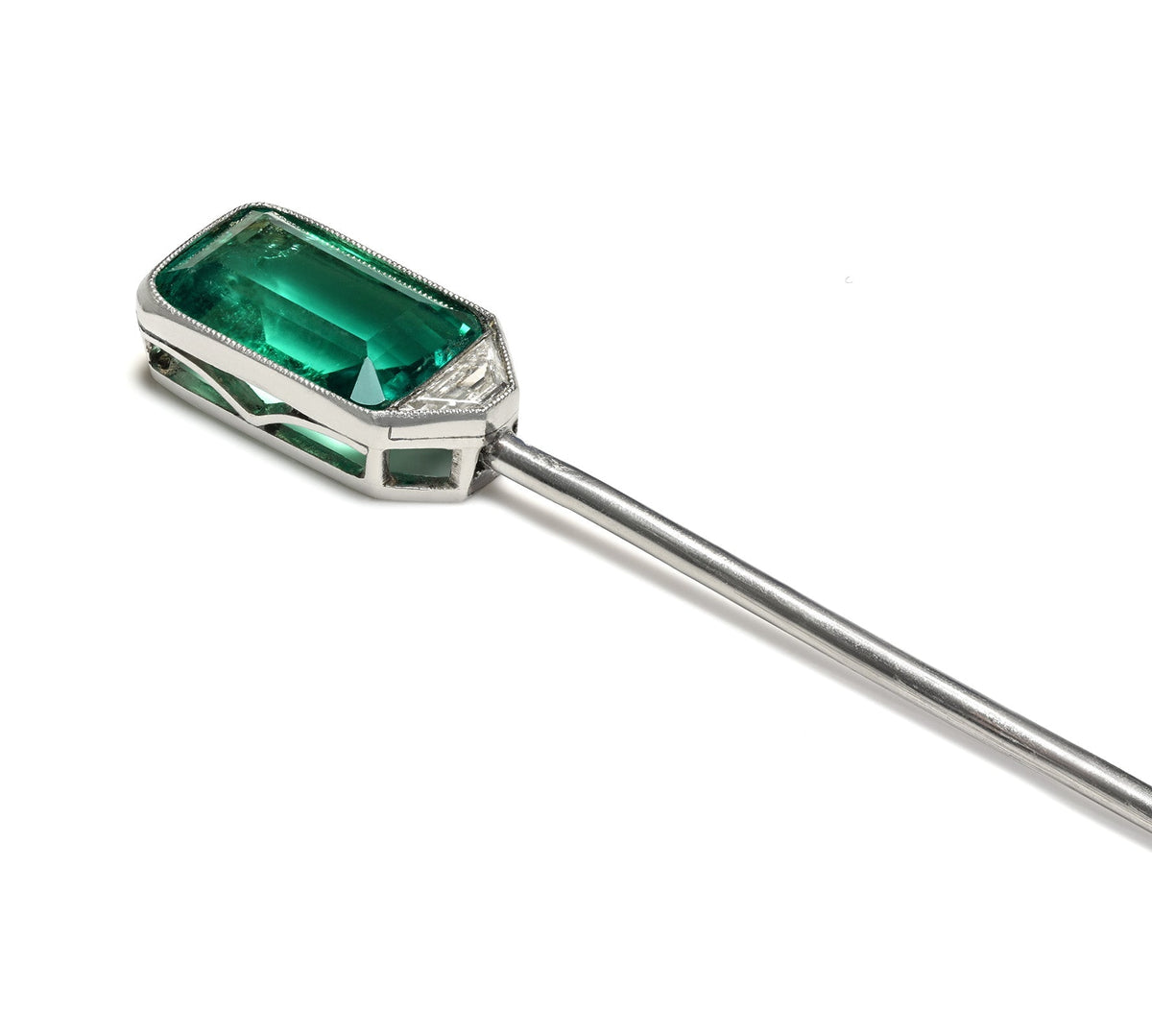
The gold setting around this sapphire is deliberately restrained. Small prongs secure the gemstone while leaving the outer facets and central intaglio visible. The long pin stem provides a simple visual counterpoint to the elaborate carving above it.
Historically, stick pins offered a place for jewelers and collectors to explore unusual materials, private symbols, miniature sculpture and exceptional gemstones. Their small size often encouraged closer observation. A wearer might choose a motif for its personal meaning, while another viewer would need to approach the jewel closely to understand its details.
DSF’s collection of antique and vintage stick pins reflects this remarkable variety, ranging from signed designer pieces and important gemstones to animals, symbols, portraits and whimsical subjects.
In the Kashmir sapphire intaglio, the stick pin format preserves the private quality historically associated with engraved gems. The helmeted figure is visible, but it is not immediately announced. It waits to be discovered.
Where Gemology and Artistry Meet
Rarity is sometimes described simply as the number of comparable objects known to exist. With an important antique jewel, however, rarity is often created by the intersection of several independent qualities.
Here, the gemstone is natural, unheated and documented as Kashmir origin. It weighs 5.20 carats. It has been carved as an intaglio rather than presented solely as a conventional faceted or cabochon sapphire. The engraving depicts a detailed classical figure, and the stone survives in an antique gold stick pin mounting.
Remove any one of these qualities and the object would still be interesting. Together, they create something far more difficult to categorize or reproduce.
The jewel also demonstrates why the most compelling pieces of fine jewelry are not always those that reveal everything immediately. Some are understood in stages. First comes color, then form, then craftsmanship, followed by the history and documentation that deepen the experience.
For collectors exploring the relationship between origin, treatment status, craftsmanship and historical mounting, DSF’s earlier article on important rare gemstone jewelry for collectors provides additional context on how these characteristics may contribute to the significance of a jewel.
A Gemstone That Rewards a Closer Look
At first, this antique stick pin appears to be an extraordinary blue sapphire. Then the classical profile emerges, followed by the carved lines of the helmet, face and surrounding details. The more closely the stone is viewed, the more the boundary between gemstone and miniature sculpture begins to disappear.
Its Kashmir origin and untreated condition establish its gemological importance. Its 5.20-carat weight gives the engraver a substantial field in which to work. Its intaglio carving introduces the presence of the artist, while the restrained gold setting allows the stone to remain the focus.
The result is more than an important sapphire and more than an antique ornament. It is a reminder that a gemstone can carry not only geological history, but also an image, an artistic decision and the touch of a human hand.
In this rare Kashmir sapphire intaglio, blue is not simply a color. It becomes the setting for a work of art.