The Engraved Gems - A Journey through Magic and Myths
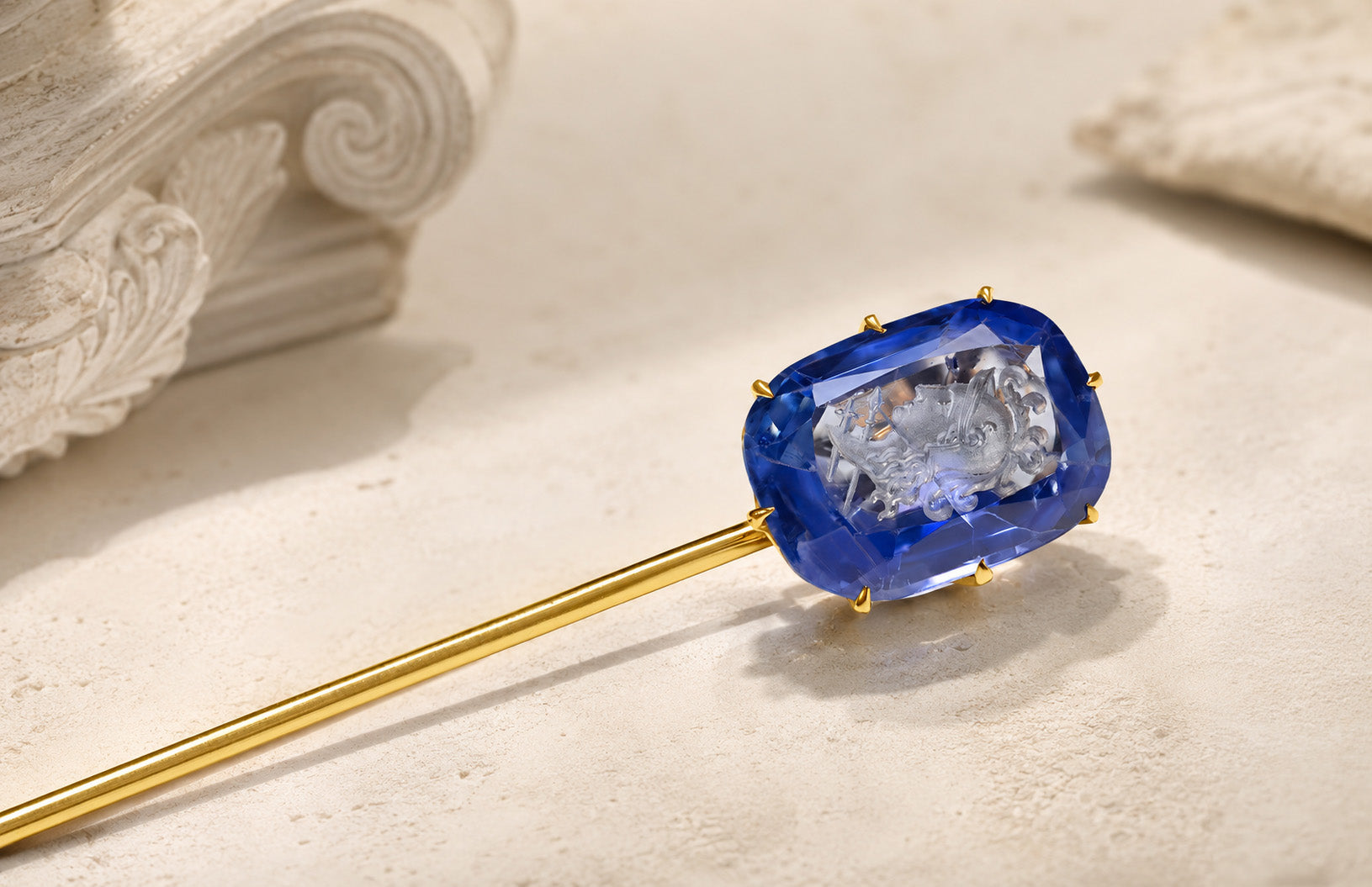
Long ago, wise men believed that the world was permeated by hidden forces and that certain figures—when engraved upon precious gems—could channel these powers for the safety and flourishing of humankind. Over the centuries, ancient physicians and mystics observed the stars and beasts, mapping the influences they believed shaped human destiny. From these observations, they created their sigilla: magical images inscribed with purpose and power.
The Figures of Fortune and Protection
As Charles William King explains in his book Antique Gems: Their Origin, Uses, and Value as Interpreters of Ancient History; and as Illustrative of Ancient Art: With Hints to Gem Collectors, among these enchanted carvings, each image possessed a distinct virtue:
A bearded man seated behind a plow, between two bulls, with a vulture upon his arm, a fox nearby, and four men resting upon his neck—such a gem, placed beneath one's pillow, was said to reveal dreams of hidden treasures and guide the dreamer to them. Water in which this stone had been steeped was believed to cure the diseases of cattle.
A warrior with sword and shield trampling a dragon, engraved on red jasper and worn around the neck, brought victory in battle—especially on Tuesdays.

Illustration from Charles William King, Antique Gems (1866). Public domain. Source: Internet Archive
A horse crowned by a crocodile, engraved on jacinth and set in gold, guaranteed triumph in lawsuits.
A man and woman with flowing hair, carved upon carnelian—he gazing upward, she with arms outstretched—ensured that all who came into contact with the stone would obey the bearer's will, particularly when terebinth and ambergris were placed beneath it.
Some gems promised prestige and renewal rather than power. A racing horse with a rider holding a scepter, engraved on hematite, conferred the ability to rule and regain lost favor, provided that gold and silver were set in equal measure.
Wonders of Myth and Legend
In more mystical traditions, certain marvels surpassed even these charms.
The rabbinical legend of the worm Samir tells how Moses engraved the names of the tribes of Israel upon the High Priest's breastplate using the creature's blood—a substance said to dissolve the hardest stone. Likewise, Solomon sought this wondrous agent to build the Temple from untouched rock.
Other symbols guarded travelers and ruled over spirits:
A man holding a hook above his head while standing over a crocodile, set in a lead ring with squill beneath, protected its wearer from thieves.
A warrior seated upon a dragon, carved into amethyst and mounted in iron or lead, granted mastery over spirits and revealed answers whispered in the darkness.
Birds, Beasts, and Forgotten Chimeras
Even birds carried enchantment.
An eagle engraved on ethica and set in lead brought good fortune to fishermen.
A hare engraved on jasper protected its bearer from the shades of demons.
A man bearing a palm, carved upon any stone, made its wearer pleasing to princes.
Yet, curiously, one group was omitted: the chimeras—monsters composed of a ram's head, the mask of Silenus, an elephant's trunk, a rabbit, a lizard, and a cornucopia. Though admired after the Classical Revival, these "Basilidan" gems were dismissed by medieval astrologers, their true power remaining veiled even to the most learned.
The Moral of the Magi
The ancient physicians and astrologers who prescribed these stones always included a safeguard: the talisman would work only if its wearer remained "in all honor and purity." Should it fail, the fault was attributed to the wearer's moral shortcomings, never to the inefficacy of the art itself.
Among modern peoples, this belief survives most vividly in Ireland. Certain smooth, rounded pebbles—kept upon chapel altars for centuries—are believed to cure ailments of cattle when dipped in water. Unlike the engraved gems of Italy, these Celtic stones are left uncarved; their virtue rests upon faith and antiquity.
Mystical Spheres and the Magic Wheel
Orpheus ascribed great power to engraved stones used in sacrificial rites, most likely as offerings to the gods of the Underworld. The famous "magic sphere" of Dr. John Dee, now preserved in the British Museum, is a notable example of such an instrument.
Two Roman spheres further support this tradition:
- A red jasper sphere, unpierced and engraved with arcane symbols.
- A green jasper sphere depicting Osiris and Isis, together with twelve intaglio busts of deities.
Ancient poets also referred to the Iynx, Rhombos, or "magic wheel," an instrument employed by witches in love enchantments. When spun in one direction, it was believed to kindle passion; when turned in the opposite direction, it was said to undo the spell. Horace alludes to this in his appeal to Canidia:
Retro potens, retro solve turbinem.
"Turn back thy mighty wheel; reverse the spell."
The Greek Anthology (Book V, 205) likewise describes a magical wheel associated with the sorceress Nico:
"That magic wheel which power to Nico gave
To draw the lover o’er the distant wave,
And from her couch, half willing, half afraid,
At dead of night to lure the trembling maid,
Cut in bright Amethyst by a skilful hand,
And nicely balanced on its golden stand,
Lies strung on twisted wool of purple sheen,
A grateful offering to the Cyprian queen:
Which erst the sorceress from Larissa brave,
A precious keepsake, for her hostess gave."
The Tongues of the Gods
The traveler Damis described four Iynxes hanging from the dome of the Parthian king's hall. Known as the "Tongues of the Gods," they served as reminders of Nemesis—symbols of humility meant to restrain pride. They most likely represented the Ferouers, the guardian spirits of Magian belief, akin to the Platonic "Ideas" conceived by Ormuzd before the creation of the world.
Νουσπερας ιλυγες παραρθεν νουσεν και αιται.

Illustration from Charles William King, Antique Gems (1866). Public domain. Source: Internet Archive
The Druids' Ovum Anguinum
Before leaving the subject of magical spheres, one must mention the legendary Ovum Anguinum—the Druids' "Serpent's Egg." Modern antiquarians have often applied this name to the large, variegated glass beads frequently unearthed in Britain. In truth, these are nothing more than decorative beads from Roman, British, or Saxon necklaces.
The authentic Ovum Anguinum, as described by Pliny, was something altogether different. He claimed to have personally seen one worn by a Druid as a badge of office. It was round, about the size of an apple, enclosed in a cartilaginous shell, and covered with small knobs resembling the suckers of a cuttlefish. Clearly a natural formation rather than a man-made ornament, it may well have been a fossil sea urchin (echinus).
According to Druidic legend, this mysterious object was born from the union of serpents:
“The mystic egg aloft in air;”
At a certain season, countless snakes gathered, twining themselves together until, from their foaming coils, this enchanted egg emerged. It had to be caught in a cloak before it touched the ground, for once it did, it lost its virtue. Whoever caught it was then pursued by the serpents until he could cross a running stream—his only hope of escape.
"Ah Tam, ah Tam, thou 'lt get thy fairing,
In hell they'll roast thee like a herring."
Possession of this wondrous egg was said to ensure victory in legal disputes. Pliny recounts the story of a Gallic knight who carried such an amulet into court, perhaps even before the Emperor Claudius himself, only to be executed for attempting to pervert justice through its supposed power.
It seems likely that the Ovum Anguinum was indeed some variety of fossil echinus, especially since one type of that shell is still known as the "Mermaid's Egg."

AI generated image
Though we must dismiss the notion that the large glass beads were sacred Druidic relics, they remain extraordinary examples of ancient craftsmanship. Many display vivid, swirling colors comparable to the finest Venetian glasswork of Murano. Others—perhaps finger rings—are thick bands of blue or green glass, decorated at regular intervals with small spiral beads resembling snail shells. Some are simple rings of bluish glass or vitrified clay. Wherever they are unearthed, local people invariably treasure them as charms of good fortune.
This Druidic talisman finds a striking parallel, both in name and in its supposed powers, in the "Ophite," or Serpent Stone, of the Asiatic Greeks, celebrated by Orpheus:
"To him had Phoebus giv’n the vocal stone,
Hight Sideritis, for true answer known;
The 'Living Ophite' some the wonder call,
Black, hard, and weighty, a portentous ball.
Around the stone, in many a mazy bend,
In wrinkles deep the furrowed lines extend.
For thrice seven days the mighty wizard held
The bath’s refreshment and his spouse’s bed;
For thrice seven days a solemn fast maintained;
No flesh of living thing his strength sustained.
Then in the living fount the gem he laves,
And in soft vestments like an infant swathes;
As to a god he sacrifices brings,
And potent spells in mystic murmurs sings.
Till, moved by offered prayer and mighty charms,
A living soul the prescient substance warms;
Then in his arms he bears the thing divine
Where kindled lamps in his pure mansion shine;
And as her infant so a mother holds,
So in his arms the talisman he holds.
And thou—when thou wouldst hear the mystic voice,
Thus do; and in the wondrous charm rejoice.
For, when thou long hast dandled it on high,
‘I will utter forth a faint and feeble cry,
Like to a suckling’s wail, when, roused from rest,
It seeks refreshment from the nurse’s breast.
But with courageous heart perform the rite
Lest thou the anger of the gods excite,
If from thy hand, unnerved by sudden fear,
Down to the ground thou dash the vocal sphere.
Be bold, and dare the oracle to teach
A true response 'twill yield to each request.
Then having bathed it hold it near thine eye,
And mark in wondrous mode its spirit fly.'
Through this the Trojan to the Atrida bold
The coming ruin of his race foretold."
Magic and Prophylactic Rings
The engraved Gnostic rings, covered with spells and divine names, recall the enchanted rings described by Clement of Alexandria. He quotes Aristotle, who wrote that "Execestus, tyrant of the Phocians, used to wear two enchanted rings. By clinking them together, he could divine the proper moment for his undertakings—though he was ultimately slain by assassination, despite the warning sound of his magic."
Lucian, in Philopseudes, tells of Eucrates, who remarked:
“Is Lon then the only person that has seen such things? Have not many others met with spirits—some by night, some by day? I, for my part, have seen them not once only, but thousands of times… ever since the Arabian gave me the ring made out of the iron nails got from crosses, and taught me the incantation of many names.”
This clearly refers to the Gnostic practice of engraving long sequences of Hebrew and Coptic names, each invoking the spirit of a planet or deity. Orpheus (verse 720) notes that the gods are best pleased when addressed by their secret names during sacrifices. Caylus describes a gold ring, probably belonging to a medieval French Manichaean, entirely covered with such Gnostic inscriptions.
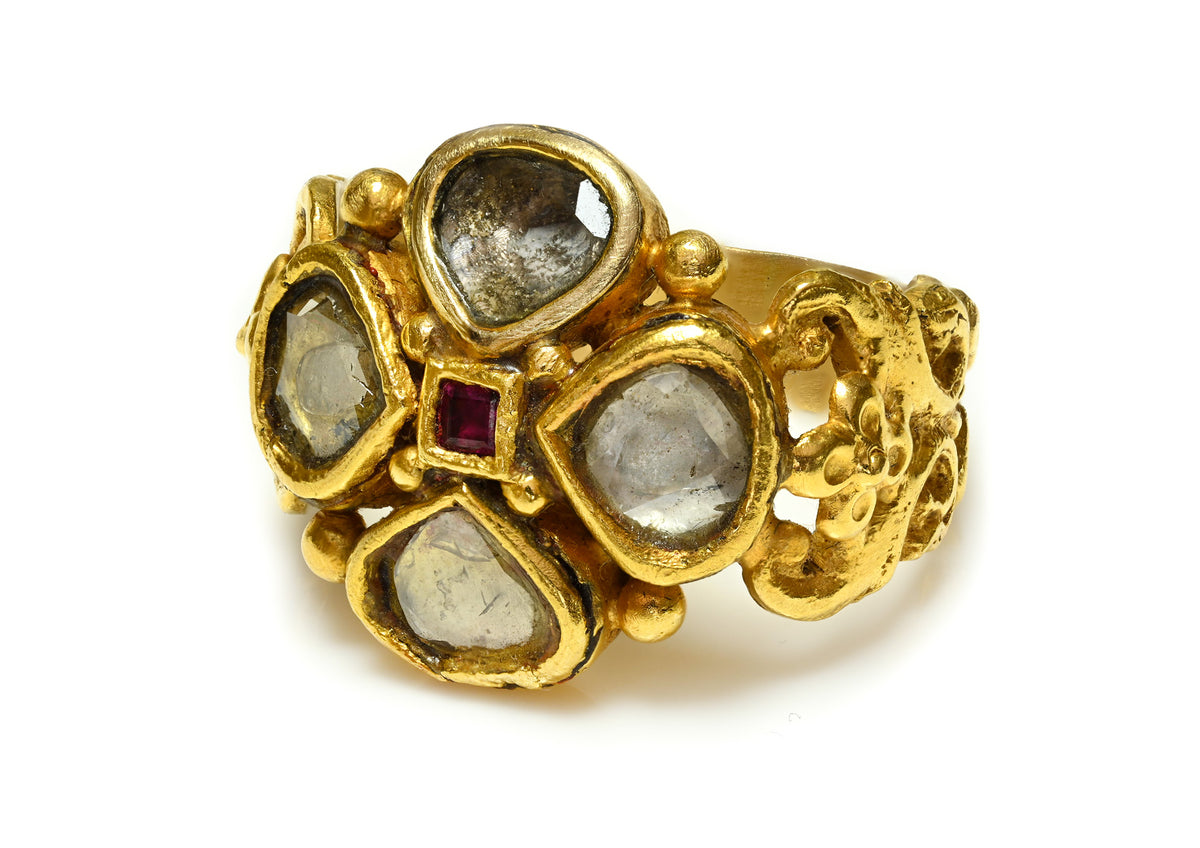
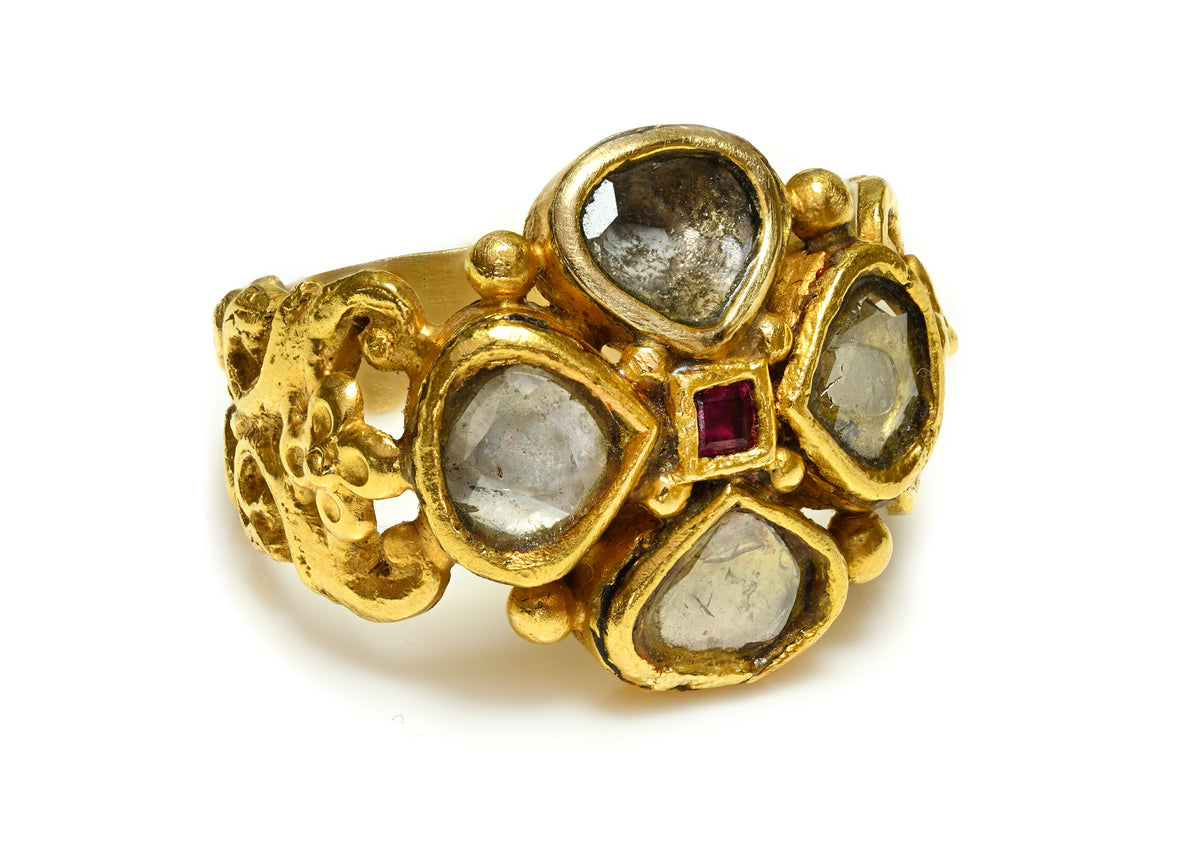
I have seen a similar ring myself—broad, of pure gold, and probably of Indian origin—engraved in delicate relief with the symbols of the Zodiac. Such a ring must once have served as the badge of a great astrologer. Another, dating from the Middle Ages, bears a large opal set in gold, surrounded by astrological figures and cabalistic formulas, among them adros madros.

AI generated image
Planetary and Healing Rings
During the Middle Ages, planetary rings became especially celebrated. Each was fashioned from the gem and metal associated with a particular planet and was believed to channel its celestial influence into the wearer.
According to the mystical science of the age, every planet possessed its own corresponding gem and metal, which, when properly united, were thought to bestow protection, wisdom, and favor from the celestial sphere to which they belonged.
These rings were crafted with meticulous care. The metal of the setting had to correspond to the planet's influence, while the engraved gem served as its living emblem. Thus, a ring dedicated to the Sun was made of gold and set with a ruby or chrysolite, engraved with a lion or the figure of Apollo. The Moon required silver and crystal or pearl, bearing the image of Diana or the crescent itself.
Venus demanded copper and an emerald or turquoise, marked with a dove or Cupid. Mars required iron and a bloodstone or jasper engraved with a warrior or spear. Jupiter's ring, fashioned from tin and set with sapphire, bore the image of a king or an eagle. Saturn's, made of lead and onyx, displayed a sickle or an aged man. Mercury's was formed from a quicksilver alloy, set with agate or opal, and inscribed with the caduceus.
Each combination had to be completed during the proper planetary hour and under the appropriate ascendant; otherwise, the charm was believed to fail. These rites, blending astrology with alchemy, gave rise to an entire art of talismanic metallurgy—an art at once feared and revered.
The old masters of astrology also assigned to each planet its own particular gem and metal, believing that, when properly united, they formed a conduit for celestial virtue. Accordingly, the planetary rings were composed as follows:
- Sun - Diamond or sapphire, set in gold.
- Moon - Crystal, mounted in silver.
- Mercury - Magnet, set in quicksilver (though how the liquid could be fixed, no one now can say).
- Venus - Amethyst, set in copper.
- Mars - Emerald, set in iron.
- Jupiter - Carnelian, set in tin.
- Saturn -Turquoise, set in lead.
Each of these rings was to be fashioned and consecrated during the hour when its ruling planet reigned supreme in the heavens, so that the stone might absorb the astral force of its celestial patron. The efficacy of such talismans, it was said, depended not merely upon their material construction, but also upon the purity and faith of the wearer.
Symbolism and the Astral Connection
The purpose of these planetary rings was not merely ornamental but profoundly spiritual. They were intended as vessels through which the divine harmony of the cosmos might manifest itself in the mortal realm. Medieval magi believed that all material things reflected celestial forces—that every stone, every metal, and every movement of the heavens possessed its sympathetic counterpart within the human soul.
Thus, to wear the ring of Jupiter was to seek prosperity, honor, and justice; to wear that of Venus was to invoke love, beauty, and grace; while Saturn's ring bestowed patience and foresight—but also melancholy, if worn without due reverence. The magus who fashioned such rings was regarded as a priest of natural law, translating the silent language of the stars into tangible form.
It was said that, when consecrated with the proper invocations and fumigations, these planetary rings could influence even the elements: winds would be calmed, fevers would subside, and distant hearts might be stirred to sympathy or repentance. The wearer became, in essence, an intermediary between earth and the heavens.
Rings as Guardians and Omens
The medieval physician and astrologer Paracelsus wrote at length on the virtues of metals and stones, asserting that each bore the "signature" of its ruling planet. To understand this hidden mark was to read nature's divine handwriting. Thus, to the learned, the planetary ring was not a mere superstition but a visible prayer—an act of harmony between human intention and the order of the cosmos.
Some rings were fashioned solely as prophylactic or protective charms. They were inscribed with the names of angels, saints, or the sacred syllables of ancient faiths, and were believed to repel disease, envy, and evil spirits. To lose such a ring was considered a dire omen; to find one, a sign of divine favor.
In certain regions of Europe, it was customary to bury these rings with their owners, that they might continue to afford protection in the life to come. Others were passed from master to disciple as tokens of initiation, imbued with generations of accumulated faith and ritual.
Among the most romantic forms of mystical jewelry were the Gimmel Rings, treasures often celebrated in early poetry as emblems of love and betrothal. Their name derives from the Old French jumelle, meaning "twin," for each consisted of two interlocking hoops of gold. The inner ring fitted neatly within the outer and was secured by a delicate rim, so that together the two appeared as one.
Each half bore an inscription—usually the name of one lover, or a line from an affectionate distich in Old French. The rings could be separated and worn apart, serving both as tokens of fidelity and as a means of recognition between lovers long separated. Such rings appear frequently in literature; indeed, the entire plot of Dryden's Don Sebastian turns upon one of these twin tokens:
“Those rings, when you were born and thought another’s,
Your parents glowing yet in sinful love
Bade me bespeak: a curious artist wrought them,
With joints so close as not to be perceived,
Yet are they both each other’s counterpart.
His part had Juan inscribed and hers had Zayda;
You know these names are theirs; and in the midst
A heart divided in two halves was placed.”
The Gimmel ring also recalls the posy ring so often mentioned by Shakespeare, who used its inscribed motto as a byword for sentiments grown commonplace through frequent repetition—yet one that remained, nevertheless, a powerful emblem of human affection.
Divination by Rings
“Now if the rivets of these rings inclosed
Fit not each other I have forged this lie,
But if they join you must for ever part.”
The long catalogue of mystical powers once attributed to gems and engraved sigils culminates in one of the strangest of all ancient practices: divination by rings, or dactyliomancy.
The art was widely practiced—or at least widely believed—in the later Roman Empire and throughout the Middle Ages.
A remarkable account survives in the confession of Hilarius and Patricius, who, under torture, were accused of attempting to divine the future and to raise to the imperial purple a certain Gaul named Theodorus during the reign of Emperor Valens (A.D. 371).
“We constructed, illustrious judges,” they declared, “this ill-omened little table which you see before you, out of twigs of bay-tree, under direful auspices, after the pattern of the Delphic tripod. After consecrating it with mystic verses and solemn ceremonies, we placed upon it a circular dish made from a blend of metals. Around the rim of this dish were engraved the twenty-four letters of the alphabet, equally spaced.
One of us, dressed in linen garments, with slippers to match and a fillet upon his brow, holding a branch of fruit-tree in his hand, stood over the tripod. The room had first been purified with Arabian incense, and the proper invocations had been spoken to propitiate the deity who reveals the future. Then, balancing above the tripod, he suspended a ring tied to a fine thread of Carpathian flax, the ring itself having been consecrated by enchantments.
This ring, when set in motion, began to vibrate rhythmically, striking against the letters that attracted it. By these motions it spelled out words—heroic verses, perfect in meter and form—such as the ancient oracles of Delphi once produced.
At last, as we inquired who should succeed the present emperor, the ring struck successively the letters Θ, Ε, and Ο, before pausing again. One of those present cried out that the destined ruler must be Theodorus, for so the syllables plainly declared. We ceased our questioning, fully convinced that the oracle had named its chosen man.”

Exhibit in the Bode-Museum with the image of emperor Valens, Berlin, Germany, Author Daderot, Source Wikimedia Commons
When asked whether they had foreseen their own fate through the same oracle, the accused recited ominous verses foretelling their doom:
“Not twinèd, O seer, thy blood shall flow,
Tisiphone prepares the fatal blow;
For thy fell judges, all on Mimas’ plain,
Alla Kar! by fire devouring slain.”
After these words had been spoken, both men were cruelly tortured and left for dead. The mysterious phrase "Alla Kar," according to some scholars, may have been of Slavonic origin—a language that appears frequently in Byzantine oracles—or perhaps a cipher, its letters forming a date according to the Greek numeral system.
In A.D. 378, the prophecy was believed to have been fulfilled. Emperor Valens, wounded by an arrow during battle against the Goths, sought refuge in a small cottage. Unable to force an entrance, the enemy piled straw around the building and set it ablaze, consuming Valens and all who were within.
This ancient art of dactyliomancy has, in modern times, dwindled into little more than a parlor amusement. A wedding ring or coin is tied to a thread and suspended above a glass tumbler while the hand is held motionless. Before long, the ring begins to swing gently, striking the glass at regular intervals, its taps said to correspond with the hours of the day. I have tried this experiment myself and have, at times, found its accuracy most extraordinary.
The Toad-Stone
A curious superstition endured throughout the Middle Ages—and lingered even into comparatively recent times—that:
“The toad, ugly and venomous,
Wears yet a precious jewel in his head.”
This marvelous jewel was known as the Toad-stone, or Bufonite, and was also called Borax, Nosa, or Crapondinus. According to the old naturalist Camillo Leonardo, it was found within the head of a freshly killed toad. He described two varieties: a superior white stone and a darker bluish kind bearing the mark of an eye. When swallowed, he maintained, it acted as a sovereign antidote against poison, cleansing the body as it passed through the bowels. Even when merely worn in a ring, the toad-stone was believed to protect its wearer against venom and disease.
The Christian philosopher Vossius likewise wrote that the Bufonites, or Toad-stone, was commonly taken in drink before meals as a safeguard against poisoning. It was further believed that, when mounted in an open ring and worn against the skin, it would grow warm—or even burn the wearer—if poison were brought near, just as Chinese porcelain was then thought to crack when a poisoned liquid was poured into it.

AI generated image
Erasmus, in his Peregrinatio Religionis Ergo, mentions a famous example of such a stone at the shrine of Our Lady of Walsingham:
“At the feet of the Virgin is a gem to which no name has yet been given amongst the Greeks or Romans, but the French have styled it after the toad, inasmuch as it represents the figure of a toad so exactly, that no art of man could do as well. And the wonder is so much the greater, that the stone is very small: the figure of the toad does not project from the surface, but shines through as if inclosed in the gem itself. And some, no mean authorities, add that this kind of gem being put into vinegar the toad will swim in it and move its legs.”
A few of these ancient toad-stones, still preserved in their original rings, survive to this day, though the "gems" appear to be little more than common black pebbles. Whether any stony substance is ever truly found within the body of a toad remains uncertain. Most likely, the entire legend arose from a misunderstanding of Pliny's account of the Batrachites—the "Frog-stone," brought from Coptos and so named because its color resembled that of the animal. Pliny distinguishes both ebony-black and reddish-black varieties.
Pliny himself says nothing of the stone being taken from a living creature, nor does he attribute to it any medicinal virtue. Yet the medieval imagination, ever eager to discover marvels in nature, transformed this passing reference into an entire mythology of "animal gems."
He also describes several other curious stones of the same kind: the Bronte, found in the head of a tortoise and said to extinguish fires caused by lightning; the Cinaedia, a transparent stone from a certain fish that became cloudy before a storm at sea, serving as a kind of natural barometer; the Chelonitis, a grass-green gem from the belly of a swallow, which, when mounted in iron, became a powerful magical charm; the Draconites, a brilliant white stone cut from the head of a living serpent, for it was believed to lose its radiance if removed after death—the Indians, Pliny tells us, stupefied their dragons with opiates before obtaining this prize; the Hyenia, taken from the eye of a hyena and believed to bestow the gift of prophecy when placed beneath the tongue; and finally the Saurites, obtained from the entrails of a green lizard dissected with a reed knife.
Orpheus himself praised two of these marvelous stones—the Scorpius and the Echites, or Viper-stone—as sovereign antidotes against venom.
Animal Stones and Serpent Gems
The fascination with stones derived from animals extended far beyond the toad. Natural philosophers and magicians alike attributed remarkable virtues to gems believed to originate within certain creatures, blending careful observation with allegory and tradition. Such stones were thought to retain the very essence of the animal from which they came, bestowing protection, foresight, or healing upon their possessor.
Orpheus, for example, mentions two stones of particular renown: the Scorpius and the Echites, also known as the Viper-stone. Both were celebrated for their power to counteract venom and were regarded as indispensable in both magical and medicinal practice. The Echites, in particular, was believed to neutralize the effects of any poisonous bite, whether inflicted by serpent, insect, or tainted food.
Many of these animal stones were never cut or polished, being left in their natural state lest their innate virtue be diminished. Some were mounted in rings, amulets, or pendants; others were carried loose, wrapped in cloth or concealed within small pouches. Their rarity and mysterious origin only heightened their reputation, and the search for such stones became one of the more secret branches of natural magic.
The Legends and Practices of Serpent-Stones
Serpent-stones occupied a place of special honor in magical tradition. The Druids' legendary Ovum Anguinum—the Serpent's Egg—may well be regarded as the symbolic forerunner of the Viper-stone and other ophidian gems. As previously described, these eggs were believed to come into being when innumerable serpents entwined themselves together, producing a mystical object endowed with supernatural virtue. To capture such an egg required courage, cunning, and swift action, for the serpents were said to pursue the finder relentlessly until he crossed running water, the only sure means of escape.
Orphic and Greco-Roman writers alike celebrated the serpent-stone in verse:
"To him had Phoebus giv’n the vocal stone,
Hight Sideritis, for true answer known;
The 'Living Ophite' some the wonder call,
Black, hard, and weighty, a portentous ball.
Around the stone, in many a mazy bend,
In wrinkles deep the furrowed lines extend."
These stones were prized not only as safeguards against poison but also as instruments of divination and prophecy. According to the traditions surrounding the Trojan magicians, elaborate rites of fasting, purification, and nightly vigil preceded their use. The stone was bathed in consecrated water, wrapped as an infant might be swaddled, and only then was it believed capable of revealing its hidden voice. Held to the ear, it was said to utter faint cries resembling those of a child seeking its nurse, thereby imparting guidance and prophetic counsel to the patient inquirer.
Medicinal and Magical Applications
The virtues attributed to animal stones were believed to be more than merely symbolic. Toad-stones, Viper-stones, and similar marvels were thought to exercise a direct influence upon the human body. They were prescribed as antidotes to poison, remedies for fevers and colic, and talismans promoting general health and well-being. Medieval and Renaissance writers frequently recommend that such stones be worn in rings or amulets over the heart or upon the hand, where their influence was believed to act most effectively.
Some natural philosophers even experimented with these stones in the earliest forms of pharmacology. They were immersed in water, wine, or oils, and in certain instances were ground into powders or infused into medicinal preparations. Although modern science has found no inherent medicinal properties in these objects, their long history illustrates the remarkable union of faith, ritual, and empirical observation that characterized the medieval search for health, protection, and hidden knowledge
Symbolism and Alchemy
Beyond their practical applications, animal and serpent-stones were invested with rich allegorical meaning. They symbolized vigilance, transformation, and the hidden powers of nature. The serpent, casting its skin, represented renewal; the toad, emerging from murky waters, embodied concealed wisdom; and the lizard, swift and elusive, suggested cunning and foresight.
In alchemical philosophy, these stones were sometimes regarded as condensed manifestations of the vital force itself. By combining the proper materials, performing the prescribed rites, and observing the appointed courses of the planets, the practitioner sought to command not merely the material properties of the stone, but also the unseen virtues believed to reside within it. Thus, art, ritual, natural philosophy, and the earliest forms of science were united in a single pursuit of hidden knowledge and power