The Great Diamonds of the World - Tales Carved in Light
Across centuries and continents, certain gems have captured more than glittering light—they have seized the imagination of empires, toppled kings, sparked rumors of sorcery, and vanished into the folds of history, only to resurface with new names and new legends.
Their journeys are woven through coronations and conquests, through battlefield dust and palace intrigue. Each stone holds not just brilliance, but a story: a fragment of human ambition, triumph, greed, and wonder.
We invite you to discover the stories of some of the most extraordinary jewels ever known—the Darya-i-Nûr, the enigmatic Turkish diamonds, and the storied Austrian Yellow. These are not mere objects; they are characters in their own right, drifting from hand to hand as history twists around them.
The text you are about to read is inspired by and based on the historical accounts found in The Great Diamonds of the World: Their History and Romance by Edwin William Streeter and Joseph Hatten—a work that itself blends meticulous research with the irresistible allure of legend.
What follows is a reimagining of those accounts, bringing forward the drama, the mystery, and the shimmering enchantment of each gem’s long and dangerous voyage through time. These stories invite you to step into courts and treasuries, to walk beside warriors and emperors, and to witness how a single stone can shape a destiny.
Prepare to enter a world where diamonds are never merely jewels—they are witnesses to history and keepers of secrets.
DARYA-I-NÛR
Delhi, famed as a city overflowing with jewels and treasures, had long been a tempting prize for ambitious conquerors. When Mohammed Shah ascended the throne, he inherited the wealth extracted by earlier rulers from the defeated kings of Golconda and Beejapoar. The splendor of Delhi—its palaces, shrines, and noble residences adorned with gems of extraordinary size and brilliance—made it a beacon for any daring warrior willing to descend the Suleiman Range, cross the Indus, and march upon the richest capital of the East.

Portrait of Muhammad Shah holding an emerald and the mouthpiece of a huqqa ca. 1730 The San Diego Museum of Art, Source: San Diego Museum of Art via Wikimedia Commons
Among those drawn to its wealth was Nadir Shah, once a lowly sheepskin dealer who had risen to command Persia. Without warning, he descended upon Delhi, plundering its palaces and devastating its streets. His soldiers left the city choked with the bodies of its defenders, while he carried away the accumulated riches of generations. Nothing escaped his grasp: the famed Peacock Throne, the jewels of the populace, even the stores of common laborers were swept into his vast plunder. Among the treasures taken were the celebrated “Koh-i-Nûr” and the “Darya-i-Nûr,” transported in great wagonloads to Khorassan. There, clothed in the spoils of his conquest, Nadir Shah unknowingly set the stage for his own downfall and the eventual destruction of his dynasty.

The Daria-i Noor ('Sea of Light') diamond from the collection of the Iranian National Jewels at the Central Bank of Iran, via Wikimedia Commons
Despite the carnage from which it emerged, the “Darya-i-Nûr” remained as pure and beautiful as when it was first cut. It is likely the finest of the Shah of Persia’s diamonds, and certainly the largest. A stone of exceptional clarity and nearly unrivaled brilliance, it has long borne the proud Persian title “Sea (or River) of Light.”
The gem is rose-cut and weighs 186 carats—the same original weight attributed to the “Koh-i-Nûr” before its recutting in London. If the story were true that Aurung-zeb once set the “Koh-i-Nûr” and another diamond of similar size into the eyes of the peacock on his throne, the “Darya-i-Nûr” might well have been its companion. What is certain is that this diamond was among the jewels seized by Nadir Shah during his plunder of Delhi in 1739.
Though not directly connected with the “Koh-i-Nûr,” the “Darya-i-Nûr” is today linked with another magnificent Persian jewel, the “Taj-e-Mah.” Both stones, according to Sir John Malcolm, appear together in a pair of splendid bracelets valued collectively at no less than one million pounds sterling (approximately $150 million in today’s U.S. dollars).
Some writers have proposed that the “Darya-i-Nûr” may in fact be the long-lost “Great Mogul,” a diamond last recorded by Tavernier in Aurung-zeb’s treasury in 1665. Barbot, among others, suggested that Nadir Shah—known formally as Thamask Kouli-Khan—might have captured the gem, and that it later became known in Persia as the “Darya-i-Nûr,” or “Ocean of Light.”
But this identification is unlikely. The “Great Mogul,” reduced by the cutter Borgio to 279½ carats, differs greatly from the “Darya-i-Nûr,” which weighs only 186 carats. Their shapes also diverge significantly: the former resembled a halved egg, while the latter is a relatively flat oval. Moreover, the “Darya-i-Nûr” is mounted in a bracelet—an impractical setting for the massive “Great Mogul.” Whatever its origin, the Persian diamond cannot reasonably be equated with that legendary Indian stone.
The later history of the “Darya-i-Nûr,” after it passed from Nadir Shah to his son Shah Rukh, is described in the chapter devoted to the “Taj-e-Mah.”
THE TURKEY I AND II
Among the treasures of the Turkish Regalia lie two mysterious diamonds—large, impressive stones whose past is almost entirely lost to time. One weighs 147 carats, the other 84. No tales of royal mines or ancient merchants accompany them; instead, the only story told of the larger diamond is that a boy once found it lying in the sands. It is the sort of explanation that reveals nothing, a scrap of folklore rather than true history.
Determined to learn more, we reached out to contacts in the East, hoping that someone might uncover even a fragment of their origin or some account of their present condition. One such ally, a man in official service, agreed to investigate. From Galata, on July 19, 1881, he wrote with cautious optimism.
He explained that the holy month of Ramadan was about to begin, and that nothing in Turkey could be accomplished until after the festivities of Bairam—five weeks hence. After that, he promised to apply for a firman through the Embassy, a special permission that might allow him to examine the jewels. He even hoped to gather drawings and legends connected to them, should any still exist.

Kaşıkcı Elması, Topkapı Sarayı, İstanbul 2023, Author Karakalem via Wikimedia Commons
But his letter carried a darker note as well: in recent years, he warned, vast robberies had plagued the empire. It was entirely possible that the diamonds had vanished. He recounted, almost as a tale of intrigue, how, when Sultan Abdul Aziz was dethroned and Murad took his place, the new ruler settled a debt of £500,000 (approximately $115 million in today's U.S. dollars) to his banker, Christaki Effendi—not in coin, but in diamonds. According to rumor, the jewels handed over were worth far more than the debt itself—perhaps £800,000 (approximately $185 million in today's U.S. dollars). Effendi then traveled to Paris and sold them; and when Murad was himself dethroned, the banker never bothered to return or account for what he had taken.
“It is very likely,” our correspondent concluded, “that the stones you seek have simply disappeared.”
Still, he promised not to abandon the search.
Months passed. Then, from Constantinople came a second letter - its tone weary, resigned.
He understood our surprise at his long silence, he wrote, but no progress had been made. He had spoken to influential men, approached every possible source, and yet learned nothing new. Money was not the obstacle. The real barrier was fear - fear born of the tightening grip of terror within the palace. No one dared ask questions about the crown jewels, or even hint that such questions might be asked.
And so the trail ended - not in revelation, but in silence.
Perhaps someday, when the turmoil that shadows the Porte has lifted, the true stories of these two Turkish diamonds will emerge from obscurity. For now, they remain phantoms of the regalia - seen, acknowledged, but largely unknown, their histories swallowed by the uneasy years through which they have passed.
THE AUSTRIAN YELLOW - A Story Told in Diamonds
The gem now known as the Austrian Yellow has lived many lives and borne many names—the Tuscan, the Florentine, the Austrian. Its history drifts through palaces and battlefields, through myths, mistakes, and miracles. For centuries, scholars have argued over its identity, yet its golden glow continues to draw the curious, just as it once captivated the wandering eyes of the great traveler Tavernier. He saw the gem “more than once” in the treasury of the Grand Duke of Tuscany, describing it as a 139½-carat marvel, faceted on all sides and shimmering with a rare citron tint.
Though it was the largest diamond in Europe in his time, its warm yellow color made it less fashionable than the colorless stones that drew the highest admiration. Still, Tavernier calculated its worth at over two and a half million livres—a fortune even for a king.
In more recent centuries, the diamond found a home in the House of Austria, its presence officially recorded in the catalog of the Imperial and Royal Treasury. There it was listed as the Florentine, one of the largest diamonds in the world, cut into nine faceted planes radiating in a star of nine rays and—almost unbelievably—mounted not in a crown or scepter, but in a hat button.
But like every gem that has survived great empires, it carries not just history, but legend.
One story tells that this diamond once belonged to Charles the Bold, the fiery Duke of Burgundy. Following the customs of the time, Charles carried his most precious jewels into battle, believing in their supposed powers and wishing always to see them glittering near at hand. On the bloody field of Morat in 1476, Charles lost everything—his troops, his treasures, and, according to tradition, the great yellow gem.
It is said that a peasant found it lying in the dirt, mistaken at first for a piece of colored glass. He sold it for a single florin.
From that humble exchange, the stone began a wandering life. Bartholomew May of Berne purchased it, passing it to Genoese merchants, who then sold it to Ludovico Sforza of Milan. Through the influence of the powerful Fugger family, it eventually entered the Medici treasury in Florence. And when Francis Stephen of Lorraine traded his duchy for Tuscany, he inherited the diamond. Through his marriage to Maria Theresa, the gem crossed into Austrian hands—where it dazzled upon the crown of Francis Stephen when he became Emperor of Germany in 1745.
It is a magnificent story, rich with twists and royal intrigue.
But is it true?
Sadly, the official account is more fantasy than fact.
For one thing, a diamond of the size described could not have been worn in a ring, as some versions claim. Contemporary chronicles indicate that Charles the Bold lost his greatest jewels not at Morat, but earlier, at the Battle of Granson. And the descriptions left by those who actually saw Charles’s diamond tell of a very different stone: a pyramidal jewel carved into a four-rayed star—nothing like the nine-rayed Florentine.
Even more puzzling is the testimony of J. J. Fugger, whose detailed manuscripts describe a diamond purchased from the Bernese government - not by Bartholomew May, but by Fugger’s own grand-uncle, Jacob. This diamond, according to Fugger, became the centerpiece of a magnificent pendant of diamonds, rubies, and pearls. Henry VIII of England bought the pendant in 1547, and from there it passed into the English regalia before Queen Mary gifted it to Philip II of Spain. In Fugger’s telling, the diamond returned- after seventy-six years - to the descendant of Charles the Bold from whom it had originally been lost.
But this stone, too, was not the Florentine. Its shape, its cut, its story—none match the glowing yellow gem now associated with Austria.
In truth, the Florentine’s real journey began not in Burgundy or Bern, but in the East. Its cut- faceted on all sides in the Indian manner—reveals its origin far more clearly than any legend. It most likely traveled directly to Italy long before the Fuggers or Sforzas laid hands on it. Over time, storytellers tangled its identity with that of other famous diamonds, blending fact with fable until history could no longer separate the two.

The confusion went so far that some mistook the Florentine for the Sancy, though the two stones differ entirely in weight, color, and character. Others called it the “Maximilian Diamond,” though it did not enter Austrian possession until Maria Theresa’s reign. The truth is far simpler: the gem came into the Austrian treasury not through ancient inheritance, but through political marriage.
According to Fugger’s own account, among the jewels dismantled from the magnificent Cap of Maintenance were several large diamonds. One of these- reset for Maximilian II - may well have been the stone that later came to be known as the Austrian Yellow. It crossed the Alps long before Maria Theresa’s time, though she would be the one to bring it permanently into the wealth of Austria through her marriage to Francis Stephen in 1736.
As for its worth? The estimates vary wildly, from £40,000 (approximately $8.5 million in today’s U.S. dollars) to as high as £155,000 (approximately $33 million in today’s U.S. dollars). Even the highest valuation might not be excessive—were it not for its unusual citron hue, which has always kept it slightly apart from the most coveted stones of Europe.
Yet perhaps that tint is part of its magic.
For in its soft yellow glow lies the shimmer of half a dozen kingdoms, the shadows of battles long past, and the whispered confusion of centuries of storytellers—each certain they had grasped the truth of a gem that has always, somehow, slipped just out of reach.
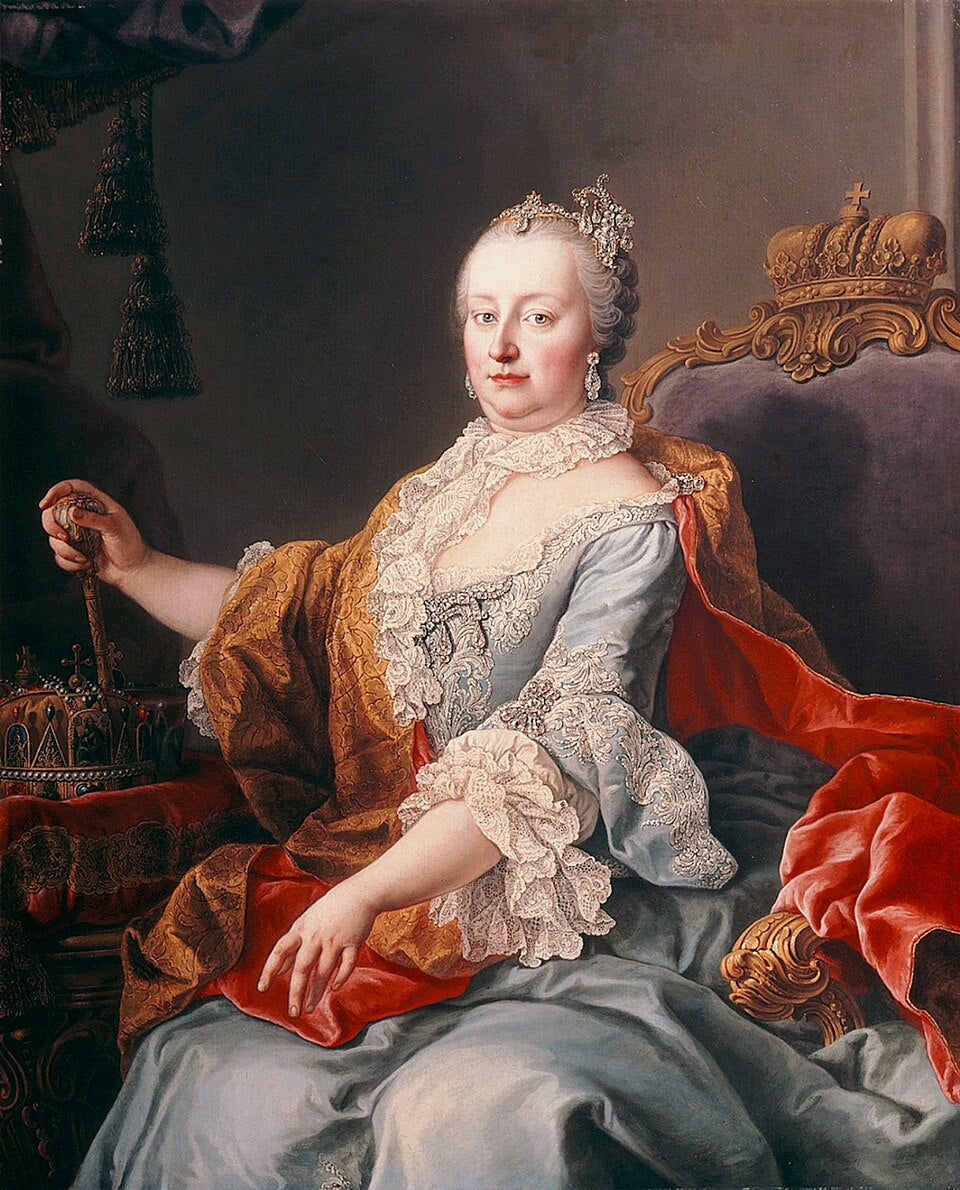
Cover Photo: Portrait of Maria Theresa by Martin van Meytens - Buchscan, Academy of Fine Arts Vienna, https://commons.wikimedia.org/w/index.php?curid=68471