The Great Sancy Diamond: The Mysterious “Sphinx” of Diamonds
A Jewel Wrapped in Mystery
Among all the legendary diamonds that have passed through the hands of kings, queens, courtiers, and adventurers, few possess a history as tangled, dramatic, and elusive as the Great Sancy. But the “Sancy” seems to be wrapped in a dense cloud of mystery, defying the most subtle analysis and remaining impenetrable to the attacks of the keenest processes of reasoning.
Other gems may boast greater size or more modern fame, but the Sancy surpasses them in intrigue. Its story stretches across centuries, across continents, and across the volatile lives of monarchs and empires. At every stage of its existence, the Sancy appears and disappears like a riddle—glittering briefly in the light of history before vanishing once more into shadow.
The difficulty of tracing the Sancy’s past lies not merely in the scarcity of records, but in the abundance of false ones. Legends, misunderstandings, deliberate fabrications, and political agendas have obscured its true course. Yet, when these layers are carefully stripped away, a coherent narrative begins to emerge—one that is no less dramatic for being true.
Breaking with Myth: Not a Burgundian Relic
As shown in The Great Diamonds of the World: Their History and Romance by Edwin William Streeter and Joseph Hatten, for generations, it was commonly asserted that the Sancy was among the great diamonds lost by Charles the Bold, Duke of Burgundy, after his defeat at Nancy or Granson. This belief entangled the Sancy’s supposed history with that of other Burgundian jewels, particularly the Florentine Diamond. The romance of medieval warfare and lost treasure made the claim attractive—but it was wrong.

Portrait of Charles the Bold, Duke of Burgundy, source www.museodelprado.es via Wikimedia Commons
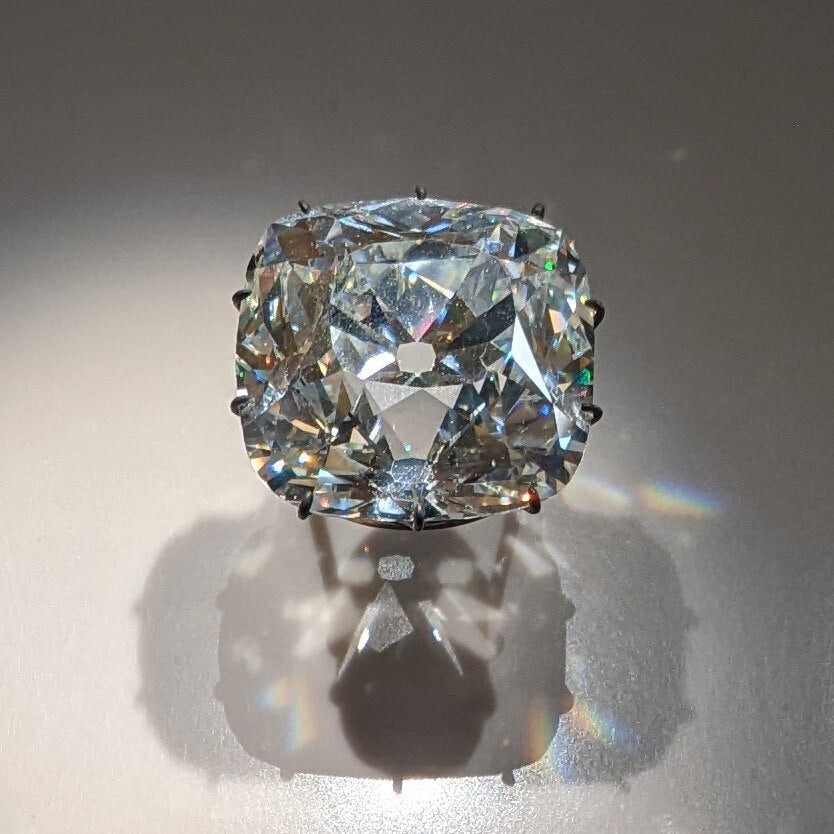
Once the Sancy is separated from the Burgundian legend, its true origins become clearer. Unlike European-cut stones of the fifteenth century, the Sancy bears the unmistakable characteristics of Indian craftsmanship. Almond-shaped and faceted on both sides, it belongs to a style unknown in Europe at the time. This alone is sufficient to prove that it could not have been cut or owned by Charles the Bold, nor shaped by Louis de Berquem, the great pioneer of European diamond cutting.
The Sancy’s story does not begin on a battlefield in Burgundy. It begins in the East.
An Indian Origin and a French Collector
The first verifiable owner of the Sancy was Nicholas Harlai, Seigneur de Sancy, a French nobleman and diplomat of the late sixteenth century. Serving as ambassador to the Ottoman court, Harlai was well positioned to acquire rare gems arriving from India through Constantinople. Around 1570, he purchased a remarkable diamond there—one that would later bear his name.
Harlai was no casual collector. His dealings reveal a man deeply involved in the world of precious stones, using them not only as objects of beauty but also as instruments of finance and power. In 1589, he accepted another large diamond from Don Antonio, the Portuguese pretender, as security for a massive loan that was never repaid. The Sancy, like its owner, moved easily between diplomacy, finance, and intrigue.
Diamonds and Desperation: Henry III of France
The Sancy’s first brush with scandal came through King Henry III of France, during one of the most turbulent periods of French history. The formation of the Catholic Holy League in 1576 plunged the kingdom into chaos. The king, threatened politically and personally, withdrew from the responsibilities of rule and abandoned himself to extravagance and excess.
Contemporary chroniclers describe Henry III as bald, vain, and obsessed with his appearance. To conceal his deformity, he wore a jeweled cap or turban—adorned, it was said, with an enormous diamond. That diamond, according to many accounts, was the Sancy.

Portrait of Henri III of France, Source https://philipmould.com/gallery/edit/henry-III-nicholas-hilliard-burlington-feb-2019, via Wikimedia Commons
Officially, Henry claimed that he intended to pawn the stone in order to raise funds for Swiss mercenaries. In practice, the jewel never left his possession. While Paris bled and factions battled for control of the realm, the Sancy glittered on the king’s head as he indulged in spectacle and decadence. It became, symbolically, a gem shining amid moral and political decay.
A Faithful Servant and a Grisly Journey
After Henry III’s assassination, the Sancy returned to its owner—only to be thrust into peril once again under Henry IV of Navarre. The new king, struggling to consolidate power, needed funds to secure Swiss troops. Once more, the diamond was entrusted to a messenger, intended as collateral.
This time, fate intervened. The courier was ambushed and murdered. Weeks passed, and the diamond seemed lost forever. But Harlai, trusting in the ingenuity of his servant, searched for the body. When it was found and examined, the truth emerged: the loyal valet had swallowed the diamond to prevent its capture by thieves.
The image is unforgettable—one of the most striking episodes in the history of any jewel. The Sancy, literally hidden within the body of a faithful servant, passed through death to return to its owner. Fact or embellishment, the story captured imaginations for centuries and reinforced the gem’s reputation as both cursed and protected.
Crossing the Channel: England and the Crown
From France, the Sancy traveled to England. Nicholas Harlai, serving as ambassador to Queen Elizabeth I, eventually sold the diamond to the English Crown. Documentary evidence confirms its presence among the royal jewels around the turn of the seventeenth century.

Portrait of Queen Elizabeth I, Scanned from the book The National Portrait Gallery History of the Kings and Queens of England by David Williamson, via Wikimedia Commons
In 1605, an inventory of the jewels in the Tower of London lists a magnificent ornament known as the “Mirror of Great Britain.” Among its components is a diamond described as “cut in fawcettes, bought of Sauncey.” This description precisely matches the Sancy’s distinctive cut and confirms its identity beyond doubt.
This single line in a royal inventory resolves centuries of confusion. It proves that the Sancy never vanished in Burgundy, never passed mysteriously through imaginary descendants, and never strayed from its original owner until its sale to the English Crown.
Queens and Exile: Henrietta Maria
The Sancy remained within the English royal family well into the seventeenth century. During the upheavals of the English Civil War, it came into the possession of Queen Henrietta Maria, wife of Charles I. Forced into exile, the queen used her jewels as political and financial instruments, rewarding loyalty and securing support.

Portrait of Queen Henrietta Maria by Anthony van Dyck, Source Art UK, via Wikimedia Commons
In a remarkable letter written from exile, Henrietta Maria records gifting a necklace containing rubies, pearls, and two large diamonds—explicitly naming the “Sanci.” This act places the diamond firmly within the royal household and demonstrates how jewels served as currency in times of political desperation.
Eventually, the Sancy passed to James II, either by gift or purchase. When his fortunes declined, the diamond was sold to Louis XIV of France, returning it to the country from which it had once departed.
The Sun King and Revolutionary Chaos
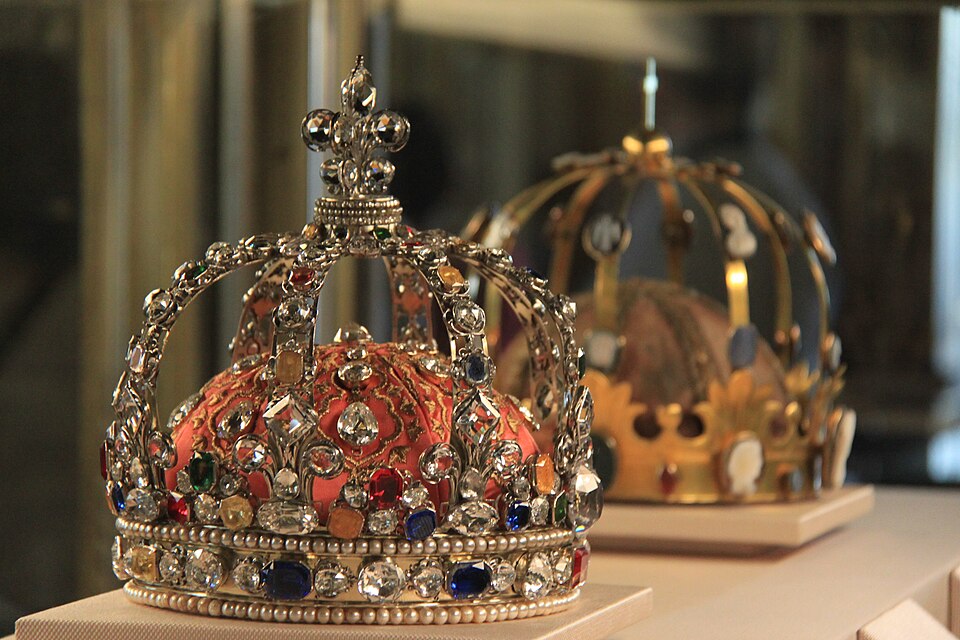
Under Louis XIV, the Sancy regained prominence as part of the French Crown Jewels. It passed to Louis XV, who famously wore it as an ornament at his coronation. By 1791, official inventories valued the diamond at an extraordinary sum, reflecting both its beauty and its historical prestige.

Portrait of Louis XV by Jacint Rigau-Ros i Serra, Source Wikimedia Commons
Then came the French Revolution. In the chaos of 1792, the Garde-Meuble was robbed, and many of France’s greatest jewels vanished. The Sancy disappeared once more, joining the Blue Diamond and other treasures lost to the upheaval of the age.
For decades, rumors abounded. Some claimed that it had been smuggled abroad by royalist agents. Others suggested that it had fallen into foreign hands or been secretly retained by the Bourbons. None of these stories could be proven.
Lawsuits, Merchants, and Modernity
By the early nineteenth century, the Sancy resurfaced in the possession of the Demidoff family, having been acquired not through royal intrigue but through commercial channels. Its ownership soon became the subject of a famous legal dispute when a Swiss industrialist challenged its value after agreeing to purchase it.
The resulting lawsuit became a cause célèbre, exposing the diamond’s reduced weight after recutting and reigniting debate over its identity. Ultimately, the courts ruled in favor of the seller, affirming the Sancy’s authenticity and restoring it to its owner.
The diamond continued its travels, appearing in exhibitions and private collections. In 1865, it was sold to Sir Jamsetjee Jeejeebhoy of Bombay, returning—symbolically, at least—to the East from which it had originated.
A Final Return to the Market
Even in the nineteenth century, the Sancy refused to settle into obscurity. It appeared again in Paris, displayed behind glass, its price soaring and its legend growing ever more elaborate. Writers compared it to the Koh-i-Nur, the only jewel whose history rivaled its own in confusion and contradiction.
Eventually, it passed into the hands of the Maharajah of Patiala, who wore it as a pendant. Yet fate intervened once more. Upon the Maharajah’s sudden death, the diamond returned to the market—its long journey still unfinished.
The Sancy as a Political Instrument
Beyond its aesthetic and monetary value, the Great Sancy functioned repeatedly as a political instrument—an object through which power could be borrowed, displayed, or symbolically asserted. In early modern Europe, where standing armies were costly and state treasuries were often depleted, jewels were not mere adornments but liquid assets of the highest order. A diamond like the Sancy could raise regiments, secure alliances, or finance wars. It was portable sovereignty.
This explains why the Sancy appears so often at moments of crisis. It surfaces when kings are desperate, when legitimacy is contested, and when survival depends on immediate capital. Unlike crowns or scepters, which were bound to ceremonial roles, the Sancy moved freely between public and private hands. It crossed borders, changed owners, and slipped quietly into transactions that altered the course of history. Its brilliance masked its function as a silent negotiator between power and necessity.
The Psychology of Possession
Equally fascinating is the psychological grip the Sancy exerted on those who possessed it. Monarchs did not merely own the diamond; they performed with it. Henry III wore it conspicuously, not as a symbol of stability but as a defiant assertion of personal magnificence amid political decay. Louis XV transformed it into a theatrical emblem of divine kingship at his coronation. The Maharajah of Patiala wore it to signal imperial continuity and cosmopolitan prestige.
In each case, the diamond amplified identity. It absorbed meaning from its wearer and reflected it outward. This dynamic helps explain why so many embellished stories clung to the Sancy. To possess it was to inherit not just a gem, but a mythology—one that owners eagerly reinforced, even at the cost of historical truth.
A Jewel That Resists Finality
What distinguishes the Sancy from other historic diamonds is its refusal to settle into a final narrative. Many great jewels reach a point of institutional rest: locked into museum cases, embedded in regalia, or stabilized within national collections. The Sancy resists this fate. It continually re-enters circulation, reappearing at auctions, exhibitions, or private negotiations.
This instability is not accidental. The Sancy’s relatively moderate size—compared to colossal stones like the Koh-i-Nur—made it uniquely mobile. It could be worn discreetly or displayed dramatically. It could be hidden, swallowed, pawned, or smuggled. Its very design, faceted on both sides, suggests motion rather than permanence. It was a diamond made to travel.
Truth, Embellishment, and Historical Desire
The contradictory accounts surrounding the Sancy reveal as much about human desire as they do about the jewel itself. Writers, collectors, and historians repeatedly attempted to enhance its allure by extending its lineage deeper into the medieval past or by associating it with legendary figures. These inventions were not always malicious; they were often expressions of reverence. A jewel so beautiful seemed to demand a history equally grand.
Yet, paradoxically, the real history of the Sancy—once disentangled from fiction—is more compelling than the myths. The image of a servant swallowing the stone to protect it, of queens in exile trading diamonds for loyalty, and of revolutions scattering crown jewels across Europe—these are not fantasies. They are the lived realities of a world where objects could carry lives within them.
Cover image: Crown of king Louis XV of France, Source Louvre Museum, Photographer Cristian Bortes, Source Wikimedia Commons