How to Identify Chanel Accessories: Hallmarks, Serial Numbers & Authentication Guide
Chanel accessories are instantly recognizable, but not always easy to identify correctly. A pair of vintage Chanel earrings, a gilt brooch, a pearl sautoir, a quilted handbag, a chain belt, a wallet, a pair of sunglasses, or a watch may all carry different types of marks, signatures, serial numbers, stamps, plaques, or construction clues. Some pieces are clearly signed. Others require a closer look at the materials, hardware, proportions, stitching, clasp, engraving, font, and the period in which they were made.
This is why identifying Chanel accessories is not simply a matter of finding the interlocking CC logo. The logo is important, but it is only one part of a much larger authentication story. Chanel hallmarks and signature marks can help date a piece, but they must be read together with the object itself. A genuine Chanel accessory should feel consistent in quality, design, weight, finish, and execution. When one detail looks correct but the rest of the piece feels wrong, collectors should be cautious.

Chanel jewelry is especially interesting because the house helped change the way fashion understood costume jewelry. Gabrielle Chanel did not treat faux pearls, gilt chains, poured glass, or dramatic brooches as inferior substitutes for fine jewelry. She used them as powerful design elements.
The Metropolitan Museum of Art notes that one of Chanel’s enduring legacies was her elevation of costume jewelry to high fashion, including her important collaboration with Maison Gripoix, the historic French workshop known for its pâte de verre glass technique.

This makes Chanel jewelry authentication very different from the authentication of traditional gold or diamond jewelry. Many collectible Chanel pieces were intentionally made with imitation pearls, glass, rhinestones, gilt metal, enamel, resin, or other non‑precious materials. Their value often comes from design, rarity, period, condition, workmanship, and their connection to the Chanel aesthetic—not from metal purity alone.
At the same time, Chanel also has a serious history in fine and high jewelry. In 1932, Gabrielle Chanel created the famous Bijoux de Diamants collection, a landmark moment in the history of high jewelry.
Chanel’s official high jewelry archive presents this collection as a defining expression of diamonds, celestial motifs, freedom, and modern design. Chanel Understanding this difference between Chanel costume jewelry, fine jewelry, high jewelry, and fashion accessories is essential before examining any mark or stamp.

Handbags and leather goods follow another identification system. Vintage and pre‑owned Chanel bags may include serial stickers, authenticity cards, interior stamps, specific hardware engravings, quilting patterns, chain straps, zipper pulls, and lining details. Newer Chanel handbags, from around 2021 onward, have moved away from the older sticker‑and‑card system toward metal plates with microchip technology, which changed the way modern Chanel bags are documented and authenticated.
Because Chanel accessories cover so many categories, this guide is organized as a practical reference for collectors. We will begin with Chanel jewelry hallmarks and signature plaques, then move into handbags, serial numbers, authenticity cards, microchip plates, leather goods, belts, buttons, eyewear, watches, and other accessories.
Along the way, we will examine the details that matter most: the period of production, the form of the mark, the quality of the engraving, the construction of the piece, the materials used, and the red flags that often appear in imitations.
The goal is not to suggest that one mark can prove authenticity. In luxury collecting, authentication is rarely that simple. Instead, the purpose of this guide is to help readers understand how Chanel accessories should be studied: patiently, historically, and detail by detail.

Table of Contents
- What Counts as a Chanel Accessory?
- Why Chanel Hallmarks and Signature Marks Matter
- Chanel Costume Jewelry vs. Fine Jewelry vs. High Jewelry
- A Short History of Chanel Accessories
- The Main Chanel House Codes Collectors Should Know
- Chanel Jewelry Hallmarks: What Collectors Usually Mean
- Early Chanel Jewelry and Unsigned Pieces
- Chanel Jewelry Marks by Period: A Practical Timeline
- How to Read a Chanel Oval Plaque
- Chanel Season Codes and Date Marks on Jewelry
- Made in France vs. Made in Italy on Chanel Jewelry
- Maison Gripoix and Chanel Poured Glass Jewelry
- How to Identify Chanel Brooches
- How to Identify Chanel Necklaces and Pearl Sautoirs
- How to Identify Chanel Earrings
- How to Identify Chanel Bracelets and Cuffs
- How to Identify Chanel Belts and Chain Belts
- How to Identify Chanel Buttons
- Chanel Handbag Identification: The Main Details
- Chanel Serial Numbers and Date Stickers
- Chanel Authenticity Cards: Useful but Not Definitive
- Chanel Microchip Plates on Modern Bags
- How to Identify Chanel Wallets and Small Leather Goods
- How to Identify Chanel Sunglasses and Eyewear
- How to Identify Chanel Watches
- Fonts, Engravings, and Logo Proportions
- Weight, Feel, Sound, and Finish
- Common Red Flags in Fake Chanel Accessories
- Replacement Parts, Repairs, and Converted Pieces
- Can Chanel Accessories Be Authenticated by Markings Alone?
- How Collectors Should Buy Vintage Chanel Accessories
- Why Chanel Accessories Remain So Collectible
- FAQ: Chanel Hallmarks, Serial Numbers, and Authentication
- Further Reading and Reference Sources
- The Collector’s Takeaway
1. What Counts as a Chanel Accessory?
A Chanel accessory is not limited to a handbag or a piece of jewelry. In the world of Chanel, accessories form an entire visual language: pearls, chains, camellias, quilted leather, gold-tone hardware, interlocking CC logos, tweed details, black-and-white contrasts, and sculptural costume jewelry all help create the unmistakable Chanel look. For collectors, this matters because each type of accessory must be identified in a different way.
A vintage Chanel brooch is not authenticated the same way as a Classic Flap handbag. A pearl sautoir does not carry the same kind of information as a wallet, a pair of sunglasses, or a watch. A chain belt may have a signature plaque, while a handbag may have a serial sticker, interior stamp, authenticity card, or modern microchip plate. A button may display the Chanel name, but that does not automatically make it an original Chanel jewelry piece. Understanding the category is the first step in understanding the mark.

In this guide, the term “Chanel accessories” includes several major groups: costume jewelry, fine jewelry, high jewelry, handbags, wallets, belts, buttons, scarves, eyewear, watches, small leather goods, and collectible fashion objects. Chanel’s own official website presents the house across categories such as Fashion & Accessories, Eyewear, Fine Jewelry, and Watches, showing how broad the Chanel universe has become. Its official small leather goods category includes wallets, card holders, coin purses, pouches, and related leather accessories, which is useful context when identifying modern Chanel accessories.
For jewelry collectors, Chanel costume jewelry is one of the most important categories. It includes brooches, necklaces, earrings, bracelets, cuffs, sautoirs, pendants, chain belts, and decorative pieces made with gold-tone metal, faux pearls, rhinestones, glass, resin, enamel, leather, and other materials. These pieces are often described as “costume jewelry,” but that term should not be misunderstood. Chanel costume jewelry can be highly collectible, historically significant, and valuable, especially when it is rare, well preserved, or connected to an important design period.
The Metropolitan Museum of Art notes that Gabrielle Chanel helped elevate costume jewelry to high fashion and highlights Maison Gripoix, known for its glass‑paste technique, as a key collaborator. This history explains why many Chanel jewelry pieces are judged by design, period, craftsmanship, rarity, and their link to the Chanel aesthetic rather than by gold or diamond content.
However, Chanel is not only a costume jewelry house. Chanel also has a major place in fine and high jewelry. In 1932, Gabrielle Chanel created the famous Bijoux de Diamants collection, which Chanel presents as a landmark high jewelry collection built around diamonds, precious materials, freedom of movement, and celestial motifs. This distinction is essential. Chanel costume jewelry, Chanel fine jewelry, and Chanel high jewelry may all belong to the same house, but they follow different rules of material, marking, production, and authentication.
Handbags and leather goods form another major category. Chanel bags are often identified through quilting, stitching, leather quality, interior stamps, hardware, zippers, chain straps, turn-locks, serial stickers, authenticity cards, and, in newer examples, microchip plates. Small leather goods such as wallets, card holders, pouches, and Wallet on Chain styles require the same level of attention, but on a smaller scale. The font, heat stamp, stitching, lining, zipper pull, hardware finish, and serial placement can all provide useful clues.

Other Chanel accessories have their own identification systems. Belts may be studied through chain links, medallions, leather tabs, buckle engravings, and plaques. Buttons may carry Chanel marks but must be understood in relation to garments, not automatically as jewelry. Scarves and textile accessories require attention to fabric, labels, hems, print quality, and care tags.
Eyewear may include model numbers, color codes, temple markings, lenses, hinges, and logo placement. Watches require a different level of examination, including case backs, reference numbers, bracelet construction, dial details, movement, and service documentation. Chanel’s official watchmaking category is useful background because it shows watches as a distinct field within the house, separate from costume jewelry and leather accessories.
This is why a serious Chanel authentication guide cannot begin with a single rule such as “look for the logo” or “check the serial number.” Those details are useful, but they are not universal. Some authentic vintage jewelry may not follow later marking systems. Some bags may have lost their cards. Some accessories may have been repaired. Some buttons may have been converted into earrings or pendants. Some modern pieces may use identification systems that older Chanel items never had.
The correct approach is to first ask: what kind of Chanel accessory is this? Once the category is clear, the right authentication clues become easier to read. A brooch should be examined as a brooch. A bag should be examined as a bag. A belt should be examined as a belt. A watch should be examined as a watch. The mark matters, but the object must make sense as a whole.
This brings us to the next important question: why do Chanel hallmarks, signature plaques, serial numbers, and stamps matter so much—and why can they still be misleading if they are studied alone?

2. Why Chanel Hallmarks and Signature Marks Matter
Chanel hallmarks, signature marks, plaques, serial numbers, stamps, and engravings matter because they help place an accessory within the larger history of the house. They can suggest when a piece was made, where it may have been produced, whether it belongs to costume jewelry, fine jewelry, handbags, watches, eyewear, or leather goods, and whether its details are consistent with known Chanel standards. For collectors, these marks are often the first clue—but they should never be the only clue.
The word “hallmark” can be slightly misleading when discussing Chanel accessories. In traditional jewelry, a hallmark often refers to an official mark that indicates precious-metal purity, maker, assay office, or place of testing. Chanel costume jewelry is different. Many of the house’s most collectible necklaces, brooches, earrings, bracelets, and chain belts were made with gold-tone metal, poured glass, faux pearls, rhinestones, enamel, resin, or other decorative materials. In these cases, collectors often use the term “Chanel hallmark” informally to describe a brand signature, oval plaque, cartouche, stamp, logo mark, or season/date code.
This distinction is important because Chanel’s importance in jewelry does not depend only on precious materials. The Metropolitan Museum of Art notes that Gabrielle Chanel helped elevate costume jewelry to high fashion, particularly through her collaboration with Maison Gripoix, known for its glass-paste technique. That historical context explains why a Chanel necklace made of glass and gilt metal can still be a serious collector’s piece. The mark helps identify the object, but the design, construction, and period are equally important.
On Chanel costume jewelry, signature marks may appear on small oval plaques, round plaques, rectangular cartouches, clasp elements, earring backs, pendant backs, brooch backs, or discreet metal tags. A later Chanel jewelry plaque may include the CHANEL name, the interlocking CC logo, a copyright symbol, a registered mark, a season letter, year digits, or a country mark such as “Made in France” or “Made in Italy.” These elements can help date a piece and compare it with known examples from similar periods.

However, an authentic-looking mark does not automatically prove authenticity. Chanel is one of the most copied luxury names in the world, and counterfeiters often focus on reproducing visible logos and plaques. A fake piece may have a convincing CC logo but poor plating, weak casting, uneven font, messy soldering, incorrect proportions, light weight, or a clasp that does not match the quality of the rest of the object. This is why the signature mark must be examined as part of the whole accessory, not as an isolated detail.
The same principle applies to Chanel handbags and small leather goods. A serial sticker, authenticity card, interior heat stamp, or hardware engraving can provide useful information, but it must match the bag’s leather, quilting, stitching, lining, chain, zipper, and turn-lock. Chanel’s official website presents leather goods as part of the house’s broader Fashion & Accessories universe, and this matters because the identification process is different from jewelry. A bag is not authenticated like a brooch; it has its own construction logic.
For modern Chanel bags, the system has changed again. Newer pieces may use metal plates with microchip technology instead of the older serial sticker and authenticity card system. This means that a missing authenticity card is not automatically a problem on a modern piece, while its absence may be more relevant when examining a bag from an earlier period. In other words, the date of the accessory changes the meaning of the mark.
Chanel watches and fine jewelry require another level of precision. Unlike costume jewelry, these pieces may involve precious metals, diamonds, ceramic, sapphire crystal, reference numbers, case-back engravings, and official service documentation. Chanel’s official Watches and Fine Jewelry categories show how these objects belong to a more technical luxury field. Here, marks are not only decorative or historical; they may relate to model identification, material, reference, and documentation.

This is why collectors should read Chanel marks in context. A plaque can help confirm the period of a brooch. A serial number can help place a handbag within a production era. A heat stamp can support the authenticity of a wallet. A case-back engraving can help identify a watch. But none of these elements should be treated as a shortcut. The most reliable method is comparative: the mark, material, construction, finishing, proportions, and condition must all point in the same direction.
A good Chanel mark should feel integrated into the object. It should not look randomly placed, crudely attached, poorly engraved, or inconsistent with the rest of the piece. The letters should be clean, the spacing controlled, the logo proportionate, and the placement logical for that type of accessory. Even when a vintage piece shows age, the quality of the mark should still make sense with the quality of the object.
This is especially important for converted or altered pieces. Chanel buttons are sometimes turned into earrings, pendants, brooches, or charms. A button may be authentic Chanel, but that does not mean the finished jewelry piece was originally made and sold by Chanel as jewelry. Similarly, a repaired brooch, replaced clasp, re-plated necklace, or restored handbag may still be genuine, but the alteration should be understood because it affects value, collectibility, and description.
In short, Chanel hallmarks and signature marks matter because they help tell the story of an accessory. They can point toward period, category, origin, and authenticity. But they are only one chapter of the story. To identify Chanel properly, collectors must also understand the difference between costume jewelry, fine jewelry, high jewelry, and fashion accessories—because each category follows its own rules.

3. Chanel Costume Jewelry vs. Fine Jewelry vs. High Jewelry
Before examining Chanel hallmarks, serial numbers, plaques, or stamps, it is important to understand which type of Chanel object you are studying. Chanel jewelry does not belong to a single category. The house has produced costume jewelry, fine jewelry, and high jewelry, and each category follows a different logic of materials, markings, value, and authentication.
Chanel costume jewelry is one of the most famous parts of the house’s identity. These pieces may include faux pearls, gold‑tone metal, glass, poured glass, rhinestones, resin, enamel, leather, chains, and other decorative materials. They were not designed as timid imitations of fine jewelry. Instead, they were often bold, theatrical, and intentionally modern. A Chanel sautoir, brooch, cuff, or pair of earrings can be highly collectible even when it is not made from gold, platinum, or precious gemstones.
This is central to Gabrielle Chanel’s legacy. The Metropolitan Museum of Art describes her elevation of costume jewelry to high fashion and notes her important collaboration with Maison Gripoix, one of the house’s earliest and most frequent jewelry collaborators. Gripoix’s glass‑paste technique helped create jewelry with unusual color, depth, and form. As a result, many vintage Chanel costume jewelry pieces must be judged by design quality, craftsmanship, period, condition, and rarity—not simply by material value.
Fine jewelry is different. Chanel fine jewelry is made with precious or high‑grade materials such as 18K gold, diamonds, ceramic, rock crystal, and cultured pearls. Chanel’s official Fine Jewelry category includes rings, bracelets, necklaces, and earrings, described as creations inspired by the house’s codes and symbols. In this category, marks and documentation relate more directly to precious materials, model identification, retail origin, and service history.
High jewelry represents an even more exclusive category. These are exceptional creations made with precious stones, complex design, and a higher level of craftsmanship. Chanel’s official High Jewelry collections reinterpret important house symbols such as the lion, the number 5, the comet, the ribbon, the feather, and the camellia. These pieces are not authenticated in the same way as costume jewelry; they require professional examination, documentation, gemstone verification, and a careful review of provenance.
The historical foundation of Chanel high jewelry is especially important. In 1932, Gabrielle Chanel presented Bijoux de Diamants, her famous diamond collection. Chanel describes it as the first high jewelry collection in history based on a single theme and presented together in one place. The collection used diamonds and precious metals while applying ideas from couture to jewelry: freedom of movement, elegance on the body, and a modern approach to form.
This creates an important distinction for collectors. A vintage Chanel brooch made with gilt metal and glass may be costume jewelry, but that does not make it insignificant. A Chanel ring in 18K gold belongs to fine jewelry, but it is not the same category as a unique or limited high jewelry creation. A diamond Chanel necklace may require a different level of documentation than a 1980s logo brooch. The value, rarity, and authentication process depend on the category.
The marks also differ. Chanel costume jewelry often uses plaques, cartouches, stamps, season letters, date codes, and country marks. Fine jewelry may carry precious‑metal marks, model information, and Chanel signatures appropriate to the piece. High jewelry usually requires direct documentation, expert review, and provenance in addition to any physical marking. A collector should not expect the same type of hallmark on every Chanel object.
This is where many mistakes happen. Some buyers assume that a Chanel piece must be precious because it is valuable. Others assume that a costume jewelry piece is less important because it uses faux pearls or glass. Both assumptions are too simple. Chanel changed the meaning of fashion jewelry by making non‑precious materials part of a sophisticated visual language, while also developing serious fine and high jewelry traditions.
For authentication, the first question should not be “Is there a Chanel mark?” but “What type of Chanel piece is this?” A costume jewelry necklace, a fine jewelry ring, a high jewelry bracelet, and a chain belt all require different expectations. Once the category is clear, the markings can be interpreted more accurately.
This distinction prepares us for the next section: the history behind Chanel accessories and the design codes that made them so recognizable. Without that history, hallmarks and serial numbers are only technical details. With it, they become part of a larger story of fashion, jewelry, and collecting.

4. A Short History of Chanel Accessories
The history of Chanel accessories begins with Gabrielle “Coco” Chanel’s larger transformation of modern fashion. Chanel did not simply design clothes; she created a new way for women to dress, move, and present themselves. The Metropolitan Museum of Art describes her as one of the key figures who shaped twentieth‑century taste, noting that she turned her own personal attitude and style into a powerful fashion identity. Accessories were central to that identity from the beginning.
Chanel understood that an accessory could change the entire meaning of an outfit. A long pearl necklace could soften a simple black dress. A gilt chain could add weight and rhythm to a jacket. A brooch could bring personality to a plain garment. A handbag could be beautiful and practical at the same time. This was one of Chanel’s great strengths: she made luxury feel modern, wearable, and personal rather than stiff or ceremonial.
Jewelry played a particularly important role. In the 1920s, Chanel helped make costume jewelry a serious part of high fashion. She wore and promoted bold pieces made with faux pearls, gilt metal, glass stones, and decorative chains, often combining them with simple clothing. The ASU FIDM Museum notes that gilt chains became a recurring visual theme in the Chanel vocabulary and that Chanel promoted costume jewelry as an alternative to traditional precious jewelry. In her hands, costume jewelry was no longer only an imitation of fine jewelry; it became a deliberate style statement.
This approach also explains why Chanel accessories often need to be judged differently from traditional jewels. A Chanel necklace made with glass, faux pearls, or gold‑tone metal can still be historically important and highly collectible. The value may come from the design, period, scale, condition, craftsmanship, rarity, or connection to the house’s visual codes. Identification cannot depend only on precious‑metal marks or gemstone content.
One of the most important collaborations in Chanel jewelry history was with Maison Gripoix. The Metropolitan Museum of Art identifies Gripoix as one of Chanel’s earliest and most frequent collaborators and highlights its pâte de verre technique, where molten glass was poured directly into molds. This technique gave Chanel jewelry a distinctive richness of color and texture and allowed pieces to look handmade, sculptural, and slightly irregular in a sophisticated way. For collectors, these details matter because they help separate quality costume jewelry from ordinary imitation.
Chanel’s jewelry universe was never limited to costume pieces. In 1932, Gabrielle Chanel presented Bijoux de Diamants, a diamond high jewelry collection that Chanel describes as the first high jewelry collection in history based on a single theme and shown together in one place. The collection used diamonds, precious metals, celestial motifs, and fluid forms, applying ideas from couture to jewelry: movement, lightness, and freedom on the body. This moment shows that Chanel’s jewelry identity developed in two directions at once: theatrical costume jewelry and serious high jewelry.
Handbags created another important chapter. Chanel’s most famous handbag, the 2.55, was introduced in February 1955 and became one of the defining luxury accessories of the twentieth century. Its chain strap, flap structure, quilting, and practical interior helped create a new model for the modern handbag. Later, Karl Lagerfeld reinterpreted Chanel’s handbag language through pieces such as the Classic Flap, adding a more visible interlocking CC turn‑lock and reinforcing the bag as a central symbol of the house. Vogue’s overview of Chanel handbag history describes the 2.55, Classic Flap, and Boy Bag as major stages in the evolution of Chanel’s handbag design.
The return of visible branding in the late twentieth century also changed Chanel accessories. Under Karl Lagerfeld, the interlocking CC logo became more prominent across jewelry, bags, belts, buttons, shoes, eyewear, and seasonal accessories. This does not mean earlier Chanel pieces lacked identity; rather, the signs became more visible, more collectible, and more varied. For today’s collector, this shift is important because many vintage Chanel accessories from the 1980s and 1990s carry distinctive plaques, logos, seasonal references, and bold design elements.
Chanel accessories also became increasingly category‑specific. Jewelry developed its own signature plaques and dating systems. Handbags developed serial stickers, authenticity cards, specific hardware engravings, and later microchip plates. Eyewear used model numbers and temple markings. Watches carried case‑back information and reference details. Small leather goods used heat stamps, interior markings, and hardware clues. Over time, the Chanel accessory universe became broader, but also more technically complex.
This history matters because it helps collectors understand why no single authentication rule works for every Chanel piece. A 1930s‑inspired poured‑glass necklace, a 1980s brooch, a 1990s chain belt, a Classic Flap handbag, a J12 watch, and a modern wallet all belong to the Chanel world, but each must be studied according to its own category and period. The older the piece, the more important construction, design, and provenance become. The newer the piece, the more important serial systems, hardware precision, and official markings may be.
The strongest Chanel accessories are usually those in which history, design, and execution work together. Pearls, chains, quilting, camellias, lions, comets, tweed, black‑and‑white contrast, and the interlocking CC are not random decorations. They are house codes—visual signatures repeated and reinterpreted across decades. Before we examine hallmarks and serial numbers in detail, it is useful to understand these codes, because they often provide the first visual clue that a Chanel accessory belongs to the language of the house.


5. The Main Chanel House Codes Collectors Should Know
Before studying Chanel hallmarks, serial numbers, plaques, or stamps, collectors should understand the visual codes of the house. Chanel accessories are often identified not only by what is written on them, but also by the design language they use. Pearls, chains, camellias, lions, comets, quilted leather, tweed, black‑and‑white contrast, and the interlocking CC logo all form part of the Chanel vocabulary. These details do not prove authenticity by themselves, but they help explain why a piece looks, feels, and functions as Chanel.
One of the most important Chanel codes is the pearl. Gabrielle Chanel famously used long strands of pearls with simple clothing, helping to make costume jewelry feel modern and sophisticated rather than secondary to fine jewelry. In Chanel’s world, pearls were not only precious objects; they were rhythm, light, contrast, and movement. A pearl necklace could transform a black dress, soften a tweed jacket, or add elegance to a daytime look without feeling overly formal. This is why faux pearls appear so often in Chanel costume jewelry, from sautoirs and earrings to brooches, cuffs, and chain belts.
Chains are another central Chanel code. They appear in jewelry, handbags, belts, and garment construction. Chanel used chains as decoration, but also as structure. On jackets, hidden chains helped garments hang properly. On handbags, chain straps allowed women to carry bags more freely. In jewelry, gilt chains became bold decorative statements. Museum research has highlighted how chains became a recurring part of Chanel’s design language, connecting function, movement, and ornament.
The camellia is one of Chanel’s most recognizable floral symbols. Unlike a rose, the camellia has a clean, rounded form that suits Chanel’s taste for controlled elegance. It appears in brooches, necklaces, earrings, rings, watches, handbags, textile accessories, and couture details. Chanel’s official Camélia fine jewelry collections show how the flower continues to be reinterpreted in precious materials, while vintage costume jewelry often uses the camellia in gold‑tone metal, enamel, resin, or pavé‑style rhinestones.
The lion is another powerful Chanel symbol. Gabrielle Chanel was born under the sign of Leo, and the lion became associated with strength, protection, and personal mythology within the house. Today, Chanel continues to use the lion in high jewelry and fine jewelry collections, where it often appears as a sculptural, three‑dimensional motif. When a lion appears on a Chanel accessory, collectors should examine not only the mark, but also the quality of the modeling, surface detail, weight, and finish.
Celestial motifs are also deeply connected to Chanel. Stars, comets, moons, and suns appeared in the 1932 Bijoux de Diamants collection, one of the most important jewelry moments in the history of the house. Chanel presents this collection around themes of comets, stars, and freedom of movement. These motifs later became part of Chanel’s broader design vocabulary, appearing in high jewelry, fine jewelry, costume jewelry, and seasonal accessories.
The interlocking CC logo is perhaps the most visible Chanel code today, but it should be interpreted carefully. A CC logo can appear on jewelry plaques, brooches, earrings, handbag turn‑locks, belt buckles, sunglasses, buttons, wallets, and hardware. However, because it is so recognizable, it is also one of the most copied elements. Collectors should not only ask whether the CC is present, but whether the proportions, alignment, finish, and placement make sense for the accessory. A correct logo on a poorly made object is still a warning sign.
Quilted leather is one of the strongest Chanel handbag codes. It is most closely associated with the 2.55 and later flap bags, but quilting appears across many Chanel accessories, including wallets, card holders, pouches, belts, footwear, and seasonal pieces. The quilting should look balanced and intentional. On handbags, the diamonds should usually align across the flap, body, and pocket areas, although construction and style variations must always be considered. Poor alignment, uneven puffiness, loose stitching, or an unnatural leather surface may indicate a problem.
Tweed is another essential Chanel code. The Chanel jacket made tweed part of a modern luxury vocabulary, and the material later influenced handbags, shoes, belts, jewelry details, watches, and small accessories. Fashion historians have noted Chanel’s broader role in redefining modern fashion, and tweed became one of the materials most associated with that legacy. In accessories, tweed should be examined for texture, finishing, pattern quality, and how well it is integrated into the object.
Black‑and‑white contrast is also central to Chanel. It appears in clothing, packaging, jewelry, handbags, watches, eyewear, and boutique presentation. This contrast can be simple, graphic, and highly effective. In accessories, black enamel with gold‑tone metal, white faux pearls against black fabric, black leather with gold or silver‑tone hardware, and ceramic watches in black or white all draw from this visual language. The contrast should look refined rather than harsh or cheaply executed.
The number 5 is another Chanel code, connected to the famous fragrance and later repeated across jewelry, watches, handbags, and seasonal accessories. It may appear as a charm, pendant, motif, graphic detail, or collection reference. Like the CC logo, the number itself does not prove authenticity. Its execution matters: shape, finish, attachment, proportion, and relationship to the rest of the design.
These house codes are useful because they help collectors see the object as a whole. A Chanel accessory should not feel like a random logo added to an ordinary item. The design should connect naturally to the house’s aesthetic, whether through pearls, chains, quilting, camellias, celestial motifs, lions, tweed, or graphic contrast. Even a playful seasonal piece usually has some relationship to Chanel’s broader language.
At the same time, collectors should be careful not to overvalue a motif without examining quality. Counterfeit pieces often copy obvious signs: a camellia, a CC logo, a quilted pattern, a chain strap, or a pearl strand. What is harder to copy is the balance of the design, the precision of the construction, the weight of the hardware, the refinement of the finish, and the way each element works with the object. This is why house codes are a starting point, not a conclusion.
Once these visual codes are understood, Chanel hallmarks and signature marks become easier to interpret. A plaque, stamp, serial number, or engraved logo should support the identity of the accessory, not compensate for a weak design.

6. Early Chanel Jewelry and Unsigned Pieces
Early Chanel jewelry can be more difficult to identify than later Chanel costume jewelry because not every piece follows the signature systems collectors expect today. Modern buyers often look first for an oval plaque, an interlocking CC logo, a “Made in France” stamp, or a season code. Those details can be very useful on later pieces, but they are not always present on earlier jewelry. In some cases, the absence of a familiar Chanel mark does not automatically disqualify a piece; it simply means the object must be studied with greater care.
This is especially important when discussing jewelry associated with the earlier decades of the house. Gabrielle Chanel’s approach to costume jewelry developed before the modern market became so dependent on visible branding. Her jewelry language was built through pearls, chains, glass, gilt metal, Byzantine references, crosses, cuffs, brooches, and bold decorative scale. Museum research on Chanel’s early costume jewelry highlights her role in elevating non‑precious pieces to high fashion and emphasizes her collaboration with Maison Gripoix. For this reason, early Chanel jewelry should be considered through design, workmanship, and historical context, not only through a logo.
Unsigned Chanel‑attributed jewelry requires a different level of caution. A signed piece can still be fake, and an unsigned piece can still be authentic, but the burden of proof is much higher when a clear Chanel signature is missing. Collectors should look for strong supporting evidence: documented provenance, comparison with museum or auction examples, period‑appropriate materials, construction consistent with known Chanel designs, and a design language that fits the house rather than merely imitating it.
This is where serious research becomes essential. A necklace with faux pearls and gilt chains is not automatically Chanel. A poured‑glass brooch is not automatically Chanel. A Byzantine‑style cross is not automatically Chanel. These elements belong to the Chanel vocabulary, but they also appeared in broader twentieth‑century costume jewelry. The question is whether the piece shows a combination of design, material quality, construction, period, and provenance strong enough to support a Chanel attribution.
Maison Gripoix is a good example of why this can be complex. Gripoix worked with Chanel and became closely associated with richly colored poured‑glass jewelry, but not every Gripoix‑style glass piece is Chanel. The material technique can suggest the right world, but it cannot prove the maker or the retailer by itself. The collector must ask whether the glass work, setting, metal finish, shape, scale, and overall design correspond to documented Chanel pieces of the same type and period.
The reopening of the Chanel couture house in 1954 also matters for understanding later accessory history. Chanel’s official history describes 1954 as “the comeback,” when Gabrielle Chanel reopened her Couture House with a February fashion show after closing during World War II. Museum timelines confirm that this postwar return helped reestablish many of the codes now associated with Chanel: tweed suits, camellias, black‑and‑white contrast, chains, pearls, and a renewed modernity that influenced later jewelry and accessories.
For collectors, this means that a piece’s supposed date must make sense. A brooch described as 1930s Chanel should not be judged by the same expectations as a 1980s Chanel brooch. A post‑1954 piece may belong to a different production context from a prewar or early‑style piece. A later Karl Lagerfeld‑era jewel may have a clear plaque or date system, while an earlier piece may rely more on provenance and design comparison. The period changes the authentication method.
Unsigned pieces also raise the issue of later alteration. Some Chanel buttons have been converted into earrings, pendants, rings, or brooches. Some necklace parts may have been reassembled. Some clasps may have been replaced. Some brooch fittings may have been repaired. A component may be authentic Chanel while the finished object is not an original Chanel jewel in its present form. This distinction is important for both honesty and value. A converted Chanel button can be decorative and desirable, but it should not be described as an original Chanel brooch unless there is evidence that Chanel made and sold it that way.
Condition can also complicate identification. A missing plaque, replaced clasp, worn surface, old repair, or damaged reverse can remove important clues. This does not automatically make a piece fake, but it reduces certainty. In such cases, collectors should avoid absolute claims unless the object has strong documentation or has been examined by a qualified specialist. Words such as “attributed to,” “in the manner of,” or “Chanel‑style” may be more appropriate when evidence is incomplete.
The safest approach is to separate possibility from proof. It is possible for early Chanel jewelry to be unsigned or less clearly marked than later pieces. It is also possible for unsigned jewelry to be misattributed, especially when it uses popular Chanel‑like motifs such as pearls, chains, crosses, lions, camellias, or glass cabochons. A responsible authentication process does not begin with desire; it begins with evidence.
When examining an unsigned or early Chanel piece, collectors should ask several questions. Does the design correspond to known Chanel codes from the relevant period? Are the materials appropriate? Is the construction refined enough? Does the reverse show quality finishing? Are the stones, glass, pearls, or enamel consistent with high‑level costume jewelry? Is there provenance from a reputable source? Can the piece be compared with documented examples in books, museum collections, or major auction archives?
This level of caution protects both buyers and sellers. Chanel’s history is rich enough that early and unusual pieces do exist, but the market is also full of incorrect attributions. The absence of a mark does not automatically mean a piece is false, but it does mean the rest of the evidence must be stronger.

8. Chanel Jewelry Marks by Period: A Practical Timeline
Chanel jewelry marks changed over time, and understanding these changes can help collectors date a piece more accurately. A signature plaque, stamp, cartouche, country mark, or season code may offer important clues about when a Chanel jewel was made. However, these marks should always be interpreted together with the design, construction, materials, condition, and provenance of the piece.
The most important rule is that Chanel jewelry marks are not the same across all periods. Early pieces may be unsigned. Mid‑century pieces may have simpler signatures. Later vintage pieces may carry plaques or cartouches. Modern costume jewelry may include date and season information. Fine jewelry and high jewelry follow a different logic altogether. A mark that looks correct for one period may be wrong for another.
For early Chanel costume jewelry, especially pieces associated with the 1920s and 1930s, collectors should not expect the same clear signature systems found on later pieces. Gabrielle Chanel’s early jewelry world was built around pearls, chains, glass, gilt metal, crosses, cuffs, and dramatic fashion ornament rather than modern brand‑labeling habits. In this early period, attribution often depends more on design, provenance, construction, and comparison with documented examples than on a neat Chanel plaque.
The 1940s require special caution. Chanel closed her couture house during World War II and officially returned in 1954. This historical gap matters when evaluating jewelry described as “1940s Chanel.” Some jewelry from the period bearing the Chanel name may relate to other companies or disputed uses of the name rather than to the French house as collectors understand it today. For that reason, any piece described as 1940s Chanel should be studied especially carefully.
After Chanel’s 1954 comeback, the house’s accessories gradually entered a different era. The postwar return brought renewed attention to tweed suits, chains, pearls, camellias, black‑and‑white contrast, and the visual codes now strongly associated with Chanel. Jewelry from the 1950s and 1960s may still be less standardized than later pieces, but collectors begin to encounter more signed examples. Some pieces may be stamped directly, while others may have small plaques or tags. The exact form of the mark can vary, so the entire object must still be considered.
By the 1960s and 1970s, Chanel costume jewelry signatures became more recognizable. Collectors often look for the CHANEL name, country marks such as “Made in France,” and, in some cases, round or oval plaques. The interlocking CC logo became increasingly important over time, although its use and placement were not always identical from one piece to another. This period can include substantial, beautifully made costume jewelry, but dating should be done cautiously because the marks are not always as precise as later season‑code systems.
The late 1970s and early 1980s are especially important because Chanel jewelry marks became more structured. Oval or round cartouches became more familiar, and collectors often associate this period with plaques that include the CHANEL name, the CC logo, copyright or registered symbols, and country marks. These plaques are useful, but they must be examined for quality. The lettering should be clean, the surface well finished, and the plaque integrated naturally into the piece.
The Karl Lagerfeld era, beginning in the 1980s, brought greater visibility to Chanel’s logos and seasonal identity. Chanel jewelry from this period is often bold, highly collectible, and easier to date than many earlier pieces because the marking system became more consistent. Specialist vintage jewelry resources describe the 1980s and later Chanel marking systems as especially useful for dating costume jewelry.
A particularly important dating system appears in Chanel costume jewelry from the mid‑to‑late 1980s. Many references describe a numbered system using codes such as 23 to 29, associated with seasons from the 1980s into around 1990. These numbers may appear on an oval cartouche along with the CHANEL name, copyright and registered symbols, and the interlocking CC logo. When present and correct, these numbers can help narrow the period of a piece more precisely than a simple brand stamp.
From the early 1990s, Chanel introduced another widely discussed system for costume jewelry: year digits combined with season letters. In this format, the oval plaque may include the last two digits of the year on one side and a season letter on the other. Common examples include “95” for 1995, with a letter such as “A” for Automne, “P” for Printemps, “C” for Cruise, or “V” for a continuous line. In many guides, this system is described for pieces produced from 1993 onward, with the year represented by two digits and the season indicated by a letter.
This post‑1993 system is extremely useful, but it must still be read carefully. A plaque marked “98 A,” for example, may suggest a 1998 autumn collection piece, but the mark must match the design, materials, clasp, weight, and construction. Counterfeiters often copy date codes, and a copied code on a poorly made object does not create authenticity. The mark should confirm the piece, not rescue it.
Country marks are another important part of the timeline. Many collectors associate vintage Chanel jewelry with “Made in France,” but modern Chanel costume jewelry can also be marked “Made in Italy.” This is not automatically a red flag. The country mark must be judged in relation to the period, style, and construction of the object. A genuine later Chanel piece may carry an Italian country mark, while an older piece may be expected to show different characteristics.
Modern Chanel costume jewelry continues to use small plaques, tags, engravings, and signature details, but collectors should not assume every modern piece follows a single visible format. Some marks are extremely small and require magnification. The quality of the engraving becomes especially important. Authentic marks should look sharp, controlled, and intentional, with clean spacing and proportionate lettering. Blurry letters, uneven symbols, crude plaque edges, or poor attachment can all be warning signs.
A practical Chanel jewelry timeline can therefore be summarized this way: early pieces may be unsigned or less clearly marked; post‑1954 pieces gradually become more recognizable; 1960s and 1970s jewelry may show CHANEL marks and country marks; 1980s pieces often use more developed plaques and season numbering; post‑1993 pieces may use year digits and season letters; modern pieces may include very small but precise marks, often with “Made in France” or “Made in Italy.”
The purpose of this timeline is not to replace professional authentication. Instead, it gives collectors a framework for asking better questions. Does the mark fit the claimed period? Does the design fit the mark? Does the construction support the date? Is the plaque consistent with the quality of the object? Are the fonts, symbols, country marks, and placement logical?
A Chanel mark is most useful when it agrees with everything else. If the plaque suggests one period but the materials, clasp, logo style, or construction suggest another, the piece requires deeper review.

9. How to Read a Chanel Oval Plaque
The Chanel oval plaque, often called an oval cartouche, is one of the most familiar signature marks found on Chanel costume jewelry. It appears on many brooches, necklaces, earrings, bracelets, cuffs, pendants, and chain belts, especially from the later twentieth century onward. For collectors, this small plaque can offer valuable clues about period, collection, country of production, and authenticity. However, it must be read carefully. The plaque is a guide, not a guarantee.
A typical Chanel oval plaque may include several elements: the CHANEL name, the interlocking CC logo, a copyright symbol, a registered trademark symbol, a country mark, and sometimes numbers or letters that relate to season and date. On many later pieces, the plaque is small, discreet, and attached to the reverse of the jewel or near a clasp. Because the mark can be tiny, collectors often need magnification to read it properly.
The first element to examine is the CHANEL name. The letters should appear clean, balanced, and evenly spaced. They should not look swollen, fuzzy, irregular, or poorly cast. On an authentic plaque, the word should feel intentional and refined, even when the piece shows natural age or wear. Counterfeit plaques often fail in small details: uneven letter height, awkward spacing, overly thick strokes, shallow engraving, or surfaces that look melted around the text.
The second element is the interlocking CC logo. This is one of the most copied symbols in luxury fashion, so it must be studied with care. The CC should be proportionate, symmetrical, and consistent with the style of the period. On a well‑made Chanel plaque, the logo is not just stamped at random; it is integrated into the layout. Its relationship to the surrounding text, symbols, and date marks should look balanced. If the CC is too thick, too thin, distorted, off‑center, or poorly finished, the piece deserves closer examination.
The copyright and registered trademark symbols are also useful clues. Many later Chanel plaques include a copyright symbol and a registered mark near the CHANEL name. Their placement can vary depending on period and plaque type, but the symbols should be sharp and legible. Blurry circles, broken marks, incorrect spacing, or symbols that look like afterthoughts may indicate poor manufacturing or a copied plaque.
Country marks are another important part of the oval plaque. A Chanel costume jewelry plaque may read “Made in France” or “Made in Italy,” depending on the period and production context. Collectors sometimes assume that “Made in Italy” is suspicious, but this is too simple. Many authentic later Chanel costume jewelry pieces were produced in Italy. The country mark must be considered together with the date system, design, construction, and finishing. A country mark that fits one period may be unusual in another.
On some Chanel jewelry plaques, numbers or letters help date the piece. In the 1980s, certain pieces used numbered season codes, often described as numbers such as 23 through 29. From the early 1990s onward, Chanel costume jewelry often used a system combining the last two digits of the year with a season letter. In this format, a plaque might show a number such as “95” and a letter such as “A” or “P.” The year digits and season letters can be helpful, but only when the rest of the jewel supports the date.
The season letters are commonly understood as collection indicators. “A” is often used for Automne, or autumn. “P” refers to Printemps, or spring. “C” can refer to Cruise, and “V” is often discussed in connection with continuous or ongoing lines. These letters can help collectors understand when a piece was produced, especially when they are paired with year digits. However, they should not be treated mechanically. A copied plaque can carry a plausible‑looking code, so the date mark must always be compared with design, materials, clasp, and overall execution.
The placement of the plaque is just as important as the information on it. On a brooch, the oval plaque is usually found on the reverse, positioned in a way that fits the back construction. On earrings, it may appear on the clip back, on a small applied plaque, or on part of the reverse. On necklaces and bracelets, it may be attached near the clasp or integrated into a tag or metal element. A plaque that looks awkwardly placed, too large for the piece, or crudely attached may be a red flag.
The attachment method should also be examined. Authentic Chanel plaques are usually integrated cleanly, with careful soldering or secure attachment appropriate to the piece. Rough glue marks, uneven solder, gaps, excess metal, or a plaque that appears added later should raise concern. This does not mean every repaired piece is fake, but it does mean the object needs a more cautious description and closer inspection.
Scale matters as well. Chanel plaques are often small and elegant rather than oversized and clumsy. A counterfeit plaque may look too thick, too rounded, too heavy, or too prominent for the jewelry. On a genuine piece, the signature should identify the object without overwhelming the design. Even when the logo is part of the decorative concept, the workmanship should remain refined.
The reverse of the jewel often tells as much as the front. A Chanel brooch with a beautiful front but a rough, unfinished, or poorly assembled back should be examined carefully. High‑quality costume jewelry generally shows attention to the back construction, clasp, soldering, stone setting, and metal finish. The plaque should belong to that same level of quality. If the mark looks more convincing than the object itself, the piece may be problematic.
A useful way to read an oval plaque is to move from general to specific. First, identify the form of the plaque. Is it oval, round, rectangular, or another type? Second, read the text and symbols. Does it include CHANEL, CC, copyright, registered mark, country mark, date digits, or season letters? Third, compare the format with the claimed period. Fourth, examine execution: font, spacing, depth, clarity, attachment, and placement. Finally, compare the plaque with the whole jewel.
For example, a 1990s Chanel brooch with a clear oval plaque, season code, strong metalwork, well‑set stones, clean reverse, appropriate pin mechanism, and period‑correct design may present a coherent picture. A similar plaque on a lightweight brooch with messy soldering, dull stones, uneven plating, and a strange clasp would not inspire the same confidence. The mark must agree with the object.
This is why oval plaques are so useful, but also so dangerous when overtrusted. They provide a framework for dating and comparison, yet they can be copied, replaced, misread, or misunderstood. The best collectors use them as part of a larger investigation. They ask not only what the plaque says, but whether the piece deserves the plaque it carries.

10. Chanel Season Codes and Date Marks on Jewelry
Chanel season codes and date marks are among the most useful tools for identifying later Chanel costume jewelry. They can help collectors place a brooch, necklace, bracelet, pair of earrings, or chain belt within a more specific production period. However, they should be understood as part of a larger authentication process, not as a final answer by themselves.
The most important point is that not all Chanel jewelry has a season code. Earlier pieces may be unsigned, simply stamped, or marked in a less standardized way. Later pieces, especially from the 1980s onward, are more likely to include structured plaques, numbers, letters, copyright symbols, registered marks, and country marks. This is why the period of the piece must be considered before drawing conclusions from the mark.
For collectors, the two most discussed systems are the numbered season codes used during part of the 1980s and the year‑and‑letter system that became widely associated with Chanel costume jewelry from the early 1990s onward. Specialist vintage jewelry references often describe these systems as important clues for dating fashion jewelry.
During the 1980s, Chanel costume jewelry often used numbered codes that are generally associated with collection seasons. Collectors frequently refer to numbers such as 23, 24, 25, 26, 27, 28, and 29, which are commonly linked to the mid‑to‑late 1980s and around 1990. These numbers may appear on an oval plaque, usually along with the CHANEL name, the interlocking CC logo, and copyright or registered symbols. When the number, plaque style, and design all agree, the code can help narrow the date of the piece.
This system is especially useful for Karl Lagerfeld‑era jewelry. Chanel accessories from the 1980s are often bold, sculptural, logo‑driven, and highly collectible. Large brooches, chain belts, medallion necklaces, oversized earrings, cuffs, faux pearl designs, and dramatic gold‑tone pieces from this period often carry a strong visual identity. The mark can help support the dating, but the style must also fit the era. A plaque with an 1980s‑style code on a piece that looks cheaply made or stylistically inconsistent should be questioned.
From 1993 onward, Chanel costume jewelry is often associated with a more readable date system: two digits for the year and a letter for the season. In this format, the last two digits of the year may appear on one side of the plaque, while a season letter appears on the other. For example, a plaque marked “95 A” would generally be read as 1995 Autumn, while “96 P” would generally indicate 1996 Spring.
The most commonly cited season letters are A, P, C, and V. “A” refers to Automne, meaning autumn. “P” refers to Printemps, meaning spring. “C” is commonly associated with Cruise collections. “V” is often discussed in relation to continuous or ongoing lines, depending on the reference and period. These letters are useful because they connect the jewelry not only to a year, but to a particular collection rhythm within the Chanel fashion calendar.
This system makes Chanel jewelry more accessible to collectors because it allows many later pieces to be dated more precisely than earlier examples. A brooch with a clear year‑and‑season plaque can often be placed within a narrower timeframe than an unsigned or simply stamped piece. This can help with research, valuation, cataloging, and comparison with runway or collection references.
However, season codes are not foolproof. A code can be copied. A plaque can be reproduced. A genuine plaque can theoretically be attached to an altered or assembled piece. A date mark can also be misread if the plaque is worn, damaged, dirty, or photographed poorly. For that reason, collectors should avoid relying on a season code without examining the whole accessory.
The quality of the code itself matters. On authentic Chanel plaques, the digits and letters should be sharply defined, evenly spaced, and proportionate to the rest of the plaque. They should not look bloated, uneven, shallow, or blurred. The symbols around them should also make sense: the CHANEL name, CC logo, copyright mark, registered mark, and country mark should appear clean and controlled. If the code looks correct but the engraving looks poor, the piece should be examined more closely.
Country marks also interact with date marks. A piece marked “Made in France” may be correct for many periods, but “Made in Italy” can also appear on authentic later Chanel costume jewelry. The country mark should not be judged in isolation. It must be considered together with the date code, plaque layout, style of the piece, materials, and construction. A later Italian‑made Chanel jewel can be authentic, while a poorly executed piece marked “Made in France” can still be fake.
Collectors should also remember that different categories follow different rules. These season codes are mainly discussed in relation to Chanel costume jewelry. They should not be applied mechanically to handbags, watches, fine jewelry, or high jewelry. A Chanel bag may have a serial sticker, microchip plate, interior heat stamp, or hardware engraving. A Chanel watch may have reference information on the case back. A Chanel fine jewelry piece may carry precious‑metal marks or model‑related details. Each category has its own system.
When reading a Chanel season code, it is useful to follow a simple sequence. First, identify the plaque type. Second, look for the year digits or numbered code. Third, identify any season letter. Fourth, read the country mark. Fifth, examine the quality of the engraving. Sixth, compare the mark with the design, materials, clasp, reverse construction, and overall quality. Only when all these elements agree does the code become strong evidence.
A correct date mark should also make aesthetic sense. If a piece is marked as 1995, does the design look plausible for mid‑1990s Chanel? If it is marked as an 1980s collection piece, does it have the scale, finish, and style associated with that period? If it is a subtle modern design, does the plaque format match a later production context? Authentication is not only about reading numbers; it is about judging whether the date and object belong together.
This is why Chanel season codes are powerful but limited. They can turn a vague description such as “vintage Chanel brooch” into a more precise one, such as “Chanel brooch, autumn 1995 collection,” when the evidence supports it. But they cannot transform a poorly made object into an authentic jewel. The code is only convincing when the entire piece confirms it.

11. Made in France vs. Made in Italy on Chanel Jewelry
One of the most common questions collectors ask when examining Chanel jewelry is whether a piece marked “Made in Italy” can be authentic. The answer is yes. While many vintage Chanel costume jewelry pieces are associated with “Made in France,” later Chanel jewelry can also be marked “Made in Italy.” The country mark should never be judged alone. It must be read together with the period, plaque style, design, materials, construction, and overall quality of the piece.
This is important because Chanel has always been a French house in identity, heritage, and design language, but not every Chanel accessory was necessarily produced in France. Chanel’s official universe includes Fashion, Watches, Fine Jewelry, Eyewear, and other accessories, and production details can vary depending on category, period, and type of object. Costume jewelry, handbags, eyewear, watches, and leather goods do not all follow the same manufacturing and marking patterns.
On Chanel costume jewelry, the country mark usually appears as part of the signature plaque or cartouche. It may be written along the bottom edge of an oval plaque, near the CHANEL name and interlocking CC logo, or on a small tag attached near the clasp. On later jewelry, “Made in France” and “Made in Italy” are both seen on authentic pieces. The important question is not simply what country appears, but whether the mark makes sense for the jewel.
A “Made in France” mark is often expected on many older Chanel costume jewelry pieces, especially those connected to earlier French production traditions. It can appear on plaques, tags, or stamped metal elements. However, the presence of “Made in France” does not automatically prove authenticity. Counterfeiters know that collectors look for this phrase, so it is frequently copied. The font, spacing, engraving quality, plaque shape, attachment, and surrounding construction must all be examined.
A “Made in Italy” mark should not be dismissed automatically. Many later Chanel costume jewelry pieces, particularly from more modern production periods, may carry Italian country marks. In these cases, the mark should be sharp, clean, and proportionate. The plaque should be neatly finished, and the rest of the piece should show the level of design and execution expected from Chanel. If the country mark is correct but the object feels light, rough, poorly plated, or badly assembled, the mark is not enough.
The difference between France and Italy also matters because collectors sometimes apply one rule to every Chanel object. This can lead to mistakes. A vintage brooch, a pair of modern earrings, a fine jewelry ring, a handbag, and a pair of sunglasses may all carry different forms of identification. Chanel’s Fine Jewelry category, for example, belongs to a different material and marking context from costume jewelry. A costume necklace with a plaque and a precious‑metal ring with fine jewelry markings should not be evaluated by the same checklist.
The country mark must also match the date system. If a piece carries a post‑1993 style oval plaque with year digits and a season letter, the country mark should be evaluated in relation to that format. If the plaque shows a layout commonly associated with later Chanel costume jewelry, “Made in Italy” may be perfectly plausible. If the same mark appears on a piece claimed to be very early Chanel, the claim should be questioned more carefully.
Font quality is especially important. On a convincing Chanel plaque, “Made in France” or “Made in Italy” should be clear, even, and carefully spaced. The letters should not look crowded, misshapen, melted, or inconsistent. The engraving or stamping should be controlled rather than crude. A weak country mark can be one of the easiest places to spot a problem, especially when the CHANEL name and CC logo have been copied more carefully than the smaller text.
Placement also matters. On an oval plaque, the country mark usually belongs naturally within the layout. It should not appear squeezed in, crooked, off‑center, or floating too close to the edge. On a tag or clasp element, it should be positioned logically and finished with the same care as the rest of the object. A country mark that looks randomly added or poorly aligned can suggest a reproduction plaque or later alteration.
Collectors should also be careful with wear. A vintage Chanel piece may show age, surface rubbing, or light discoloration, but natural wear usually looks different from poor manufacturing. A slightly worn “Made in France” line on an older brooch can still be consistent with authenticity if the rest of the piece is strong. By contrast, a new‑looking plaque on a heavily worn object, or a rough‑looking plaque on an otherwise polished piece, may indicate a mismatch.
The safest method is to compare the country mark with several other details. Does the plaque shape fit the period? Does the CHANEL font look correct? Is the CC logo proportionate? Does the season code, if present, make sense? Is the metal finish refined? Are the stones, faux pearls, enamel, or glass elements well set? Is the clasp appropriate? Does the reverse show careful construction? A country mark becomes meaningful only when all of these elements support the same conclusion.
This is why “Made in France” and “Made in Italy” should be understood as context clues rather than final proof. Both can appear on authentic Chanel jewelry, and both can appear on imitations. The phrase itself is less important than how it is executed and whether it belongs to the object in front of you.
For collectors, the practical rule is simple: do not reject a Chanel jewel only because it says “Made in Italy,” and do not accept one only because it says “Made in France.” Read the country mark as part of a larger identification system. The best Chanel pieces feel coherent: the design, mark, material, weight, finish, and construction all point in the same direction.
12. Maison Gripoix and Chanel Poured Glass Jewelry
Maison Gripoix occupies a special place in the history of Chanel costume jewelry. For many collectors, the name immediately suggests rich color, poured glass, gilt metal, Byzantine inspiration, and the dramatic style associated with some of the most admired Chanel jewels. Understanding this connection is essential because it explains why Chanel costume jewelry can be so desirable even when it is made from glass, faux pearls, and gold‑tone metal rather than precious stones.
The Metropolitan Museum of Art identifies Maison Gripoix as one of Gabrielle Chanel’s earliest and most frequent collaborators in jewelry and highlights its use of glass‑paste techniques. This workshop was known for its pâte de verre process, in which molten glass was poured directly into molds to create jewel‑like elements with depth, color variation, texture, and sculptural presence. The result was not a flat imitation of gemstones, but a decorative material with its own character and visual richness.
This is one of the reasons Chanel costume jewelry should not be judged by the rules of traditional fine jewelry alone. A poured‑glass Chanel necklace or brooch may not contain emeralds, rubies, or sapphires, but it can still have significant design value. The glass may echo the richness of precious stones, yet the effect is often intentionally theatrical rather than deceptive. Chanel used costume jewelry as fashion architecture: it created shape, contrast, movement, and personality.
Gripoix‑style pieces are often associated with saturated colors such as emerald green, ruby red, sapphire blue, amber, turquoise, and deep purple. They may include cabochon‑like glass elements, irregular surfaces, cross motifs, medallions, floral forms, Byzantine‑inspired details, and gold‑tone settings. Some pieces have a handmade quality, with subtle differences in glass texture or color that give them life. This irregularity should not automatically be seen as a flaw. In high‑quality poured glass, variation can be part of the beauty.
However, collectors should be careful with the phrase “Gripoix.” Not every poured‑glass jewel is Chanel. Not every Gripoix‑style piece was made for Chanel. And not every glass cabochon set in gilt metal should be described as Chanel or Gripoix without evidence. Because the look became influential, many other costume jewelry makers used similar colors, shapes, and settings. The technique and aesthetic can suggest a world, but they do not prove the attribution by themselves.
When examining a Chanel poured‑glass jewel, the first question is whether the design belongs convincingly to the Chanel vocabulary. Does the piece relate to known Chanel motifs such as chains, crosses, pearls, camellias, medallions, Byzantine forms, or bold couture‑scale ornament? Does it have the visual richness and balance expected from Chanel costume jewelry? Does the piece feel intentional rather than merely decorative? Chanel jewelry often has drama, but it rarely feels accidental.
The second question is construction. Poured‑glass elements should be securely and thoughtfully set. The surrounding metal should be well finished, with controlled edges and a refined surface. On brooches, the reverse should show careful assembly, not crude soldering or careless glue. On necklaces and bracelets, the links, clasp, and articulation should feel strong and deliberate. A beautiful front with a poorly finished back is always a reason to look more closely.
Color is another important clue. Good poured‑glass jewelry often has depth rather than flatness. The color may appear luminous, slightly uneven, or layered, depending on the design. Cheap glass or plastic imitations may look too uniform, too glossy, too light, or too lifeless. The goal is not to demand perfection; rather, the collector should look for richness, intention, and quality.
Weight and feel also matter. Chanel costume jewelry from strong vintage periods often has presence. It may feel substantial because of the metalwork, glass, chain construction, or scale of the design. A large poured‑glass piece that feels unusually light, hollow, or flimsy may need further examination. At the same time, weight alone is not proof of authenticity. It must be considered with the plaque, design, materials, and finishing.
The mark, if present, should support the piece rather than carry the entire authentication. A Chanel plaque on a poured‑glass brooch may help place it within a period, especially if it includes a recognizable signature format, country mark, or date system. But a plaque can be copied, replaced, or misunderstood. The glass, setting, reverse, clasp, and overall design must all agree with the mark. A signature cannot transform a weak object into an important Chanel jewel.
Unsigned or early‑style poured‑glass pieces require even greater caution. Because early Chanel jewelry can be difficult to document, some pieces may be described as “attributed to Chanel,” “in the manner of Chanel,” or “Gripoix‑style.” These terms are not interchangeable. “Attributed to Chanel” should be used only when there is meaningful supporting evidence. “Gripoix‑style” describes an aesthetic or technique, not necessarily Chanel authorship. “In the manner of Chanel” is weaker and should be reserved for pieces that evoke the look without proof.
For collectors, the most valuable approach is comparison. Look at museum examples, major auction archives, Chanel references, and serious books on Chanel jewelry. Patrick Mauriès’s Jewelry by Chanel is often cited as an important reference for understanding the design language of Chanel jewelry, while Chanel’s own official pages on High Jewelry and Fine Jewelry help clarify the difference between precious Chanel creations and costume jewelry traditions. These sources do not replace physical examination, but they help train the eye.
Maison Gripoix matters because it shows the sophistication of Chanel costume jewelry. The materials may be non‑precious, but the artistic ambition can be high. Poured glass allowed Chanel to explore color, scale, and fantasy in ways that traditional fine jewelry did not always permit. This freedom is one reason vintage Chanel costume jewelry remains so collectible.
At the same time, the beauty of the Gripoix association has created a market full of loose attributions. A serious collector should admire the style but verify the evidence. The strongest examples are those where design, material, construction, mark, provenance, and comparison all work together.
13. How to Identify Chanel Brooches
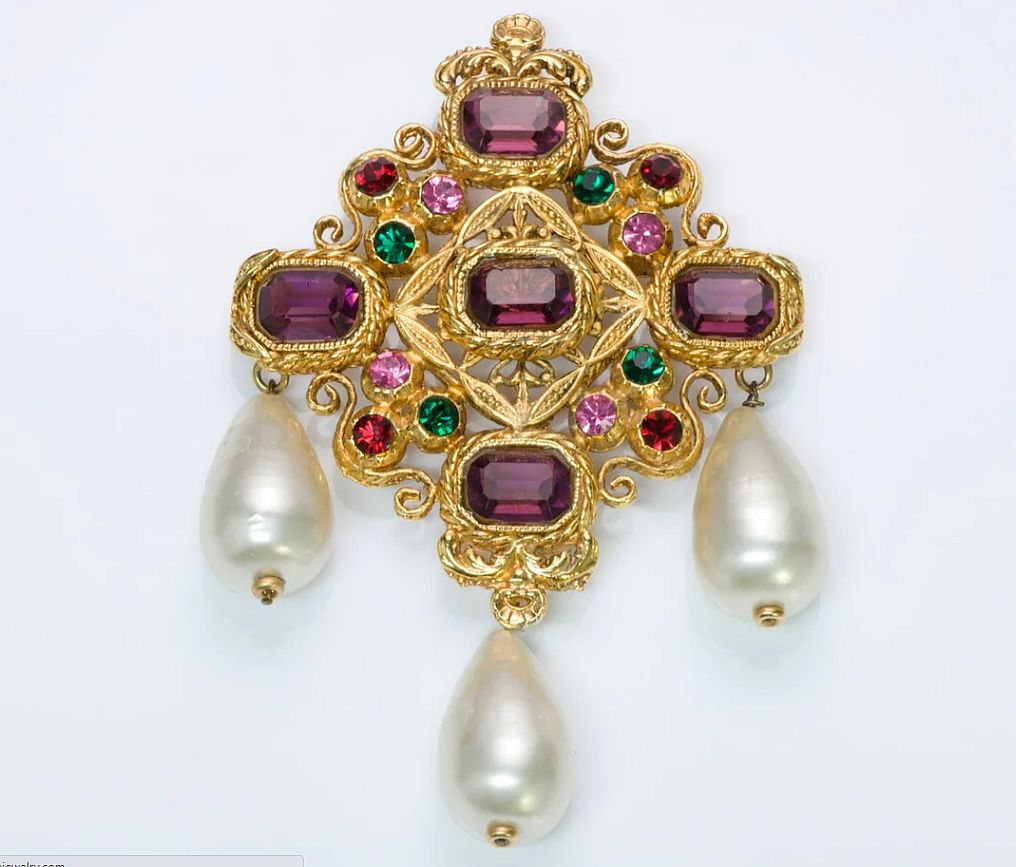
Chanel brooches are among the most collectible accessories produced by the house. They can be bold, elegant, playful, symbolic, or sculptural, and they often bring together several Chanel codes in one object: pearls, chains, camellias, lions, stars, crosses, tweed, quilting, black enamel, gold‑tone metal, rhinestones, poured glass, and the interlocking CC logo. Because brooches are so recognizable, they are also frequently copied. A careful identification process should look at the whole piece, not only at the signature mark.
The first step is to examine the front design. A Chanel brooch should feel deliberate in composition. Whether it is a camellia, a cross, a lion, a heart, a star, a logo brooch, or an abstract seasonal design, the proportions should feel balanced. Chanel costume jewelry can be large and dramatic, especially in vintage pieces from the 1980s and 1990s, but scale should not be confused with clumsiness. The design may be theatrical, but it should still have rhythm, refinement, and control.
The motif can also provide useful context. The camellia, for example, is one of Chanel’s most important floral symbols, and Chanel continues to reinterpret it in its official Camélia fine jewelry collections. A brooch shaped like a camellia should therefore be studied not only as a flower, but as part of a long Chanel design language. The petals, surface finish, material, and attachment should look intentional rather than generic.
Logo brooches require special caution. The interlocking CC is one of the most copied luxury symbols in the world. On an authentic Chanel brooch, the CC should usually be well proportioned, cleanly finished, and integrated into the design. It should not look like a random emblem attached to an ordinary pin. The curves should be smooth, the metal finish refined, and the spacing between the two Cs visually balanced. A slightly awkward logo can sometimes reveal more than a fake plaque.
The reverse of a Chanel brooch is often just as important as the front. Turn the piece over and examine the back construction carefully. High‑quality costume jewelry should not look unfinished simply because the back is less visible when worn. The reverse may show a signature plaque, a pin mechanism, solder points, stone‑setting backs, metal texture, or reinforcement elements. These details should look consistent with the quality of the front.
The signature plaque, if present, is one of the most useful clues. Many Chanel brooches have an oval plaque or cartouche on the reverse, sometimes including the CHANEL name, interlocking CC logo, copyright symbol, registered mark, country mark, year digits, or season letters. As explained earlier, the plaque must fit the period and the object. A later‑style plaque on a piece claimed to be early Chanel should raise questions. A correct‑looking plaque on a poorly made brooch should not be accepted without further examination.
Placement matters. A Chanel brooch plaque should normally sit where it makes sense structurally and visually. It should not be crooked, oversized, crudely soldered, or placed in a way that interrupts the pin mechanism. Some plaques are small and discreet, while others are more visible, depending on the design and period. The important point is that the plaque should feel integrated into the brooch, not added as an afterthought.
The pin mechanism is another major clue. The clasp should feel secure, proportionate, and appropriate to the weight of the brooch. A large, heavy brooch should not have a weak or flimsy pin. The hinge and clasp should be cleanly attached, and the metal should not show crude glue, rough solder, or irregular repair unless the piece has been honestly described as restored. On a genuine vintage brooch, age‑related wear can be normal, but poor construction is not.
Weight can also help. Many authentic Chanel brooches, especially substantial vintage examples, have a satisfying presence in the hand. Gold‑tone metal, glass stones, faux pearls, and layered construction often give the piece density. However, weight alone should never be used as proof. Some authentic brooches may be lighter by design, while some fakes are made heavy to appear convincing. The question is whether the weight matches the scale, materials, and construction.
The quality of the materials should be examined closely. Faux pearls should have a refined surface, not a cheap plastic look. Rhinestones should be set cleanly and should not appear dull, cloudy, or poorly aligned unless there is age‑related wear. Enamel should look controlled and intentional, with clean edges and good color depth. Poured‑glass elements should have richness and dimension rather than flat, lifeless color. Gold‑tone plating should appear smooth and even, not thin, brassy, or rough at the edges.
Stone setting is particularly important. Chanel costume jewelry may use imitation stones, glass, rhinestones, or resin, but these elements should still be handled with care. Stones should sit securely and evenly. Prongs, bezels, or settings should look deliberate. Glue should not be visible in an obvious or messy way. A brooch with poorly placed stones or uneven settings should be examined cautiously, even if the back carries a Chanel‑style mark.
Condition also affects identification and value. Missing stones, replaced pearls, worn plating, bent pins, repaired clasps, or damaged plaques do not automatically mean a brooch is fake, but they must be considered. A genuine Chanel brooch with a replaced pin mechanism may still be authentic, but the repair should be disclosed. A brooch with a missing plaque becomes harder to identify. A heavily restored piece may lose collector value even if it began as an authentic Chanel accessory.
Collectors should also watch for converted pieces. Chanel buttons are often transformed into brooches, earrings, pendants, or charms. A button may be authentic Chanel, but if it was not originally produced and sold as a brooch, it should not be described as an original Chanel brooch. The same caution applies to reassembled necklace elements, added pin backs, or decorative components taken from garments or belts. The Chanel name on one part of an object does not automatically authenticate the entire object in its current form.
A useful method is to compare the brooch with documented Chanel examples. Look at the motif, scale, back construction, plaque style, clasp, and materials. Museum references and serious books on Chanel jewelry can help illustrate the design language and construction standards of authentic pieces, while specialist vintage guides can assist with reading plaques and date codes on fashion jewelry. These sources do not replace physical examination, but they help train the eye.
Red flags on Chanel brooches include uneven lettering on the plaque, distorted CC logos, crude soldering, visible glue, poor‑quality plating, incorrect season codes, misspellings, unusually cheap materials, weak pin mechanisms, and backs that look unfinished or inconsistent with the front. Another warning sign is a brooch that relies entirely on the logo but lacks the craftsmanship expected from Chanel.
The best Chanel brooches feel coherent. The front design, back construction, plaque, pin mechanism, materials, weight, and finish all work together. A collector should not have to ignore several weak details in order to believe the mark. When the object is right, the signature supports what the eye and hand already suggest.
Chanel brooches remain desirable because they condense the house’s identity into a wearable object. A single brooch can carry the camellia, the pearl, the lion, the chain, the cross, the comet, or the CC logo. But serious identification depends on more than recognizing a symbol. It requires looking at how that symbol was made, how it was finished, how it was marked, and whether the entire piece belongs convincingly to the Chanel world.
14. How to Identify Chanel Necklaces and Pearl Sautoirs
A Chanel necklace often reveals its character before the signature is even found. The way it falls, the rhythm of the chain, the spacing of the pearls, the scale of the medallions, and the balance between ornament and movement can all say a great deal about the quality of the piece. Chanel necklaces were never only decorative lines around the neck; many were designed to move with clothing, echo couture details, and build a layered silhouette.
The pearl sautoir is one of the most recognizable Chanel necklace forms. Long strands of pearls, sometimes worn singly and sometimes layered, became part of Gabrielle Chanel’s modern style language. They were elegant but not rigid, luxurious but not dependent on preciousness. This is why Chanel pearl necklaces should not be judged only by whether the pearls are natural, cultured, or imitation. In costume jewelry, the better question is whether the pearls are well finished, well matched, properly strung, and consistent with the design.
On a Chanel pearl necklace, the surface of the pearls matters. Faux pearls should not look cheap, overly plastic, or unevenly coated in a careless way. A vintage piece may show gentle age, minor surface wear, or slight variation, but the overall effect should remain refined. Peeling, excessive flaking, rough seams, cloudy coating, or pearls that feel too lightweight for the design can be warning signs. When pearls are combined with gilt metal, rhinestones, glass, or enamel, the transition between materials should feel considered rather than thrown together.
Chains are equally important. Chanel used chains as both fashion symbol and structural element, and museum research on the house has underlined how chains became a recurring feature of its design language. On necklaces, the chain should have a satisfying rhythm: links should be evenly formed, properly finished, and proportionate to the scale of the piece. A heavy medallion should not hang from a weak chain. A long sautoir should drape naturally. A link necklace should move smoothly without feeling brittle or tinny.
The clasp is one of the first places to inspect. Chanel necklaces may have hook clasps, spring rings, lobster clasps, toggle‑style closures, box clasps, or decorative closures, depending on period and design. The clasp should feel secure and appropriate to the weight of the necklace. If a necklace is substantial, the closure should be strong enough to support it. A flimsy modern replacement clasp on a vintage Chanel necklace does not necessarily make the entire piece false, but it should be noted because it affects originality and value.
Signature marks on Chanel necklaces are often found near the clasp, on a small hanging tag, on a plaque attached to the chain, on the reverse of a pendant, or on the back of a medallion. On later costume jewelry, the mark may include the CHANEL name, interlocking CC logo, country mark, date digits, or a season letter. The mark should not interrupt the structure of the necklace. It should sit naturally within the design, with clean attachment and a plaque or tag that feels proportionate to the rest of the piece.
Medallion necklaces need especially close attention. Chanel often used medallions, coins, crosses, shields, and logo discs in designs that evoke history, Byzantium, talismans, or couture ornament. A well‑made medallion should have clear relief, controlled edges, and a back that is finished with care. If rhinestones, faux pearls, or glass elements are added, they should be set evenly. The surface should not look like soft, low‑quality casting. Details should remain crisp, even when the piece has some age.
Cross necklaces are another category closely associated with Chanel’s costume jewelry vocabulary, especially in richly colored or Byzantine‑inspired pieces. In this type of necklace, look at the depth of the glass, the neatness of the setting, and the harmony between color and metal. Good poured glass should feel expressive, not flat, and the surrounding metal should visually support the scale and drama of the design rather than fight against it.
Length can also provide clues. Sautoirs are designed to be long and fluid. Short chokers, layered chains, pendant necklaces, and station necklaces each have different expectations. A Chanel necklace should feel wearable in a way that matches its design period. Many bold 1980s and 1990s necklaces have a strong visual presence, larger links, more visible logos, and dramatic scale. Pieces with a Gripoix‑inspired aesthetic may rely more on color, texture, and historical reference. Delicate modern necklaces tend to have cleaner lines and a smaller, more discreet signature.
Collectors should pay close attention to logo stations. Some Chanel necklaces include small CC elements, pearl stations, decorative links, or branded discs placed along the chain. These details should be aligned, finished on both sides when visible, and consistent in tone. On poor imitations, logo stations often appear too flat, too shiny, badly spaced, or crudely attached. If the necklace twists while worn, the reverse of each station may also be visible, so unfinished backs quickly betray a weak piece.
A necklace assembled from authentic Chanel parts is not the same as an original Chanel necklace. This issue appears frequently with charms, buttons, belt elements, broken chains, and pendants. A Chanel button attached to a modern chain may be attractive, but it should not be described as a Chanel necklace unless there is evidence that the house produced it in that form. The same applies to pendants added later to unrelated chains or broken elements reassembled into new designs.
Repairs deserve careful handling. A replaced clasp, restrung pearls, restored coating, or repaired link may be acceptable if disclosed, especially on older pieces. What matters is transparency. A professionally restrung Chanel pearl necklace can still be collectible, but it is not identical to one that remains fully original. A necklace with replaced pearls or added charms may have decorative appeal, yet its collector value should be assessed more cautiously.
The sound and movement of a necklace can also be revealing. High‑quality costume jewelry often has a more muted, solid feel when the links move together. Cheap pieces may sound thin, sharp, or hollow. This is not a scientific test, but experienced collectors often notice the difference: the hand registers density, articulation, friction, smoothness, and balance long before a photograph does.
When examining a Chanel necklace, it helps to move from structure to detail. Look first at the full silhouette. Then study the chain, clasp, pearls, stones, medallions, logo elements, and signature. Finally, ask whether the necklace behaves as a coherent object. A strong Chanel necklace should not feel like a collection of decorative parts competing with one another; it should have flow, weight, and intention, with every detail in the right place.
15. How to Identify Chanel Earrings
Chanel earrings deserve a separate examination because they concentrate a surprising amount of information into a small object. A pair of clip‑on earrings, pearl drops, logo studs, camellia earrings, crystal hoops, or oversized runway‑style clips can reveal its period through the back construction, the plaque, the weight, the comfort mechanism, the symmetry of the pair, and the quality of the finishing.
Vintage Chanel earrings are often clip‑ons rather than pierced. This is not unusual: many important twentieth‑century costume earrings were designed with clip backs, especially larger pieces that needed stronger support. A substantial Chanel earring should have a clip mechanism that feels secure, proportionate, and well attached. The clip should open and close with controlled tension, not with a loose or brittle snap.
The back of the earring is often the most useful area to inspect. On many Chanel earrings, the signature may appear on the clip back, on a small applied plaque, on the reverse of the decorative element, or on a tiny cartouche integrated into the metalwork. The mark may be smaller than expected, especially on later pieces, so a loupe or macro photograph can be helpful. The lettering should remain clean and legible, even when the surface shows normal wear.
Symmetry is especially important. A pair should feel like a true pair, not two similar pieces forced together. The size, curve, stone placement, pearl color, enamel tone, clip angle, and plaque position should be consistent. Slight variation can occur in handmade or vintage costume jewelry, especially with poured glass or complex settings, but the overall balance should make sense. If one earring looks noticeably different in construction or finish, the pair may have been mismatched or altered.
The weight of Chanel earrings should match their design. Large logo clips, medallion earrings, glass cabochon earrings, or pearl cluster earrings often have a satisfying density, but they should still be wearable. An oversized earring that feels flimsy may be suspicious. At the same time, a very heavy earring with an unstable clip is also problematic, because Chanel’s better costume jewelry usually considers how the piece sits on the body.
Pearl earrings require attention to surface quality. Faux pearls are common in Chanel costume jewelry, and their use is part of the house’s history rather than a weakness. The Metropolitan Museum of Art notes Chanel’s role in elevating costume jewelry to high fashion, which helps explain why imitation pearls can still belong to serious collectible pieces. On authentic Chanel earrings, faux pearls should usually look refined, with a smooth coating and a tone that suits the design. Excessive peeling, visible seams, or a cheap plastic appearance should be treated cautiously.
Stone‑set Chanel earrings should be studied under good light. Rhinestones, crystals, glass cabochons, or poured‑glass elements should sit securely and evenly. Prongs or bezels should appear controlled, not rough or uneven. If the design includes pavé‑style rhinestones, the stones should form a clean surface, not a scattered or poorly spaced pattern. Missing stones are not unusual in older costume jewelry, but replacements should be disclosed and assessed for color, size, and setting quality.
Logo earrings are among the most copied Chanel accessories. A pair of interlocking CC earrings may look convincing in a quick photograph, but the details often reveal the difference. The curves of the Cs should be smooth, the intersections balanced, and the finish even. On enamel or rhinestone logo earrings, check the edges carefully. Poor imitations may have rough borders, uneven enamel, cloudy stones, or metal that looks too yellow, too bright, or too thinly plated.
Camellia earrings should be judged by the quality of the flower, not only by the presence of the motif. Chanel continues to use the camellia in its official fine jewelry collections, and the motif also appears widely in costume jewelry and fashion accessories. On earrings, the petals should have a controlled rhythm. Resin, enamel, metal, pearl, or rhinestone versions should look carefully shaped rather than generic.
Comfort pads and clip cushions can complicate identification. Some earrings may have original pads; others may have replacement pads added later for comfort. Replacement pads do not automatically harm authenticity, but they can hide part of the clip or mark. If possible, examine the earring without relying only on photographs taken from the front. Clear images of the reverse, clip mechanism, plaque, and any visible repair are essential.
Soldering is another important clue. The clip mechanism should be attached cleanly, without excessive glue or crude metal buildup. On larger earrings, support structures may be necessary, but they should look intentional. Rough soldering around the clip, a plaque placed over damage, or a back that looks unfinished compared with the front can indicate repair, alteration, or lower‑quality manufacture.
Converted pieces are common in the Chanel market. Buttons may be made into earrings, charms may be turned into drops, and broken jewelry parts may be reassembled into new pairs. Some converted pieces can be attractive, but they should be described accurately. A pair of earrings made from authentic Chanel buttons is not the same as a pair of earrings originally produced by Chanel. The difference matters for value, collecting, and honest cataloging.
Pierced Chanel earrings require the same level of care. Posts should be straight, secure, and properly attached. The earring backs should be appropriate in quality. If the earrings were originally clip‑ons and later converted to posts, this should be disclosed. A conversion may make a pair more wearable, but it changes originality. For collectors, original construction often matters as much as the design itself.
The best way to examine Chanel earrings is to treat them as small sculptural objects. Study the front, then the side profile, then the back. Check whether the clip or post supports the design naturally. Compare the two earrings to each other. Look at the mark last, after the construction and materials have already told you something. A correct signature is most convincing when the pair already feels right in the hand. Chanel earrings can be playful, bold, restrained, or theatrical, but they should not feel carelessly made: even the most whimsical design needs control in proportion, finish, and assembly.
16. How to Identify Chanel Bracelets and Cuffs
Chanel bracelets and cuffs are often more architectural than delicate. They sit directly on the wrist, so their quality is felt immediately: the curve of the metal, the way a hinge opens, the sound of a clasp, the smoothness of enamel, the rhythm of a chain, or the balance of a pearl‑and‑logo design. Unlike earrings or brooches, bracelets are handled constantly when worn, which means construction and durability are especially important.
Start with the form. Chanel bracelets can appear as chain bracelets, bangles, cuffs, charm bracelets, pearl bracelets, leather‑and‑chain designs, logo bracelets, or seasonal runway pieces. Each type has a different structure. A chain bracelet should move fluidly. A cuff should keep its shape. A hinged bangle should open and close cleanly. A charm bracelet should have secure links and well‑finished suspended elements. Before looking for the signature, decide what kind of bracelet it is supposed to be.
The interior is one of the most revealing areas. On cuffs and bangles, Chanel marks may appear inside the piece, on a small plaque, or on a discreet flat area of the metal. On chain bracelets, the signature is often near the clasp or on a hanging tag. The mark should be readable, but it should not look oversized or carelessly placed. A signature hidden inside the structure can still be correct; Chanel marks are often discreet rather than theatrical.
Hinges deserve special attention. A hinged Chanel cuff or bangle should open with controlled movement, without wobbling or grinding. The hinge should be aligned with the shape of the bracelet and should not interrupt the design. On poor imitations, hinges often feel loose, uneven, or too light for the weight of the piece. Repairs around the hinge should be examined carefully because the wrist puts pressure on this area every time the bracelet is worn.
Clasps should feel secure and appropriate to the bracelet’s scale. A heavy bracelet with a weak clasp is a concern. A chain bracelet should fasten smoothly and remain closed when gently moved. A box clasp should sit flush. A hook or toggle should feel intentional rather than improvised. When a safety chain is present, it should be well attached and proportionate. Replacement clasps are possible on older jewelry, but they should be disclosed because they affect originality.
Enamel is common on many Chanel bracelets and cuffs, especially in designs using black, white, red, or seasonal colors. Good enamel should have depth, clean edges, and a controlled surface. Light scratches may appear with wear, but bubbling, rough borders, cloudy patches, or enamel that spills unevenly into the metalwork can indicate poor manufacture or later restoration. Black enamel with gold‑tone metal is especially associated with Chanel’s graphic visual language, so the contrast should feel refined rather than harsh.
Pearl bracelets should be examined for coating, spacing, and attachment. Faux pearls are part of Chanel’s costume jewelry tradition, not a flaw in themselves. What matters is how they are used. Pearls should be securely mounted, evenly spaced, and visually harmonious. A bracelet with loose pearls, visible glue, peeling coating, or mismatched replacements should be assessed more cautiously. On a vintage piece, some age may be acceptable; careless repair is different.
Chain bracelets and leather‑and‑chain bracelets connect directly to one of Chanel’s strongest house codes. The chain should have rhythm and weight. Links should be smooth enough to move comfortably but strong enough to support the design. Leather woven through a chain should look carefully integrated, with clean edges and a natural relationship between material and metal. If the leather looks brittle, poorly cut, or obviously replaced, that affects both identification and value.
Charm bracelets need a detailed inspection because each charm can carry its own clues. A Chanel charm bracelet may include CC logos, pearls, camellias, number 5 motifs, stars, hearts, perfume‑bottle references, coins, or seasonal symbols. The charms should feel consistent with one another in finish, metal tone, and quality. A bracelet assembled later from mixed Chanel‑like charms may look appealing at first glance, but inconsistency in scale, attachment, and metal color can reveal that it is not an original composition.
Cuffs are especially important in Chanel collecting because they can show the boldness of the house’s costume jewelry tradition. Some cuffs use poured glass, rhinestones, enamel, resin, leather, or large sculptural forms. The curve of the cuff should sit naturally on the wrist. Edges should be smooth. The interior should not feel rough or unfinished. A dramatic cuff can be large, but it should still feel designed for the body.
Look carefully at metal tone. Chanel gold‑tone jewelry can vary by period and collection, but the finish should usually have richness and control. A bracelet that looks too brassy, too orange, too thinly plated, or unevenly colored may require closer inspection. Wear at high‑contact points is normal on vintage bracelets, especially near edges and clasps, but widespread flaking or rough plating is more concerning.
Bracelets often show more wear than brooches because they touch surfaces, clothing, and skin. Scratches, small dents, worn plating near the clasp, or softened edges may appear on genuine vintage pieces. This type of wear should be judged in context. Natural wear follows the way the bracelet was used. Artificial distress, poor casting, or low‑quality plating looks different and often appears in places that do not correspond to normal handling.
The mark should match the bracelet’s physical story. If the plaque suggests a 1990s Chanel bracelet, the style, clasp, metal tone, and construction should not feel decades away from that period. If a cuff is described as early Chanel but carries a later‑style oval plaque, the description should be questioned. If a bracelet has no visible signature, provenance and comparison become much more important.
Converted pieces are also found in bracelet form. Chain belts may be shortened into bracelets. Necklace segments may be adapted for the wrist. Buttons or charms may be attached to modern chains. These pieces can be fashionable, but they should not be described as original Chanel bracelets unless the evidence supports that claim. The difference between “made by Chanel” and “made from Chanel components” is essential.
When evaluating a Chanel bracelet or cuff, handle it as an object built for movement. Open it, close it, feel the hinge, listen to the clasp, examine the edges, turn it under light, and study how the decorative elements are attached. A photograph can show the logo; the wrist reveals the construction. Strong Chanel bracelets have presence, but they also have control.
17. How to Identify Chanel Belts and Chain Belts
Chanel belts occupy a fascinating space between jewelry and fashion accessory. Some are functional leather belts with buckles, while others are closer to necklaces for the waist: chain belts, medallion belts, pearl belts, logo belts, charm belts, and runway pieces designed to transform the silhouette of a jacket, dress, or suit. Because of this hybrid identity, a Chanel belt should be examined both as an accessory and as an object of costume jewelry.
The first question is what type of belt it is. A leather Chanel belt depends heavily on the quality of the leather, buckle, stitching, edge finishing, interior stamp, and hardware. A chain belt depends more on metalwork, link construction, medallions, plaques, hooks, charms, and overall drape. A textile or tweed belt requires attention to fabric, lining, structure, and label details. A pearl or charm belt may need to be assessed much like a necklace or bracelet, but with greater concern for strength because it is worn around the waist.
Chain belts are among the most collectible Chanel belt styles. They often reflect the same vocabulary seen in Chanel necklaces and bracelets: gold‑tone links, faux pearls, interlocking CC logos, medallions, camellias, number 5 motifs, coins, leather threading, and seasonal charms. The chain should feel fluid but not weak. Links should be evenly formed, smoothly finished, and strong enough to support the belt’s weight. If the belt twists awkwardly, catches on itself, or feels brittle, it deserves closer inspection.
A Chanel chain belt should also have visual rhythm. The spacing of charms, medallions, pearls, or logo elements should feel deliberate. A belt assembled from random Chanel‑like parts may look decorative, but the proportions often betray it. Original Chanel belts usually have a sense of design continuity: the chain, closure, decorative elements, and signature all belong to the same composition. When one charm looks newer, brighter, cheaper, or differently finished than the rest, the belt may have been altered.
Closures are especially important. Chain belts may use hooks, lobster‑style clasps, toggle closures, adjustable chains, or decorative fastening elements. The closure should feel secure and consistent with the scale of the belt. A heavy chain belt should not rely on a weak hook. An adjustable section should be finished with the same care as the main chain. Wear around the fastening point is worth checking closely, because this area takes the most stress when the belt is worn.
Signature marks on Chanel belts can appear in several places. A chain belt may have a small plaque, tag, engraved charm, stamped hook, or marked medallion. A leather belt may have an interior stamp or marked buckle. The signature should be easy to explain in relation to the design. It should not look like a loose plaque attached only to create value. On better pieces, the mark feels like part of the object’s structure, not an add‑on.
Leather belts require a different eye. The leather should feel substantial and well finished, with clean edges, neat stitching, and a buckle that matches the quality of the strap. Interior markings may include the Chanel name, country of origin, size, or material information depending on the period and model. The heat stamp or foil stamp should be sharp and aligned. Fuzzy lettering, uneven pressure, or a stamp that looks too large or too shallow can be a warning sign.
The buckle is one of the strongest identification points on a leather Chanel belt. It may feature the interlocking CC, the CHANEL name, enamel, rhinestones, metal relief, leather covering, or seasonal motifs. A good buckle should have clean edges, controlled plating, and a secure attachment to the strap. The back of the buckle should not be ignored: screws, soldering, hinge points, and attachment loops should look carefully made rather than crude or lightweight.
Medallion belts need close study because they are often copied. Chanel medallions may include coins, perfume references, camellias, lions, stars, hearts, CC logos, or other house motifs. The relief should be crisp. The surface should not look soft or muddy. If a medallion has rhinestones or pearls, the settings should be even. If it has enamel, the color should sit cleanly within the design. A medallion that looks impressive from a distance but rough in close‑up may be a problem.
Pearl belts are another area where photographs can mislead. Faux pearls may look attractive online but feel cheap in person. On a strong Chanel belt, pearls should have an appropriate luster, secure mounting, and a relationship to the chain or leather that feels designed rather than improvised. Peeling, flaking, glue residue, and uneven replacements should be noted. Because belts move against clothing and the body, pearls on belts may show more wear than pearls on brooches or earrings.
Chanel belts are also frequently confused with converted jewelry. A long necklace may be worn as a belt. A chain belt may be shortened into a necklace or bracelet. A broken belt may be reassembled with replacement links. Buttons or charms may be attached to modern chains and sold as Chanel‑style waist jewelry. The question is not whether an individual component is Chanel, but whether the object in its current form was originally produced as a Chanel belt.
Size and wearability should make sense. A belt should sit properly at the waist or hips depending on its design. Chain belts often include adjustable sections, while leather belts may show size markings or multiple holes. If a belt has been heavily altered in length, the change should be visible in the link pattern, hole placement, or finishing. Alterations do not always destroy value, but they affect originality and should be described honestly.
Condition is especially important with belts because they experience stress. Leather can crack, stretch, darken, or lose shape. Chain links can open. Hooks can bend. Gold‑tone plating can wear at contact points. Enamel can chip near the buckle. These signs should be evaluated according to age and use. Normal wear on a vintage Chanel belt can be acceptable; poor repair or structural weakness is more serious.
For collectors, Chanel belts are valuable because they show how the house turned accessories into identity. A chain belt can carry the same language as a necklace, but with a different function. A leather belt can echo handbag hardware. A medallion belt can bring jewelry‑like drama to clothing. The strongest examples are those where function, decoration, and Chanel codes work together naturally, without relying only on a logo to create interest.
18. How to Identify Chanel Buttons
Chanel buttons are small objects, but they can carry a surprising amount of design history. They appear on jackets, suits, coats, dresses, cardigans, blouses, and couture‑inspired garments, often echoing the same codes found in Chanel jewelry and accessories: the interlocking CC, camellia, lion, chain, star, number 5, pearl, coin, or black‑and‑gold contrast. Because they are decorative, collectible, and easy to remove from garments, Chanel buttons also require careful identification.
A Chanel button should first be understood as a garment component, not automatically as jewelry. This distinction matters. A button may be authentic Chanel and originally attached to a Chanel jacket, but that does not mean it was produced as earrings, a pendant, a brooch, or a bracelet charm. Many Chanel buttons are later converted into jewelry. These pieces can be attractive and wearable, but they should be described accurately.
The front of a Chanel button often gives the first clue. Some buttons are simple and restrained, while others are highly decorative. They may be metal, resin, enamel, pearl‑like, leather‑covered, fabric‑covered, rhinestone‑set, or designed with relief motifs. The design should make sense in relation to Chanel’s fashion language. A button with a CC logo, lion, camellia, or chain border may fit the house vocabulary, but the motif alone does not prove authenticity.
The reverse is usually more important than the front. Many Chanel buttons are marked on the back with the CHANEL name, sometimes with the interlocking CC logo, a country mark, or other production details. The lettering should be clear and controlled. The back should not look crudely molded, rough, or unfinished. A poorly cast reverse, fuzzy text, or uneven surface can be a warning sign, especially if the front looks overly polished.
The shank is another key detail. Most garment buttons have a shank or attachment point on the reverse, allowing the button to be sewn onto fabric. The shank should be well formed and appropriate to the button’s size and weight. If the shank has been cut off, filed down, drilled, or replaced with a jewelry fitting, the button has likely been altered. This does not necessarily mean the button itself is fake, but it changes what the object is.
Converted Chanel button jewelry is very common in the resale market. Buttons are turned into earrings, rings, pendants, charms, cufflinks, and brooches. A seller may describe such a piece as “Chanel button earrings” or “jewelry made from Chanel buttons,” which can be acceptable if accurate. Problems arise when a converted button is presented as original Chanel jewelry. For collectors, that difference affects value, rarity, and historical meaning.
A useful question is whether the construction belongs to Chanel, or only the button. If a button has been attached to a modern earring post, a generic chain, or a new brooch pin, the jewelry setting may not be Chanel even if the button is. In that case, the correct description should separate the authentic Chanel component from the later conversion. Clear wording protects both buyer and seller.
Condition should also be read differently on buttons. A button removed from a garment may show thread residue, slight wear around the shank, surface rubbing, or fabric‑related marks. These signs can be consistent with use. However, excessive glue, rough drilling, badly attached findings, or heavy filing may indicate later alteration. A pristine‑looking back on a supposedly old button is not automatically suspicious, but it should be compared with the rest of the object.
Chanel buttons can also be replaced on garments. A vintage jacket may have original buttons, later Chanel replacement buttons, or non‑original buttons added by a previous owner. When identifying a Chanel garment or accessory, the presence of Chanel buttons alone is not enough. The garment label, fabric, construction, lining, seams, chain weighting, and overall design must also be considered. A Chanel button sewn onto a non‑Chanel garment does not make the garment Chanel.
Materials vary widely. Metal buttons should have clean relief and a controlled finish. Resin or plastic buttons should feel well molded rather than cheap or brittle. Enamel should have neat edges and good color depth. Rhinestone‑set buttons should show careful placement. Pearl‑like buttons should have a refined surface. Because buttons are functional, their materials should also withstand wear. A button that looks decorative but structurally weak may not match Chanel quality.
The scale of a button should make sense. Jacket buttons, cuff buttons, coat buttons, and decorative buttons may differ in size and weight. A large coat button converted into earrings may feel too heavy or sit awkwardly, which can reveal that the current use is not original. Small sleeve buttons may be more wearable as converted earrings, but again, wearability does not prove Chanel jewelry origin.
Collectors should also be aware of loose button lots. Genuine Chanel buttons may appear separately after being removed from damaged garments, but the market also contains reproductions and Chanel‑style buttons. When buying loose buttons, clear photographs of both front and back are essential. It is also useful to compare the button with documented Chanel garments from similar periods when possible, to see whether the design, scale, and markings match known examples.
The safest description for converted pieces is precise rather than inflated. “Earrings made from Chanel buttons” is more accurate than “Chanel earrings” if Chanel did not originally produce the earrings. “Chanel button pendant on later chain” is clearer than “Chanel necklace.” In luxury collecting, accuracy increases trust. It also prevents confusion between original Chanel accessories and later creations using Chanel components.
Chanel buttons are desirable because they condense the house’s codes into a small surface. A single button can echo a collection, a jacket, a symbol, or a design period. But their small size also makes them easy to detach, reuse, and misrepresent. The button itself may be authentic; the object it has become may tell a more complicated story.
19. Chanel Handbag Identification: The Main Details
Chanel handbags require a different kind of examination from Chanel jewelry. A brooch may be studied through its plaque, pin mechanism, stones, metal finish, and motif. A handbag, however, is a larger constructed object. Leather, stitching, quilting, lining, hardware, chain strap, interior stamp, serial or microchip system, zipper, flap shape, and overall proportions all need to agree with one another.
The first impression should come from the shape. A Chanel handbag usually has a controlled silhouette. Whether the bag is a 2.55, Classic Flap, Boy Bag, Gabrielle, Wallet on Chain, seasonal flap, tote, vanity case, or minaudière, the proportions should feel intentional. Counterfeit bags often fail in the outline before they fail in the details: the flap may sit awkwardly, the base may sag unnaturally, the sides may bulge, or the bag may look too soft or too rigid for the model.
Quilting is one of the strongest Chanel handbag codes. On many classic designs, the diamond pattern should appear balanced and consistent. The diamonds should not look stretched, uneven, or randomly spaced. On flap bags, the quilting often continues visually across the flap and body, although this depends on the style and construction. Poor alignment is not always proof of a fake, especially on certain seasonal models or heavily used vintage pieces, but careless quilting is one of the first details worth checking.
The stitching should be neat, regular, and appropriate to the leather. Chanel bags are known for refined construction, so the stitch line should not look rushed or uneven. Loose threads, wandering seams, inconsistent stitch length, or corners that look clumsy should raise concern. Vintage wear is one thing; poor construction is another. A genuine older bag may show softened leather and gentle use, but the original stitching should still reflect good workmanship.
Leather quality is equally important. Chanel has used lambskin, caviar leather, calfskin, patent leather, exotic skins, tweed, jersey, satin, velvet, and other materials depending on the model and period. Lambskin should feel soft and rich, while caviar leather has a more textured and durable surface. The leather should correspond to the style. A bag that claims to be lambskin but feels plastic‑like, thin, or overly stiff should be examined carefully.
The interior lining can reveal many issues. Chanel interiors vary by model, but the lining should sit cleanly and fit the bag properly. It should not bubble excessively, pull away in strange areas, or show rough finishing near seams and pockets. On many classic flap bags, the interior color and structure are part of the model’s identity—for example, the 2.55 is closely associated in its original form with a burgundy‑toned lining that references Chanel’s convent school uniforms.
The interior stamp is one of the most important details. It may read “CHANEL” with “Made in France” or “Made in Italy,” depending on the bag. The font should be crisp, evenly spaced, and cleanly applied. Foil stamping should not look messy or overly thick. A faint stamp can occur with age and wear, but irregular letters, poor alignment, or a stamp placed awkwardly should be treated cautiously. As with jewelry plaques, the country mark alone is neither proof nor disproof.
The hardware deserves close attention. Chanel handbag hardware may be gold‑tone, silver‑tone, ruthenium‑tone, aged gold‑tone, brushed metal, enamel, or other finishes depending on the model and collection. The finish should feel substantial and controlled. Lightweight, overly shiny, brassy, or easily scratched hardware can be a warning sign. Screws, chain links, zipper pulls, grommets, and turn‑locks should all look like they belong to the same quality level.
The CC turn‑lock is one of the most recognizable details on Chanel bags, especially Classic Flap styles. The proportions of the interlocking Cs should be balanced, and the lock should turn smoothly. The backplate may be engraved, often with Chanel branding and sometimes with visible screws. The engraving should be sharp rather than fuzzy. Screws should be appropriate to the period and model; crude or unexpected screw types on a style where they do not belong are a common red flag.
The chain strap should be examined both visually and by touch. On many Chanel bags, leather is woven through the chain. The leather strip should be properly fitted, not twisted carelessly or cut roughly. The metal links should feel smooth and consistent, with a finish that matches the rest of the hardware. A chain that feels too light, too sharp, or too bright compared with the bag may indicate replacement or imitation.
Zippers and pulls can also help. Chanel has used different zipper suppliers and zipper styles over time, so this area requires model‑specific knowledge, but the basic standard remains the same: the zipper should move smoothly, the pull should feel well made, and any branding or engraving should be clean. A cheap zipper can undermine the credibility of an otherwise convincing bag.
The serial sticker or microchip plate, depending on the period, should be examined in context. Older and vintage Chanel bags use interior serial stickers, originally paired with authenticity cards. Newer Chanel bags have transitioned away from that system: since around the 21A collection in 2021, the brand has replaced stickers and cards with a small metal plate containing an embedded NFC microchip and an engraved code. Chanel does not publish a complete public chart for every serial format, so collectors rely on reputable guides and professional authenticators, but the key point is that the identification method must match the age of the bag.
A missing authenticity card is not automatically a problem, especially with vintage bags. Cards can be lost easily over decades. A present card is not automatic proof either, because cards can be copied, mismatched, or paired with the wrong bag. The number on the card, when present, should match the serial sticker on bags from the sticker‑and‑card era. If the number does not match, that is a serious warning sign.
Modern Chanel bags require different expectations. A recent bag may have a metal serial plate and embedded microchip instead of a hologram sticker and black card, and it will be linked electronically in Chanel’s internal system. For those pieces, the absence of a card is normal, while the absence of the plate would be a concern.
Model familiarity is essential. A Classic Flap, 2.55 Reissue, Boy Bag, Gabrielle bag, Chanel 19, seasonal flap, or Wallet on Chain each has its own proportions, interior layout, chain style, hardware language, and expected details. A common mistake is applying one Chanel handbag checklist to every model. Authenticity depends on the specific bag, not on a universal formula.
Condition should be read honestly. A vintage Chanel bag may show softened corners, light rubbing, creasing, hardware wear, interior marks, or a gently faded stamp. These signs can be consistent with age. More concerning is a combination of weak construction, incorrect details, poor materials, and a suspicious serial or plate system. A bag can be old and authentic; it can also be new‑looking and fake. Age alone proves nothing.
Repairs and restorations are especially important. Re‑dyeing, replaced chains, replaced turn‑locks, re‑stitched seams, relined interiors, replaced zipper pulls, or restored corners can all affect value. A restored Chanel bag may still be genuine and beautiful, but restoration should be disclosed. Many collectors prefer honest wear over heavy, undocumented intervention.
A careful handbag examination should feel layered. First, look at the silhouette. Then study the leather, quilting, stitching, lining, stamp, hardware, chain, zipper, and identification system. Only after those details have been considered should the serial sticker, card, or microchip plate be treated as supporting evidence. A Chanel handbag is not authenticated by one number; it is authenticated by the way many details agree with each other.
20. Chanel Serial Numbers and Date Stickers
Chanel serial numbers are among the most discussed identification details on pre‑owned and vintage Chanel handbags. They can help place a bag within a general production period, especially when the number appears on the interior serial sticker and matches the authenticity card. However, serial numbers must be handled carefully. They are useful clues, not complete authentication by themselves.
Chanel began using serial stickers in the 1980s, and these stickers became one of the best‑known ways to help date handbags and small leather goods. Depending on the period, a Chanel serial number may have six, seven, or eight digits. Major luxury resale references describe the general evolution from earlier serial stickers to later eight‑digit codes and, eventually, to the modern metal‑plate microchip system.
A serial sticker is usually found inside the bag, often placed on the lining, inside a pocket, or in another discreet interior location depending on the model. Its position can vary, so collectors should not expect every Chanel bag to have the sticker in the exact same place. What matters is whether the placement makes sense for the model and period. A sticker that looks randomly placed, poorly attached, or inconsistent with the bag’s age deserves closer inspection.
Older serial stickers may show natural wear. They can darken, crack, peel, fade, or become difficult to read after years of use. A missing or damaged sticker is not automatically proof that a bag is fake, especially on vintage pieces. Many authentic Chanel bags have lost their stickers over time. However, a missing sticker reduces the amount of evidence available, so the rest of the bag must be examined more carefully.
The number itself should be read in relation to the bag’s claimed period. Earlier serial numbers were shorter, while later sticker‑era bags used eight digits. A number range can help estimate a production period, but collectors should avoid treating date charts as absolute proof. Chanel does not publicly provide a complete official database for buyers to verify every vintage number. The serial must match the physical evidence of the bag: model, leather, hardware, lining, stitching, and stamp.
The authenticity card, when present, should match the serial sticker exactly. During the sticker‑and‑card era, the card functioned as a companion to the interior sticker. If the number on the card and sticker do not match, that is a serious red flag. If a seller provides a card but refuses to show the sticker clearly, the buyer should be cautious. A card without a matching bag is only a card.
Authenticity cards are also copied frequently. A convincing‑looking black card with gold lettering does not prove that the bag is genuine. The printing, weight, finish, and number format should be considered, but even a good card cannot replace examination of the bag itself. Cards can be lost, swapped, reproduced, or paired with the wrong item. For this reason, a Chanel handbag with no card may still be authentic, while a handbag with a card may still require full authentication.
The sticker’s physical appearance matters. Older stickers may have specific fonts, security features, and background patterns depending on the era. The edges, typography, color, wear pattern, and relationship to the lining should look plausible. A brand‑new‑looking sticker inside a heavily worn vintage bag can be suspicious. A damaged sticker inside a gently used bag may be less concerning if the damage corresponds to where the sticker sits and how the bag was used.
One mistake buyers often make is asking only, “What year is this serial number?” A better question is, “Does this serial number belong with this bag?” The number may suggest a certain era, but the hardware, interior stamp, leather type, or model details may suggest another. When those details conflict, the serial number should not be trusted blindly.
Small leather goods can also have serial stickers or codes, depending on the item and production period. Wallets, card holders, pouches, and Wallet on Chain styles may require careful searching because the sticker can be placed in a small interior section. The same rules apply: the number, stamp, leather, stitching, hardware, and structure must agree with the period.
For newer Chanel handbags, the older sticker‑and‑card system is no longer the standard. From around the 21A collection in 2021, Chanel moved toward metal plates with embedded microchips, changing how modern bags are identified and tracked internally. In these cases, a buyer should not reject a modern Chanel bag simply because it does not have a traditional sticker or authenticity card; the correct expectation depends on the year of production.
Serial stickers are therefore most useful when they support a bag that already looks right. A clear, period‑appropriate sticker with a matching card can strengthen confidence. A missing sticker does not automatically condemn a vintage bag. A copied sticker does not save a poorly made one. The serial number is part of the evidence, but the bag’s construction still has to speak for itself.
21. Chanel Authenticity Cards: Useful but Not Definitive
Chanel authenticity cards are often treated with more confidence than they deserve. They can be helpful when examining a handbag from the period in which Chanel used the sticker‑and‑card system, but they are not proof by themselves. A card can support authentication only when it belongs to the correct bag, matches the serial sticker, and fits the period of production.
For many years, Chanel handbags were accompanied by a black authenticity card with a serial number printed on it. That number was meant to correspond to the serial sticker inside the bag. When both are present, the numbers should match exactly. If the card shows one number and the interior sticker shows another, that is a serious warning sign. If the seller shows the card but avoids showing the sticker, the buyer should ask for clearer documentation.
The card itself should feel like a high‑quality plastic card, not a thin paper insert or flimsy laminated tag. The printing should be sharp, the numbers should be clean, and the overall appearance should be controlled. Many genuine cards have a simple black‑and‑gold look, which counterfeiters often copy. This is why the presence of a card should never replace a full examination of the handbag.
A missing authenticity card is not automatically a problem, especially with vintage Chanel bags. Cards are small, separate from the bag, and easy to lose over decades. Many authentic vintage Chanel handbags no longer have their original card. A missing card may affect resale value or buyer confidence, but it does not automatically make a bag false. In these cases, the serial sticker, construction, leather, hardware, lining, stamp, and overall model details become even more important.
A present card can also be misleading. Cards can be copied, swapped, sold separately, or paired with the wrong bag. A real Chanel authenticity card from one handbag does not authenticate another handbag. A fake card can be placed next to a fake bag. A mismatched card can create confusion for buyers who focus on accessories rather than the object itself.
Collectors should also understand that authenticity cards belong to a specific era of Chanel handbag identification. They are not expected with every Chanel piece. Earlier bags may not follow the same system, and newer bags have moved away from the older card‑and‑sticker format toward embedded identification plates and microchip technology on more recent bags. A modern Chanel bag without an authenticity card can therefore be completely consistent with current production.
This means a modern Chanel bag without a card should not be judged by the same checklist as a 1990s bag. The first step is always to understand the period of the bag. Only then can the absence or presence of a card be interpreted correctly.
The card should also correspond to the number format expected for the bag. A six‑, seven‑, or eight‑digit number should make sense in relation to the bag’s age. If the number format suggests one period while the bag’s hardware, leather, interior stamp, or design suggests another, the card should be treated cautiously. A correct‑looking number is not enough when the physical bag tells a different story.
Packaging should be treated the same way. Boxes, dust bags, ribbons, receipts, care booklets, and boutique bags can be useful context, but they do not authenticate a Chanel handbag on their own. Packaging can be lost, replaced, purchased separately, or reproduced. A genuine dust bag can accompany a fake handbag, just as a genuine handbag can be missing its original packaging. The object remains the primary evidence.
Receipts can help, but they also need scrutiny. A receipt from a Chanel boutique or reputable department store may add confidence if the details match the bag, date, style, and serial information. However, receipts can be copied or separated from the original item. When the value is high, documentation should be consistent across every element: bag, serial sticker or plate, card (if applicable), receipt, hardware, and model.
For online buyers, photographs matter. A seller should provide clear images of the front and back of the authenticity card, the serial sticker or identification plate if applicable, the interior stamp, hardware, chain, stitching, corners, and overall shape. Blurry card photos are not enough. A listing that emphasizes the card while avoiding close‑up images of the bag itself should be approached carefully.
The most responsible way to treat a Chanel authenticity card is as supporting documentation. It can strengthen a case when everything else agrees. It can help confirm the serial number when the interior sticker is intact. It can add value when original to the bag. But it cannot substitute for craftsmanship, period accuracy, and proper construction.
A Chanel card is useful because it belongs to the history of how the house documented its handbags. It is not definitive because it is separate from the handbag and can be copied, lost, mismatched, or misunderstood. The bag must still be examined as a luxury object built from leather, hardware, stitching, lining, and design—not as an item validated by a small plastic card.
22. Chanel Microchip Plates on Modern Bags
Modern Chanel handbags changed the authentication conversation because the house moved away from the older serial sticker and authenticity card system. For many years, collectors expected to find an interior serial sticker and, ideally, a matching black authenticity card. On newer bags, that expectation is no longer always correct. Chanel has introduced metal identification plates with embedded microchip technology, replacing the traditional sticker‑and‑card format on many modern pieces.
This shift matters because many buyers still use vintage authentication habits when looking at recent Chanel bags. They ask, “Where is the authenticity card?” or “Where is the serial sticker?” Those questions make sense for older bags, but they may be the wrong questions for a newer piece. A modern Chanel bag without a traditional card or sticker is not automatically suspicious; in many cases, the identification system has simply changed.
The microchip plate is usually a small metal rectangle placed inside the bag, attached to the interior lining or a discreet interior area depending on the model. It typically matches the tone of the other hardware and is engraved with the interlocking CC logo and an eight‑character alphanumeric code that is unique to the item. The chip itself is embedded in or behind the plate and uses NFC‑based technology that can be read only by Chanel’s internal devices.
For collectors familiar only with vintage Chanel, this interior plate can feel unfamiliar at first, especially because it replaces the hologram‑style sticker and separates modern bags from the older card‑and‑sticker era. Guides from specialist resellers and authentication services are therefore useful, since Chanel does not publish a complete public manual explaining every detail of the system.
The presence of a microchip plate should be judged in relation to the bag’s production period. Bags from around the 21A collection onward (spring/summer 2021) are expected to use the metal plate and microchip instead of a traditional serial sticker and authenticity card, whereas 1990s or early‑2000s bags should still follow the older hologram‑sticker logic. When the identification method does not match the supposed age of the bag, the description should be questioned.
The plate itself should look refined and properly integrated into the interior. It should not appear as a loose tag or a cheap label. The engraving should be crisp, the font and spacing should look controlled, and the metal should be consistent with the rest of the hardware. Sloppy engraving, a plate that feels thin or roughly attached, or metal that clashes with the bag’s hardware tone are all warning signs.
A microchip plate does not remove the need to examine the handbag. It is simply one part of the modern identification system. The bag still needs to be judged through leather, stitching, quilting, lining, hardware, chain strap, turn‑lock, zipper pulls, interior stamp, proportions, and model‑specific construction details. A plate cannot compensate for poor materials or incorrect design.
This is especially important because counterfeiters adapt quickly. As soon as buyers begin looking for a specific feature, imitations begin to copy that feature. Fake bags can carry metal plates with random alphanumeric codes that mimic the new system. The question is not only whether a plate is present, but whether the entire bag has the craftsmanship, structure, and finish expected from Chanel.
The move to microchip plates also changes how collectors think about documentation. With older bags, the matching card and sticker were part of the resale story. With modern bags, the absence of a card is normal, and the plate and embedded chip act as the primary factory identification. Receipts, boutique records, after‑sales service documentation, and professional authentication remain helpful, but the vintage habit of elevating the card above the bag no longer applies.
For buyers, a practical approach is to identify the generation of the bag first. Is it a vintage sticker‑era piece, a 2000s or 2010s bag with an eight‑digit hologram sticker, or a modern microchip‑era bag with a metal plate and alphanumeric code? Once the production context is understood, the correct set of expectations becomes clearer. A modern system should not be expected on an older bag, and an older system should not be required on a newer one.
Microchip plates are useful because they reflect Chanel’s effort to modernize identification and reduce reliance on removable stickers and separate cards, while storing data about a bag’s life cycle in a closed internal system. But they are not magic proof. A modern Chanel bag still has to pass the fundamental tests of luxury construction: the leather should feel right, the stitching should be controlled, the hardware should be precise, the lining should sit cleanly, and the shape should correspond to the model. When those elements are convincing, the plate and chip become strong supporting evidence rather than the sole reason to believe in the bag.
23. How to Identify Chanel Wallets and Small Leather Goods
Chanel wallets and small leather goods can be harder to assess than handbags because the details are compressed into a much smaller object. A wallet, card holder, pouch, key holder, coin purse, clutch, or Wallet on Chain may carry many of the same Chanel codes as a handbag—quilted leather, CC hardware, interior stamping, chain details, lambskin, caviar leather, or refined lining—but there is less room for error. On small accessories, poor stitching, weak embossing, uneven edges, or low‑quality hardware becomes visible very quickly.
Chanel’s official small leather goods category includes pieces such as wallets, card holders, coin purses, pouches, clutches, and related leather accessories, often offered in the same leathers and seasonal colors as the main handbag line. This matters because small leather goods are not secondary objects in the Chanel universe. They are part of the same luxury language, but they follow their own construction logic. A card holder should not be judged exactly like a Classic Flap, and a Wallet on Chain should not be judged exactly like a compact wallet.
The first detail to study is shape. A Chanel wallet or card holder should have clean proportions. The edges should not look wavy, swollen, or poorly cut. The flap, if present, should sit correctly. The corners should be finished with care. A compact item that looks slightly crooked, bulky in the wrong places, or uneven when closed deserves closer attention. Small leather goods are handled often, so wear is normal, but the original design should still feel controlled.
Leather quality is one of the strongest clues. Chanel small leather goods may be made from lambskin, caviar leather, calfskin, patent leather, or seasonal materials. Lambskin should feel soft and smooth, while caviar leather should have a structured, pebbled texture. The material should match the model and period. A piece that visually imitates caviar leather but feels plasticky, thin, or overly stiff may not meet the expected standard.
Stitching is especially revealing on wallets and card holders. Because the surface is small, uneven stitching is hard to hide. The stitches should be regular, clean, and aligned with the shape of the piece. Around flaps, card slots, zipper compartments, and edges, the stitch line should remain controlled. Loose threads, inconsistent spacing, or seams that drift toward the edge can indicate poor manufacture or heavy alteration.
The interior layout should feel precise. Card slots should be evenly cut. Compartments should open smoothly. The lining should sit flat and not bubble excessively. Zippered sections should not pull awkwardly. A Chanel wallet is often opened and closed many times, so the interior must be both elegant and practical. If the inside feels flimsy, rough, or poorly finished, the piece should be examined with caution.
The interior stamp is one of the most important areas. It may include “CHANEL,” the registered mark, and a country mark such as “Made in France” or “Made in Italy,” depending on the item and period. The stamp should be crisp, aligned, and proportionate. Foil stamping should not look thick, blurry, or uneven. Blind embossing should have clean edges. A weak stamp does not automatically mean a piece is false, especially if there is wear, but messy lettering is a warning sign.
Hardware should be small but refined. A wallet may have a CC snap, zipper pull, chain strap, logo charm, turn‑lock‑inspired closure, or metal plaque. The metal should feel consistent with Chanel quality: not overly light, brassy, or roughly finished. Engraving, if present, should be sharp. On a small piece, hardware that is too large, too bright, or poorly attached can disturb the entire design.
Zippers deserve careful inspection. Chanel uses quality zippers, and the movement should be smooth. The pull should feel substantial enough for the item, not flimsy or sharp. If the zipper tape, teeth, or pull look inconsistent with the rest of the piece, it may indicate replacement or poor construction. A replaced zipper on an older wallet should be disclosed because it affects originality.
For Wallet on Chain styles, the chain is a major clue. The chain should move smoothly and feel proportionate to the body of the piece. Leather woven through the chain should be neatly cut and integrated. The chain should not feel too light for the bag, and the metal tone should match the other hardware. Because Wallet on Chain pieces sit between handbag and small leather good, they should be examined through both categories: leather structure and chain construction.
Serial stickers, codes, or microchip plates may appear depending on the production period. Older small leather goods may have a serial sticker placed in a discreet interior area; newer pieces may follow the modern metal‑plate system used on recent Chanel bags, sometimes with the plate hidden in a pocket or lining panel. The location can be harder to see than on a handbag, so buyers should request clear images. A number or plate is useful only when the rest of the item also makes sense.
Authenticity cards, when relevant to the period, should match the serial sticker exactly. However, as with handbags, a missing card does not automatically make a vintage or pre‑owned item fake, especially for small leather goods that are easy to separate from their accessories. A matching card can support confidence, but leather quality, stitching, stamp, hardware, and construction remain more important than the card alone.
Edge finishing is a small detail with large importance. Wallets and card holders have many edges: exterior edges, flap edges, card‑slot edges, compartment edges, and zipper borders. These should be sealed and finished neatly. Peeling, cracking, uneven paint, or rough cuts may occur with heavy wear, but poor edge finishing on a supposedly lightly used item is suspicious.
Because small leather goods are handled daily, condition must be interpreted realistically. Corner wear, slight creasing, interior marks, softened leather, hardware scratches, or light discoloration may be normal on a used item. Structural problems are more serious: warped shape, broken snap, torn card slots, separating lining, replaced hardware, or a zipper that no longer functions properly. A beautiful exterior cannot compensate for a failing structure.
Counterfeit Chanel wallets often focus on the logo while neglecting quiet details. The CC may look convincing in a photo, but the card slots may be uneven, the leather may feel thin, the stamp may be fuzzy, or the zipper may feel cheap. This is why small leather goods should be examined slowly. The smaller the object, the more each detail matters.
A strong Chanel wallet or small leather accessory should feel precise, compact, and refined. It should not depend on a large logo to create value. The leather, stitching, interior structure, stamp, hardware, and finishing should all show that it belongs to the same world as Chanel’s larger accessories—even in miniature.
24. How to Identify Chanel Sunglasses and Eyewear
Chanel sunglasses and eyewear are often authenticated through very small details. Unlike a handbag, they do not offer a large interior structure to examine, and unlike jewelry, they usually do not rely on oval plaques or seasonal costume jewelry marks. Instead, the most useful clues are found on the temples, lenses, hinges, nose pads, model codes, logo placement, frame quality, and case documentation. Chanel treats eyewear as its own category alongside fashion accessories, with dedicated collections and model references.
Start with the frame. Chanel eyewear should feel well balanced in the hand. The frame should not feel brittle, rough, overly light, or poorly finished. Acetate frames should have smooth edges and a polished surface, while metal frames should feel controlled rather than flimsy or sharp. If you open the glasses and place them on a flat surface, the arms should sit evenly unless the pair has clearly been bent through use; a distorted frame can be a condition issue, but poor balance on a new‑looking pair is more concerning.
The temple arms are one of the most important areas to inspect. Authentic Chanel sunglasses usually include information printed or engraved on the inside of the arms, such as the CHANEL name, a model number, color code, lens and bridge measurements, and country of production. The lettering on the temple should be clean, straight, and evenly spaced. Text should not look smudged, overly thick, crooked, or cheaply printed. Wear can soften markings over time, but poor application and obvious printing flaws are different from age.
The Chanel logo on the temples must also be studied closely. Some sunglasses have prominent interlocking CC logos on the sides, while others use more discreet branding. The logo may be metal, enamel, crystal‑set, inlaid, printed, or integrated into the frame design. The shape should be proportionate and clean. A side logo that is crooked, loosely attached, too bright, poorly glued, or badly shaped is one of the easiest red flags to notice in counterfeit eyewear.
Hinges are especially revealing. They should open and close smoothly, with steady resistance. Screws should sit properly and should not look stripped, oversized, or inconsistent with the frame. On luxury eyewear, the hinge area should feel engineered rather than improvised. If the arms wobble, scrape, or fail to close evenly, the pair may be damaged or poorly made.
The lenses should be checked for quality, clarity, and fit. Some Chanel sunglasses may have subtle lens branding, etched details, gradient tints, polarized lenses, or seasonal design elements depending on the model. The lenses should sit securely in the frame, without rattling or showing rough edges, and they should not distort vision in a way that feels cheap or inconsistent with luxury eyewear. A genuine frame with non‑original replacement lenses should be described honestly, because replacement lenses affect originality even if the frame itself is authentic.
Nose pads and bridge construction can also help. On metal frames, nose pads should be well attached, symmetrical, and proportionate to the frame. On acetate frames, the molded nose bridge should feel smooth and comfortable. Adjustable nose pads may show discoloration or replacement over time, which is not unusual, but the hardware and finish should still match the overall quality of the frame.
Packaging is useful but secondary. Chanel eyewear may come with a case, cleaning cloth, box, booklet, or receipt, but these items can be lost, replaced, or copied. A genuine case does not authenticate fake sunglasses, and authentic sunglasses can appear without original packaging. When buying online, request clear images of both temples, the front, the hinges, the lenses, the interior markings, and the case or paperwork if present.
Model numbers are particularly valuable. A model code on the temple can be checked against known Chanel frames, past retail listings, or reputable resale archives. The model number, color code, lens size, bridge width, and temple length should form a coherent set that matches the actual frame shape and color. If the code corresponds to a different style or colorway than the pair shown, the glasses should be questioned.
Materials should match the design. Some Chanel sunglasses use acetate, metal, leather details, pearls, chains, tweed‑inspired textures, rhinestones, enamel, or camellia and CC motifs. Decorative elements should be well integrated, not loosely attached. Pearl or rhinestone temple details should be secure and evenly placed, and leather elements should be neatly cut and finished. Even highly decorated runway‑style frames need precision; sloppy decoration is inconsistent with Chanel standards.
Condition strongly affects value in eyewear. Scratched lenses, bent arms, loose hinges, missing stones, replaced nose pads, worn temple lettering, or damaged acetate may not make a piece fake, but they matter to collectors and to usability. A rare Chanel frame in clean, structurally sound condition will usually be more desirable than a heavily worn example, while a common model with major functional issues may have limited appeal.
Counterfeit Chanel sunglasses often concentrate on an oversized side logo while neglecting subtle construction and marking details. The CC may look impressive at first glance, but the temple text may be wrong, the hinge weak, the frame too light, or the lens quality poor. This is why a understated frame with precise markings can feel more convincing than a loud pair covered in logos.
Good Chanel eyewear should feel like a complete design object: balanced on the face, polished in the hand, and precise in its smallest marks. The logo is only one part of that impression. The real test is whether the frame, lenses, hinges, temple codes, materials, and finishing all belong to the same level of luxury execution.
25. How to Identify Chanel Watches
Chanel watches should be examined as precision luxury objects, not simply as fashion accessories with a logo on the dial. A Chanel watch combines design, engineering, materials, reference information, bracelet construction, dial details, clasp quality, and often service documentation. The authentication process is therefore different from the one used for Chanel costume jewelry or handbags.
The first step is to identify the model family. Chanel’s watch collections include lines such as J12, Première, Boy‑Friend, Code Coco, Monsieur de Chanel, and other designs. Each collection has its own proportions, case shape, bracelet style, dial layout, and material language. A J12 should not be assessed like a Première, and a Première should not be judged like a Boy‑Friend. Model familiarity is essential.
The J12 is one of Chanel’s most recognizable watch designs. It is strongly associated with high‑resistance ceramic, a clean sport‑luxury profile, and a bold bracelet structure. On a genuine J12, the ceramic should feel smooth, dense, and refined rather than plasticky or lightweight. The case and bracelet should have a controlled shine, and the bracelet links should articulate cleanly. Poor imitations often fail in the ceramic effect: the surface looks too dull, too glassy in the wrong way, or too cheap under close light.
The Première has a different identity. Inspired by the geometry of Place Vendôme and the stopper of the N°5 perfume bottle, it often has an elegant octagonal case and a bracelet or chain structure that feels closer to Chanel’s fashion codes. On this type of watch, the shape of the case, the proportions of the dial, and the quality of the bracelet or chain are especially important. Sharp corners, clean facets, and a bracelet that feels like jewelry rather than costume are good signs.
The dial should be studied under good light. Chanel dials are usually clean and controlled, even when the design is decorative. The logo, numerals, indexes, hands, date window, seconds track, and any diamond or decorative setting should be aligned and sharply finished. Fuzzy printing, uneven spacing, misaligned markers, or hands that look too short or too long can indicate a problem. A watch dial is a small surface; mistakes are often easier to see than on larger accessories.
The case back can provide important information. Depending on the model, it may include Chanel branding, reference numbers, material information, water‑resistance details, “Swiss Made” indication, serial information, or other engravings. The engraving should be crisp and evenly applied. It should not look shallow, rough, crooked, or laser‑burned in a careless way. If a case back looks heavily polished, some information may be softened or missing, which can affect confidence and value.
Reference numbers matter. A Chanel watch reference can help identify the model, material, case size, dial type, bracelet style, and sometimes production context. The reference should match the watch in front of you. If the number points to a different model, color, bracelet, or configuration, the piece needs deeper review. Collectors should compare reference details with official model descriptions, reputable watch dealers’ listings, service documents, and trusted auction or resale records.
The bracelet or strap is another major clue. A ceramic J12 bracelet should have smooth, solid‑feeling links and a clasp that closes securely. A leather strap should be well finished, with clean stitching and a quality buckle or deployant clasp. A chain‑style Première bracelet should feel refined, not flimsy. If the bracelet feels too light, rattles excessively, has sharp edges, or uses hardware that does not match the case, it may be a replacement or imitation.
The clasp should be opened and closed several times. It should lock securely and release smoothly. Chanel branding on the clasp, if present, should be clean and proportionate. Wear on the clasp is common because it is a high‑contact area, but poor construction is different from use. A genuine watch may show scratches from wear; it should not feel mechanically weak or reluctant to close.
Materials should match the model. Chanel watches may use ceramic, steel, gold, diamonds, leather, sapphire crystal, and other luxury materials depending on the reference. A diamond‑set watch should have carefully placed stones, consistent brightness, and clean setting work. A gold watch should correspond to the appropriate gold marks and reference details. A ceramic watch should not feel like painted metal or coated plastic. Material mismatch is one of the strongest signs that a watch needs professional inspection.
The crystal should be clear and properly fitted. Many Chanel watches use sapphire crystal, which should resist scratches better than ordinary glass. A heavily scratched or cloudy crystal may suggest replacement, poor care, or a non‑original component, depending on the situation. The crystal should sit evenly in the case, with no strange gaps, distortion, or glue traces.
Movement is a technical area and should be handled carefully. Some Chanel watches use quartz movements, while others use mechanical or automatic movements, depending on the model. A quartz Chanel watch is not automatically less authentic or less important; the movement type must match the reference. If a watch is described as automatic but the reference should be quartz, or the reverse, the claim should be questioned. Opening a watch to inspect the movement should be done only by a qualified watchmaker.
Documentation is especially valuable. Original box, papers, warranty card, service records, purchase receipt, and repair documentation can all help support identification and value. Official service records are particularly reassuring, because they show that the watch has passed through the brand’s hands or an authorized service center. However, documents can be separated from the original object, copied, or mismatched. The paperwork should support the watch, not replace examination of the watch.
Condition has a major impact on Chanel watches. Scratches, bracelet stretch, worn clasps, chipped ceramic, damaged crowns, replaced crystals, aftermarket diamonds, non‑original straps, over‑polished cases, or missing links can all affect value. Some issues are normal with wear; others change the integrity of the piece. Aftermarket diamond setting, in particular, should be treated with caution because it may reduce collectibility even if the base watch is authentic.
The crown should be proportionate and functional. It should pull and turn properly, set the time cleanly, and sit correctly against the case when pushed in. If the crown is loose, incorrectly signed, too large, too small, or rough in operation, the watch needs professional review. Water resistance should never be assumed on a pre‑owned watch, even if the case back states a rating; seals age, and service history matters.
For collectors, a Chanel watch is strongest when the model, reference, materials, dial, case, bracelet, clasp, and documents all agree. A watch with a beautiful dial but inconsistent bracelet, unclear reference, and no service history may still be worth examining, but it should not be purchased casually. The higher the value, the more important professional authentication and watchmaker inspection become.
Chanel watches are compelling because they translate the house’s design codes into mechanical or quartz objects worn daily on the wrist. A J12 expresses modern ceramic luxury. A Première reflects Chanel’s geometry and perfume history. A diamond watch connects the house to fine jewelry. But the name on the dial is only the beginning. The details of the watch must support the identity claimed by the logo.
26. Fonts, Engravings, and Logo Proportions
Fonts, engravings, and logo proportions are among the quiet details that separate a convincing Chanel accessory from a weak imitation. Many buyers look first for the word “CHANEL,” the interlocking CC logo, a serial number, or a country mark. That is understandable, but the real question is not only whether those elements are present. The better question is how they are executed.
On Chanel accessories, lettering should usually look deliberate, balanced, and controlled. Whether it appears on a jewelry plaque, handbag heat stamp, authenticity card, watch case back, sunglasses temple, belt buckle, zipper pull, or leather accessory, the typography should feel precise. Luxury objects rarely have careless lettering. If the letters look swollen, uneven, fuzzy, crowded, or strangely shaped, the piece deserves closer attention.
The CHANEL name is especially important because counterfeiters often reproduce it incorrectly in small ways. The spacing between letters should be even. The letters should sit on a straight line. The strokes should not look too thick in one area and too thin in another. The word should not appear stretched, compressed, or awkwardly centered. On a worn vintage item, the mark may soften with age, but the underlying quality of the original stamp or engraving should still be visible.
The interlocking CC logo requires the same level of care. It is one of the most recognizable fashion symbols in the world, and also one of the most copied. On authentic Chanel accessories, the logo should usually feel proportionate to the object. It should not be too wide, too narrow, too round, too flat, or placed without regard to the design. The two Cs should relate to each other with balance and clarity. A logo can look “almost right” at first glance and still feel wrong when compared with a well‑made Chanel example.
On handbag turn‑locks, the CC logo is especially visible. The curves should be smooth, the metal surface should be clean, and the lock should turn properly. The logo should not feel flimsy, sharp at the edges, or roughly cast. On jewelry, the CC may appear as a plaque detail, pendant element, earring design, brooch motif, or charm. In each case, the edges, thickness, and finish should match the quality of the piece.
Engraving depth matters. A good engraving is usually sharp enough to read clearly but not so aggressive that it looks crude. Very shallow, blurry, or uneven engraving can be suspicious. So can engraving that looks too harsh, as if it was cut without refinement. On watch case backs, belt buckles, zipper pulls, sunglasses temples, and handbag hardware, the engraving should look integrated into the object, not added carelessly after production.
Heat stamps and foil stamps on leather goods require a slightly different eye. On a handbag, wallet, pouch, or card holder, the CHANEL stamp should be straight, clean, and proportionate to the interior surface. Foil should not bleed around the letters. Blind embossing should have crisp edges. The country line, when present, should align naturally with the brand name. If the stamp looks crooked, too deep, too shallow, or unusually thick, compare it with the rest of the item before drawing conclusions.
On jewelry plaques, small text is often where problems appear. A counterfeit plaque may copy the main CHANEL name and CC logo reasonably well, but fail on the smaller details: copyright symbol, registered mark, season letter, year digits, or “Made in France” / “Made in Italy.” These elements should still be legible and controlled. Tiny does not mean sloppy. A small oval cartouche can be difficult to read without magnification, but it should not look like a blurred lump of metal.
Serial numbers and date codes should also be judged visually. On sticker‑era handbags, the digits should correspond to the correct general format for the period, but the typography and placement matter too. On jewelry plaques, year digits and season letters should not look randomly squeezed into the design. On modern pieces, identification plates should be aligned and cleanly finished. A correct‑looking number in a careless format is not reassuring.
Sunglasses and eyewear provide a useful example because the markings are often printed or engraved in very small type along the temple arms. Model numbers, color codes, size information, and country marks should be straight, clean, and consistent. If the text looks smudged, misaligned, or cheaply applied, the frame should be examined more carefully.
Watches are even less forgiving. On a Chanel watch, the dial printing, case‑back engraving, clasp logo, crown detail, and bracelet markings must be crisp. Small differences in dial layout, numeral shape, and logo centering matter greatly. A watch with fuzzy dial printing, uneven numerals, poorly centered logos, or soft case‑back engraving should not be assessed casually.
One of the most common red flags is inconsistency. A handbag may have a clean heat stamp but weak zipper engraving. A necklace may have a strong front design but a crude plaque. A pair of sunglasses may have a convincing side CC but poor temple text. A watch may have a good dial logo but a suspicious case back. Authentic luxury pieces usually show consistency across details. Counterfeit pieces often concentrate effort on the most visible mark and neglect the rest.
The finish around the mark is just as important as the mark itself. On metal, the area surrounding the engraving should not look rough, pitted, melted, or uneven. On leather, the stamp should not distort the material in a cheap or excessive way. On plastic or acetate eyewear, printed text should not sit on a poorly finished surface. On a jewelry plaque, the edges of the cartouche should be clean and proportionate.
Collectors should also consider scale. A mark that is too large can feel as wrong as one that is too small. Chanel branding is sometimes bold, especially in fashion jewelry and runway accessories, but even bold branding has design control. A logo should relate to the piece’s shape, size, and purpose. When a mark dominates the object in a crude way, it may be trying to compensate for weak design.
Age can soften marks, but it should not erase good construction. A vintage brooch may have a lightly worn plaque. A bag’s interior stamp may fade with use. A watch case back may show scratches. Sunglasses may lose some temple printing after years of wear. These signs can be normal. The issue is whether the wear looks natural and whether the original quality still comes through.
Magnification is useful, but it should not replace judgment. A loupe can reveal fuzzy lettering, rough edges, glue residue, plating loss, or engraving problems. Macro photographs can help when buying online. But a single close‑up can also mislead if the rest of the object is not shown. Always compare the mark with the full accessory: front, back, sides, interior, hardware, and construction.
The most convincing Chanel markings are those that appear effortless because they are so well integrated. The logo belongs to the design. The lettering fits the surface. The engraving has clarity without harshness. The heat stamp sits naturally in the leather. The plaque feels like part of the jewel. When fonts, engravings, and proportions are right, they do not shout for attention; they quietly confirm the quality of the piece.
27. Weight, Feel, Sound, and Finish
Some of the most important clues in a Chanel accessory are not visible in a photograph. They are felt in the hand. Weight, balance, sound, surface texture, clasp movement, chain articulation, leather softness, and metal density can reveal a great deal about quality. These details are difficult to describe in a listing, but experienced collectors notice them quickly when handling a genuine luxury object.
Weight should be judged in relation to the type of accessory. A large Chanel brooch, chain belt, cuff, or medallion necklace should usually have presence. It may feel substantial because of its metalwork, glass, faux pearls, enamel, or layered construction. A handbag should not feel hollow or strangely weightless for its size. A watch should have the density expected from its case, bracelet, and materials. The question is not simply whether the piece is heavy, but whether the weight makes sense.
Too much weight can also be a problem. Some counterfeit accessories are made heavy because sellers know buyers associate weight with luxury. A fake brooch can feel dense but still have poor casting, weak plating, awkward proportions, and rough finishing. A handbag can feel heavy but have incorrect leather, cheap hardware, and poor stitching. Weight is useful only when it agrees with the design and construction.
Feel is often more revealing than weight. A Chanel chain should move smoothly, without sharp edges or brittle stiffness. A clip earring should open with controlled tension. A bracelet clasp should close securely. A handbag chain should glide through the grommets without feeling rough or thin. A wallet should feel compact and precise, not swollen or flimsy. These small tactile details are part of how luxury quality communicates itself.
Sound can also provide clues, especially with jewelry and chain accessories. A well‑made Chanel necklace, bracelet, or belt often has a more muted, solid sound when the links move together. Cheap metal may sound thin, sharp, or overly bright. This is not a formal authentication test, but it can help the hand and ear notice what the eye may miss. The sound should correspond to the materials and scale of the object.
Finish is one of the strongest indicators of quality. On Chanel costume jewelry, gold‑tone metal should usually have richness and control. It should not look thinly sprayed, overly orange, rough, or patchy. Silver‑tone and ruthenium‑tone finishes should appear deliberate, not dull from poor manufacturing. Enamel should sit cleanly within the design. Rhinestones should be set evenly. Faux pearls should have an appropriate luster. Poured glass should show depth rather than lifeless flatness.
The reverse side often reveals the truth. On brooches, earrings, cuffs, medallions, and belt elements, the back should not look like an afterthought. Even when the reverse is simpler than the front, it should be finished with care. Rough casting, sharp edges, visible glue, messy soldering, and untreated surfaces are warning signs. A jewel that looks impressive only from the front may not meet Chanel’s expected standard.
Leather has its own language of touch. Lambskin should feel soft and supple, while caviar leather should feel textured and structured. Calfskin, patent leather, tweed, satin, and exotic skins each have different expectations. A Chanel handbag or wallet should not feel plasticky unless the material itself is a seasonal synthetic or coated design, and even then the finish should be intentional. Cheap imitation leather often feels thin, dry, sticky, or overly stiff.
Hardware should feel integrated into the accessory. A turn‑lock should move cleanly. A zipper should open smoothly. A belt buckle should feel secure. Sunglasses hinges should close with controlled resistance. A watch clasp should click into place confidently. These movements matter because they show engineering, not just appearance. A piece can look convincing in a photo but feel wrong the moment it is used.
Surface aging should be read carefully. Vintage Chanel accessories may show wear: softened leather, light scratches, rubbing on metal, patina on hardware, small marks on pearls, or gentle fading on interior stamps. These signs can be consistent with age. What is more concerning is poor original finish: uneven plating, rough edges, sloppy enamel, weak casting, cloudy stones, or construction that feels cheap even before wear is considered.
Smell can sometimes be relevant, especially with handbags and leather goods. Genuine vintage leather may have a soft aged scent, while poor storage can create mustiness. Strong chemical smells, plastic odors, glue smells, or artificial fragrance used to mask odor should raise caution. Smell alone cannot authenticate a Chanel bag, but it can alert a buyer to restoration, storage issues, or questionable materials.
The way an object sits on the body is another clue. A brooch should not drag awkwardly unless it is exceptionally large and intended for heavy fabric. Earrings should sit securely rather than tilt forward dramatically. A necklace should drape according to its design. A cuff should follow the wrist. A handbag should hold its shape in a way that matches the model. Luxury accessories are designed to be worn, not only photographed.
For online buyers, these tactile clues are harder to access, so photographs and seller communication become more important. Ask for close‑ups of clasps, backs, hinges, corners, interior stamps, plaques, zipper pulls, and wear points. Videos can be helpful for chains, clasps, locks, hinges, and bag structure. A short video of a turn‑lock closing or a bracelet clasp opening can reveal more than several still images.
Finish should also be compared across the whole piece. If the front of a brooch is bright and polished but the back is rough and crude, something may be wrong. If handbag hardware looks new but the leather is heavily aged, the hardware may have been replaced. If one earring is more worn than the other, the pair may be mismatched. Consistency is often more persuasive than perfection.
A strong Chanel accessory usually feels complete. The weight suits the design. The surface feels refined. The hardware moves properly. The sound is appropriate. The finish continues beyond the most visible areas. These qualities are difficult for counterfeiters to reproduce because they require more than copying a logo. They require understanding how the object should live in the hand, on the body, and over time.
28. Common Red Flags in Fake Chanel Accessories
Fake Chanel accessories often look convincing at first glance because they copy the most obvious signs: the interlocking CC logo, the CHANEL name, quilted leather, gold‑tone hardware, faux pearls, chain straps, serial numbers, or oval jewelry plaques. The problem usually appears in the details. A counterfeit piece may imitate the symbol but fail in proportion, material, finish, construction, or consistency.
One of the first red flags is poor lettering. The CHANEL name should not look stretched, crowded, uneven, or oddly spaced. On jewelry plaques, handbag stamps, watch case backs, sunglasses temples, authenticity cards, belt buckles, and zipper pulls, the letters should appear controlled and clean. Fuzzy stamping, swollen letters, crooked alignment, or inconsistent spacing can indicate a problem.
The interlocking CC logo is another area where imitations often fail. The curves may look too round, too flat, too thick, too thin, or slightly unbalanced. On handbags, the turn‑lock may look convincing from the front but feel loose or poorly made when turned. On jewelry, the CC may be too sharp at the edges, too shiny, or awkwardly attached. On sunglasses, the side logo may sit crookedly or feel glued on rather than integrated into the frame.
Misspellings are obvious red flags, but they still appear. “Made in Frence,” uneven country marks, incorrect symbol placement, wrong season letters, strange copyright marks, or missing registered symbols in places where they would normally be expected should all raise concern. Small text is often where counterfeiters make mistakes because they focus more attention on the larger logo.
A suspicious plaque is another warning sign. On Chanel costume jewelry, an oval plaque or cartouche should be proportionate, cleanly finished, and properly attached. A plaque that looks too thick, too large, too rounded, too shiny, or crudely soldered may not be correct. Rough glue around the plaque, uneven metal edges, or a plaque that feels newer than the rest of the piece should be examined carefully.
Poor soldering and visible glue are especially concerning on jewelry. Chanel costume jewelry may use non‑precious materials, but it should not look carelessly assembled. Brooch backs, earring clips, bracelet hinges, necklace clasps, belt medallions, and charm attachments should look secure and intentional. If the back of the piece looks messy while the front is heavily branded, the object may be relying on the logo to distract from weak construction.
Low‑quality plating is another common problem. Fake Chanel jewelry often has metal that looks too yellow, too orange, too bright, too thin, or unevenly coated. Plating may flake around edges, clasps, and high points. Vintage Chanel pieces can show wear, but there is a difference between honest age and poor original finish. Natural wear usually follows handling patterns; cheap plating often looks unstable across the entire surface.
Faux pearls can also reveal quality issues. Chanel used faux pearls as a deliberate design element, not as a careless substitute. Pearls should have a refined surface and appropriate luster. Peeling, visible seams, chalky coating, plastic‑like weight, or pearls that look badly glued into place are red flags. On vintage pieces, slight wear may be acceptable, but the overall effect should still feel elegant.
Rhinestones, crystals, and glass elements should be set with care. Uneven spacing, cloudy stones, loose settings, visible glue, mismatched replacements, or stones sitting at different angles can all suggest poor quality or later alteration. On Gripoix‑style pieces, the glass should have depth and character, not the flat look of cheap molded plastic. A rich color effect is one thing; lifeless imitation is another.
For handbags, poor quilting is one of the most visible warning signs. The diamonds may look uneven, stretched, or misaligned in a way that does not fit the model. The bag may lose shape quickly, the flap may sit awkwardly, or the body may feel too soft or too rigid. Chanel bags vary by design and period, but careless construction is never a good sign.
Stitching should also be examined closely. Wandering seams, inconsistent stitch length, loose threads, rough corners, or crooked pocket construction can all indicate a problem. A used vintage bag may show wear, but the original workmanship should still be visible. Poor stitching on a supposedly luxury item should never be ignored.
Hardware on fake bags often looks wrong in the hand. It may be too light, too shiny, too brassy, or too easy to scratch. Zipper pulls may feel thin. Chain links may have sharp edges. Grommets may look rough. Turn‑locks may wobble. Screws may be inappropriate for the model. A bag can photograph well and still fail when the hardware is touched.
Serial stickers and authenticity cards are frequently copied. A bag with a card is not automatically authentic, and a bag without a card is not automatically fake. The number, sticker style, card, bag construction, and production period must agree. A perfect‑looking card paired with a weak bag is not reassuring. A serial sticker that looks new inside a heavily worn vintage bag should also be questioned.
Modern microchip‑style plates can be imitated too. A metal plate does not prove a modern Chanel bag is genuine if the rest of the bag is poorly made. The plate should sit naturally in the interior and match the production era. A crooked, cheap, or oddly placed plate is a warning sign, especially when combined with poor leather, weak stitching, or incorrect hardware.
Converted pieces are another area of confusion. Chanel buttons turned into earrings, pendants, or brooches may be sold as “Chanel jewelry,” but that wording can be misleading if Chanel did not produce the object in that form. A genuine Chanel button on a later chain is not the same as an original Chanel necklace. A charm removed from a belt and attached to a bracelet should be described honestly.
Inconsistent aging is often revealing. A brooch may have a bright new plaque but worn metal everywhere else. A handbag may have heavily aged leather but new‑looking hardware. A pair of earrings may have one clip more worn than the other. A watch may have a clean dial but a suspicious case back. Natural wear usually tells a coherent story. Mixed, illogical wear patterns can suggest replacement parts, assembly, or restoration.
Seller behavior can be a red flag too. Be cautious with listings that show only the front of the item, hide the back, avoid close‑ups of marks, refuse to photograph the serial sticker or plaque, or rely heavily on phrases such as “guaranteed authentic” without evidence. A serious seller should be willing to show the areas that matter: reverse, clasp, plaque, stamp, hardware, interior, serial system, and condition details.
Price can also be a warning sign. Chanel accessories are highly collectible, and rare vintage pieces, iconic handbags, and desirable jewelry are rarely sold far below market value without a reason. A low price does not always mean fake, but it should make the buyer ask better questions. Is there damage? Is it converted? Is it missing documentation? Is it misattributed? Is the seller credible?
The strongest warning sign is not one single flaw, but a pattern of inconsistencies. One replaced clasp may be explainable. One missing card may be normal. One worn pearl may be age‑related. But when weak font, poor plating, sloppy construction, strange markings, low‑quality materials, and inconsistent wear appear together, the risk becomes much higher.
A Chanel accessory should not require excuses at every step. It may be vintage, repaired, worn, or missing paperwork, but its design and construction should still make sense. When the object depends only on the logo and fails in the quieter details, collectors should step back.
29. Replacement Parts, Repairs, and Converted Pieces
Not every problematic Chanel accessory is counterfeit. Some pieces are genuine but repaired. Some are authentic but altered. Some include original Chanel components that have been turned into something else. This distinction is essential for collectors because authenticity, originality, condition, and value are related, but they are not the same thing.
A Chanel brooch with a replaced pin may still be a genuine Chanel brooch. A vintage Chanel necklace that has been restrung may still be authentic. A handbag with restored corners may still be a real Chanel bag. A watch with a replaced strap may still have an authentic Chanel case and movement. The issue is not always whether the object is real or fake. Often, the more precise question is: how much of it remains original?
Replacement parts can appear in many forms. Jewelry may have replaced clasps, stones, faux pearls, earring backs, pin mechanisms, safety chains, or missing charms. Handbags may have replaced chains, zipper pulls, turn‑locks, lining, screws, or strap sections. Belts may have shortened chains or changed hooks. Watches may have replaced crystals, crowns, straps, bracelets, bezels, or aftermarket diamond settings. Each replacement changes the object’s story.
Repairs are not automatically negative. A professional repair can preserve a valuable piece and make it wearable again. A loose pearl can be secured. A broken chain can be repaired. A damaged clasp can be replaced. A handbag corner can be restored. A watch can be serviced. In the luxury market, condition work is sometimes necessary. The problem begins when repairs are hidden, poorly executed, or described as original.
Jewelry repairs should be examined under good light. Look for solder marks, glue residue, different metal tones, uneven plating, replaced rhinestones, mismatched pearls, or findings that do not match the period. A replaced clasp on a necklace may be functional, but if it is modern and unsigned, it should be noted. A brooch with a new pin stem may still be collectible, but the back no longer tells the same original story.
Earrings are especially vulnerable to alteration. Clip‑ons may be converted to pierced posts, posts may be added to button backs, and comfort pads may hide marks or repairs. A conversion can make earrings easier to wear, but it affects originality. For collectors, original clip mechanisms often matter, especially on vintage Chanel costume jewelry. If the earring has been changed, the description should say so clearly.
Converted Chanel buttons are one of the most common areas of confusion. A button removed from a Chanel garment can be authentic, beautifully made, and collectible. But when that button is attached to a later earring post, chain, ring shank, or brooch fitting, the final object is not automatically original Chanel jewelry. The accurate description would be something like “earrings made from Chanel buttons” or “Chanel button pendant on later chain,” not simply “Chanel earrings” or “Chanel necklace.”
The same issue appears with charms and belt components. A charm from a Chanel chain belt may be made into a pendant. A necklace element may be turned into a bracelet. A broken bracelet may be reassembled with added links. These pieces can be attractive and wearable, but they must be separated from original Chanel designs. A piece made from Chanel components is not always the same as a piece made by Chanel in that form.
Handbag restoration also requires careful wording. Re‑dyed leather, replaced lining, new chains, repaired quilting, changed hardware, replaced screws, or refurbished corners can affect value. Some restorations are subtle and professional; others change the character of the bag. A restored Chanel handbag may still be desirable, but collectors should know whether the leather surface, hardware, or interior has been altered.
Recoloring is particularly important. A black Chanel bag that has been professionally restored may look excellent, but if the original color was different, that is a major change. Dye can also affect leather texture, stitching color, interior edges, and resale value. A bag that looks too perfect for its age should be examined carefully for restoration signs, especially around corners, flap edges, seams, and high‑contact areas.
Watches bring another level of complexity. A Chanel watch with a non‑original strap may still be authentic, but it should not be described as fully original. Aftermarket diamond bezels or dials can significantly affect value, even if the base watch is genuine. Over‑polishing can soften case lines. Replacement crystals and crowns may be acceptable if done properly, but service documentation becomes important. For higher‑value watches, a professional watchmaker’s inspection is strongly recommended.
The strongest clue to alteration is inconsistency. A necklace may have an old pendant but a new chain. A bracelet may have one charm that does not match the others. A handbag may have hardware that looks much newer than the leather. A brooch may have a plaque that appears cleaner than the surrounding metal. A watch may have a bracelet with a different finish from the case. These mismatches do not always prove fraud, but they ask for explanation.
Collectors should also distinguish between repair, restoration, and transformation. A repair fixes damage while trying to preserve the original object. Restoration improves condition, sometimes by replacing or refinishing parts. Transformation changes the object into something else, such as turning a button into earrings or a belt charm into a pendant. These categories should not be blurred.
Documentation helps. Receipts from reputable repair services, Chanel boutique service papers, watch service records, restoration invoices, or seller notes can clarify what has been done. For expensive items, this transparency can preserve trust. For vintage costume jewelry, even a simple written note explaining replaced stones or converted fittings is better than silence.
When buying online, ask direct questions. Has the piece been repaired? Are all stones original? Has the clasp been replaced? Are the pearls original to the piece? Has the bag been recolored or restored? Is the chain original? Was the button originally sold as jewelry? Are the watch diamonds factory‑set or aftermarket? A serious seller should be able to answer clearly or say when they do not know.
For serious dealers, accuracy is part of value. A properly described converted Chanel button pendant may still appeal to a buyer who loves the look. A restored Chanel bag may still be a beautiful luxury object. A repaired Chanel brooch may still be collectible. What matters is that the buyer understands exactly what is original, what is repaired, and what has been changed.
The most trustworthy descriptions avoid exaggeration. They do not turn an authentic component into a fully original accessory. They do not hide replaced parts behind vague language. They do not use the Chanel name to cover uncertainty. In collecting, clarity protects both the object’s history and the buyer’s confidence.
30. Can Chanel Accessories Be Authenticated by Markings Alone?
No Chanel accessory should be authenticated by markings alone. A plaque, stamp, serial number, authenticity card, microchip plate, engraving, country mark, or logo can provide useful evidence, but it cannot tell the full story of an object by itself. Chanel pieces are identified through the relationship between many details: design, materials, construction, period, condition, documentation, and the way the mark is integrated into the accessory.
This is especially true because Chanel is one of the most copied names in luxury fashion. Counterfeiters understand that buyers look for visible signs such as the interlocking CC logo, “CHANEL” lettering, oval jewelry plaques, handbag serial numbers, and authenticity cards. Those features are often copied first. The quieter details—the weight of a chain, the curve of a clasp, the quality of enamel, the sharpness of a heat stamp, the proportion of a turn‑lock, or the feel of leather—are harder to reproduce convincingly.
A Chanel costume jewelry plaque can help date a brooch, necklace, bracelet, or pair of earrings, especially when it includes year digits, season letters, country marks, or the CHANEL name. But a copied plaque can be attached to a weak piece. A genuine plaque could also be placed on an altered object. A missing plaque may reduce certainty, but it does not automatically mean that every early or repaired piece is false. The plaque is important, but it has to agree with the jewel.
Handbag serial numbers work the same way. A serial sticker can help place a Chanel bag within a general period, and a matching authenticity card can support the evidence. But serial stickers and cards can be copied, lost, damaged, swapped, or mismatched. A bag with a plausible number but poor quilting, weak leather, wrong hardware, and bad stitching remains suspicious. A vintage bag missing its card may still be authentic if the construction, materials, and period details are strong.
Modern microchip plates also require context. Their presence may be correct on newer Chanel bags, especially after the move away from the traditional sticker‑and‑card system. But a metal plate does not excuse poor workmanship. The plate should match the production era and sit naturally within a bag that already looks right in leather, hardware, stitching, lining, and shape.
For jewelry, the word “hallmark” itself must be used carefully. Many Chanel costume jewelry marks are not hallmarks in the legal precious‑metal sense. They are brand signatures, plaques, cartouches, stamps, or collection indicators. This matters because many valuable Chanel jewels were intentionally made with faux pearls, poured glass, gilt metal, rhinestones, and other non‑precious materials. Their identity cannot be reduced to metal marks.
Fine jewelry and watches bring a different standard. A Chanel fine jewelry ring, diamond pendant, or watch may include precious‑metal marks, reference numbers, case‑back engravings, or service documentation. These objects belong to a more technical luxury field than costume jewelry, but even there a mark is not enough. Model, material, setting, movement, bracelet, dial, and documentation must all make sense together.
The strongest authentication process is comparative. A collector should compare the mark with documented examples from the same category and period. A 1990s Chanel brooch should be compared with other 1990s brooches, not with a modern fine jewelry ring or a 1950s‑inspired necklace. A Classic Flap handbag should be compared with the correct model, size, leather, hardware, and production era. A J12 watch should be examined against the correct reference and material configuration.
Context often reveals what a mark cannot. A plaque may say “Made in France,” but the design may look too modern for the claimed period. A bag may have a serial sticker, but the hardware may not match the era. A pair of earrings may have the right logo, but the clips may be badly attached. A button may be authentic Chanel, but the pendant made from it may be a later conversion. These are not minor issues; they change how the object should be described.
Good authentication also separates identity from value. A genuine Chanel piece can be heavily worn, repaired, restored, or altered. A converted Chanel button pendant may include an authentic Chanel component but still not be original Chanel jewelry. A restored handbag may be authentic but less collectible than an untouched example. A watch with aftermarket diamonds may be real Chanel at its core but no longer fully original. Markings may help identify the brand, but they do not automatically answer questions of originality, condition, or value.
For online buying, markings should be treated as one part of a larger photo set. A serious listing should show the front, back, close‑ups of the mark, clasp, plaque, interior stamp, serial sticker or plate, hardware, corners, reverse construction, and any signs of wear or repair. A seller who shows only the logo and avoids the functional areas of the object is not giving enough information. The hidden areas often matter most.
A useful rule is to ask whether the mark confirms what the object already suggests. If the accessory looks beautifully made, period‑consistent, properly finished, and well constructed, a correct Chanel mark strengthens the case. If the object feels weak, awkward, cheaply finished, or inconsistent, a mark should not override those concerns. The mark should be the final confirmation, not the entire argument.
The most reliable Chanel identification comes from agreement. The design should fit the house language. The materials should fit the category. The construction should fit the value. The mark should fit the period. The condition should tell a believable story. When those details work together, the accessory becomes much easier to understand. When they conflict, the safest response is not confidence, but further research.
31. How Collectors Should Buy Vintage Chanel Accessories
Buying vintage Chanel accessories requires a different mindset from buying something new in a boutique. The object may be authentic, but still repaired. It may be rare, but not in perfect condition. It may have its original plaque, but missing packaging. It may be beautiful, but altered. A serious collector has to look beyond the word “Chanel” and ask better questions about period, originality, condition, documentation, and seller credibility.
The first step is to identify the category correctly. A Chanel brooch, necklace, chain belt, handbag, wallet, watch, scarf, or pair of sunglasses should not be judged by the same checklist. Jewelry may depend on plaques, clasps, materials, and construction. Handbags require leather, quilting, stitching, hardware, serial systems, and interior stamps. Watches need reference numbers, case details, movement type, and service history. Eyewear depends on temple markings, hinges, lenses, and frame quality. Knowing what kind of object you are buying prevents many mistakes.
Condition should be studied before price. A rare Chanel brooch with missing stones, worn plating, or a replaced pin may still be desirable, but it should not be valued like an excellent example. A vintage bag with corner wear may be acceptable, while a bag with re‑dyed leather, replaced hardware, or damaged structure needs a more careful price evaluation. A watch with aftermarket diamonds or a non‑original bracelet may appeal visually, but it is a different collector object from a fully original example.
Ask for photographs that show the areas sellers often avoid. For jewelry, request the front, back, plaque, clasp, hinge, earring backs, pin mechanism, stone setting, and any visible wear. For handbags, ask for the front, back, sides, base, corners, interior stamp, serial sticker or microchip plate, chain, turn‑lock, zipper pulls, lining, and hardware. For watches, request the dial, case back, clasp, bracelet, crown, reference details, and any papers. For sunglasses, ask for both temple arms, hinges, lenses, model codes, and side logos.
A good listing should not rely only on beautiful front‑facing images. The reverse of a brooch, the inside of a bag, the clasp of a bracelet, or the case back of a watch can be more informative than the most attractive photograph. Luxury authentication often happens in the less glamorous areas of an object.
Provenance can add confidence, especially for rare or unsigned pieces. A purchase receipt, old boutique documentation, auction record, estate provenance, original box, repair invoice, service paper, or prior collection history can help build a stronger case. Documentation is especially valuable for high jewelry, fine jewelry, watches, and rare vintage costume pieces. However, paperwork should support the object, not replace physical examination.
Be careful with vague descriptions. Phrases such as “Chanel style,” “inspired by Chanel,” “attributed to Chanel,” “from a Chanel estate,” “possibly Chanel,” or “made with Chanel parts” do not mean the same thing as “Chanel.” These distinctions matter. A Chanel‑style necklace may not be Chanel at all. A piece attributed to Chanel requires evidence. A pendant made from a Chanel button may include an authentic component but still be a later conversion.
Seller reputation is one of the most important protections. Buy from sellers who provide detailed photographs, clear condition descriptions, return policies, and honest answers. A serious seller should be willing to say when a part has been replaced, when a piece has been restored, or when an attribution is uncertain. Overconfidence without evidence is not reassuring.
Return policy matters because Chanel accessories often need to be examined in person. Photographs can hide weight, texture, smell, hinge quality, leather feel, clasp movement, and restoration. A buyer should be able to inspect the piece after delivery, especially for high‑value items. If a seller refuses returns on an expensive item while providing limited images, the risk increases.
For handbags, compare the serial system with the bag’s supposed era. A vintage Chanel bag from the sticker‑and‑card period should be assessed differently from a modern bag with a microchip plate. A missing authenticity card may be normal for an older bag, while a mismatched card is a serious concern. Serial guides can help buyers understand the general shift from serial stickers and cards to modern metal plates, but the physical bag still needs full review.
For jewelry, compare the plaque or mark with the design period. A later oval cartouche may help date a piece, but it should not be accepted blindly. Examine the materials, setting, clasp, reverse construction, weight, and surface finish. Chanel costume jewelry is valuable because of design and craftsmanship, not because every piece is made from precious materials. Understanding Chanel’s collaboration with houses such as Maison Gripoix, for example, helps explain why poured glass and faux pearls can belong to important pieces.
For watches and fine jewelry, professional review becomes more important. These objects belong to more technical fields where material, reference, condition, and service history matter greatly. A high‑value Chanel watch, diamond piece, or gold jewelry item should be assessed by a qualified specialist, especially if paperwork is incomplete.
Do not ignore alterations just because the piece is attractive. Converted buttons, shortened belts, reassembled necklaces, replaced clasps, re‑dyed bags, aftermarket watch parts, and restored surfaces can all affect value. Some altered pieces remain beautiful and wearable. The issue is not whether they can be enjoyed, but whether they are being described and priced accurately.
Price should be evaluated in relation to rarity, category, condition, originality, and documentation. A rare vintage Chanel Gripoix‑style necklace in excellent condition may command a very different price from a modern logo necklace with wear. A Classic Flap in a desirable size and leather may hold value differently from a seasonal bag. A converted Chanel button pendant should not be priced like original Chanel jewelry. The market value depends on what the object truly is.
Collectors should also be cautious with urgency. Phrases such as “rare,” “museum quality,” “investment piece,” or “won’t last” can be accurate, but they can also pressure buyers into skipping research. Rarity should be supported by evidence. A piece is not rare simply because a seller says so. Look for comparable examples, auction records, specialist references, and condition‑based pricing.
The strongest purchases usually have clarity. The seller knows what the piece is, shows it fully, describes condition honestly, explains any repairs, and provides relevant documentation when available. The accessory itself feels consistent in design, construction, mark, material, and period. The price reflects both desirability and condition.
Vintage Chanel collecting rewards patience. The goal is not only to buy a logo, but to acquire an object with history, design integrity, and lasting appeal. Whether the piece is a brooch, pearl necklace, chain belt, handbag, watch, or wallet, the best examples invite close study. They become more convincing the longer you look.
33. FAQ: Chanel Hallmarks, Serial Numbers, and Authentication
What are Chanel hallmarks?
In Chanel costume jewelry, the word “hallmark” is often used informally. Collectors usually mean a Chanel signature mark, plaque, cartouche, stamp, tag, or logo mark rather than an official precious‑metal hallmark. Many Chanel costume jewelry pieces are made from gold‑tone metal, faux pearls, glass, rhinestones, enamel, resin, or mixed materials, so the mark usually identifies the brand, period, or collection rather than metal purity.
Does all Chanel jewelry have a hallmark?
No. Not all Chanel jewelry has the same type of mark. Some early or vintage pieces may be unsigned, while many later costume jewelry pieces have plaques, stamps, or tags. Modern Chanel jewelry may use different signature formats depending on the category. Fine jewelry and high jewelry should be evaluated differently from costume jewelry because they may involve precious metals, diamonds, reference details, and official documentation.
Can Chanel jewelry be authentic without a signature?
It is possible, especially with earlier pieces, but an unsigned Chanel attribution requires strong supporting evidence. Design, construction, materials, provenance, period comparison, and documented examples become much more important when a signature is missing. An unsigned piece should not be called Chanel simply because it has pearls, chains, poured glass, or a Chanel‑like style.
What does a Chanel oval plaque mean?
A Chanel oval plaque, often called an oval cartouche, is a small signature plate found on many Chanel costume jewelry pieces. It may include the CHANEL name, interlocking CC logo, copyright symbol, registered mark, country mark, and sometimes year digits or season letters. The plaque can help date and identify a piece, but it must match the design, construction, and period.
What do Chanel season letters mean?
On many later Chanel costume jewelry pieces, letters such as A, P, C, and V may appear on the plaque. “A” usually refers to Automne, or autumn. “P” refers to Printemps, or spring. “C” is commonly associated with Cruise collections. “V” is often discussed in relation to continuous or seasonal lines. These letters are useful dating clues, especially when paired with year digits.
What does “95 A” mean on Chanel jewelry?
A mark such as “95 A” is generally read as 1995 Autumn collection. The two digits usually indicate the year, while the letter indicates the season. However, the mark should not be read alone. The design, plaque quality, materials, clasp, and overall construction must also support the date.
Is “Made in Italy” authentic on Chanel jewelry?
Yes, “Made in Italy” can appear on authentic Chanel costume jewelry, especially on later pieces. “Made in France” is also common. The country mark should not be judged alone. It must be evaluated together with the period, plaque style, design, materials, and quality of execution.
Is “Made in France” always better than “Made in Italy”?
No. “Made in France” is not automatic proof of authenticity, and “Made in Italy” is not automatic proof of a problem. Both marks can appear on genuine Chanel pieces, and both can be copied. The important question is whether the country mark fits the object and whether it is executed cleanly.
What is Maison Gripoix, and why does it matter for Chanel jewelry?
Maison Gripoix was an important French workshop associated with poured‑glass jewelry. It is identified as one of Gabrielle Chanel’s early and frequent collaborators, especially in the interwar period. Gripoix matters because it helps explain the richness of Chanel costume jewelry made with glass, color, and non‑precious materials. However, “Gripoix‑style” does not automatically mean Chanel.
Are Chanel faux pearls valuable?
Yes, Chanel faux pearls can be valuable when they are part of an authentic, collectible Chanel design. Gabrielle Chanel helped make costume jewelry fashionable and sophisticated, and faux pearls became one of the house’s strongest codes. Value depends on design, period, condition, rarity, and authenticity, not only on material.
How can I tell if a Chanel brooch is real?
Examine the front design, reverse construction, pin mechanism, plaque, metal finish, stone setting, weight, and overall quality. A Chanel brooch should feel coherent: the motif, mark, clasp, materials, and finish should all make sense together. Be cautious with poor lettering, messy soldering, visible glue, weak plating, or a plaque that looks added later.
Are Chanel button earrings authentic Chanel jewelry?
Not necessarily. A pair of earrings made from authentic Chanel buttons may include genuine Chanel components, but that does not mean Chanel originally produced the earrings. The accurate description would be “earrings made from Chanel buttons” unless there is evidence that Chanel made and sold them as earrings.
Do Chanel handbags always have serial numbers?
No. Chanel serial systems changed over time. Many bags from the sticker era have interior serial stickers, often originally paired with authenticity cards. Newer Chanel bags may have metal plates with microchip technology instead of traditional stickers and cards. Older or heavily used bags may have damaged or missing stickers.
When did Chanel start using serial stickers?
Chanel began using serial stickers in the 1980s. Over time, the serial system changed from shorter numbers to seven‑ and eight‑digit formats, and later to alphanumeric codes on metal plates. Serial‑number guides explain the general evolution, but the sticker or plate should always be read together with the bag’s construction, materials, and details.
Does a Chanel authenticity card prove a bag is real?
No. A Chanel authenticity card is useful only when it matches the bag and fits the production period. Cards can be copied, lost, swapped, or paired with the wrong bag. A matching card and serial sticker can support authentication, but the bag’s leather, stitching, hardware, lining, stamp, and construction still matter more.
Is a Chanel bag fake if it has no authenticity card?
Not automatically. Many authentic vintage Chanel bags have lost their authenticity cards. Newer Chanel bags may not use the old card system at all. The absence of a card should be interpreted according to the bag’s age and identification system.
What are Chanel microchip plates?
Chanel microchip plates are modern identification plates used on many newer Chanel bags after the brand moved away from traditional serial stickers and authenticity cards. They are typically found inside the bag and carry an engraved alphanumeric code linked to an embedded chip. The plate should be evaluated together with the bag’s leather, stitching, hardware, lining, shape, and overall construction.
How do I identify Chanel sunglasses?
Check the temple markings, model number, color code, size information, logo placement, hinges, lenses, frame quality, and case details. Chanel eyewear should have clean lettering, balanced construction, smooth hinges, and precise finishing. A large side logo alone does not prove authenticity.
How do I identify a Chanel watch?
Start with the model family, such as J12, Première, Boy‑Friend, Code Coco, or Monsieur de Chanel. Then examine the case, dial, bracelet, clasp, crown, reference number, case‑back engraving, material, movement type, and documentation. The model name and reference should match the physical watch, including size, material, and dial layout.
Can Chanel accessories be authenticated from photos only?
Sometimes photographs can provide strong clues, but they may not be enough for high‑value pieces. Good photos should show the front, back, plaque, clasp, stamp, serial sticker or plate, hardware, corners, hinges, and condition details. Weight, feel, sound, leather texture, clasp movement, and repairs are harder to judge from images alone.
What are the most common red flags in fake Chanel accessories?
Common red flags include poor font, distorted CC logos, uneven plaques, misspellings, visible glue, messy soldering, weak plating, cheap faux pearls, cloudy stones, bad quilting, incorrect serial systems, flimsy hardware, inconsistent wear, and seller listings that avoid showing important details.
Should I authenticate Chanel before buying?
For high‑value Chanel jewelry, handbags, watches, or rare vintage accessories, professional authentication is strongly recommended. Even when a piece looks convincing, a specialist can help evaluate details that are difficult to judge from photos, especially repairs, replacement parts, converted components, and period‑specific marks.
34. Further Reading and Reference Sources
A serious Chanel identification process should not rely on one source alone. Chanel accessories cover several different fields: costume jewelry, fine jewelry, high jewelry, handbags, watches, eyewear, leather goods, buttons, belts, and collectible fashion objects. Each category has its own language of marks, materials, construction, and documentation. The best research combines museum references, official Chanel archives, specialist books, reputable resale guides, and careful comparison with documented examples.
For historical context, the Metropolitan Museum of Art’s essay on Gabrielle Chanel and the House of Chanel is one of the strongest public resources. It places Chanel within the larger history of twentieth‑century fashion and explains why her influence went far beyond clothing. This is useful background for understanding why accessories became such an important part of the Chanel identity.
The Met’s collection page for a Chanel necklace associated with Maison Gripoix is especially valuable for jewelry collectors. It notes Chanel’s role in elevating costume jewelry to high fashion and identifies Maison Gripoix as one of her earliest and most frequent collaborators. This source is important because it supports one of the central ideas of this guide: Chanel costume jewelry can be historically and artistically significant even when made with glass, faux pearls, and gilt metal rather than precious gemstones.
For high jewelry, Chanel’s official page on Bijoux de Diamants is essential. The 1932 diamond collection remains a landmark in the history of Chanel jewelry, and it helps clarify the difference between Chanel costume jewelry and Chanel high jewelry. Chanel’s official High Jewelry and Fine Jewelry pages are also useful for understanding the house’s current precious jewelry language, recurring motifs, and material standards.
For watches, Chanel’s official Watches section is the best starting point for model families such as J12, Première, Boy‑Friend, Code Coco, and Monsieur de Chanel. Official pages are especially helpful for understanding design language, materials, case shapes, and collection identity, although they should be supplemented with professional watch expertise when examining pre‑owned or high‑value pieces.
For eyewear and small leather goods, Chanel’s official Eyewear and Small Leather Goods pages help define the categories and show how the house currently presents these accessories. They are not authentication manuals, but they are useful for understanding model families, design vocabulary, and the broader Chanel accessory universe.
Books remain important because many details of Chanel jewelry and accessory history are not fully explained on public websites. Patrick Mauriès’s Jewelry by Chanel is one of the most useful references for the history, aesthetics, and visual richness of Chanel jewelry. It is especially valuable for understanding how costume jewelry, pearls, chains, Byzantine references, color, and couture scale became part of Chanel’s identity.
Julie Levoyer’s Chanel High Jewelry is useful for readers who want to understand Chanel’s precious jewelry tradition more deeply. It helps separate high jewelry from costume jewelry and shows how the house’s symbols—comets, lions, camellias, ribbons, feathers, and the number 5—were developed in precious materials. For collectors, this distinction matters because a Chanel gilt brooch, a fine jewelry ring, and a high jewelry diamond necklace should not be evaluated by the same standards.
For handbag serial numbers and modern identification systems, reputable luxury resale references can be helpful because Chanel does not publish a complete public database for collectors. Fashionphile’s guide to Chanel serial codes is useful for understanding the general evolution from serial stickers and authenticity cards to newer metal plates with microchip technology. Such guides should be used as supporting references, not as substitutes for full authentication.
For Chanel costume jewelry date marks, season letters, and oval plaques, specialist vintage jewelry resources can provide practical information that museums and official brand pages usually do not cover. Guides from established vintage jewelry sellers and specialists, such as Susan Caplan’s Chanel fashion jewelry authentication guide and Gadelles’ guide to dating Chanel jewelry, are useful for understanding the collector terminology around plaques, date codes, and season marks. These should be treated as specialist market references rather than official Chanel documentation.
Auction catalogues and major resale archives can also be useful when studying rare pieces. Sotheby’s, Christie’s, Bonhams, and leading luxury resale platforms may provide photographs, descriptions, and sale histories for Chanel jewelry, handbags, and watches. These records can help with comparison, but they must be read critically. A past listing can support research, but it should not be the only basis for authentication.
Museum collections are especially valuable for training the eye. Looking at documented Chanel garments, jewelry, and accessories in institutions such as The Met helps collectors understand proportion, materials, and design language. Even when the exact object being studied is different, museum examples help establish what high‑quality Chanel design looks like in context.
Finally, professional authentication should be considered for valuable Chanel accessories. This is especially important for rare costume jewelry, unsigned or early pieces, expensive handbags, watches, fine jewelry, high jewelry, or any item with repairs, replaced parts, unclear provenance, or conflicting details. A guide can teach what to look for, but physical examination by an experienced specialist remains important when value and certainty matter.
The most reliable research method is layered. Start with the category of the object. Study its design language. Examine the mark. Compare the construction. Check the period. Review reputable sources. Ask for documentation. When needed, consult a professional. Chanel accessories reward this kind of careful looking because their value often lies not in one signature, but in the way history, craftsmanship, and design come together in a single object.
35. The Collector’s Takeaway
Identifying Chanel accessories requires more than recognizing a logo. A Chanel brooch, necklace, handbag, belt, watch, wallet, pair of sunglasses, or button should be studied through its category, period, materials, construction, markings, proportions, condition, and documentation. Hallmarks, plaques, serial numbers, authenticity cards, and microchip plates can all provide valuable clues, but they are strongest when they agree with the object as a whole.
This is especially true because Chanel’s accessory universe is unusually broad. The house moves between costume jewelry, fine jewelry, high jewelry, handbags, watches, eyewear, leather goods, and fashion objects, each with its own identification rules. A vintage costume jewelry brooch cannot be judged like a modern handbag. A Chanel watch cannot be authenticated like a pearl sautoir. A Chanel button converted into a pendant is not the same as an original Chanel necklace.
The best Chanel accessories reward close looking. Pearls, chains, camellias, lions, comets, quilted leather, tweed, gold-tone metal, poured glass, and the interlocking CC are not just decorative details; they are part of a design language developed across generations. When that language is supported by quality construction, correct markings, strong materials, and honest condition, the piece becomes more than a luxury accessory. It becomes a collectible object with history.
For collectors, the safest approach is patient and comparative. Study the mark, but do not stop there. Examine the reverse, clasp, stamp, serial system, hardware, stitching, leather, stones, finish, and any signs of repair or conversion. Ask whether every detail tells the same story. When the answer is yes, a Chanel accessory becomes much easier to understand, appreciate, and collect.
At DSF Antique Jewelry, Chanel pieces are viewed within a wider world of rare designer jewelry, vintage luxury accessories, signed jewels, collectible costume jewelry, fine watches, and unusual objects with history and character. Whether you are drawn to a Chanel brooch, a pearl necklace, a chain belt, a handbag, or a rare accessory, the most important step is always the same: look closely, ask the right questions, and let the details speak.